From Surf Wiki (app.surf) — the open knowledge base
Rajah Humabon
One of the chiefs of Cebu involved in the Magellan expedition
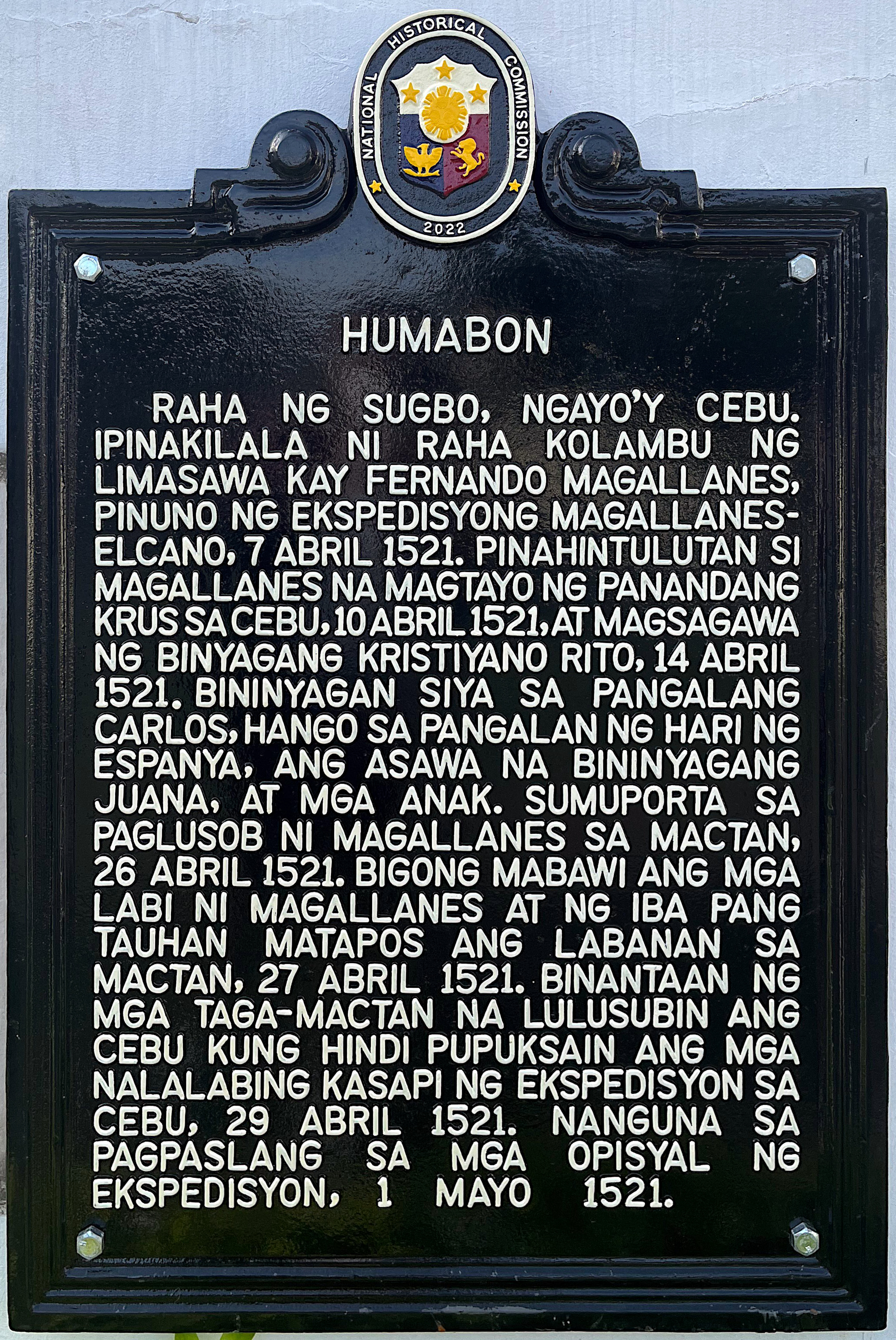
One of the chiefs of Cebu involved in the Magellan expedition
| Field | Value |
|---|---|
| name | Humabon |
| succession | Rajah of Cebu |
| reign | 16th century – 27 April 1521 |
| birth_date | |
| birth_place | Cebu |
| death_date | before 1565 |
| burial_place | |
| predecessor | Sri Parang the Limp |
| successor | Rajah Tupas |
| spouse | Hara Humamay (Juana) |
| royal house | Cebu |
| father | Sri Bantug |
| religion | Hinduism (before 1521) |
| Roman Catholicism (after 1521 until Magellan's death)Hinduism (again after Magellan's death) |
Roman Catholicism (after 1521 until Magellan's death)Hinduism (again after Magellan's death)
Rajah Humabon (also Hamabao or Hamabar), baptized as Don Carlos Valderrama, was a Filipino official who was one of the recorded chiefs in the historic polity of Cebu who encountered Ferdinand Magellan in 1521. Humabon, his wife, and his subjects were the first known Christian converts in the Philippines. Humabon is also considered the "first Filipino traitor" due to his politicking to force Magellan to subdue neighboring Mactan chief Lapulapu, and Humabon's subsequent massacre of the surviving Spaniards and crewmen.
There is no official record of Humabon's existence before the Spanish contact. The existing information was written by Magellan's Italian voyage chronicler, Antonio Pigafetta on Humabon and the indigenous Philippine peoples that existed prior to Spanish colonization. Rajah Humabon is cited as the reason for why Magellan fought in the Battle of Mactan, as the latter wanted to earn the trust of Humabon by helping him subdue his opponent Lapulapu, one of the oldest of four chiefs (or datus) of Mactan. Despite being referred to as "king" in the journal of Antonio Pigafetta, he was not one in the manner of a monarch in centralized societies. It is plausible that the title was mistakenly applied, as according to succeeding chroniclers, there were no kingdoms in the pre-colonial Philippines.
Name variation
According to the book "Visayas en la Epoca de la Conquista" ("Visayas at the Time of Conquest") published in 1889 by Isabelo de los Reyes, his name was also pronounced as Hamabao which contains the Cebuano word, mabaw, "shallow" and the prefix ha-, which is added to adjectives referring to degree, or in poetic usage, gives formal flavor to the style. This is possible as it is common in Philippine languages wherein the sounds of /d/, tapped /ɾ/, and /l/ are sometimes identical to one another, case in point danaw and lanaw ("lake") as in Maguindanao, Maranao, and Lanao*.* Using this trend, it is possible that the sound shifted through either the /l/ sound shifting to /w/ or through /r/ to /l/ and then eventually /w/.
Legendary accounts
The local academia is skeptical of the folk narrative as there is no official record of the origins of Rajah Humabon prior to the arrival of Magellan. According to Jovito Abellana, Humabon (also known as Sri Hamabar) was the son of Sri Bantug, and the grandson of Sri Lumay. His ancestor, Sri Lumay, a half-Malay and half-Indian Tamil from Sumatra established Cebu as an Indianized monarchy, and sired at least four known sons, namely Alho, Ukob, Parang the Limp, and Bantug (father of Rajah Humabon). Sri Alho ruled a land known as Sialo which included the present-day towns of Carcar and Santander in the southern region of Cebu. Sri Ukob ruled a kingdom known as Nahalin in the north which included the present-day towns of Consolación, Liloan, Compostela, Danao, Carmen and Bantayan. He died in battle, fighting with the tribal group known as magalos from Mindanao. A third brother was Sri Parang the Limp, but could not rule because of his physical infirmity. Sri Bantug, the youngest, ruled a kingdom known as Singhapala (a variation of the Sanskrit Singha-Pura, "City of the Lion", which is also the root of Singapore), in a region which is now part of Cebu City, who later died of disease and was succeeded by his son Sri Hamabar, also known as Rajah Humabon. Because of his infirmity, Sri Parang handed Bantug's throne to Bantug's son Humabon as regent, and Humabon became the rajah (king) of Cebu.
Spanish contact
When Sri Bantug died, Sri Parang became his successor, but due to his limp he passed the throne to Humabon. The phrase Cata Raya Chita was documented by historian Antonio Pigafetta to be a warning in the Malay language, from a merchant to the Rajah. Following Pigafetta's inscription, the phrase is creole Malay for "Kata-katanya adalah raya cita-cita". The phrase may mean "What they say is mainly ambitious": kata-kata ("words"), –nya (second person possessive), adalah ("is/are"), raya (great, main, large), cita-cita ("ambitious"). Another interpretation is that the phrase was spoken by merchants under the authority of Rajah Humabon was actually the Old Malay Kota raya kita, meaning "We are of the great fortress": Kota ("fortress"), Raya ("great"), Kita ("we"). The meeting between Rajah Humabon and Enrique of Malacca, the slave accompanying Magellan's voyage, was documented by Antonio Pigafetta and Spanish explorer Miguel López de Legazpi and is evidence that Old Malay was understood in parts of what is now the Philippines .
Conversion to Catholicism, betrayal of Magellan's crew
According to historical accounts, Rajah Humabon was among the first indigenous converted to Catholicism after he, his wives, and his subjects were baptized by the expedition's priest, Pedro de Valderrama. On April 14, 1521, Humabon was christened Carlos Valderrama in honor of King Charles I of Spain, while his chief consort, Hara Humamay was given the name Juana, after Charles' mother, Joanna of Castile. It is later presumed that his conversion to Catholicism was a ploy calculated to ensure that he had the support of the visiting Spaniards and to win their friendship.
He also made a blood compact with Magellan, as a sign of friendship; according to Pigafetta, it was Humabon who had requested Magellan to kill his rival, Lapulapu, the datu or chieftain of nearby Mactan Island.
After the death of Magellan at the Battle of Mactan and the consequent failure of the Spanish to defeat Lapulapu, Humabon's relationship with the Spanish deteriorated, and he eventually renounced Christianity and turned against the Spanish. Humabon and his warriors plotted to poison the remaining Spanish soldiers in Cebu during a feast. Several men were killed, including the then-leaders of the expedition, Duarte Barbosa and João Serrão.
According to the chronicler Pigafetta, Serrão, begging to be saved from the Cebuanos, allegedly referred to Enrique (Magellan's slave) as having instigated the massacre by claiming to Humabon that the Europeans planned to take over the kingdom.
Humabon's motivations for renouncing Christianity and turning against the Spaniards are not entirely clear, but it is believed that he was influenced by various factors, including dissatisfaction with Spanish rule, conflicts with other native groups, and his desire to maintain his autonomy and authority over his people.
Historical commemoration
The Rajah Humabon monument is located at Burgos Street in Cebu City.
References
References
- [http://www-atdp.berkeley.edu/9931/jvillafl/history.html Product of the Philippines : Philippine History] {{webarchive. link. (October 31, 2007)
- Ilarde, Eddie. (2017-11-07). "‘Pilipino tago, Pilipino turo’".
- Ocampo, Ambeth. (November 13, 2019). "Lapu-Lapu, Magellan and blind patriotism". [[Philippine Daily Inquirer.
- Mojarro, Jorge. (November 10, 2019). "[OPINION] The anger toward the 'Elcano & Magellan' film is unjustified". Rappler Inc..
- de los Reyes y Florentino, Isabello. (1889). "Las islas visayas en la epoca de la conquista". Tipo-Litografía de Chofré y ca.
- Wolff, John U.. (2012-06-24). "A Dictionary of Cebuano Visayan".
- Alcina, Ignacio. (1668). "History of the Bisayan People in the Philippine Islands". UST Publishing House.
- Ouano-Savellon, Romola. (May 4, 2018). ""Aginid Bayok Sa Atong Tawarik": Archaic Cebuano and Historicity in a Folk Narrative". Philippine Quarterly of Culture and Society.
- Marivir Montebon, Retracing Our Roots – A Journey into Cebu’s Pre-Colonial Past, p.15
- (2014). ""Aginid Bayok Sa Atong Tawarik": Archaic Cebuano and Historicity in a Folk Narrative". Philippine Quarterly of Culture and Society.
- "The Aginid". Philstar.com.
- "Early Cebu History".
- Jovito Abellana, Aginid, Bayok sa Atong Tawarik, 1952
This article was imported from Wikipedia and is available under the Creative Commons Attribution-ShareAlike 4.0 License. Content has been adapted to SurfDoc format. Original contributors can be found on the article history page.
Ask Mako anything about Rajah Humabon — get instant answers, deeper analysis, and related topics.
Research with MakoFree with your Surf account
Create a free account to save articles, ask Mako questions, and organize your research.
Sign up freeThis content may have been generated or modified by AI. CloudSurf Software LLC is not responsible for the accuracy, completeness, or reliability of AI-generated content. Always verify important information from primary sources.
Report