From Surf Wiki (app.surf) — the open knowledge base
Railway accident
Disaster involving one or more trains

Disaster involving one or more trains
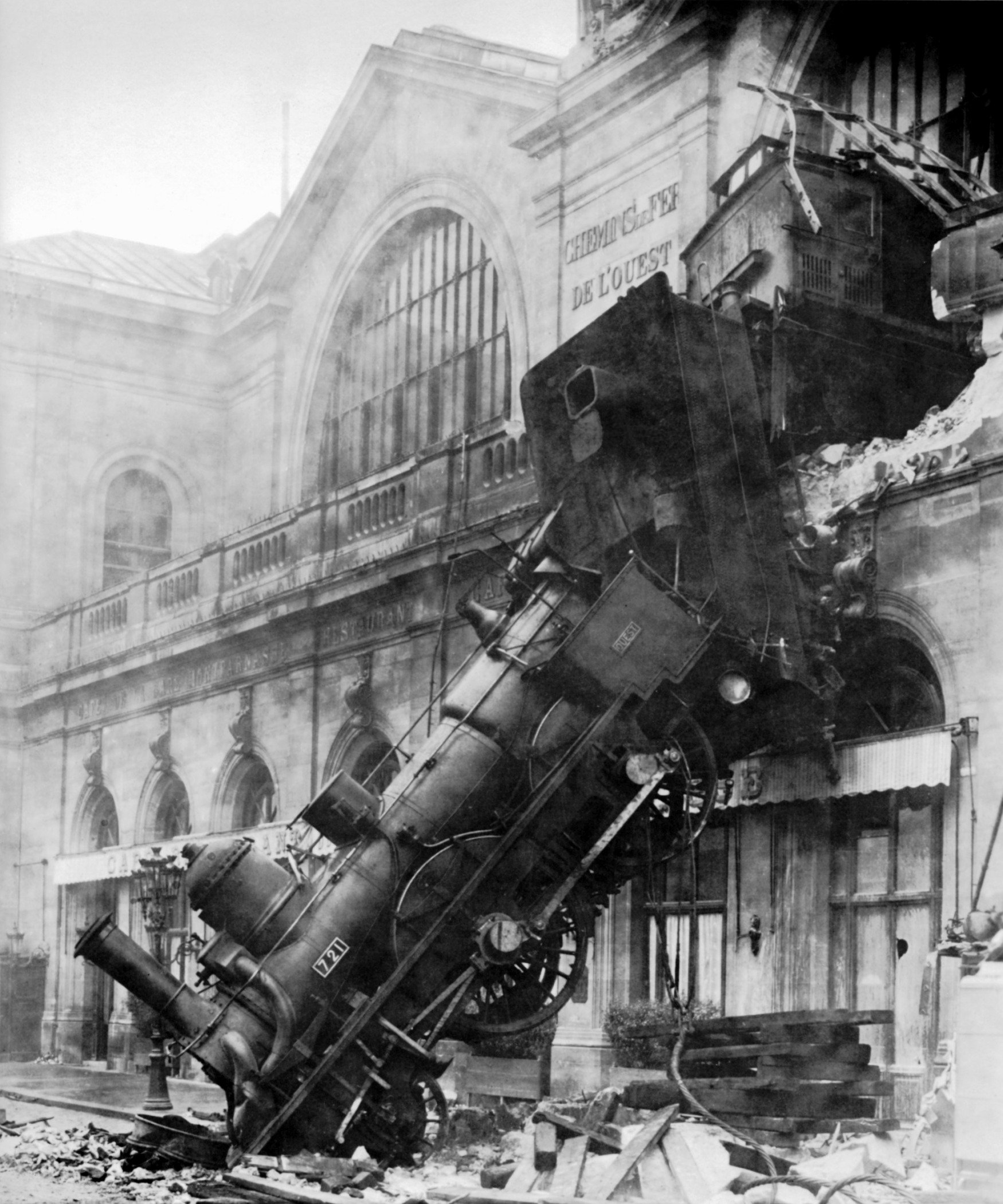

A railway accident (also known as a train accident, train wreck, and train crash) is a type of disaster involving one or more trains. Train wrecks often occur as a result of miscommunication, for example when a moving train meets another train on the same track, when the wheels of train come off the track, or when a boiler explosion occurs. Train accidents have often been widely covered in popular media and in folklore. A head-on collision between two trains is colloquially called a "cornfield meet" in the United States.
The classification of railway accidents—both in terms of cause and effect—is a valuable aid in studying railway accidents in order to help to prevent similar ones occurring in the future. Systematic investigation for over 150 years has led to the railways' excellent safety record (compared, for example, with road transport).
Ludwig von Stockert (1913) proposed a classification of accidents by their effects (consequences) – e.g., head-on-collisions, rear-end collisions, derailments. Schneider and Mase (1968) proposed an additional classification by causes – e.g., driver's errors, signalmen's errors, mechanical faults. Similar categorisations had been made by implication in previous books e.g. Rolt (1956), but Stockert's and Schneider/Mase's are more systematic and complete. With minor changes, they represent best knowledge.
Types of accidents
Collisions
In comparison to other types of railway incidents, collisions are very rare, with about one in 24 crashes being collisions between multiple trains. There are several types of train collision, such as head-on, rear-end and side collisions. The three most common causes of collisions in freight trains are all types of human error: failure to obey or display signals, speeding, and violation of mainline rules. Of these, the misuse of signals accounted for over half of the total damage costs. Collisions are the most severe type of train accident, causing on average 21 casualties in passenger trains.
Derailments
Main article: Derailment
Apart from incidents at grade crossings, derailments are the most common type of train accident, accounting for approximately 18 percent of all train accidents between 1996 and 2017 According to a 2018 study, the most common causes of derailments include, in order of frequency: broken rails and welds, track geometry, bearing failure, and wheel failures.{{cite journal|first1=Xiang|last1=Lu|first2=Rapik|last2=Saat|title=Analysis of Causes of Major Train Derailment and Their Effect on Accident Rates Speed is an important factor in determining the most common types of derailment, with human error common below 25 mph, but rare elsewhere, and mechanical issues peaking at higher speeds. Because the majority of derailments are caused by rail problems, rail maintenance and track geometry inspection have been found to be some of the most effective strategies to prevent derailment.
Other
Other forms of train accident include:
- Fires, explosions and release of hazardous chemicals (including sabotage/terrorism)
- People falling from trains (including as a result of train surfing), collisions with people on tracks
- Attack, shooting or bombing on a train.
Causes of accidents
Driver error
Driver error is the most dangerous cause of passenger train derailments and collisions, with 21 deaths occurring on average when driver error is involved. Driver error can take several forms, the most common in passenger trains being disobeying signals, speeding, and disregarding mainline rules. Freight trains follow a similar pattern, with the top three types of driver error accounting for over 75% of all freight collisions. Human factors, including driver error, are most prevalent in the 81-100 mph range. Features such as positive train control help prevent the most common types of human error, such as speeding and disregard of signals. Human factors relating to automation, such as unsupervised use of automated systems and ignorance of alarms, are also known to have caused several train accidents.
Signalman error
Errors caused by the actions of signalmen include:
- Allowing two trains into same occupied block section
- Incorrect operation of signals, points or token equipment
Rolling stock failure
Issues with rolling stock include:
- Poor design
- Poor maintenance
- Undetected damage
- Overloading or freight that is not adequately secured.
- Fire starting from combustion motors, electric cables or equipment, leaking fuel or cooling oil
Civil engineering failure
Issues with the civil engineering of the railway include:
- Track (permanent way) faults
- Bridge and tunnel collapses
- Poor track or junction layout
Other people
Reasons other people accidentally cause a train accident include:
- Accidental track obstruction, e.g., with road vehicles or by working construction vehicles
People can break, place something, intentionally set the switch to a collision course, destroy tracks, and this is called rail sabotage. Reasons other people deliberately cause a train accident include:
- Deliberate track obstruction, e.g., with road vehicles or (heavy) objects
- Intentional damage to infrastructure like tracks, points or signals
- Intentional misalignment of switches to send the train to a collision course
- Level crossing misuse
- Trespass
- Riot
- Terrorism
Natural causes
- Track obstruction or damage by landslides, avalanches, floods, trees
- Fog or snow that obscure signals or the current position of the train
- Wet leaves (or their remains) making the tracks slippery.
Contributory factors
- Strength of rolling stock
- Fire hazards or dangerous goods in the train, in involved road vehicles or the vicinity
- Effectiveness of brakes
- Inadequate rules
References
Bibliography
- Ludwig von Stockert (1913), Eisenbahnunfalle (Railway Accidents – a contribution to railway operating technology). Leipzig 1913.
- Later editions available.
References
- "Definition of CORNFIELD MEET".
- (2019). "Analysis of freight train collision risk in the United States". Proceedings of the Institution of Mechanical Engineers, Part F: Journal of Rail and Rapid Transit.
- (2020). "Quantitative causal analysis of mainline passenger train accidents in the United States". Proceedings of the Institution of Mechanical Engineers, Part F: Journal of Rail and Rapid Transit.
- (2021). "HAZARDS 31".
- (20 July 2018). "Train Wrecks and Track Attacks: An Analysis of Attempts by Terrorists and Other Extremists to Derail Trains or Disrupt Rail Transportation".
- (19 February 2023). "Are the railroads being sabotaged causing derailments?".
This article was imported from Wikipedia and is available under the Creative Commons Attribution-ShareAlike 4.0 License. Content has been adapted to SurfDoc format. Original contributors can be found on the article history page.
Ask Mako anything about Railway accident — get instant answers, deeper analysis, and related topics.
Research with MakoFree with your Surf account
Create a free account to save articles, ask Mako questions, and organize your research.
Sign up freeThis content may have been generated or modified by AI. CloudSurf Software LLC is not responsible for the accuracy, completeness, or reliability of AI-generated content. Always verify important information from primary sources.
Report