From Surf Wiki (app.surf) — the open knowledge base
RAF Habbaniya
Former Royal Air Force station in Iraq (1936–1959)

Former Royal Air Force station in Iraq (1936–1959)
| Field | Value | |
|---|---|---|
| name | RAF Habbaniya | |
| ensign | Ensign of the Royal Air Force.svg | |
| ensign_size | 90px | |
| native_name | قاعدة الحبانية الجوية () | |
| location | Habbaniya | |
| country | Iraq | |
| image | Habbaniya airfield, circa 1941.jpg | |
| alt | A black and white image of some hangars, tentage and hard standings in a desert | |
| caption | Habbaniya airfield, circa 1941 | |
| image2 | RAF Habbaniya Unit Badge.jpg | |
| alt2 | The heraldic badge of RAF Habbaniya | |
| caption2 | Station badge (Infestos ferimus | |
| ) | ||
| type | Flying station | |
| coordinates | ||
| pushpin_map | Iraq | |
| ownership | Air Ministry | |
| operator | Royal Air Force | |
| controlledby | RAF Iraq Command | |
| built | ||
| used | 1936– | |
| past_commanders | {{plainlist | |
| *H H Brookes (1954–1956)<ref name | "TT" | |
| *Hughie Edwards (1956–58)<ref name | "AU" | |
| r1-length | 2,000 yard |
)
- H H Brookes (1954–1956)
- Hughie Edwards (1956–58) | r1-number = | r1-length = 2,000 yard | r1-surface =
Royal Air Force Habbaniya, more commonly known as RAF Habbaniya () (originally RAF Dhibban) was a Royal Air Force station at Habbaniyah, about 55 mi west of Baghdad in modern-day Iraq, on the banks of the Euphrates near Lake Habbaniyah. It was developed from 1934, and was operational from October 1936 until 31 May 1959 when the RAF finally withdrew after the July 1958 Revolution made the British military presence no longer welcome. It was the scene of fierce fighting in May 1941 when it was besieged by the Iraqi Military following the 1941 Iraqi coup d'état.
It is currently a major Iraqi military airbase.
History
Originally called RAF Dhibban, the station was built on the west bank of the Euphrates in the then Hashemite Kingdom of Iraq at a cost of £1,750,000 (), and opened on 19 October 1936. It was the British Royal Air Force (RAF) base built "West of the Euphrates" in accordance with Article 5 of the Anglo-Iraqi Treaty of 1930. It was on the West bank of the Euphrates, between Ramadi and Fallujah, and was a major military and air base for the entire British Empire. The squadrons, units and headquarters and the hospital gradually moved in from RAF Hinaidi, Baghdad, which was then finally vacated by the British on 21 December 1937 and renamed "Rashid Airfield" by the Iraqis. RAF Dhibban was originally named after the nearby village of Sin el Dhibban, in Arabic "Teeth of the Fly", but was renamed, more appropriately, RAF Habbaniya on 1 May 1938. Not long after its renaming, an aircraft went missing on a flight from Habbaniya. The aircraft, a bomber of No. 30 Squadron, left on 10 December 1938, and was found 11 days later some 60 mi north of Habbaniya. All six occupants were dead.
RAF Habbaniya was extensive and, as well as the airfield, included the Air Headquarters of RAF Iraq Command, communication facilities, maintenance units, an aircraft depot, an RAF hospital, RAF Iraq Levies barracks, the RAF Armoured Car Company depot as well as fuel and bomb stores.
There were numerous billets, messes and a wide range of leisure facilities including swimming pools, cinemas and theatres, sports pitches, tennis courts and riding stables. It was self-contained with its own power station, water purification plant and sewage farm. Water taken from the Euphrates for the irrigation systems enabled green lawns, flower beds and even ornamental botanical gardens. After the Second World War the families of British personnel started living at Habbaniya and a school was started.
Within the camp perimeter was the civil cantonment which provided the accommodation for the families of the RAF Iraq Levies and the civilian workers and their families. The cantonment population of about 10,000 had their own schools, hospital, mosques, churches, temples, cinema and bazaars. The base had extended to some 28 mi2, which required a taxi service to get people around. Just outside the perimeter was the village of Humphreya in which more locally employed civilians and their families lived. It was the original construction camp for the company which built the base, Messrs Humphreys of Knightsbridge, London (and from which the name Humphreya arose).
There was a 7 mi perimeter fence round the base but this did not enclose the airfield which was outside. In 1952 a second airfield was built on the plateau to cope with the long range and jet aircraft using the base (this subsequently became the Iraqi Air Force Al Taqaddum airbase).
In the late 1930s, Imperial Airways established a staging post on Lake Habbaniya for the flying boat service from the UK to British India using Short Empires. The lake provided the necessary landing area for these aircraft in the middle of the Mesopotamian desert.
The station was a large flying training school in the Second World War, as well as a transport staging airfield. In the Rashid Ali rebellion in 1941, the airfield was besieged by units from the Royal Iraqi Army encamped on the overlooking plateau. On 2 May 1941, British forces from the airfield launched pre-emptive airstrikes on Iraqi forces throughout Iraq and the Anglo-Iraqi War began. The siege was lifted by the units based at Habbaniya, including pilots from the training school, a battalion of the King's Own Royal Regiment flown in at the last moment, Number 1 Armoured Car Company RAF and the RAF's Iraq Levies. The subsequent arrival of a relief column (Kingcol), part of Habforce sent from Palestine, then a British mandate, combined with the Habbaniya units to force the rebel forces to retreat to Baghdad.
Later in the Second World War, Habbaniya became an important stage on the southern air route between the UK and the USSR. British Overseas Airways Corporation (BOAC) ran a regular passenger service via North Africa and the Middle East using Consolidated Liberator transports. The United States Army Air Forces Air Transport Command used Habbaniya as a stopover point between the large Lend-Lease aircraft assembly facility at Abadan Airport, Iran, and Payne Field, Cairo. Also ATC operated a transport route from Habbaniya to Mehrabad Airport, Tehran. After the Second World War, BOAC discontinued the flying boat service and the hotel buildings at the lake were acquired by the RAF and used as a Rest and Recreation Centre. In 1949, Habbaniya was assessed as having six hangars and two metal runways, the longest being 2,000 yard in length.
No. 6 Squadron RAF, No. 8 Squadron RAF and No. 73 Squadron RAF were the last flying squadrons to depart the base in the mid-1950s. Although the British presence continued until 1959, on 2 May 1955, command of the base was handed over to the Iraqi government.
During the Cold War, from 1 August 1946, GCHQ ran a large signals intelligence (SIGINT) monitoring station at Habbaniya staffed by 276 Signals Unit until 31 July 1958. It also operated SIGINT aircraft over Iran and the Caspian Sea to monitor the Soviet Union.
On 14 July 1958, the July 1958 Revolution took place, which brought down the Hashemite Kingdom of Iraq. At that time, Habbaniya had 900 personnel and the uprising in Baghdad had caused the loss of one British life and the burning of the embassy. By the start of 1959, the base was host to 600 RAF staff with 60 dependants. The dependants were flown back to the United Kingdom in early April 1959. The base closed on 31 May 1959 when the RAF finally withdrew after the July 1958 Revolution made the presence of British military no longer welcome. On abandonment of the base, a question was asked in the UK Parliament concerning the cost of the base over the 23 years of its operational life. It was estimated that it had the amount was £3.5 million ().
In June 1961 there were two Iraqi Air Force squadrons at the base:
- No.1 Squadron, Venom FB.1, based at Habbaniyah AB, CO Capt. A.-Mun’em Ismaeel
- No.6 Squadron, Hunter, based at Habbaniyah AB, CO Capt. Hamid Shaban
The airbase was bombed by the Islamic Republic of Iran Air Force in Operation Kaman 99 on the second day of the Iran–Iraq War, just after the Iraqi invasion of Iran.
Tom Cooper's book Arab MiG-19 and MiG-21 Units in Combat describes Habbaniya as a base for Mikoyan-Gurevich MiG-21s by 1990.
RAF Hospital Habbaniya
As part of the treaty of 1930, the RAF were required to withdraw from Hinaidi and Mosul, so the hospital at Hinaidi was also relocated to Habbaniya in 1937 with 500 beds. Sometimes referred to as No. 6 RAF Hospital, it operated as a general hospital until 1956, being downgraded to a station hospital until 1958. In 1942, the commanding officer of the hospital, Group Captain Gerard Hanly, was killed in an aircraft crash.
Current use
According to the Federation of American Scientists the site was used to produce Mustard gas (a chemical weapon). The production site was built in 1983–84 and provided the gas used in the Iran–Iraq War. The factory produced 60–80 tonnes per year. Alwan Hassoun Alwan al-Abousi was Base Commander 1985-1988.
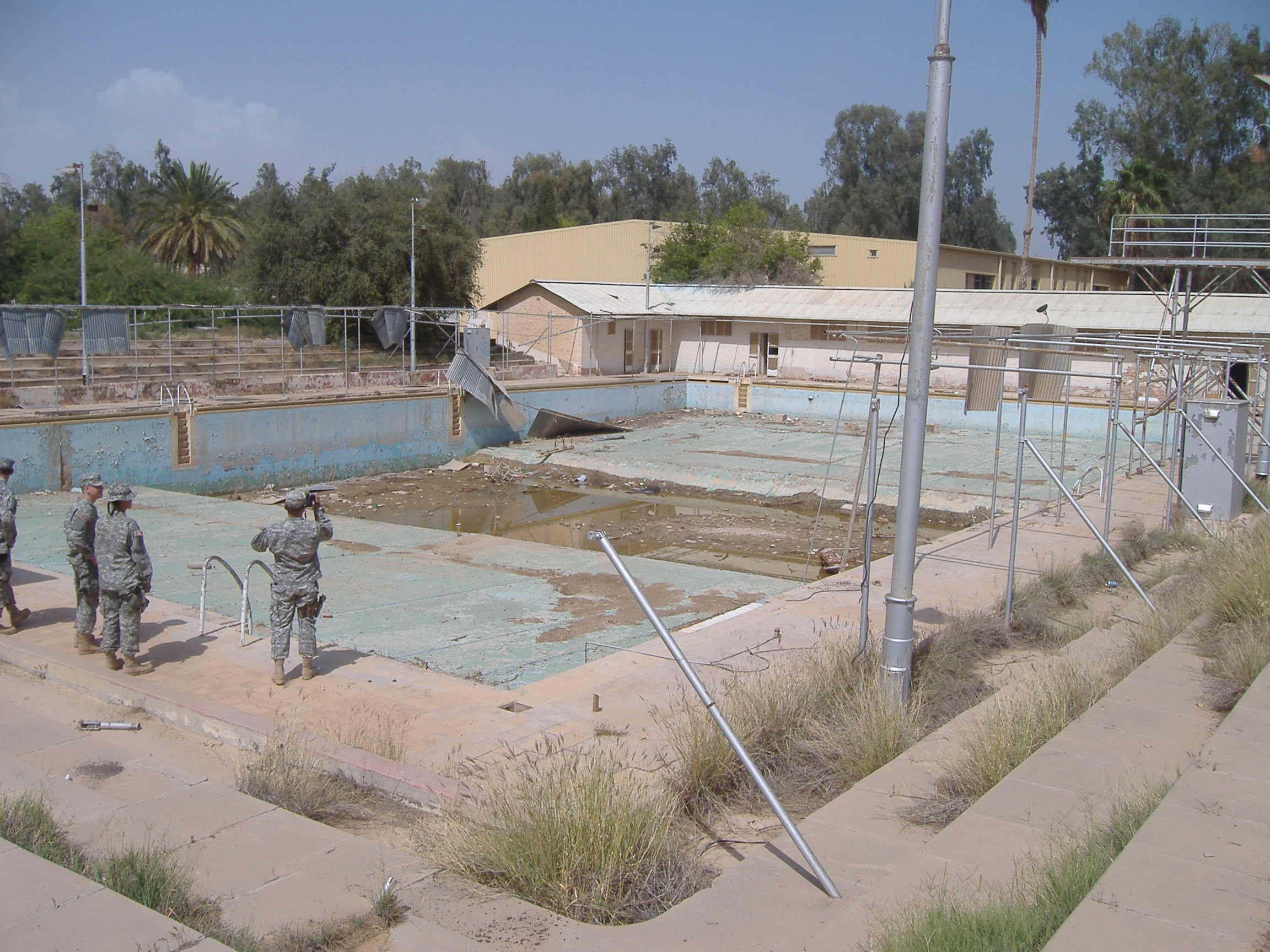
After 2003, the former British airfield was used by both the United States Armed Forces and the New Iraqi Army as a forward operating base, and is now known as Camp Habbaniyah. From this outpost, combat operations are run from the outskirts of Fallujah to the outskirts of Ramadi. Since 2006, Camp Habbaniyah has grown into a Regional Training and Regional Support Center as well as the headquarters for the Iraqi Army 1st Division. Ongoing Coalition and Iraqi construction projects have revitalised much of the base.
In December 2008, the U.S. Army and all civilian contractors, including less than twelve contractors from MPRI, departed Camp Habbaniyah. U.S. Marines had stayed behind to provide the Iraqi Army with additional perimeter security until a time TBD.
On 16 April 2009, a suicide-bomber dressed as an Iraqi 1st Lieutenant detonated a bomb among a group of Iraqi soldiers at a canteen.
In 2015, Habbaniya was a base for Shia militias, the Iraqi Army and its American trainers, in their ongoing campaign against ISIS.

289 British and Commonwealth personnel, along with women, children and babies, remain buried in the Commonwealth War Graves Commission (CWGC) cemetery in Habbaniya. The register of those buried is held by the RAF Habbaniya Association. In 2019, the site was renovated and 289 replacement Portland stone grave markers were installed.
Notable personnel
- Michael Beetham, later Marshal of the Royal Air Force, served at Habbaniya in 1951 on detachment
- Hugh Hamilton Brookes, commanding officer, 1954–1956
- Roald Dahl was stationed there in 1940, as described in his book, Going Solo, but his opinion rather was unfavourable compared with that of most personnel who served there.
- Hughie Edwards, commanding officer, 1956–1958
- Jeremy Swan, was a medical officer at Habbaniya in the 1940s
- George Unwin, officer commanding No. 84 Squadron in 1949
Flying Units and Aircraft
- No. 6 Squadron RAF (1950–1954) de Havilland Vampire FB5 & FB9
- No. 8 Squadron RAF (1956) de Havilland Vampire FB4
- No. 11 Squadron RAF (1941) Bristol Blenheim IV
- No. 14 Squadron RAF (1941) Bristol Blenheim IV
- No. 30 Squadron RAF (1938) Hawker Hardy, later Bristol Blenheim I
- No. 45 Squadron RAF (1941) Bristol Blenheim IV
- No. 52 Squadron RAF (1941–1942) Hawker Audax
- No. 55 Squadron RAF (1937–1939) Vickers Vincent Bristol Blenheim I
- No. 70 Squadron RAF (1937–1939) Vickers Valentia
- No. 73 Squadron RAF (1953–1955) de Havilland Vampire FB9 & FB1
- No. 74 Squadron RAF (1943) Hawker Hurricane I
- No. 82 Squadron RAF detachment (1951–1952) Avro Lancaster PR1
- No. 84 Squadron RAF (1941) Bristol Blenheim IV
- No. 94 Squadron RAF detachment (1941) Gloster Gladiator
- No. 123 Squadron RAF (1942) Gloster Gladiator
- No. 162 Squadron RAF (1942) Bristol Blenheim IV
- No. 185 Squadron RAF (1952) de Havilland Vampire FB5
- No. 203 Squadron RAF detachment (1941) Bristol Blenheim IV
- No. 208 Squadron RAF detachment (1941) Hawker Audax
- No. 216 Squadron RAF detachment (1942) Lockheed Hudson IV
- No. 223 Squadron RAF detachment (1942) Martin Baltimore
- S' Squadron RAF Formed Habbaniya 1939 & re-designated [No. 244 Squadron RAF on move to RAF Shaibah on 1 November 1940.
- No. 249 Squadron RAF (1946) de Havilland Mosquito FB26 Hawker Tempest F6
- No. 261 Squadron RAF (1941) Gloster Gladiator Hawker Hurricane I
- No. 651 Squadron RAF detachment (1948) Auster AOP6
- No. 680 Squadron RAF detachment (1945–1946) Fairchild Argus
- No. 683 Squadron RAF (1952–1953) Vickers Valetta C1
- No. 1415 (Meteorological Flight) RAF (1942–1946) Gloster Gladiator, Hawker Hurricane
- No. 1434 (Photo Survey) Flight RAF (1942) Bristol Blenheim
- No. 4 Flying Training School RAF (1939–1941)
- A Communications Flight (with various designations) was based at Habbaniya from 1936 until 1 April 1958.
Ground Units
- No. 104 Maintenance Unit RAF (1954–1956)
- No. 134 Maintenance Unit RAF (1942 and 1943 to 1946)
- No. 115 Maintenance Unit RAF (1945 to 1958)
- No. 123 Signals Unit RAF (1 January 1956 to 31 October 1958)
- No. 276 Signals Unit RAF (1946–1958)
- 19 Topographical Squadron R.E.
- No. 1 Armoured Car Company RAF (1936–1946)
- Number 2 Squadron RAF Regiment (1948–1955)
- 1st Battalion King's Own Royal Regiment
- Iraq Levies, HQ, 1st, 2d,3d, 4th, and 5th Assyrian Levies and 8th Levy. All companies of 125 men plus their dependents totaling 2,000 people.
- RAF Hawker Hunter Servicing Flight/(Royal Iraqi Air Force) (1957–1958)
- RAF Hospital, Habbaniya (variously named; General Hospital, No.6 RAF Hospital, Station Hospital). Transferred from RAF Hinaidi December 1937.
References
Citations
Bibliography
- Dudgeon, Air Vice-Marshal A.G., CBE, DFC (Retd). Hidden Victory: The Battle of Habbaniya, May 1941. Stroud, UK: Tempus Publishing., 2001. .
- Sturtivant, R., ISO and John Hamlin. RAF Flying Training And Support Units since 1912. Tonbridge, UK: Air-Britain (Historians) Ltd., 2007. .
References
- (1983). "A Dictionary of mottoes". Routledge & K. Paul.
- (14 April 1988). "Air Vice-Marshal H. H. Brookes". The Times.
- "Edwards, Hughie Idwal VC, DSO, OBE, DFC (Air Commodore, b.1914 - d.1982)".
- (21 April 1938). "Royal Air Force Dhibban station renamed". The Times.
- (2 May 1941). "More troops in Iraq". The Times.
- The National Archives UK AIR 28/330, FO 624/10/137 (& appendices) et al
- The National Archives, Kew, London. AIR 29/50
- (22 December 1938). "Missing RAF bomber found". The Times.
- (22 December 1949). "Middle East Command". The Times.
- "History".
- (1998). "The Royal Air Force : an illustrated history". Brockhampton Press.
- (20 December 1949). "R.A.F. In Middle East". The Times.
- (3 May 1955). "Transfer Of Air Base In Iraq". The Times.
- The National Archives, Kew, London AIR 29/1952, AIR 29/2283/1 & AIR29/2550
- Aldrich, Richard J.. (2011). "GCHQ". Harper Press.
- (October 1999). "The 'Forgotten Alliance'? Anglo-Turkish Relations and CENTO, 1959-65". Middle Eastern Studies.
- (6 April 1959). "Habbaniya Families Leave To-Day". The Times.
- (7 April 1959). "R.A.F. Families Leave Habbaniya". The Times.
- (15 July 1959). "Habbaniya".
- Tom Cooper [http://www.acig.info/artman/publish/article_203.shtml Kuwait Emergency], Air Combat Information Group
- (6 February 2013). "آشنایی با عملیات البرز (کمان ۹۹)".
- David Nicolle, Tom Cooper, Arab MiG-19 and MiG-21 Units in Combat, Volume 44 of Osprey Combat Aircraft, Osprey Publishing, 2004, {{ISBN. 1841766550, 9781841766553, 78.
- "RAF Hospital: Habbaniya (formerly No 6 RAF Hospital). With appendices".
- "Hanly, Gerard Joseph (1900 - 1942)".
- "Iraqi facilities at Habbaniya". Federation of American Scientists.
- (28 December 2015). "The successful campaign provides a blueprint for future battles — with Fallujah and Mosul the next to come". [[The Economist]].
- (29 September 2019). "Iraqi war cemetery restored after decades of destruction". I News.
- (2011). "Stay the distance : the life and times of Marshal of the Royal Air Force Sir Michael Beetham". Frontline Books.
- (2014). "Hunter boys : true tales from pilots of the Hawker Hunter".
- "Harold James Charles Swan {{!}} RCP Museum".
- (March 2005). "H Jeremy C Swan". The Lancet.
- (29 June 2006). "Wing Commander George Unwin". The Times.
- The National Archives, Kew, London. AIR 29/2052
- The National Archives, Kew, London. AIR 29/1052/2 & AIR 29/1540
- "RAF Habbaniya". Air of Authority – A History of RAF Organisation.
- The National Archives, Kew, London. AIR 29/1045, AIR 29/1537 & AIR 29/2055/1
- The National Archives, Kew, London. AIR 29/3027
- AIR 29/1952, The National Archives, Kew
- Warwick, Nigel W. M.. (2014). "IN EVERY PLACE: The RAF Armoured Cars in the Middle East 1921-1953". Forces & Corporate Publishing Ltd.
- AIR 29/943, The National Archives, Kew
This article was imported from Wikipedia and is available under the Creative Commons Attribution-ShareAlike 4.0 License. Content has been adapted to SurfDoc format. Original contributors can be found on the article history page.
Ask Mako anything about RAF Habbaniya — get instant answers, deeper analysis, and related topics.
Research with MakoFree with your Surf account
Create a free account to save articles, ask Mako questions, and organize your research.
Sign up freeThis content may have been generated or modified by AI. CloudSurf Software LLC is not responsible for the accuracy, completeness, or reliability of AI-generated content. Always verify important information from primary sources.
Report