From Surf Wiki (app.surf) — the open knowledge base
Radiodonta
Extinct order of basal arthropods

Extinct order of basal arthropods
- Amplectobeluidae
- Tamisiocarididae
- Hurdiidae
- Genera with uncertain classification
- Caryosyntrips?
- Cucumericrus?
- Houcaris
- Innovatiocaris
- Laminacaris
- Paranomalocaris
- Shucaris
- Zhenghecaris?
Radiodonta is an extinct order of stem-group arthropods that was successful worldwide during the Cambrian period. Radiodonts are distinguished by their distinctive frontal appendages, which are morphologically diverse and were used for a variety of functions. Radiodonts were among the earliest large predators, and they also included sediment sifters and filter feeders. Some of the most famous species of radiodonts are the Cambrian taxa Anomalocaris canadensis, Hurdia victoria, Peytoia nathorsti, Titanokorys gainesi, Cambroraster falcatus and Amplectobelua symbrachiata. The later surviving members include the subfamily Aegirocassisinae from the Early Ordovician of Morocco and the Early Devonian member Schinderhannes bartelsi from Germany.
Etymology
The name Radiodonta (Latin for radius "spoke of a wheel" and Greek for odoús "tooth") refers to the radial arrangement of tooth plates (oral cone) surrounding the mouth, although this feature is suggested to be absent in some radiodont species.
Definition
The original diagnosis of order Radiodonta in 1996 is as follows:
In 2014, the clade Radiodonta was defined phylogenetically as a clade including any taxa closer to Anomalocaris canadensis than Paralithodes camtschaticus. In 2019, it was redefined morphologically as animal bearing head carapace complex with central (H-) and lateral (P-) elements; outgrowths (endites) from frontal appendages bearing auxiliary spines; and reduced anterior flaps or bands of lamellae (setal blades) and strong tapering of body from anterior to posterior.
Members of Radiodonta are known as radiodonts, radiodontans, radiodontids, anomalocarids, or anomalocaridids, although the last two originally refer to the family Anomalocarididae, which previously included all species of this order but is now restricted to only a few species.
Description
Most radiodonts were significantly larger than the other Cambrian fauna, with typical body lengths of large taxa varying from 30 to. The largest described radiodont is the Early Ordovician species Aegirocassis benmoulai, which may have grown up to 2 m long. A nearly complete specimen of a juvenile Lyrarapax unguispinus measured only 18 mm, making it among the smallest radiodont specimens known, though adults reached a length of 8.3 cm An isolated frontal appendage of a hurdiid from the Ordovician with a length less than half that of the juvenile Lyrarapax is known, but it is not known whether this specimen pertains to an adult. The largest known Cambrian radiodont was Amplectobelua, reaching lengths of up to 90 cm based on an incomplete specimen. Anomalocaris canadensis was also relatively large, estimated up to 34.2 - long, and the Cambrian hurdiid Titanokorys approached around 50 cm long.
The body of a radiodont could be divided into two regions: head and trunk. The head is composed of only one body segment known as the ocular somite, covered by sclerites (head carapace complex), bore arthropodized frontal appendages, ventral mouthparts (oral cone), and stalked compound eyes. The tapering trunk is composed of multiple body segments, each associated with pairs of flaps and gill-like structures (setal blades).
Frontal appendage
The anterior structures on the head are a pair of frontal appendages which have been referred to as 'claws', 'grasping appendages', 'feeding appendages', or 'great appendages' in previous studies (the last term is discouraged since the homology between frontal appendages and the original, morphologically distinct great appendages of megacheirans questionable.). They are sclerotized (hardened) and arthropodized (segmented), bearing ventral endites (spines) on most of their podomeres (segmental units), and the endites may bear additional rows of auxiliary spines on their anterior and posterior margins. The frontal appendage consists of two regions: the shaft ('peduncle', 'base' or 'proximal region' in some studies) and the distal articulated region (also referred to as 'claw'). A triangular region covered by soft cuticle (arthrodial membrane) may occur on the ventral side between podomeres and provide flexibility. Their purported pre-ocular and protocerebral origin suggest they are homologous to the primary antennae of Onychophora and the labrum of Euarthropoda (all arose from ocular somite), while subsequent studies also suggest a deutocerebral origin and homologous with the chelicerae of Chelicerata and the antennae or 'great appendages' of other arthropods (all arose from post-ocular somite 1). Since the morphology of the frontal appendages, especially those of the spines, always differs between species, it is one of the most important means of species identification. In fact, many radiodonts are only known from a handful of fossilized frontal appendages.
File:20191221 Radiodonta frontal appendage Anomalocarididae Amplectobeluidae.png|Frontal appendages of Anomalocarididae, Amplectobeluidae, and possibly related species File:20191228 Radiodonta frontal appendage Tamisiocarididae Cetiocaridae.png|Frontal appendages of Tamisiocarididae File:20191229 Radiodonta frontal appendage Hurdiidae.png|Frontal appendages of Hurdiidae
Oral cone

The mouth is on the ventral side of the head, behind the attachment point of frontal appendages and is surrounded by a ring of tooth plates, forming the mouthpart known as oral cone ('jaws' in previous studies). Three or four tooth plates might be enlarged, giving the oral cone a triradial (e.g. Anomalocaris, Echidnacaris) or tetraradial (e.g. Hurdiidae, Lyrarapax) appearance. The inner margin of tooth plates have spikes facing towards the mouth opening. Additional rows of internal tooth plates may occur in some hurdiid genera. Detail reconstruction of some amplectobeluid oral cones are speculative, but they possibly did not present a typical radial arrangement.
Head sclerites, eyes and trunk

Three head sclerite (carapace) complex formed by a central H-element (anterior sclerite or head shield) and a pair of P-elements (lateral sclerites) cover the dorsal and laterovental surface of the animal's head. The P-elements may connect to each other as well as the H-element by a narrow anterior extension (P-element neck or 'beak'). The head sclerites are small and ovoid in Anomalocarididae and Amplectobeluidae, but often enlarged in Hurdiidae, corresponded to their distinct body shapes (streamlined in Anomalocarididae/Amplectobeluidae but often compact in Hurdiidae). The head bore two stalked compound eyes, which may have had mobility, and are located between the gaps formed by the posterior regions of the H-element and P-elements. The compound eyes of Echidnacaris are exceptionally unstalked. Some species of Hurdiid possess an additional median eye behind the H-element.
Contrary to the original diagnosis, the division of body segments (segmental boundaries) can be visible externally and no known member of Radiodonta (except the putative radiodont Cucumericrus) is known to have pediform trunk appendages (legs). The trunk has numerous body segments (somites), tapering from anterior to posterior, with the anterior three or four segments significantly constricted into a neck region.
File:20210914 Radiodonta body flaps lobes structures variations.png|Variations of radiodont body flaps File:Radiodonta body flaps movement.gif|The movement of radiodont flapping appendages File:Video animation of Cambroraster.webm|Video animation of Cambroraster falcatus, showcasing the movement of the trunk flaps File:20200103 Radiodonta gnathobase‐like structures.png|Ventral view of a generalized GLS-bearing radiodont, showing gnathobase‐like structures (GLSs) associated with reduced anterior flaps
The trunk appendages were fin-like body flaps ('lateral flaps' or 'lobes' in some studies), usually one pair of ventral flaps per body segment, each slightly overlapping the one more anterior to it, but additional, non-overlapping sets of small dorsal flaps may occur in some Hurdiid species. The flaps may have numerous vein-like structures (referred to as 'strengthening rays', 'flap rays', 'tranverse rods', 'transverse lines' or 'veins'). The flaps on the neck region (referred to as 'reduced flaps', 'neck flaps', 'head flaps', 'anterior flaps' or 'differentiated flaps') are significantly reduced. In some species, jaw-like feeding appendages called gnathobase-like structures (GLSs) arose from each of the bases of their reduced neck flaps. Numerous elongated blade-like extensions (referred to as lanceolate blades or lamellae) arranged in a row, forming bands of gill-like structures known as setal blades, covered the dorsal surface of each body segment. At least in Aegirocassis, each of the lanceolate blades are covered in wrinkles. The ventral flaps may be homologous to the endopod of the biramous limbs of euarthropods and lobopodous limbs (lobopods) of gilled lobopodians, and the dorsal flaps and setal blades may be homologous to the exite and gill-bearing dorsal flaps of the former taxa. The trunk may end either with a tail fan compose of 1 to 3 pairs of blades, a pair of long furcae, an elongated terminal structure, or a featureless blunt tip.
File:20220724 Hurdiidae.png|Stanleycaris, Hurdia, Aegirocassis, Peytoia and Cambroraster are all examples of hurdiid radiodonts. These were the most diverse and long lasting of the radiodont families, surviving from the Cambrian up until the Devonian. File:20210626 Anomalocaris.png|Anomalocaris is a member of the anomalocarididae family, which at one point included all radiodonts, but now only includes a few genera such as Lenisicaris. File:20210912 Amplectobeluidae.png|Amplectobelua and Lyrarapax are representatives of the amplectobeluidae which is a very inclusive family of mainly Chinese radiodonts. File:20191228 Radiodonta frontal appendage Tamisiocarididae Cetiocaridae.png|Echidnacaris and Tamisiocaris are examples of the family tamisiocarididae which were exclusively suspension feeding radiodonts from the Cambrian.
Internal structures

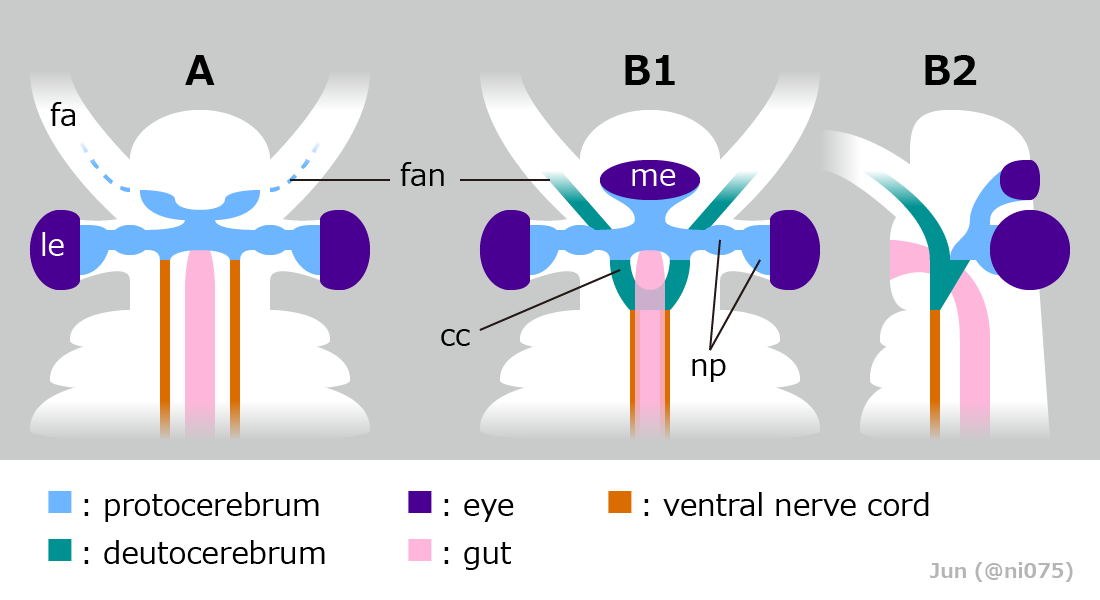
Traces of muscles, digestive system and nervous system were described from some radiodont fossils. Pairs of well-developed muscles were connected to the ventral flaps located at the lateral cavities of each body segment. Between the lateral muscles is a sophisticated digestive system, formed by a widening of the foregut and hindgut, both connected by a narrow midgut associated with six pairs of gut diverticula (digestive glands).
The brain of radiodonts was simpler than the three-segmented (compose of pro-, deuto- and tritocerebrum) brains of euarthropods, but further interpretations differ between studies. Based on Cong et al. 2014, the brain composed of only one brain segment originating from the ocular somite, the protocerebrum. The nerves of the frontal appendages and compound eyes arose from the anterior and lateral regions of the brain. Based on Moysiuk & Caron 2022, the frontal appendage nerves arose from the ventral deutocerebrum, the second brain segment. The previous "frontal appendage nerves" actually represent median eye nerve. In both interpretations, posterior to the brain was a pair of apparently unfused ventral nerve cords which ran through the animal's neck region.
Paleoecology
Physiology
Radiodonts were interpreted as nektonic or nektobenthic animals, with their morphology suggesting an active swimming lifestyle. The muscular, overlapping ventral flaps may have propelled the animal through the water, possibly by moving in a wave-like formation resembling modern rays and cuttlefish. Pairs of dorsal flaps, which make up a tail fan in some species, may have helped steering and/or stabilizing the animal during locomotion. In Anomalocaris, morphology of the tail fan even suggests it could rapidly change its swimming direction efficiently. On the other hand, some hurdiids have features significantly specialized for a nektobenthic lifestyle, such as Cambroraster with its dome-like H-element similar to the carapace of a horseshoe crab. Bands of setal blades with wrinkling lanceolate blades may have increased the surface area, suggesting they were gills, providing the animal's respiratory function. Abundance of the remains of scleritzed structures such as disarticulated frontal appendages and head sclerite complexes, suggest that mass moulting events may have occurred among radiodonts, a behavior which also has been reported in some other Cambrian arthropods such as trilobites.
Diet
Radiodonts had diverse feeding strategies, which could be categorized as raptorial predators, sediment sifters, or suspension, filter feeders. For example, raptorial predators like Anomalocaris and Amplectobeluids might have been able to catch agile prey by using their raptorial frontal appendages; the latter even bore a robust endite for holding prey like a pincer. With the smaller head carapace complex and large surface of arthrodial membranes, frontal appendages of these taxa had greater flexibility. Stout frontal appendages of sediment sifters like Hurdia and Peytoia have serrated endites with mesial curvature, which could form a basket-like trap for raking through sediment and passing food items towards the well-developed oral cone. Endites of frontal appendages from suspension/filter feeders like Tamisiocaris and Aegirocassis have flexible, densely packed auxiliary spines, which could filter out organic components such as mesozooplankton and phytoplankton down to 0.5mm. Frontal appendages of Caryosyntrips, which are unusual for radiodonts in having the direction of endite-bearing surfaces opposing one another and may have been able to manipulate and crush prey in a scissor-like slicing or grasping motion.
Oral cones of radiodonts may have been used for suction and/or biting. Together with the great variety of frontal appendages in different species of radiodonts, differentiation of oral cones between species suggests preferences of different diets as well. For example, the triradial oral cone of Anomalocaris with irregular, tuberculated toothplates and a small opening may have been adapted to small and nektonic prey, while the rigid tetraradial oral cones of Peytoia, Titanokorys, Hurdia, and one isolated oral cone attributed to Cambroraster with a larger opening and sometimes additional tooth plates may have been capable to consume larger food items relative to their body size and probably benthic or endobenthic prey.
Classification
Taxonomic affinities
(paraphyletic) [[File:20210000 Lobopodia lobopodians lobopods.png|80px]]
File:20220213 Opabiniidae Opabiniids.png|The opabiniids Opabinia (top) and Utaurora (bottom), were close relatives of the radiodonts File:20210310 Kylinxia zhangi.png|The presumed radiodont/opabiniid-euarthropod intermediate Kylinxia, shares many of the characteristics found in both dinocaridids and euarthropods — later studies have considered this relationship far less direct File:Erratus.png|A life reconstruction of the basal deuteropod Erratus, which helped reveal the evolution of arthropod trunk appendages File:20221119 Mieridduryn bonniae diagrammatic reconstruction.png|Mieridduryn is a dinocaridid panarthropod from the Middle Ordovician that shares traits with both opabiniids and radiodonts
Most phylogenetic analyses suggest that radiodonts, alongside opabiniids (Opabinia and Utaurora), are stem-group arthropods just basal to deuteropoda, a clade including upper stem (e.g. fuxianhuiids and bivalved arthropods) and crown Euarthropoda (e.g. Artiopoda, Chelicerata and Mandibulata). This interpretation is supported by numerous arthropod groundplan found on radiodonts and opabiniids, such as stalked compound eyes, digestive glands, trunk appendages forming by dorsal and ventral elements (precursor of arthropod biramous appendages). Compared to opabiniids, which possess posterior mouth opening and fused frontalmost appendages (comparable to euarthropod posterior-facing labrum/hypostome complex), radiodonts on the other hand featured euarthropod-like dorsal sclerite (H-element) and arthropodization (frontal appendages) on their head regions, alongside cuticularized gut termini. The fact that both radiodonts and opabiniids lack exoskeleton on their trunk region suggests that the origin of compound eyes and arthropodization (segmented appendages) precede arthrodization (full set of trunk exoskeleton) in the arthropod stem lineage. The constricted neck region with feeding appendicular structures of some radiodont may also shed light on the origin of the sophisticated arthropod head, which was formed by the fusion of multiple anterior body segments. Basal deuteropods that possess a mixture of radiodont/opabiniid characters like Kylinxia and Erratus, may represent intermediate forms between radiodonts, opabiniids and other euarthropods.
File:20191217 Siberiida Siberion Megadictyon Jianshanopodia.png|The siberiid lobopodians Siberion (upper left), Megadictyon (bottom center) and Jianshanopodia (upper right) File:20210730 Gilled lobopodians Pambdelurion Kerygmachela.png|The 'gilled lobopodians' Pambdelurion (left) and Kerygmachela (right) File:20191028 Megacheirans Leanchoilia Haikoucaris Yohoia Fortiforceps.png|Megacheira or 'great appendage arthropods', a class of possible stem-chelicerate previously thought to be radiodont's close relative
Taxa just basal to the radiodont, opabiniid and euarthropod branch are 'gilled lobopodians' like Pambdelurion and Kerygmachela, which are occasionally united under the class Dinocaridida with opabibiids and radiodonts. They have body flaps, digestive glands, large (presumely compound) eyes and specialized frontal appendages like the former taxa, but their frontal appendages are not arthropodized nor fused, eyes sessile, gill-like structures less prominent, and certainly bore lobopod underneath each of their flaps. Taxa even basal to 'gilled lobopodians' are siberiids like Megadictyon and Jianshanopodia, a group of lobopodians that bore robust frontal appendages and digestive glands, but no body flaps. Such intermediate forms between lobopodian and radiodont/euarthropod suggest that the total-group Arthropoda arose from a paraphyletic lobopodian grade, alongside the other two extant panarthropod phyla Tardigrada and Onychophora.
Previous studies may suggest radiodonts as a group other than stem-arthropods, such as a hitherto unknown phylum; cycloneuralian worms undergone convergent with arthropods (based on the cycloneuralian-like radial mouthparts); stem chelicerate euarthropods alongside megacheirans also known as great appendage arthropods (based on the similarity between radiodont frontal appendages, megacheiran great appendages and chelicerae); or Schinderhannes bartelsi, which resolved as a hurdiid radiodont in recent analyses, as a species more closely related to euarthropods than other radiodonts (based on some putative euarthropod-like features found on Schinderhannes). However, neither each of them were supported by later investigations. The radial mouthparts are not cycloneuralian-exclusive and more likely present result of convergent evolution or ecdysozoan plesimorphy, since they also have been found in panarthropods such as tardigrade and some lobopodians; radiodonts lacking definitive euarthropod features such as trunk tergites and multiple head appendages, and the megacheiran great appendages were considered to be deutocerebral, which could be non-homologous to the radiodont protocerebral frontal appendages; putative euarthropod characters found on the single Schinderhannes fossil is questionable and may present other radiodont-like structures.
Interrelationships
Amplectobeluidae|2={{clade
Traditionally, all radiodont species have been placed within one family, Anomalocarididae, hence the previous common name 'anomalocaridid' and it was still occasionally used to refer the whole order even after reclassification. Since the reassignment done by Vinther et al. 2014, most of the radiodont species were reclassified within three new families: Amplectobeluidae, Tamisiocarididae (formerly Cetiocaridae), and Hurdiidae. Including Anomalocarididae, the four recent radiodont families may form the clade Anomalocarida.
The original description of the order Radiodonta included Anomalocaris, Laggania (later known as Peytoia), Hurdia, Proboscicaris, Amplectobelua, Cucumericrus, and Parapeytoia. However, Proboscicaris is now regarded as a junior synonym of Hurdia, and Parapeytoia is considered to be a Megacheiran. Due to the limited discovery, The position of Cucumericrus within Radiodonta is unclear, as it was either unselected by phylogenetic analysis or resolved in a polytomy with Radiodonta and Euarthropoda.
File:20210207 Cucumericrus decoratus trunk appendage.png|One of the poorly-known body parts (trunk appendage) of Cucumericrus decoratus; this species may not represent a true radiodont. File:20191228 Radiodonta frontal appendage Anomalocaris briggsi.png|Frontal appendage of Echidnacaris briggsi, a tamisiocarid radiodont that was once suggested to belong to the Anomalocaris genus until its description in 2023.
The first in-depth phylogenetic analysis of Radiodonta was conducted by Vinther et al. in 2014, followed by a handful of subsequest studies with more or less modified results. In most analysis, Caryosyntrips is the basal-most genus, but either resolved in a polytomy with other radiodonts and Euarthropoda (alongside Cucumericrus if included) or outside of Radiodonta, casting doubt on its radiodont affinity. With the exclusion of questionable Caryosyntrips and Cucumericrus, the monophyly of Radiodonta is widely supported, with a few results suggest possible paraphyly (either the Anomalocarididae+Amplectobeluidae clade or Hurdiidae sister to Euarthropoda). Putative synapomorphies of monophyletic Radiodonta include tripartite head sclerite complex and differentiated neck region. The genus Anomalocaris in a broader sense always found to be polyphyletic, usually with "Anomalocaris" kunmingensis and "Anomalocaris" briggsi resolved as a member of Amplectobeluidae and Tamisiocarididae respectively. Interrelationship of Amplectobeluidae is uncertain, as the amplectobeluid affinities of Lyrarapax and Ramskoeldia were occasionally questioned. Monophyly of the speciose family Hurdiidae was recovered by most analysis and well-supported by several synapomorphies (e.g. distal articulated region of frontal appendage with proximal 5 podomeres bearing subequal endites). Tamisiocarididae was often suggested to be sister group of Hurdiidae in the 2010s, but this position became questionable in subsequent studies.
- Radiodonta
- ?Cucumericrus (radiodont affinity questionable)
- ?Caryosyntrips (radiodont affinity questionable)
- Anomalocarida
- Paranomalocaris (placed within Anomalocarididae by some studies.)
- Laminacaris (placed within Amplectobeluidae by some studies.)
- Houcaris (either placed within Anomalocarididae, Amplectobeluidae or Tamisiocarididae.)
- Innovatiocaris
- Anomalocarididae
- Anomalocaris (in a broader sense, some species may placed within the other families.)
- Lenisicaris
- Shucaris (either placed within Anomalocarididae or Amplectobeluidae)
- Verrocaris
- Amplectobeluidae
- Lyrarapax (position questioned by some studies.)
- Amplectobelua
- Ramskoeldia (position questioned by some studies.)
- Guanshancaris
- Shucaris (either placed within Anomalocarididae or Amplectobeluidae)
- Tamisiocarididae
- Tamisiocaris
- Echidnacaris
- Houcaris
- Hurdiidae/Peytoiidae
- Aegirocassisinae
- Aegirocassis
- Pseudoangustidontus
- Peytoia
- Schinderhannes (position questioned by some studies.)
- Stanleycaris
- Mosura
- Falciscaris
- Hurdiinae
- Hurdia
- Pahvantia
- Ursulinacaris
- Cambroraster
- ?Zhenghecaris (putative hurdiid radiodont)
- Cordaticaris
- Buccaspinea
- Titanokorys
- Huangshandongia (may be a synonym of Hurdia)
- Liantuoia (may be a synonym of Hurdia)
- Aegirocassisinae
| Species | Original description | Year named | Family | Age | Location | Frontal appendage | Head sclerite complex | |||||||||||||||||||||||||||||||
|---|---|---|---|---|---|---|---|---|---|---|---|---|---|---|---|---|---|---|---|---|---|---|---|---|---|---|---|---|---|---|---|---|---|---|---|---|---|---|
| Cucumericrus decoratus | Hou, Bergström, & Ahlberg | 1995 | (unassigned) | Cambrian Stage 3 | China | Unknown | Unknown | |||||||||||||||||||||||||||||||
| Caryosyntrips serratus | Daley & Budd | 2010 | (unassigned) | Wuliuan–Drumian | Canada United States | [[File:20191221 Radiodonta frontal appendage Caryosyntrips serratus.png | 200px]] | Unknown | ||||||||||||||||||||||||||||||
| Caryosyntrips camurus | Pates & Daley | 2017 | (unassigned) | Wuliuan | Canada United States | [[File:20191221 Radiodonta frontal appendage Caryosyntrips camurus.png | 200px]] | Incomplete | ||||||||||||||||||||||||||||||
| Caryosyntrips durus | Pates & Daley | 2017 | (unassigned) | Drumian | United States | [[File:20191221 Radiodonta frontal appendage Caryosyntrips durus.png | 200px]] | Unknown | ||||||||||||||||||||||||||||||
| Paranomalocaris multisegmentalis | Wang, Huang, & Hu | 2013 | Anomalocarididae? | Cambrian Stage 4 | China | [[File:20191221_Radiodonta_frontal_appendage_Paranomalocaris.png | 200px]] | Unknown | ||||||||||||||||||||||||||||||
| Paranomalocaris simplex | Jiao, Pates, Lerosey-Aubril, Ortega-Hernandez, Yang, Lan, Zhang | 2021 | Anomalocarididae? | Cambrian Stage 4 | China | [[File:20210707_Radiodonta_frontal_appendage_Paranomalocaris_simplex.png | 200px]] | Unknown | ||||||||||||||||||||||||||||||
| Laminacaris chimera | Guo, Pates, Cong, Daley, Edgecombe, Chen, & Hou | 2018 | (controversial) | Cambrian Stage 3 | China | [[File:20191221_Radiodonta_frontal_appendage_Laminacaris.png | 200px]] | Unknown | ||||||||||||||||||||||||||||||
| Innovatiocaris maotianshanensis | Zeng, Zhao, Zhu | 2022 | (unassigned) | Cambrian Stage 3 | China | [[File:20210531_Anomalocaris_sp._ELRC_20001.png | 200px]] | P-element unknown | ||||||||||||||||||||||||||||||
| Innovatiocaris? multispiniformis | Zeng, Zhao, Zhu | 2022 | (unassigned) | Cambrian Stage 3 | China | [[File:20220916_Innovatiocaris_multispiniformis.png | 200px]] | Unknown | ||||||||||||||||||||||||||||||
| Anomalocaris canadensis | Whiteaves | 1892 | Anomalocarididae | Wuliuan | Canada | [[File:20191221 Radiodonta frontal appendage Anomalocaris canadensis.png | 200px]] | [[File:20210516 Radiodonta head sclerites Anomalocaris canadensis.png | 200x200px]] | |||||||||||||||||||||||||||||
| Lenisicaris pennsylvanica (formerly Anomalocaris pennsylvanica) | Resser | 1929 | Anomalocarididae | Cambrian Stage 3 | United States | [[File:20191221 Radiodonta frontal appendage Anomalocaris pennsylvanica.png | 200px]] | Unknown | ||||||||||||||||||||||||||||||
| Lenisicaris lupata | Wu, Ma, Lin, Sun, Zhang, & Fu | 2021 | Anomalocarididae | Cambrian Stage 3 | China | [[File:20210513 Radiodonta frontal appendage Lenisicaris lupata.png | 200px]] | Unknown | ||||||||||||||||||||||||||||||
| Anomalocaris daleyae | Paterson, García-Bellidob & Edgecombe | 2023 | Anomalocarididae | Cambrian Stage 4 | Australia | [[File:20210211_Radiodonta_frontal_appendage_Anomalocaris_daleyae.png | 200px]] | Unknown | ||||||||||||||||||||||||||||||
| Houcaris magnabasis (formerly Anomalocaris magnabasis) | Pates, Daley, Edgecombe, Cong & Lieberman | 2019 | (controversial) | Cambrian Stage 4 | United States | [[File:20191221 Radiodonta frontal appendage Anomalocaris magnabasis.png | 200px]] | Unknown | ||||||||||||||||||||||||||||||
| last1=Wu | first1=Yu | last2=Fu | first2=Dongjing | last3=Ma | first3=Jiaxin | last4=Lin | first4=Weiliang | last5=Sun | first5=Ao | last6=Zhang | first6=Xingliang | date=1 June 2021 | title=Houcaris gen. nov. from the early Cambrian (Stage 3) Chengjiang Lagerstätte expanded the palaeogeographical distribution of tamisiocaridids (Panarthropoda: Radiodonta) | journal=PalZ | language=en | volume=95 | issue=2 | pages=209–221 | doi=10.1007/s12542-020-00545-4 | s2cid=235221043 | issn=1867-6812}} | Hou, Bergström, & Ahlberg | 1995 | (controversial) | Cambrian Stage 3 | China | [[File:20191221 Radiodonta frontal appendage Anomalocaris saron.png | 200px]] | Unknown | |||||||||
| last1=Paterson | first1=John R. | last2=García-Bellido | first2=Diego C. | last3=Edgecombe | first3=Gregory D. | date=1 January 2023 | title=The early Cambrian Emu Bay Shale radiodonts revisited: morphology and systematics | journal=Journal of Systematic Palaeontology | language=en | volume=21 | issue=1 | doi=10.1080/14772019.2023.2225066 | s2cid=259719252 | issn=1477-2019 | doi-access=free }} | Nedin | 1995 | Tamisiocarididae | Cambrian Stage 4 | Australia | [[File:20191228_Radiodonta_frontal_appendage_Anomalocaris_briggsi.png | 200px]] | Possible H-element and unique lateral sclerites associated with compound eyes | |||||||||||||||
| Ramskoeldia platyacantha | Cong, Edgecombe, Daley, Guo, Pates, & Hou | 2018 | Amplectobeluidae | Cambrian Stage 3 | China | [[File:20191221 Radiodonta frontal appendage Ramskoeldia platyacantha.png | 200px]] | Incomplete | ||||||||||||||||||||||||||||||
| Houcaris? consimilis | Cong, Edgecombe, Daley, Guo, Pates, & Hou | 2018 | (controversial) | Cambrian Stage 3 | China | [[File:20191221 Radiodonta frontal appendage Ramskoeldia consimilis.png | 200px]] | Incomplete | ||||||||||||||||||||||||||||||
| Lyrarapax unguispinus | Cong, Ma, Hou, Edgecombe, & Strausfield | 2014 | Amplectobeluidae | Cambrian Stage 3 | China | [[File:20191221 Radiodonta frontal appendage Lyrarapax unguispinus.png | 200px]] | P-element neck unknown | ||||||||||||||||||||||||||||||
| Lyrarapax trilobus | Cong, Daley, Edgecombe, Hou, & Chen | 2016 | Amplectobeluidae | Cambrian Stage 3 | China | [[File:20191221 Radiodonta frontal appendage Lyrarapax trilobus.png | 200px]] | P-element unknown | ||||||||||||||||||||||||||||||
| Amplectobelua symbrachiata | Hou, Bergström, & Ahlberg | 1995 | Amplectobeluidae | Cambrian Stage 3 | China | [[File:20191221 Radiodonta frontal appendage Amplectobelua symbrachiata.png | 200px]] | [[File:20210516 Radiodonta head sclerites Amplectobelua symbrachiata.png | 200x200px]] | |||||||||||||||||||||||||||||
| Amplectobelua stephenensis | Daley & Budd | 2010 | Amplectobeluidae | Wuliuan | United States | [[File:20191221 Radiodonta frontal appendage Amplectobelua stephenensis.png | 200px]] | Unknown | ||||||||||||||||||||||||||||||
| Guanshancaris kunmingensis | Zhang et al. | 2023 | Amplectobeluidae | Cambrian Stage 4 | China | [[File:20210212 Radiodonta frontal appendage Guanshancaris kunmingensis.png | 200px]] | Unknown | ||||||||||||||||||||||||||||||
| Tamisiocaris borealis | Daley & Peel | 2010 | Tamisiocarididae | Cambrian Stage 3 | Greenland | [[File:20191228_Radiodonta_frontal_appendage_Tamisiocaris_borealis.png | 200px]] | Incomplete | ||||||||||||||||||||||||||||||
| Ursulinacaris grallae | Pates, Daley & Butterfield | 2019 | Hurdiidae | Wuliuan | Canada China | [[File:20191229_Radiodonta_frontal_appendage_Ursulinacaris_grallae.png | 200px]] | Unknown | ||||||||||||||||||||||||||||||
| Schinderhannes bartelsi | Kühl, Briggs, & Rust | 2009 | Hurdiidae | Emsian | Germany | Incomplete | Incomplete | |||||||||||||||||||||||||||||||
| Stanleycaris hirpex | Pates, Daley, & Ortega-Hernández | 2018 | Hurdiidae | Wuliuan | Canada | [[File:20210518_Radiodonta_frontal_appendage_Stanleycaris_hirpex.png | 200px]] | last1=Moysiuk | first1=Joseph | last2=Caron | first2=Jean-Bernard | date=8 August 2022 | title=A three-eyed radiodont with fossilized neuroanatomy informs the origin of the arthropod head and segmentation | journal=Current Biology | language=en | volume=32 | issue=15 | pages=3302–3316.e2 | doi=10.1016/j.cub.2022.06.027 | pmid=35809569 | s2cid=250361698 | issn=0960-9822 | doi-access=free }} | |||||||||||||||
| Peytoia nathorsti | Walcott | 1911 | Hurdiidae | Wuliuan–Drumian | Canada United States | [[File:20191229_Radiodonta_frontal_appendage_Peytoia_nathorsti_Laggania_cambria.png | 200px]] | Incomplete | ||||||||||||||||||||||||||||||
| Peytoia infercambriensis (formerly Cassubia infercambriensis) | Lendzion | 1975 | Hurdiidae | Cambrian Stage 3 | Poland | [[File:20210218 Peytoia infercambriensis Cassubia infercambriensis id1.png | 200px]] | Unknown | ||||||||||||||||||||||||||||||
| Aegirocassis benmoulai | Van Roy, Daley, & Briggs | 2015 | Hurdiidae (Aegirocassisinae) | Tremadocian | Morocco | [[File:20191229_Radiodonta_frontal_appendage_Aegirocassis_benmoulai_Aegirocassis_benmoulae.png | 200px]] | [[File:20210516 Radiodonta head sclerites Aegirocassis benmoulai Aegirocassis benmoulae.png | 257x257px]] | |||||||||||||||||||||||||||||
| Hurdia victoria | Walcott | 1912 | Hurdiidae | Wuliuan–Drumian | Canada Czechia | [[File:20191229_Radiodonta_frontal_appendage_Hurdia.png | 200px]] | [[File:20210516 Radiodonta head sclerites Hurdia victoria.png | 200x200px]] | |||||||||||||||||||||||||||||
| Hurdia triangulata | Walcott | 1912 | Hurdiidae | Wuliuan | Canada | [[File:20191229_Radiodonta_frontal_appendage_Hurdia.png | 200px]] | [[File:20210516 Radiodonta head sclerites Hurdia triangulata.png | 200x200px]] | |||||||||||||||||||||||||||||
| Cambroraster falcatus | Moysiuk & Caron | 2019 | Hurdiidae | Wuliuan | Canada | [[File:20191229_Radiodonta_frontal_appendage_Cambroraster_falcatus.png | 200px]] | [[File:20210516 Radiodonta head sclerites Cambroraster falcatus.png | 229x229px]] | |||||||||||||||||||||||||||||
| Pahvantia hastata | Robison & Richards | 1981 | Hurdiidae | Drumian | United States | [[File:20210909 Radiodonta frontal appendage Pahvantia hastata.png | 200px]] | [[File:20210516 Radiodonta head sclerites Pahvantia hastata.png | 200x200px]] | |||||||||||||||||||||||||||||
| Cordaticaris striatus | Sun, Zeng, & Zhao | 2020 | Hurdiidae | Drumian | China | Incomplete | [[File:20210516 Radiodonta head sclerites Cordaticaris striatus.png | 200x200px]] | ||||||||||||||||||||||||||||||
| Zhenghecaris shankouensis | Vanner, Chen, Huang, Charbonnier, & Wang | 2006 | Hurdiidae | Cambrian Stage 3 | China | Unknown | [[File:20210708 Zhenghecaris shankouensis sclerite.png | left | 200x200px]] | |||||||||||||||||||||||||||||
| Buccaspinea cooperi | Pates, Lerosey-Aubril, Daley, Kier, Bonino & Ortega-Hernández | 2021 | Hurdiidae | Drumian | United States | [[File:20210718 Radiodonta frontal appendage Buccaspinea cooperi.png | 200px]] | Unknown | ||||||||||||||||||||||||||||||
| Titanokorys gainesi | Caron & Moysiuk | 2021 | Hurdiidae | Wuliuan | Canada | [[File:20210909 Radiodonta frontal appendage Titanokorys gainesi.png | 200px]] | [[File:20210909 Radiodonta head sclerites Titanokorys gainesi.png | 200x200px]] | |||||||||||||||||||||||||||||
| Pseudoangustidontus duplospineus | Van Roy & Tetlie | 2006 | Hurdiidae (Aegirocassisinae) | Tremadocian | Morocco | [[File:20230828_Radiodonta_frontal_appendage_Pseudoangustidontus_duplospineus.png | 200px]] | Unknown | ||||||||||||||||||||||||||||||
| Pseudoangustidontus izdigua | Potin, Gueriau & Daley | 2023 | Hurdiidae (Aegirocassisinae) | Tremadocian | Morocco | [[File:20230828_Radiodonta_frontal_appendage_Pseudoangustidontus_izdigua.png | 200px]] | Incomplete | ||||||||||||||||||||||||||||||
| Shucaris ankylosskelos | Wu et al. | 2024 | (controversial) | Cambrian Stage 2–Cambrian Stage 3 | China | [[File:20240904 Radiodonta frontal appendage Shucaris ankylosskelos.png | 200px]] | last1=Wu | first1=Yu | last2=Pates | first2=Stephen | last3=Liu | first3=Cong | last4=Zhang | first4=Mingjing | last5=Lin | first5=Weiliang | last6=Ma | first6=Jiaxin | last7=Wu | first7=Yuheng | last8=Chai | first8=Shu | last9=Zhang | first9=Xingliang | last10=Fu | first10=Dongjing | date=31 December 2024 | title=A new radiodont from the lower Cambrian (Series 2 Stage 3) Chengjiang Lagerstätte, South China informs the evolution of feeding structures in radiodonts | journal=Journal of Systematic Palaeontology | language=en | volume=22 | issue=1 | doi=10.1080/14772019.2024.2364887 | issn=1477-2019 | doi-access=free | hdl=10871/136118 | hdl-access=free }} |
| Stanleycaris qingjiangensis | Wu et al. | 2024 | Hurdiidae | Cambrian stage 3 | China | [[File:20240914 Radiodonta frontal appendage Stanleycaris qingjiangensis.png | 200px]] | Incomplete | ||||||||||||||||||||||||||||||
| Mosura fentoni | Moysiuk & Caron | 2025 | Hurdiidae | Wuliuan | Canada | [[File:Moysiuk_&_Caron_2025_f07_(fig_7e-i).png | 200px]] | P-element unknown, possibly absent | ||||||||||||||||||||||||||||||
| Falciscaris mumakiana | Potin et al. | 2025 | Hurdiidae | Tremadocian | Morocco | [[File:20251204_Radiodonta_frontal_appendage_Falciscaris_mumakiana.png | 200px]] | Unknown | ||||||||||||||||||||||||||||||
| Verrocaris kerrymatti | Oxman et al. | 2025 | Anomalocarididae | Cambrian Stage 4 | United States | [[File:Verrocaris camera lucida.jpg | 200px]] | Unknown |
History
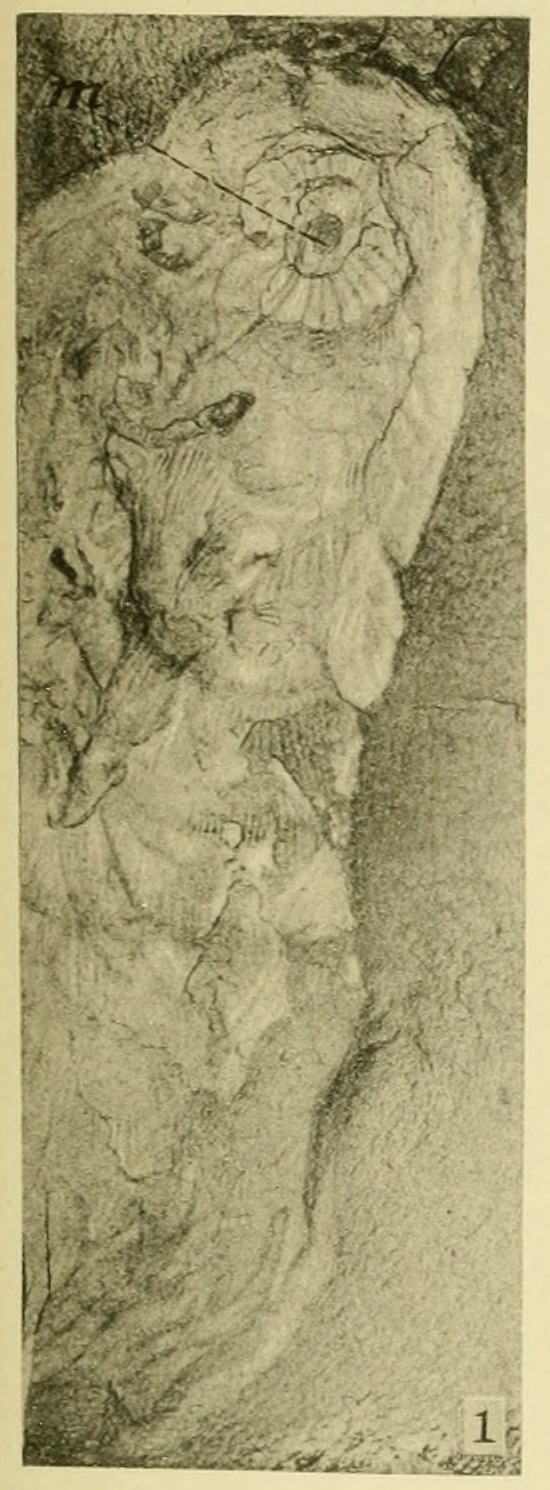
File:Anomalocaris canadensis grasping claw, Burgess Shale.jpg|Frontal appendage of Anomalocaris canadensis File:Peytoia nathorsti Laggania cambria oral cone, Burgess Shale.jpg|Oral cone of Peytoia nathorsti File:Hurdia victoria USNM PAL 57718.jpg|H-element of Hurdia victoria File:USNM PAL 57490.jpg|Paired frontal appendages from an unnamed hurdiid radiodont
The history of radiodonts is complex. Incomplete specimens pertaining to different body parts of the same species had historically been interpreted as belonging to different species and even different phyla. Prior to their recognition as a group, radiodont specimens had been assigned to five different phyla: Porifera, Cnidaria, Echinodermata, Annelida, and Arthropoda.
The first known radiodont specimens were collected from the trilobite beds of Mount Stephen by Richard G. McConnell of the Geological Survey of Canada in 1886 He interpreted an isolated oral cone, which he named Peytoia nathorsti, as a jellyfish, and a poorly preserved but relatively complete specimen, which he named Laggania cambria, as a holothurian. In 1912 Walcott named Hurdia victoria and H. triangulata based on isolated H-elements, which he interpreted as the carapaces of crustaceans. Isolated frontal appendages of Peytoia and Hurdia, collectively known as "Appendage F" in Briggs 1979, were all identified as those of Sidneyia at that time. A Hurdia P-element was named Proboscicaris in 1962, and interpreted as the carapace of a bivalved arthropod.
The Geological Survey of Canada initiated a revision of Burgess Shale fossils in 1966, overseen by Cambridge University paleontologist Harry B. Whittington.
The taxon Radiodonta itself was coined in 1996 by Desmond Collins, after it was established that Anomalocaris and its kin represented a distinctive lineage with arthropod affinities rather than a hitherto unknown phylum. Collins also established the class Dinocarida to contain the order Radiodonta as well as the Opabiniidae, which he recognized as distinct due to its lacking the distinctive oral cone structure of radiodonts. Radiodonta was first given a phylogenetic definition in 2014. Radiodonta was originally viewed as containing a single family, Anomalocarididae, but it was divided into four families in 2014: Amplectobeluidae, Anomalocarididae, Cetiocaridae, and Hurdiidae. The name Cetiocaridae did not conform to the International Code of Zoological Nomenclature and so was renamed Tamisiocarididae in 2019.
Until the 2010s, radiodonts were typically considered to be uniformly large apex predators, but discoveries of new species over the course of that decade led to a considerable increase in the known ecological and morphological diversity of the group.
References
References
- (28 July 2021). "Three-dimensional modelling, disparity and ecology of the first Cambrian apex predators". Proceedings of the Royal Society B: Biological Sciences.
- (2018). "New radiodonts with gnathobase-like structures from the Cambrian Chengjiang biota and implications for the systematics of Radiodonta". Papers in Palaeontology.
- Collins, Desmond. (1996). "The "evolution" of ''Anomalocaris'' and its classification in the arthropod class Dinocarida (nov.) and order Radiodonta (nov.)". Journal of Paleontology.
- (2014). "A suspension-feeding anomalocarid from the Early Cambrian". [[Nature (journal).
- (14 August 2019). "A new hurdiid radiodont from the Burgess Shale evinces the exploitation of Cambrian infaunal food sources". Proceedings of the Royal Society B: Biological Sciences.
- (30 August 2017). "The functional head of the Cambrian radiodontan (stem-group Euarthropoda) ''Amplectobelua symbrachiata''". BMC Evolutionary Biology.
- (September 2016). "Morphology of the radiodontan ''Lyrarapax'' from the early Cambrian Chengjiang biota". Journal of Paleontology.
- (2015). "Anomalocaridid trunk limb homology revealed by a giant filter-feeder with paired flaps". [[Nature (journal).
- Foster, J.. (2014). "Cambrian Ocean World: Ancient Sea Life of North America". Indiana University Press.
- (1 November 2018). "Origin of raptorial feeding in juvenile euarthropods revealed by a Cambrian radiodontan". National Science Review.
- (3 November 2023). "Rapid growth in a large Cambrian apex predator". National Science Review.
- (2020). "An early Cambrian euarthropod with radiodont-like raptorial appendages". Nature.
- (11 June 2019). "First report of paired ventral endites in a hurdiid radiodont". Zoological Letters.
- (1 May 2021). "New anomalocaridids (Panarthropoda: Radiodonta) from the lower Cambrian Chengjiang Lagerstätte: Biostratigraphic and paleobiogeographic implications". Palaeogeography, Palaeoclimatology, Palaeoecology.
- (1 May 2017). "Origin and evolution of the panarthropod head – A palaeobiological and developmental perspective". Arthropod Structure & Development.
- (2014). "Brain structure resolves the segmental affinity of anomalocaridid appendages". [[Nature (journal).
- (April 2012). "The oral cone of ''Anomalocaris'' is not a classic ''peytoia''". Naturwissenschaften.
- (August 2015). "Arthropod eyes: The early Cambrian fossil record and divergent evolution of visual systems". Arthropod Structure & Development.
- (September 1995). "''Anomalocaris'' and other large animals in the lower Cambrian Chengjiang fauna of southwest China". GFF.
- (2014). "Morphology of ''Anomalocaris canadensis'' from the Burgess Shale". Journal of Paleontology.
- (2013). "New anatomical information on Anomalocaris from the Cambrian Emu Bay Shale of South Australia and a reassessment of its inferred predatory habits". Palaeontology.
- (27 May 1994). "Evidence for Monophyly and Arthropod Affinity of Cambrian Giant Predators". Science.
- (8 January 2020). "Fossils from South China redefine the ancestral euarthropod body plan". BMC Evolutionary Biology.
- (2013). "Anomalocaridids had two sets of lateral flaps".
- (2 May 2014). "Sophisticated digestive systems in early arthropods". Nature Communications.
- (14 May 1985). "The largest Cambrian animal, ''Anomalocaris'', Burgess Shale, British-Columbia". Philosophical Transactions of the Royal Society of London. B, Biological Sciences.
- Usami, Yoshiyuki. (7 January 2006). "Theoretical study on the body form and swimming pattern of Anomalocaris based on hydrodynamic simulation". Journal of Theoretical Biology.
- (1 October 2018). "On the Hydrodynamics of Anomalocaris Tail Fins". Integrative and Comparative Biology.
- (1 September 2015). "The fossil record of ecdysis, and trends in the moulting behaviour of trilobites". Arthropod Structure & Development.
- (16 December 2016). "Reconstructing anomalocaridid feeding appendage dexterity sheds light on radiodontan ecology".
- (2021). "A giant nektobenthic radiodont from the Burgess Shale and the significance of hurdiid carapace diversity". Royal Society Open Science.
- (2010). "New anomalocaridid appendages from the Burgess Shale, Canada". Palaeontology.
- (2017). "''Caryosyntrips'': a radiodontan from the Cambrian of Spain, USA and Canada". Papers in Palaeontology.
- (December 2022). "The problematic Cambrian arthropod Tuzoia and the origin of mandibulates revisited". Royal Society Open Science.
- Ortega-Hernández, Javier. (Dec 2014). "Making sense of 'lower' and 'upper' stem-group Euarthropoda, with comments on the strict use of the name Arthropoda von Siebold, 1848". Biological Reviews of the Cambridge Philosophical Society.
- Edgecombe, Gregory D.. (1 March 2010). "Arthropod phylogeny: An overview from the perspectives of morphology, molecular data and the fossil record". Arthropod Structure & Development.
- (10 October 2012). "Cambrian bivalved arthropod reveals origin of arthrodization". Proceedings. Biological Sciences.
- Legg, David. (2013). "Multi-Segmented Arthropods from the Middle Cambrian of British Columbia (Canada)". Journal of Paleontology.
- (30 September 2013). "Arthropod fossil data increase congruence of morphological and molecular phylogenies". Nature Communications.
- (2013). "The affinities of the cosmopolitan arthropod Isoxys and its implications for the origin of arthropods". Lethaia.
- (2022). "A new euarthropod with large frontal appendages from the early Cambrian Chengjiang biota". Palaeontologia Electronica.
- (9 February 2022). "New opabiniid diversifies the weirdest wonders of the euarthropod stem group". Proceedings of the Royal Society B: Biological Sciences.
- Ortega-Hernández, Javier. (15 June 2015). "Homology of Head Sclerites in Burgess Shale Euarthropods". Current Biology.
- (17 June 2019). "The Phylogeny and Evolutionary History of Arthropods". Current Biology.
- Edgecombe, Gregory D.. (2 November 2020). "Arthropod Origins: Integrating Paleontological and Molecular Evidence". Annual Review of Ecology, Evolution, and Systematics.
- (28 March 2022). "The evolution of biramous appendages revealed by a carapace-bearing Cambrian arthropod". Philosophical Transactions of the Royal Society B: Biological Sciences.
- (2006). "Dinocaridids – anomalous arthropods or arthropod-like worms?".
- Budd, Graham E.. (1998). "The morphology and phylogenetic significance of Kerygmachela kierkegaardi Budd (Buen Formation, Lower Cambrian, N Greenland)". Earth and Environmental Science Transactions of the Royal Society of Edinburgh.
- (2017). "Onychophoran-like myoanatomy of the Cambrian gilled lobopodian Pambdelurion whittingtoni". Palaeontology.
- Edgecombe, Gregory D.. (2010). "Arthropod phylogeny: An overview from the perspectives of morphology, molecular data and the fossil record". Arthropod Structure & Development.
- (22 May 2018). "Early fossil record of Euarthropoda and the Cambrian Explosion". Proceedings of the National Academy of Sciences.
- (September 1995). "Anomalocaris and other large animals in the lower Cambrian Chengjiang fauna of southwest China". GFF.
- (March 2012). "Functional morphology, ontogeny and evolution of mantis shrimp-like predators in the Cambrian: MANTIS SHRIMP-LIKE CAMBRIAN PREDATORS". Palaeontology.
- (6 February 2009). "A Great-Appendage Arthropod with a Radial Mouth from the Lower Devonian Hunsrück Slate, Germany". Science.
- (June 2015). "Hallucigenia 's head and the pharyngeal armature of early ecdysozoans". Nature.
- (October 2013). "Chelicerate neural ground pattern in a Cambrian great appendage arthropod". Nature.
- (18 December 2019). "Proclivity of nervous system preservation in Cambrian Burgess Shale-type deposits". Proceedings of the Royal Society B: Biological Sciences.
- (2009). "The Burgess Shale anomalocaridid ''Hurdia'' and its significance for early euarthropod evolution". Science.
- (2021). "Exceptional multifunctionality in the feeding apparatus of a mid-Cambrian radiodont". Paleobiology.
- McCall, Christian R. A.. (13 December 2023). "A large pelagic lobopodian from the Cambrian Pioche Shale of Nevada". Journal of Paleontology.
- (14 September 2018). "New suspension-feeding radiodont suggests evolution of microplanktivory in Cambrian macronekton". Nature Communications.
- (2 January 2018). "Morphology of diverse radiodontan head sclerites from the early Cambrian Chengjiang Lagerstätte, south-west China". Journal of Systematic Palaeontology.
- (1 November 2013). "New anomalocardid frontal appendages from the Guanshan biota, eastern Yunnan". Chinese Science Bulletin.
- (2018). "A new radiodont (stem Euarthropoda) frontal appendage with a mosaic of characters from the Cambrian (Series 2 Stage 3) Chengjiang biota". Papers in Palaeontology.
- (7 September 2022). "''Innovatiocaris'', a complete radiodont from the early Cambrian Chengjiang Lagerstätte and its implications for the phylogeny of Radiodonta". Journal of the Geological Society.
- (2021). "The endemic radiodonts of the Cambrian Stage 4 Guanshan biota of South China". Acta Palaeontologica Polonica.
- (11 April 2023). "Amplectobeluid Radiodont Guanshancaris gen. nov. from the Lower Cambrian (Stage 4) Guanshan Lagerstätte of South China: Biostratigraphic and Paleobiogeographic Implications". Biology.
- (2023). "Radiodont frontal appendages from the Fezouata Biota (Morocco) reveal high diversity and ecological adaptations to suspension-feeding during the Early Ordovician". Frontiers in Ecology and Evolution.
- Ortega-Hernández, Javier. (Dec 2014). "Making sense of 'lower' and 'upper' stem-group Euarthropoda, with comments on the strict use of the name Arthropoda von Siebold, 1848". Biological Reviews of the Cambridge Philosophical Society.
- (2021). "Furongian (Jiangshanian) occurrences of radiodonts in Poland and South China and the fossil record of the Hurdiidae". [[PeerJ]].
- (2023). "The significance of ''Anomalocaris'' and other Radiodonta for understanding paleoecology and evolution during the Cambrian explosion". Frontiers in Earth Science.
- (3 March 2018). "Reply to Comment on "Aysheaia prolata from the Utah Wheeler Formation (Drumian, Cambrian) is a frontal appendage of the radiodontan Stanleycaris" with the formal description of Stanleycaris".
- Gaëtan J.-M., Potin. (2025-12-02). "A new giant nektobenthic radiodont benthivore from the Early Ordovician Fezouata Biota in Morocco". Acta Palaeontologica Polonica.
- (1 August 2020). "A new middle Cambrian radiodont from North China: Implications for morphological disparity and spatial distribution of hurdiids". Palaeogeography, Palaeoclimatology, Palaeoecology.
- (19 January 2021). "The diverse radiodont fauna from the Marjum Formation of Utah, USA (Cambrian: Drumian)". PeerJ.
- Daley, Allison C.. (October 2013). "Morphology and systematics of the anomalocaridid arthropod Hurdia from the Middle Cambrian of British Columbia and Utah". Journal of Systematic Palaeontology.
- (1 June 2021). "''Houcaris'' gen. nov. from the early Cambrian (Stage 3) Chengjiang Lagerstätte expanded the palaeogeographical distribution of tamisiocaridids (Panarthropoda: Radiodonta)". PalZ.
- (1 January 2023). "The early Cambrian Emu Bay Shale radiodonts revisited: morphology and systematics". Journal of Systematic Palaeontology.
- (8 August 2022). "A three-eyed radiodont with fossilized neuroanatomy informs the origin of the arthropod head and segmentation". Current Biology.
- (2 July 2015). "A morphological and taxonomic appraisal of the oldest anomalocaridid from the Lower Cambrian of Poland". Geological Magazine.
- (31 December 2024). "A new radiodont from the lower Cambrian (Series 2 Stage 3) Chengjiang Lagerstätte, South China informs the evolution of feeding structures in radiodonts". Journal of Systematic Palaeontology.
- (July 2024). "Exceptionally preserved radiodont arthropods from the lower Cambrian (Stage 3) Qingjiang Lagerstätte of Hubei, South China and the biogeographic and diversification patterns of radiodonts". Papers in Palaeontology.
- (14 May 2025). "Early evolvability in arthropod tagmosis exemplified by a new radiodont from the Burgess Shale". [[Royal Society Open Science]].
- Oxman, Katherine L.. (2025-12-29). "Verrocaris kerrymatti n. gen. n. sp., a new “misfit” anomalocaridid radiodont (Euarthropoda) from the Kinzers Formation (Cambrian, Series 2, Stage 4) of Pennsylvania and its implications". Journal of Paleontology.
- or 1888. These specimens were named ''[[Anomalocaris canadensis]]'' in 1892 by GSC paleontologist [[Joseph Frederick Whiteaves|Joseph Whiteaves]]. Whiteaves interpreted the specimens, now known to be isolated frontal appendages, as the abdomen of a [[Phyllocarida|phyllocarid]] [[crustacean]]. Additional radiodont specimens were described in 1911 by [[Charles Doolittle Walcott|Charles Walcott]].Walcott, C. D. 1911a. [https://repository.si.edu/handle/10088/23427 Middle Cambrian holothurians and medusae]. Cambrian geoogy and paleontology II. Smithsonian Miscellaneous Collections, 57: 41–68.
- WALCOTT, C. D. 1912. [https://repository.si.edu/bitstream/handle/10088/23430/SMC_57_Walcott_1910_6_145-245.pdf?sequence=1&isAllowed=y Middle Cambrian Branchiopoda, Malacostraca, Trilobita and Merostomata]. Smithsonian Miscellaneous Collections, 57: 145–228.
- ROLFE, W. D. I. 1962. Two new arthropod carapaces from the Burgess Shale (Middle Cambrian) of Canada. Breviora Museum of Comparative Zoology, 60: 1–9.
- Briggs, D. E. G.. (1979). "Anomalocaris, the largest known Cambrian arthropod". Palaeontology.
- (September 2021). "A giant nektobenthic radiodont from the Burgess Shale and the significance of hurdiid carapace diversity". Royal Society Open Science.
- Conway Morris, S.. (1978). "Laggania cambria Walcott: A Composite Fossil". Journal of Paleontology.
- (2020). "Disparate compound eyes of Cambrian radiodonts reveal their developmental growth mode and diverse visual ecology". Science Advances.
- (2019). "The Kinzers Formation (Pennsylvania, USA): the most diverse assemblage of Cambrian Stage 4 radiodonts". Geological Magazine.
- (2020). "A miniature Ordovician hurdiid from Wales demonstrates the adaptability of Radiodonta". Royal Society Open Science.
- Whiteaves, J. F.. (1892). "Description of a new genus and species of phyllocarid Crustacea from the Middle Cambrian of Mount Stephen, B. C.". The Canadian Record of Science.
This article was imported from Wikipedia and is available under the Creative Commons Attribution-ShareAlike 4.0 License. Content has been adapted to SurfDoc format. Original contributors can be found on the article history page.
Ask Mako anything about Radiodonta — get instant answers, deeper analysis, and related topics.
Research with MakoFree with your Surf account
Create a free account to save articles, ask Mako questions, and organize your research.
Sign up freeThis content may have been generated or modified by AI. CloudSurf Software LLC is not responsible for the accuracy, completeness, or reliability of AI-generated content. Always verify important information from primary sources.
Report