From Surf Wiki (app.surf) — the open knowledge base
Rabicano
Horse coat colors and patterns, such as white ticking or roaning
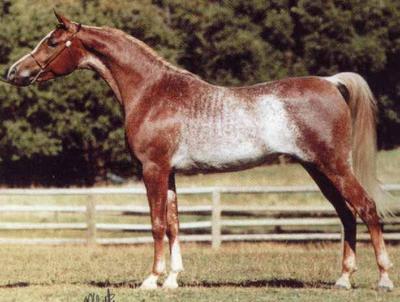
Horse coat colors and patterns, such as white ticking or roaning

Rabicano, sometimes called white ticking, is a horse coat color characterized by limited roaning in a specific pattern: its most minimal form is expressed by white hairs at the top of a horse's tail, often is expressed by additional interspersed white hairs seen first at the flank, then other parts of the body radiating out from the flank, where the white hairs will be most pronounced. Rabicano is distinct from true roan, which causes evenly interspersed white hairs throughout the body, except for solid-colored head and legs.
Etymology
The word, "rabicano" is of Spanish origin - rabo meaning "tail" and cano meaning "white" - thus, it described a horse with white hairs in its tail. The word appears very early in epic poems in Italian literature: In Orlando Innamorato (1495), "Rabicano" is a magic horse originally ridden by Argalia. In Italian, the term simply means "roan" and might therefore have been a descriptive name.
Characteristics


The original definition of "rabicano" referred to the presence of white hairs in the base of the tail, a characteristic called a "skunk" or coon tail. The term "coon tail" is associated with white hairs in the form of striping at the tailhead. The sides of the tail at the tailhead may have much white hair. Extensively marked rabicanos sometimes exhibit striations in their pattern on the ribs, giving them a striped appearance.
Prevalence and inheritance
The rabicano pattern is thought to be a dominant gene in some families, however other forms of white ticking not following the rabicano pattern may exist and be controlled by separate mechanisms. Rabicano is present even in breeds which do not possess any true roan individuals, such as Arabian horses. In the Arabian, rabicano patterning is even defined as "roan." Rabicano may occur on any base color and may occur in conjunction with any other white pattern, including true roan or gray.
Higher expression of the rabicano pattern on the flanks may produce a coat easy to mistake for true roan. However, in highly expressed rabicanos, the distribution of white hairs along the barrel may produce faint striping or stippling over the ribs, which is not seen in true roans. Furthermore, the skin of some rabicanos may be slightly mottled with pink, particularly on the abdomen and groin. This trait is not seen in true roans, and suggests that, like the white hairs associated with other white markings and patterns, the white hairs of a rabicano may be rooted in unpigmented skin cells. However, the genetic and developmental controls of such roaning are poorly understood, and has not yet been formally studied.
While rabicano itself does not produce white markings on the face and legs, it can be confused with some of the numerous sabino patterns, one of which has been mapped to the KIT gene. Other color patterns mapped to KIT include tobiano and true roan. This may explain the close association between rabicano and sabino, which are often observed in the same horse.
Vs. roan
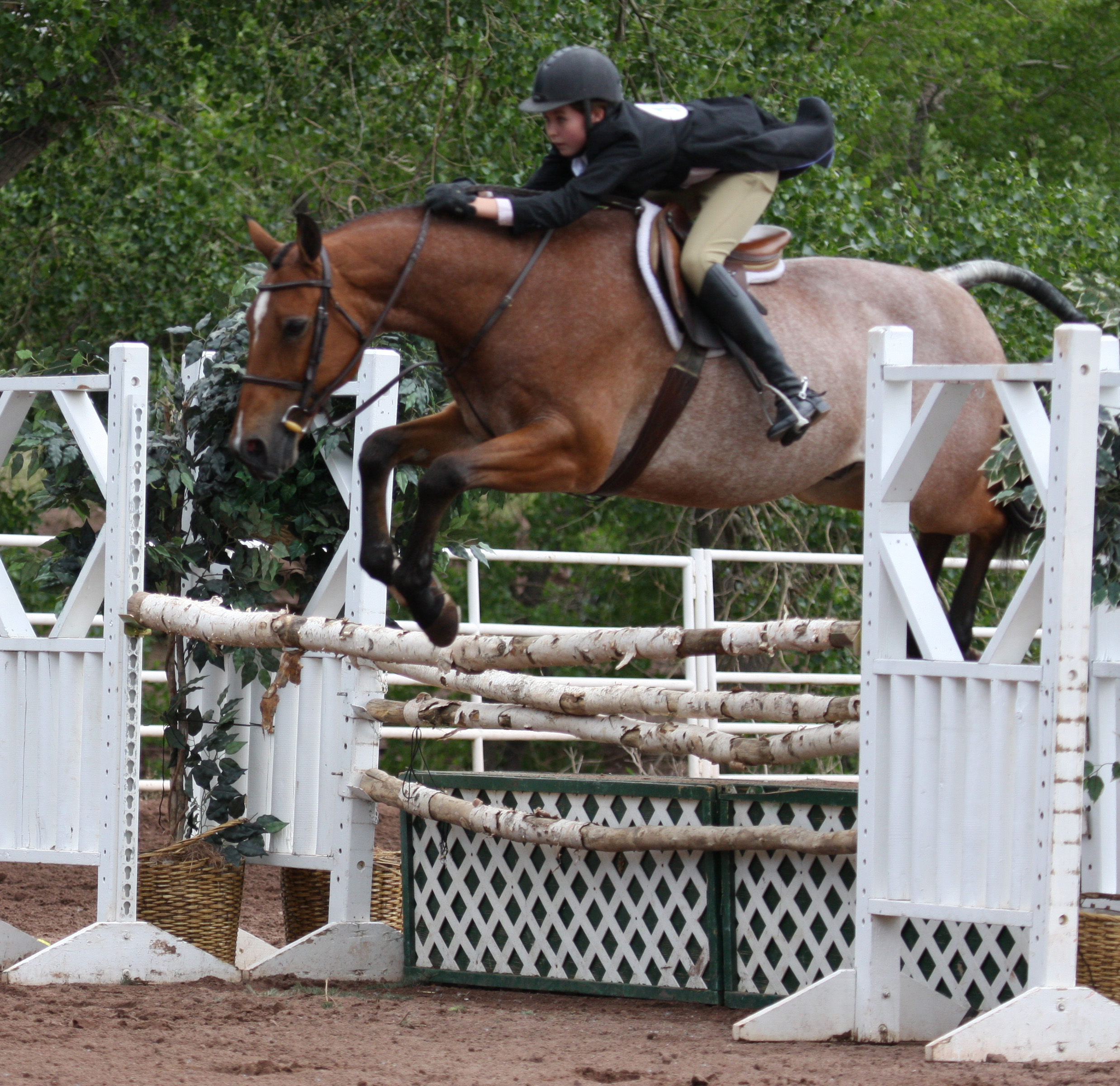
Rarely is rabicano patterning extensive enough to be confused with true roan. It is, however, possible for a horse to carry both rabicano and roan genes. Rabicanos are not true roans and can be distinguished from true roans by the following:
- Roaning on rabicanos is centralized at the junction of the stifle and the flank; true roan is evenly distributed over the whole body except the points.
- Rabicanos usually have skunk tails or rings of white hairs in the tail, while true roans do not.
- Rabicano roaning often spreads, while true roans usually become darker.
- Rabicanos do not develop corn marks when their skin is damaged.
Vs. sabino
Sabino patterning usually is expressed with high white legs markings with white sometimes extending onto the belly, face, and chin; sabinos often lack the white hairs at the base of the tail that characterize rabicano. A horse may carry the genes for both patterns, however.
References
References
- Caudill, Andrea. (25 July 2010). "Skunk Tailed". America's Horse Daily.
- Price, Steven D.. (2007). "The Lyons Press Horseman's Dictionary: Full Explanations of More than 2,000 Terms and Phrases Used by Horsemen". Globe Pequot.
- Juan de la Cruz Puig. ''Antologia de Poetas Argentinos,''1910. pg. 131. "Rabicano: caballo que tiene cerdas blancas á la raíz de la cola." [Rabicano: a horse that has white hairs at the root of the tail]
- Veterinary Genetics Laboratory. "Introduction to Coat Color Genetics". The Regents of the University of California.
- Behning, Laura. "Rabicano, Roan, Flaxen, and Frame Overo Morgan Horses". Morgan Colors.
- Peters, Anne. (2002-05-04). "A roan by any other name is a roan". Thoroughbred Times Co. Inc..
- Sponenberg 2003, p. 70, indicates that roan has reappeared in Thoroughbreds via a new mutation in a single horse
- Overton, Rebecca. (2004-12-15). "In The Genes". American Quarter Horse Association.
- B. Kostelnik. "Rabicano". Hippo-Logistics.
- "Introduction to Coat Color Genetics". UC Davis.
- Sponenberg, Dan Phillip. (2003-04-11). "Equine Coat Color Genetics". Wiley-Blackwell.
- Marklund, S. (1999). "Close association between sequence polymorphism in the KIT gene and the roan coat color in horses". Mammalian Genome.
- Brooks, SA. (2007). "A chromosome inversion near the KIT gene and the Tobiano spotting pattern in horses". Cytogenetic and Genome Research.
- Andersson, L. (March 1982). "A linkage group composed of three coat color genes and three serum protein loci in horses". Journal of Heredity.
This article was imported from Wikipedia and is available under the Creative Commons Attribution-ShareAlike 4.0 License. Content has been adapted to SurfDoc format. Original contributors can be found on the article history page.
Ask Mako anything about Rabicano — get instant answers, deeper analysis, and related topics.
Research with MakoFree with your Surf account
Create a free account to save articles, ask Mako questions, and organize your research.
Sign up freeThis content may have been generated or modified by AI. CloudSurf Software LLC is not responsible for the accuracy, completeness, or reliability of AI-generated content. Always verify important information from primary sources.
Report