From Surf Wiki (app.surf) — the open knowledge base
Quintana Roo
State of Mexico
State of Mexico
| Field | Value | ||
|---|---|---|---|
| name | Quintana Roo | ||
| official_name | |||
| Estado Libre y Soberano de Quintana Roo (Spanish) | |||
| Xóot' Noj Lu'umil Quintana Roo (Yucatec Maya) | |||
| native_name_lang | es | ||
| settlement_type | State | ||
| image_skyline | ICHKABAL QUINTANA ROO.png | ||
| image_caption | The main pyramid at Ichkabal | ||
| image_flag | |||
| flag_size | 160px | ||
| image_shield | |||
| shield_size | 70px | ||
| nickname | |||
| motto | |||
| anthem | Himno a Quintana Roo | ||
| image_map | |||
| coordinates | |||
| named_for | Andrés Quintana Roo | ||
| subdivision_type | Country | ||
| subdivision_name | Mexico | ||
| subdivision_type1 | Capital | ||
| subdivision_name1 | Chetumal | ||
| subdivision_type2 | Largest city | ||
| subdivision_name2 | Cancún | ||
| subdivision_type3 | Municipalities | ||
| subdivision_name3 | 11 | ||
| established_title | Before statehood | ||
| established_date | Territory of Quintana Roo | ||
| established_title1 | Admission | ||
| established_date1 | 8 October, 1974 | ||
| established_title2 | Order | ||
| established_date2 | 31st | ||
| leader_title | Governor | ||
| leader_name | [[File:Morena logo (Mexico).svg | link=Morena (political party) | 23px]] Mara Lezama Espinosa |
| leader_title1 | Parliament | ||
| leader_name1 | Congress of Quintana Roo | ||
| unit_pref | Metric | ||
| area_footnotes | |||
| area_total_km2 | 44705.2 | ||
| area_note | Ranked 19th | ||
| elevation_max_footnotes | |||
| elevation_max_m | 230 | ||
| population_footnotes | |||
| population_total | 1,857,985 | ||
| population_as_of | 2020 | ||
| population_rank | 24th | ||
| population_density_km2 | auto | ||
| population_density_rank | 24th | ||
| population_demonym | Quintanarroense | ||
| demographics_type2 | GDP | ||
| demographics2_footnotes | |||
| demographics2_title1 | Total | ||
| demographics2_info1 | MXN 447 billion | ||
| (US$22.2 billion) (2022) | |||
| demographics2_title2 | Per capita | ||
| demographics2_info2 | (US$11,479) (2022) | ||
| timezone1 | EST | ||
| utc_offset1 | −5 | ||
| postal_code_type | Postal code | ||
| postal_code | 77 | ||
| area_code_type | Area code | ||
| area_code | {{Collapsible list | ||
| title | Area codes | ||
| frame_style | border:none; padding: 0; | ||
| title_style | |||
| list_style | text-align:left;display:none; | ||
| 1 | • 983 | ||
| 2 | • 984 | ||
| 3 | • 987 | ||
| 4 | • 997 | ||
| 5 | • 998 | ||
| iso_code | MX-ROO | ||
| blank_name_sec1 | HDI | ||
| blank_info_sec1 | 0.790 high Ranked 15th of 32 | ||
| website |
the Mexican state
Estado Libre y Soberano de Quintana Roo (Spanish) Xóot' Noj Lu'umil Quintana Roo (Yucatec Maya) (US$22.2 billion) (2022)
Quintana Roo, officially the Free and Sovereign State of Quintana Roo, is one of the 31 states which, along with Mexico City, constitute the 32 federal entities of Mexico. It is divided into 11 municipalities, and its capital city is Chetumal.
Quintana Roo is located on the eastern part of the Yucatán Peninsula and is bordered by the states of Campeche to the west and Yucatán to the northwest, and by the Orange Walk and Corozal districts of Belize, along with an offshore borderline with Belize District to the south. As Mexico's easternmost state, Quintana Roo has a coastline to the east with the Caribbean Sea and to the north with the Gulf of Mexico. The state previously covered 44705 km2 and shared a small border with Guatemala in the southwest of the state. However, in 2013, Mexico's Supreme Court of Justice of the Nation resolved the boundary dispute between Quintana Roo, Campeche, and Yucatán stemming from the creation of the Calakmul municipality by Campeche in 1997, siding with Campeche and thereby benefiting Yucatán.
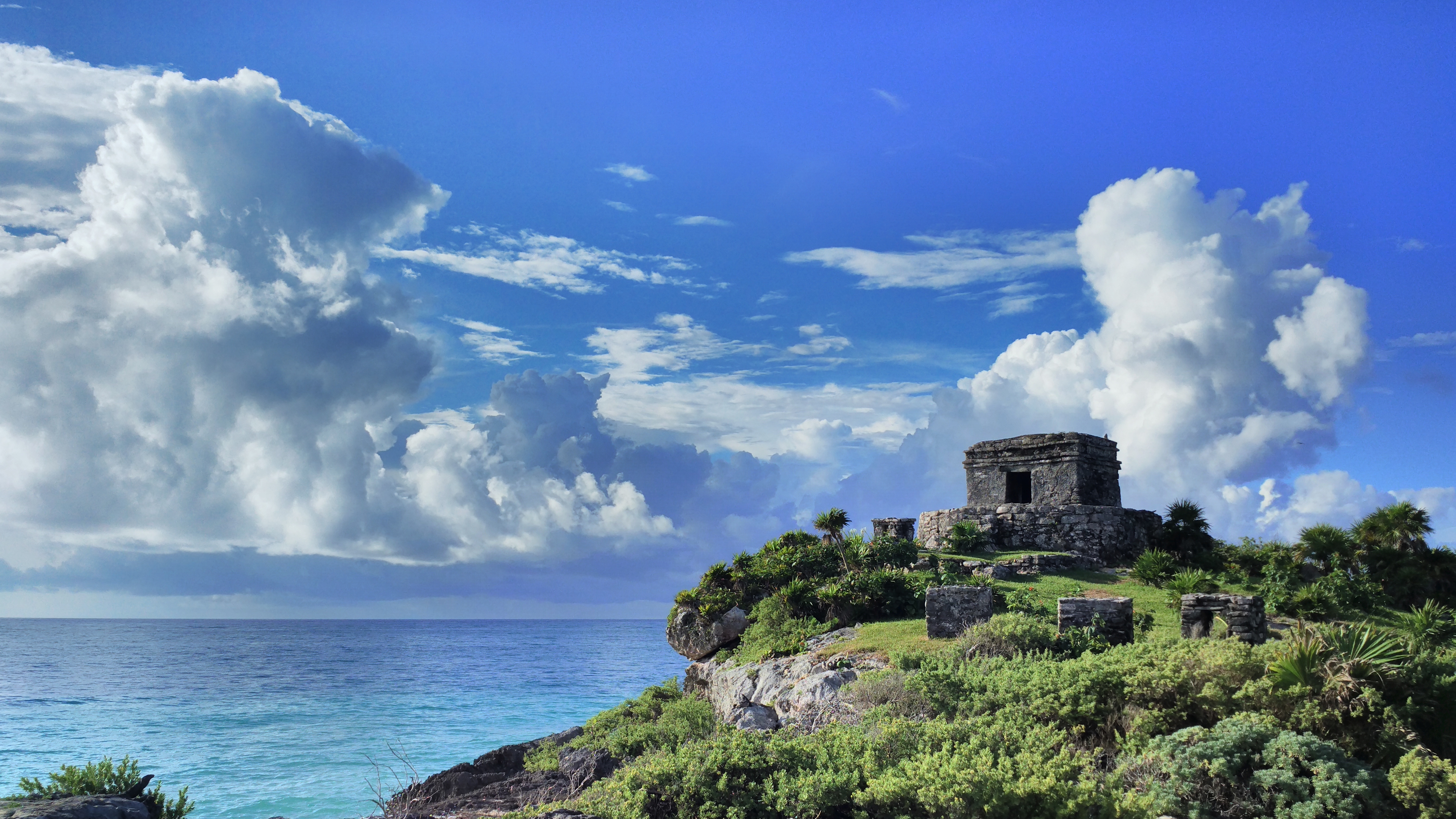
Quintana Roo is home to the city of Cancún, the islands of Cozumel and Isla Mujeres, and the towns of Bacalar, Playa del Carmen and Akumal, as well as the ancient Maya ruins of Chacchoben, Cobá, Kohunlich, Muyil, Tulum, Xel-Há, San Gervasio and Xcaret. The Sian Ka'an biosphere reserve is also located in the state. The statewide population is expanding at a rapid rate due to the construction of hotels and the demand for workers. Many migrants come from Yucatán, Campeche, Tabasco, and Veracruz. The state is frequently hit by severe hurricanes due to its exposed location, the most recent and severe being Hurricane Dean in 2007, which made landfall with sustained winds of 280 km/h, with gusts up to 320 km/h.
History
The area that makes up present-day Quintana Roo was long part of Yucatán, sharing its history. With the Caste War of Yucatán, which started in the 1840s, all non-natives were driven from the region. The independent Maya nation of Chan Santa Cruz was based on what is now the town of Felipe Carrillo Puerto. For decades, it maintained considerable independence, having separate trade and treaty relationships with British Honduras, now Belize.
The Territory of Quintana Roo was created by decree of President Porfirio Díaz on November 24, 1902. It was named after an early patriot of the Mexican Republic, Andrés Quintana Roo. The Mexican Federal Army succeeded in subjugating most of the indigenous Maya population of the region during the 1910s. In 1913, the area was again declared to be legally part of the state of Yucatán, but was again declared a separate territory in 1915. The territory of Quintana Roo was granted statehood within the United Mexican States on October 8, 1974.
In the last quarter of the 20th century and continuing into the 21st, Quintana Roo developed rapidly, with tourism being a driving force, notably with the development of Cancún. As result of this development, the northern part of Quintana Roo has been increasingly touristified. By contrast the south has continued with a traditional economy of forestry and wood extraction.
Archaeological findings
Ancient human remains have been discovered in a system of submerged caves and sinkholes in the Tulum area of Quintana Roo. To date, a total of nine skeletons have been found in these caves, including one of the oldest human skeletons found on the American continent. In 2016, underwater archaeological exploration of a cave known as Chan Hol found a skeleton of a female who lived in the region at least 9,900 years ago, during the Paleo-Indian period. Dating revealed that the skeleton was probably about 30 years old at the time of death. Three different scars on the skull of the woman showed that she was hit with something hard and her skull bones were broken. Her skull also had crater-like deformations and tissue deformities that appeared to be caused by a bacterial relative of syphilis.
According to study lead researcher Wolfgang Stinnesbeck, "It really looks as if this woman had a very hard time and an extremely unhappy end of her life. Obviously, this is speculative, but given the traumas and the pathological deformations on her skull, it appears a likely scenario that she may have been expelled from her group and was killed in the cave, or was left in the cave to die there".
The skeleton found by the 2016 exploration was 140 m away from a site where a previous expedition found human remains known as Chan Hol 2. Although archaeologists assumed the 2016 expedition had rediscovered Chan Hol 2, Stinnesbeck concluded that the two skeletons represent different individuals.
Due to their distinctive features, study co-researcher Samuel Rennie suggested the existence of at least two morphologically diverse groups of people living separately in Mexico during the transition from Pleistocene to Holocene.[[File:Cancun Strand Luftbild (22179809191).jpg|250px|thumb|The city of [[Cancún]] is a major tourist resort in Quintana Roo, especially the [[Hotel Zone (Cancún)|Hotel Zone]].]]
Geography
Climate
According to the Köppen climate classification, much of the state has a tropical wet and dry climate (Aw) while the island of Cozumel has a tropical monsoon climate (Am). The mean annual temperature is 26 C. The hottest months are April and August, in which the average high is 33 C, while January is the coldest month with an average low of 17 C.
Wildlife
| FL fig04.jpg | Trichechus manatus | Mazama americana in Barbados Wildlife Reserve 07.jpg | Mazama pandora | Hawksbill Turtle.jpg | Eretmochelys imbricata | Crax rubra (Great Curassow) - male.jpg | Crax rubra | Large american crocodile.jpg | Crocodylus acutus | Yucatan Spider Monkey (Ateles geoffroyi yucatanensis) (6766684927).jpg | Ateles geoffroyi | Pivoting king vulture.jpg | Sarcoramphus papa | Tamandua mexicana.jpg | Tamandua mexicana | Coati.jpg | Nasua narica | Boa constrictor (2).jpg | Boa constrictor | Ceiba pentandra 0008.jpg | Ceiba pentandra | Árbol de Guancaste.jpg | Enterolobium cyclocarpum | Mangroves in Puerto Rico.JPG | Rhizophora mangle | Haematoxylon campechianum0.jpg | Haematoxylum campechianum | Bixa orellana with fruits in Hyderabad, AP W IMG 1453.jpg | Bixa orellana
Conservation
The Yucatán Peninsula is one of the most forested areas of the world in terms of biotic mass per hectare. However, anthropological, biological and governmental experts have determined that Quintana Roo is 'facing a faunal crisis'. Many medium to large game animals are disappearing due to hunting and habitat loss. While its population is relatively small, Quintana Roo is experiencing both a population influx and an increase in tourism. This only increases the pressure on the plants and animals native to the area.
From 1996 to 2003, the USAID-supported programme Conserving Critical Coastal Ecosystems in Mexico operated in the southern portion of Quintana Roo with partners including Conservation International Mexico, combining site-based coastal management initiatives with policy and planning work for tourism and shoreline use in the Costa Maya region (including work in Xcalak and Chetumal Bay).
Ecosystems and animals
There are four generalized ecosystems in Quintana Roo—tropical forests, or jungle; savanna, mangrove forests, and coral reefs. One of the byproducts of traditional and large-scale agriculture is the creation of additional habitats, such as second growth forests and fields/pastures.Villa Rojas, Alfonso. 1945. The Maya of East Central Quintana Roo. Carnegie Institute of Washington Publication 559. Washington D.C. Tourism has caused Quintana Roo to become famous around the world in the last thirty or so years for its beaches, coastline, and cenote sinkholes. Biological experts consider the coastline of Quintana Roo one of the best manatee habitats worldwide. Queen conchs are also noted for their inhabitation of coastal territory. The wide variety of biotic organisms such as these has decreased drastically in the last fifteen years.
Birds
Also affected by the loss of habitat due to both agriculture and development, birds are one of the region's most varied animal assets. Hundreds of species reside in Quintana Roo permanently, with hundreds of others either wintering there or using it as a stopover on the long journey into South America. As a result, many birders come to the area annually in search of the rare and unexpected.
Demographics
|1895 | |1900 | |1910 | 9109 |1921 | 10966 |1930 | 10620 |1940 | 18752 |1950 | 26967 |1960 | 50169 |1970 | 88150 |1980 | 225985 |1990 | 493277 |1995 | 703536 |2000 | 874963 |2005 | 1135309 |2010 | 1325578 |2015 | 1501562 |2020 | 1857985
Municipalities
Main article: Municipalities of Quintana Roo
The State of Quintana Roo is divided into 11 municipalities (), each headed by a municipal president:
- Bacalar
- Benito Juárez
- Othón P. Blanco
- Puerto Morelos
- Cozumel
- Felipe Carrillo Puerto
- Isla Mujeres
- Solidaridad
- Tulum
- José María Morelos
- Lázaro Cárdenas
Tourism

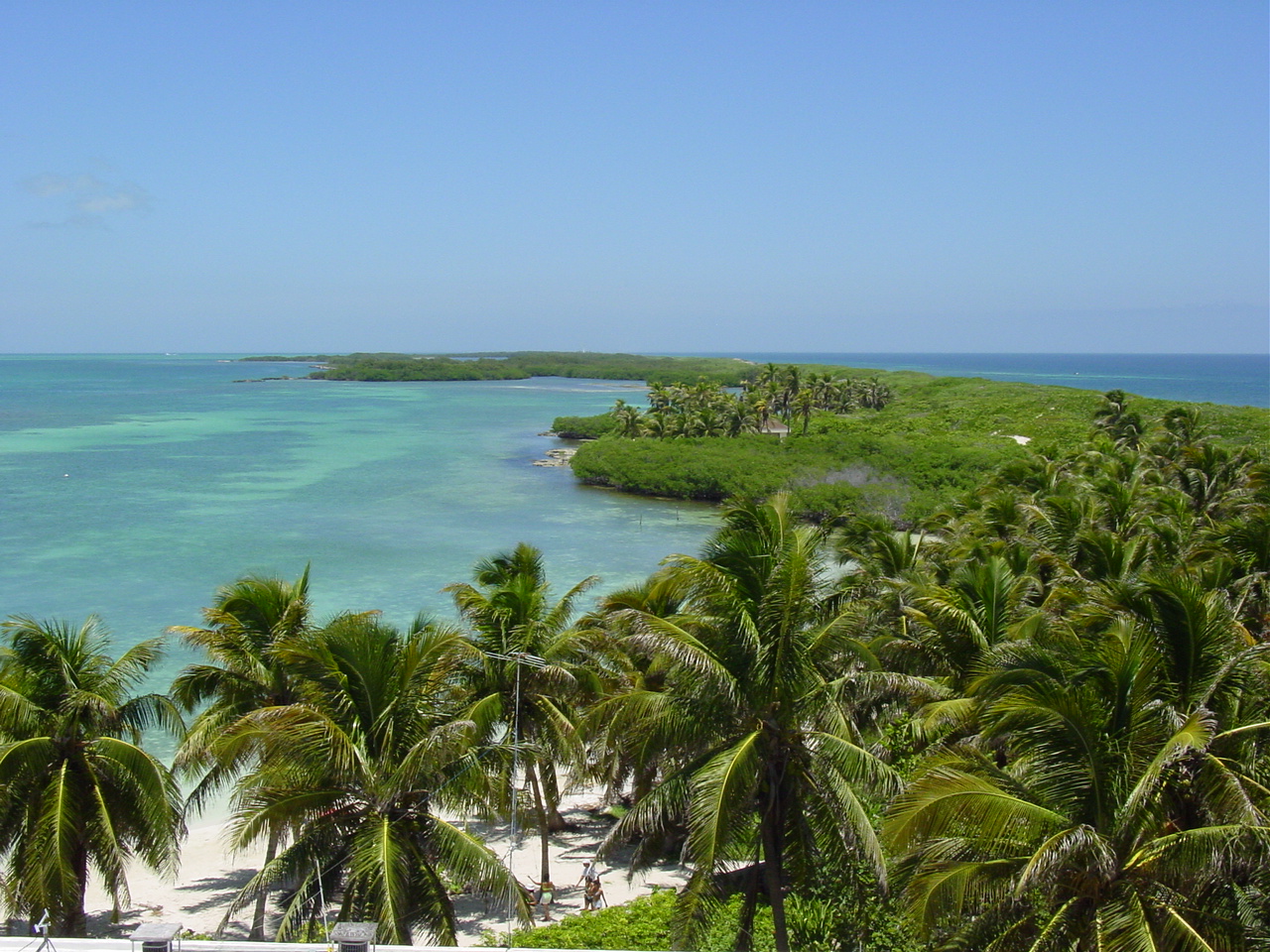

Quintana Roo's tourist boom began in the 1970s. Tourism resulted in the development of coastal hotels and resorts, in addition to ecotourism inland and in coastal regions, which have increased the development of the region as well as the gross domestic product. Quintana Roo ranks sixth among Mexican states according to the United Nations Human Development index (HDI).
The Riviera Maya is located along the Caribbean coastline, including Cancún, Playa del Carmen, Puerto Morelos, Akumal, the Hotel Zone, and Cozumel.
There are a number of Mayan archeological sites in Quintana Roo, including Chacchoben, Coba, Kohunlich, Muyil, San Gervasio, Tulum, Xcaret, Xelha, and Yo'okop.
Projections for the tourism economy of Quintana Roo have been optimistic, based on multiple attractions, from the Maya ruins to the lush forests and beautiful beaches. However, long-term problems include the effect on the local environment, economic stresses of development and population, and "economic marginalization" of the Maya natives.
Education
Universities
- Instituto Tecnológico de Cancún, Cancún
- Instituto Tecnológico de Chetumal, Chetumal
- University of Quintana Roo, Chetumal
- Intercultural Maya University of Quintana Roo, José María Morelos
- Universidad Anáhuac Cancún, Cancún
- Universidad del Caribe, Cancún
- Universidad Tecnológica de la Riviera Maya, Playa del Carmen
- Universidad La Salle Cancún, Cancún
- Universidad TecMilenio, Cancún
Media
Newspapers of Quintana Roo include: Diario de Quintana Roo, Diario Respuesta, El Periódico de Quintana Roo, El Quintanarroense, Novedades de Quintana Roo, and Por Esto!
Sports

Soccer club Atlante F.C. was founded in 1916 in Mexico City and moved to Cancun in 2007 due to poor attendance. The club announced a return to Mexico City in 2020, concurrently with the relocation of Cafetaleros de Chiapas to Cancún and its rebranding as Cancún F.C. They play in the Mexican second division Liga de Expansión MX at Estadio Andrés Quintana Roo.
In addition to soccer, the city has a professional baseball team, the Quintana Roo Tigers, which began playing at the Estadio de Béisbol Beto Ávila in Cancún in the 2006 season. The Tigers made it to the Mexican League series (analogous to MLB's World Series) in 2009, but lost to the Saraperos de Saltillo 4 games to 2.
Time zone
On February 1, 2015, Quintana Roo officially adopted a new time zone, Southeastern, which is five hours behind Coordinated Universal Time (UTC−05:00). Quintana Roo does not observe daylight saving time, so Southeastern Time is constant throughout the year. Southeastern Time (ST) is the same as Eastern Standard Time (EST) and Central Daylight Time (CDT). This means that in the winter, Quintana Roo has the same time as regions observing EST, such as the eastern U.S., eastern Canada, Cuba, and Jamaica; and in the summer, Quintana Roo has the same time as regions observing CDT, such as central Mexico.
Quintana Roo changed to Southeastern Time for economic reasons, including:
- Allowing tourists in areas such as Cancún, Cozumel, and Playa del Carmen to spend more time (and money) at beaches, restaurants, historic sites, and other venues.
- Reducing electricity usage by hotels, restaurants, and other facilities.
Before Quintana Roo adopted the Southeastern time zone (officially referred to as zona sureste in Mexico), it had been part of the Central time zone (zona centro).
Notes
References
- Dumond, Don E.1985 The Talking Crosses of Yucatán: A New Look at their History. Ethnohistory 32(4):291–308.
- Freidel, David., Schele, Linda., et al. 1993 Maya Cosmos: Three thousand years on the Shaman's Path. New York: W. Morrow
- Harrison, Peter D. 1985 Some Aspects of Preconquest Settlement in Southern Quintana Roo, Mexico. Lowland Maya Settlement Patterns edited by Wendy Ashmore Albuquerque: University of New Mexico Press, A School of American Research Book.
- Villa Rojas, Alfonso. 1945 The Maya of East Central Quintana Roo: The Pagan-Christian Religious Complex. Washington, D.C.: Carnegie Institution.
References
- "Political Constitution of the United Mexican States". [[Tribunal Electoral del Poder Judicial de la Federación]].
- "Reformas Constitucionales por Decreto en orden cronológico". [[Cámara de Diputados]].
- "Resumen". Cuentame INEGI.
- "Relieve". Cuentame INEGI.
- (January 2016). "México en cifras".
- Citibanamex. (June 13, 2023). "Indicadores Regionales de Actividad Económica 2023".
- "Quintana Roo". [[HarperCollins]].
- "Quintana Roo". [[Oxford University Press]].
- "Controversia Constitucional: Estado de Quintana Roo Vs. Estado de Yucatán (3 de Mayo de 1997)". Suprema Corte de Justicia de la Nacion.
- "Campeche insiste en que Quintana Roo le invadió terreno". Notisureste.
- (June 2017). "Renuncia Quintana Roo a conflicto limítrofe con Campeche". El Economista.
- "Poder Legislativo del Estado de Quintana Roo".
- Ojeda, Antonio B.. (2024). "Análisis geohistórico de la turistificación de Quintana Roo en México, en los últimos cien años (1920-2020)". [[Norte Grande Geography Journal]].
- (February 5, 2020). "New evidence for an early settlement of the Yucatán Peninsula, Mexico: The Chan Hol 3 woman and her meaning for the Peopling of the Americas". PLOS ONE.
- (February 5, 2020). "9,900-year-old skeleton of horribly disfigured woman found in Mexican cave". Future US Inc.
- PLOS. (February 5, 2020). "9,900-Year-Old Skeleton Discovered in Submerged Mexican Cave Has a Distinctive Skull".
- "MEDIO FÍSICO". Instituto para el Federalismo y el Desarrollo Municipal.
- "Clima". Instituto Nacional de Estadística y Geografía.
- (December 1, 2020). "2020 Atlantic Hurricane season finally comes to an end".
- Robadue Jr., Donald D.. (2003). "Capacity Building and Strategic Innovation: Conserving Critical Coastal Ecosystems in Mexico 1996–2003". University of Rhode Island, Coastal Resources Center.
- (March 10, 2014). "Tulum Beaches and Cenotes".
- "Cenotes".
- Schlesinger, Victoria. 2001. ''Animals and Plants of the Ancient Maya: A Guide''. University of Texas Press. Austin, Texas.
- Juarez, Ana M. 2002. "Ecological Degradation, Global Tourism, and Inequality: Maya Interpretations of the Changing Environment in Quintana Roo, Mexico. ''Human Organization'' 61.2, 113-124.
- "Mexico: extended population list". GeoHive.
- "Censo Quintana Roo 2020".
- Hernández, Silvia. (February 2, 2011). "Bacalar, el décimo municipio de Q. Roo". [[El Universal (México).
- Anderson, E. N. and Felix Medina Tzuc. 2005. Animals and the Maya in Southeast Mexico. University of Arizona Press. Tucson, Arizona.
- Daltabuit, Magali and Oriol Pi-Sunyer. 1990. Tourism Development in Quintana Roo, Mexico. ''Cultural Survival Quarterly'' 14.2, 9-13.
- ''Encyclopædia Britannica'' 2008. "Quintana Roo". Encyclopædia Britannica Online. http://www.britannica.com/eb/article-9062295. Retrieved February 21, 2008.
- "Publicaciones periódicas en Quintana Roo". Gobierno de Mexico.
- "Latin American & Mexican Online News". [[University of Texas at San Antonio Libraries]].
- ":: Atlante Futbol Club ::".
- (February 3, 2021). "Atlante regresa a la CDMX y jugará en el Estadio Azul".
- (February 3, 2021). "Cafetaleros se muda a Quintana Roo y nace Cancún FC".
- ".TIGRES DE QUINTANAROO.".
- "2009 Playoffs - MiLB.com Events - The Official Site of Minor League Baseball".
- "Quintana Roo estrena horario mañana (Spanish)".
- "Mexico's Quintana Roo Gears Up for Feb. 1 Time Change".
- (January 29, 2015). "Cancun switches to Eastern time zone". UPI.
- (January 14, 2015). "Cancun Region Gets Longer Evenings".
- "Boletín 266 .- Celebra SECTUR reforma a ley del sistema de horario en los Estados Unidos Mexicanos".
- "DECRETO por el que se reforman los artículos 2 y 3 de la Ley del Sistema de Horario en los Estados Unidos Mexicanos". Mexican Interior Ministry.
This article was imported from Wikipedia and is available under the Creative Commons Attribution-ShareAlike 4.0 License. Content has been adapted to SurfDoc format. Original contributors can be found on the article history page.
Ask Mako anything about Quintana Roo — get instant answers, deeper analysis, and related topics.
Research with MakoFree with your Surf account
Create a free account to save articles, ask Mako questions, and organize your research.
Sign up freeThis content may have been generated or modified by AI. CloudSurf Software LLC is not responsible for the accuracy, completeness, or reliability of AI-generated content. Always verify important information from primary sources.
Report