From Surf Wiki (app.surf) — the open knowledge base
Quimper
| Field | Value |
|---|---|
| name | Quimper |
| native name | br |
| commune status | Prefecture and commune |
| image coat of arms | Blason ville fr Quimper (Finistère).svg |
| image | Quimper2011.png |
| caption | The river Odet in the centre of Quimper |
| coordinates | |
| arrondissement | Quimper |
| canton | Quimper-1 and 2 |
| INSEE | 29232 |
| postal code | 29000 |
| mayor | Isabelle Assih |
| term | 2020–2026 |
| intercommunality | Quimper Bretagne Occidentale |
| elevation m | 6 |
| elevation min m | -5 |
| elevation max m | 151 |
| area km2 | 84.45 |
| population | |
| population date | |
| population footnotes |
|image coat of arms = Blason ville fr Quimper (Finistère).svg |image coat of arms size = |coat of arms legend =
Quimper (, ; ; or Corisopitum) is a commune and prefecture of the Finistère department of Brittany in northwestern France.
Administration
Quimper is the prefecture (capital) of the Finistère department.
Geography
The city of Quimper was built at the confluence of the Steir, Odet and Jet rivers. Routes Nationale 165, D785, D765 and D783 were designed to intersect here, 62 km northwest of Lorient, 181 km west of Rennes, and 486 km west-southwest of Paris.
Climate
Quimper has an oceanic climate (Köppen climate classification Cfb), with an average annual temperature of 12.1 C. The temperatures are highest, on average, in July and August, at around 17.7 C, and lowest in January, at around 7.1 C. The highest temperature ever recorded in Quimper was 35.9 C on 30 June 1976; the coldest temperature ever recorded was -10.1 C on 13 January 1987. The average annual rainfall is 1214.4 mm, with December being the wettest month.
|Jan record high C = 16.9 |Feb record high C = 18.6 |Mar record high C = 23.3 |Apr record high C = 27.1 |May record high C = 30.3 |Jun record high C = 35.9 |Jul record high C = 35.7 |Aug record high C = 35.8 |Sep record high C = 31.1 |Oct record high C = 26.8 |Nov record high C = 19.7 |Dec record high C = 17.7 |year record high C = 35.9 |Jan record low C = -10.1 |Feb record low C = -8.4 |Mar record low C = -7.0 |Apr record low C = -2.2 |May record low C = 0.3 |Jun record low C = 3.9 |Jul record low C = 6.6 |Aug record low C = 6.9 |Sep record low C = 4.2 |Oct record low C = -1.2 |Nov record low C = -4.6 |Dec record low C = -7.2 |year record low C = -10.1 | access-date = June 9, 2022}}
Etymology
The name Quimper comes from the Breton kemper, meaning "confluent", a reference to the meeting of the three rivers of the area.
History
Quimper is the ancient capital of Cornouaille, Brittany's most "traditional" region, and has a distinctive Breton-Celtic character, from music and dance traditions to linguistics and genetics; indeed, the historical name is also somewhat similar to "Cornwall", a region in southern England with distant cultural similarities. The word Quimper comes from the Breton word kemper (cognate to Welsh cymer), meaning "confluence". The town developed at the confluence of the rivers Le Steir and L'Odet. Shops and flags celebrate the region's Celtic heritage.
Quimper was originally settled during Roman times, when the area now known as France was known as Gaul. By AD 495, the town had become a Bishopric. It subsequently became the capital of the counts of Cornouailles. In the eleventh century, it was united with the Duchy of Brittany. During the War of the Breton Succession (1341–1364), the town suffered considerable ruin. In 1364, the duchy passed to the House of Montfort.
The town itself has a "rustic" atmosphere, with footbridges spanning the rivers that flow through it. The Church of Locmaria, a Romanesque structure, dates from the eleventh century. The Cathedral of Saint-Corentin, with its Gothic-style façade, was constructed between the thirteenth and sixteenth centuries, and is the oldest Gothic structure in lower Brittany. Its twin towers are 76 m high; its spires were added in the nineteenth century. The fifteenth-century stained glass windows are considered exceptional. The cathedral is dedicated to the 5th-century bishop Corentin, Quimper's first.
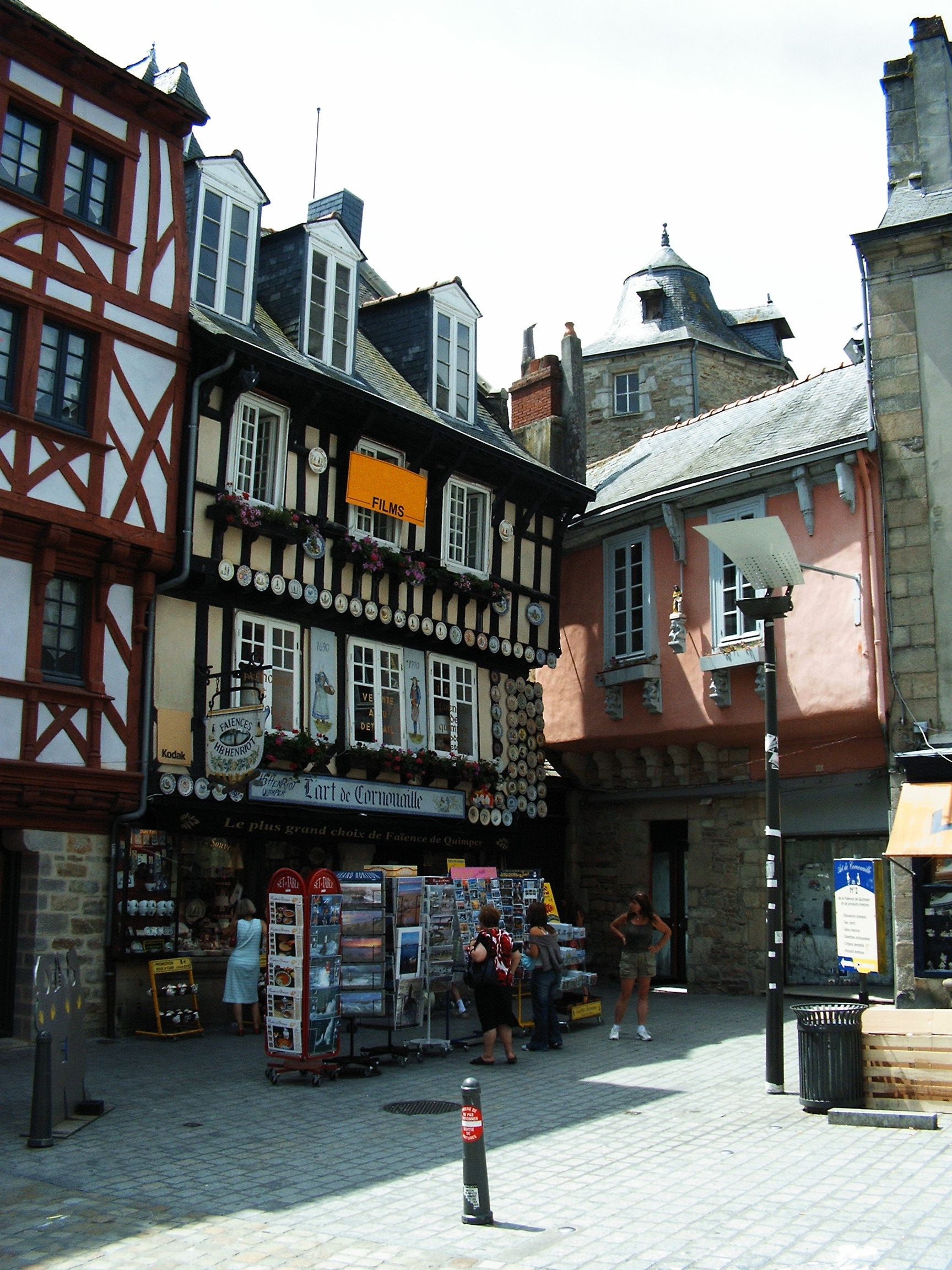
To the cathedral's west are the pedestrianised streets of Vieux Quimper (Old Quimper), which has a wide array of crêperies, half-timbered houses, and shops and cafés. Near the Episcopal palace (which now holds the Musée départemental Breton, devoted to regional history, archaeology, ethnology and economics) are the ruins of the town's fifteenth-century walls. Nearby is the Musée des beaux-arts de Quimper. The museum has a nineteenth-century façade and an entirely-rebuilt interior. It houses a collection of 14th to 21st-century paintings, including works by François Boucher, Jean-Baptiste-Camille Corot, Jean-Baptiste Oudry and Peter Paul Rubens, along with canvases by such Pont-Aven School painters as Émile Bernard, Maurice Denis, Georges Lacombe, Maxime Maufra and Paul Sérusier.
The town's best-known product is Quimper faience, a tin-glazed pottery. It has been made here since 1690, using the bold provincial designs of Jean-Baptiste Bousquet. The city has a museum devoted to faience. Quimper has also been known for copper and bronze work, galvanised ironware, hosiery, leather, paper and woollen goods, as well as being a gastronomic destination for its varied regional dishes.
Adolphe Harré was a French sailor from Quimper who died during World War I along with the 31 crew members of the SS Longwy, a French merchant vessel that was torpedoed off the coast of Scotland in 1917. Harré's body washed ashore in Scotland and was buried in Doune Cemetery in Girvan, South Ayrshire. On 12 October 2024, a memorial stele was inaugurated at the Cemetery to honour Harré and the crew of the SS Longwy. The ceremony was attended by local authorities, including the First Minister of Scotland, members of the French Navy, and dignitaries from both Scotland and France. A wreath was laid on behalf of the mayoress of Quimper and the city, symbolizing the historic ties between the French and Scottish communities, and commemorating the sacrifice of the sailors.
Population
The population data in the table and graph below refer to the commune of Quimper proper, in its geography at the given years. The commune of Quimper absorbed the former communes of Ergué-Armel, Kerfunteun and Penhars in 1959. Its inhabitants are called Quimpérois.
| graph-pos = bottom |1793 |8400 |1800 |6651 |1806 |6905 |1821 |9400 |1831 |9860 |1836 |9715 |1841 |10154 |1846 |10943 |1851 |10904 |1856 |11450 |1861 |11438 |1866 |12532 |1872 |13159 |1876 |13879 |1881 |15228 |1886 |17171 |1891 |17406 |1896 |18557 |1901 |19441 |1906 |19516 |1911 |19367 |1921 |18444 |1926 |18686 |1931 |18297 |1936 |18814 |1946 |20149 |1954 |19352 |1962 |45989 |1968 |52496 |1975 |55977 |1982 |56907 |1990 |59437 |1999 |63238 |2007 |63961 |2012 |63360 |2017 |62985
Breton language
The municipality launched a linguistic plan through Ya d'ar brezhoneg on 6 February 2008, to revive the teaching and use of Breton, the historic Celtic language of the region. In 2008, 4.61% of primary-school children attended bilingual schools.
Education
Quimper has several schools. These include two Diwan pre-schools, two Diwan primary schools and one Diwan collège (all specialise in use of Breton). In total, 287 students here attended a Diwan school in 2003–2004.
Festivals
While many French festivals are held in the summer season, Quimper has a winter festival: Les Hivernautes.
In the summer, concerts are held on street corners, with pipers and accordion players.
The Festival de Cornouaille, a cultural festival, is typically held in the last week of July.
Tourism


Points of interest in Quimper include:
- Quimper Cathedral and the nearby statue of Gradlon (looking in the direction of Ys)
- Musée des Beaux-Arts de Quimper (near the cathedral)
- Faience museum
- The Hôtel de Ville
Transport
Public transport in Quimper is provided by QUB. The network consists of seven urban bus routes and 16 suburban bus routes. During the summer months of July and August, an additional "beach" bus route is open to service.
The Gare de Quimper is the terminus of a TGV high-speed train line from Paris, which passes through Le Mans, Rennes and Vannes. Journey duration is approximately 3 hours 40 minutes. In addition, the following destinations are served by the TER Bretagne (the regional train network):
- Quimper – Brest (1 hour 9 minutes)
- Quimper – Rennes (2 hours 15 minutes)
Commercial service at Quimper–Bretagne Airport has been terminated since November 2023. The nearest major airport is Brest Bretagne Airport, located 71 km north west of Quimper.
Notable people
Quimper is the birthplace of:
.jpg)
- Guillaume-Hyacinthe Bougeant (1690–1743), Jesuit author
- Louis Billouart, Chevalier de Kerlérec (1704–1770), last French governor of Louisiana
- René Cardaliaguet (1875–1950), priest and writer
- Élie Catherine Fréron (1718–1776), critic and controversialist
- Franciscus Lé Livec de Trésurin (1726–1792), French Jesuit
- Yves-Joseph de Kerguelen-Trémarec (1734–1797), explorer, admiral, discoverer of the Kerguelen archipelago
- René-Marie Madec (1736–1784), adventurer, Nawab of India. See also René Madec
- Guillaume François Laennec (1748–1822), French physician
- René Laennec (1781–1826), physician, inventor of the stethoscope
- Max Jacob (1876–1944), poet, painter, writer and critic
- Corentin Louis Kervran (1901–1983), scientist
- Philippe Poupon (born 1954), sailor
- William Stanger (born 1985), footballer
- Jacques Villeglé (1926–2022), mixed-media artist
- Jean-Claude Andro (1937–2000), novelist
- Jessica Cérival (born 1982), athlete
- Dan Ar Braz (b. 1949), guitarist
- Anne Quemere (b. 1966), sailor and sportswoman
- Clémence Quélennec (b.1991), singer and composer
Twin towns – sister cities
Quimper is twinned with:
- IRL Limerick, Ireland
- GER Remscheid, Germany
- GRC Laurium, Greece
- ESP Ourense, Spain
- PRC Yantai, China
- ITA Foggia, Italy
References
References
- (13 September 2022). "Répertoire national des élus: les maires". data.gouv.fr, Plateforme ouverte des données publiques françaises.
- {{Cite Merriam-Webster. Quimper
- "Normales climatiques 1981-2010 : Quimper".
- . (8 September 2021). ["07201: Quimper (France)"](https://www.ogimet.com/cgi-bin/gsynres?ind=07201&ano=2021&mes=9&day=8&hora=12&min=0&ndays=30). *[[OGIMET]]*.
- "Normales et records pour Quimper (29)". Meteociel.
- "Girvan historians' 10-year toil to give French sailors a fitting memorial".
- {{Cassini-Ehess. 28471. Quimper
- [https://www.insee.fr/fr/statistiques/4515315?geo=COM-29232#ancre-POP_T1 Population en historique depuis 1968], INSEE
- {{in lang
- "Diwan e sifroù".
- "Quimper Property Listings and Info".
- "Festival de Cornouail". Brittany Tourism.
- "Saint-Corentin cathedral".
- "De 1864 à aujourd'hui". Musée des Beaux-Arts.
- "Musée de la Faïence (Quimper)". Brittany Tourism.
- "Hôtel de Ville de Quimper". Structurae.
- Hervé Gourmelon, ''Le chevalier de Kerlérec, 1704–1770: L'affaire de la louisiane'', second edition (Rennes : Les Portes du large, 2004), 14.
- "Jumelages". Quimper.
This article was imported from Wikipedia and is available under the Creative Commons Attribution-ShareAlike 4.0 License. Content has been adapted to SurfDoc format. Original contributors can be found on the article history page.
Ask Mako anything about Quimper — get instant answers, deeper analysis, and related topics.
Research with MakoFree with your Surf account
Create a free account to save articles, ask Mako questions, and organize your research.
Sign up freeThis content may have been generated or modified by AI. CloudSurf Software LLC is not responsible for the accuracy, completeness, or reliability of AI-generated content. Always verify important information from primary sources.
Report