From Surf Wiki (app.surf) — the open knowledge base
Quench polish quench
Process for hardening steel

Process for hardening steel
Quench polish quench (QPQ) is a specialized type of nitrocarburizing case hardening that increases corrosion resistance. It is sometimes known by the brand name of Tufftride, Tenifer or Melonite. Three steps are involved: nitrocarburize ("quench"), polish, and post-oxidize ("quench").
This process is often used when two or more of the following properties are required in a workpiece:
- wear resistance
- corrosion resistance
- fatigue strength
Common applications of the process are for piston rods of shock absorbers, cylinders and rods for hydraulic systems, pumps, axles, spindles, firearm slides and barrels and valves.
Process
The process starts with a standard salt bath nitrocarburizing cycle, which produces a layer of ε iron nitride. Next, the workpiece is mechanically polished; typical polishing processes include vibratory finishing, lapping, and centerless grinding. Finally, the workpiece is re-immersed into the salt quench bath for 20 to 30 minutes, rinsed, and oil dipped. This last step optimizes the corrosion resistance by creating a layer of iron oxide about 3 to 4 micrometers thick. It also gives the workpiece a black finish.
Corrosion resistance
Field immersion
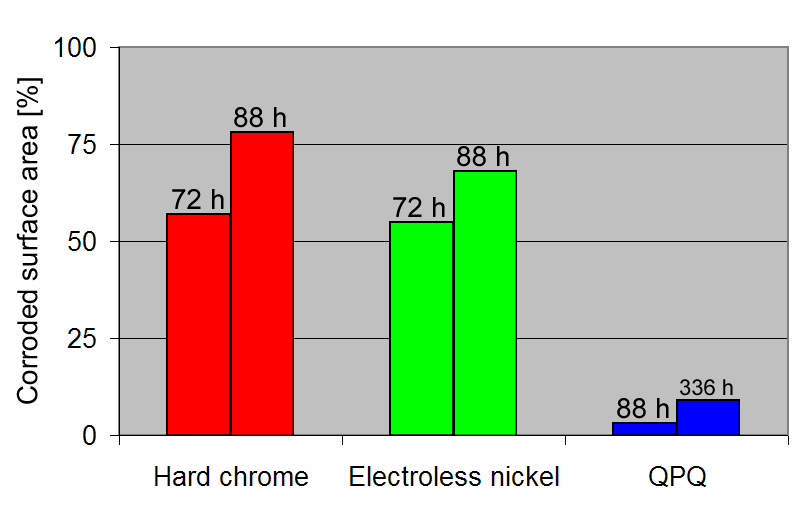
The chart on the right shows a comparison of corrosion resistance against other surface treatments, based on field immersion tests. Test conditions for the immersion test are full immersion in 3% sodium chloride plus 3 g /L of hydrogen peroxide for 24 hours.
Salt spray test
The chart on the right shows a comparison of the corrosion resistance of surface treated steel automotive steering columns based on the ASTM B117 salt spray test.
References
References
- (14 June 2012). "Melonite/QPQ". HEF Group (USA).
- (2002). "Surface Hardening of Steels: Understanding the Basics". [[ASM International (society).
- (June 2003). "Nitrogen redistribution in ε/γ′-iron nitride compound layers upon annealing". [[Elsevier]].
- "Use Salt Bath Nitriding for Uniform & Consistent Layers". Northeast Coating.
- Easterday, James R.. (1996). "The Kolene QPQ(SM) Process". Kolene Corporation.
- (2010). "QPQ Liquid Nitriding". Thermex Metal Treating Ltd.
This article was imported from Wikipedia and is available under the Creative Commons Attribution-ShareAlike 4.0 License. Content has been adapted to SurfDoc format. Original contributors can be found on the article history page.
Ask Mako anything about Quench polish quench — get instant answers, deeper analysis, and related topics.
Research with MakoFree with your Surf account
Create a free account to save articles, ask Mako questions, and organize your research.
Sign up freeThis content may have been generated or modified by AI. CloudSurf Software LLC is not responsible for the accuracy, completeness, or reliability of AI-generated content. Always verify important information from primary sources.
Report