From Surf Wiki (app.surf) — the open knowledge base
Queen (playing card)
Playing card with image of a queen

Playing card with image of a queen
The queen is a playing card with a picture of a queen on it. In many European languages, the king and queen begin with the same letter so the latter is often called dame (lady) or variations thereof. In French playing cards, the usual rank of a queen is between the king and the jack. In tarot decks, it outranks the knight which in turn outranks the jack. In the Spanish deck and some Italian decks, the Queen does not exist and the Horse or Bull appears in them instead, with the same role and value.
In several card games, including the middle eastern Trex and French Barbu, the queen is a major card to avoid taking, with each queen taken inflicting a penalty on the player. Similarly, in Hearts, the queen of spades is to be avoided, and is called a variety of unsavoury names.
In the Paris pattern, each court card is identified as a particular historical or mythological personage as follows:
Image:Queen of spades fr.svg|Pallas Athena Image:Queen of hearts fr.svg|Judith, Biblical figure Image:Queen of diamonds fr.svg|Rachel, Biblical figure Image:Queen of clubs fr.svg|Argine, an anagram of Regina (Latin for "queen")
Queens may have been an invention of early German cardmakers. One of the earliest surviving packs of playing cards, the Stuttgart pack (circa 1440), consists of all female courts in two of the four suits where Queens have replaced Kings. The Ambraser Hofjagdspiel (circa 1440 to 1445) and many other surviving 15th-century packs include the Queen as a fourth independent rank from the King, Ober, and Unter. Modern German-suited playing cards have dropped the Queen rank, but French-suited playing cards have since adopted it as a replacement for the Knights.
Cultural references
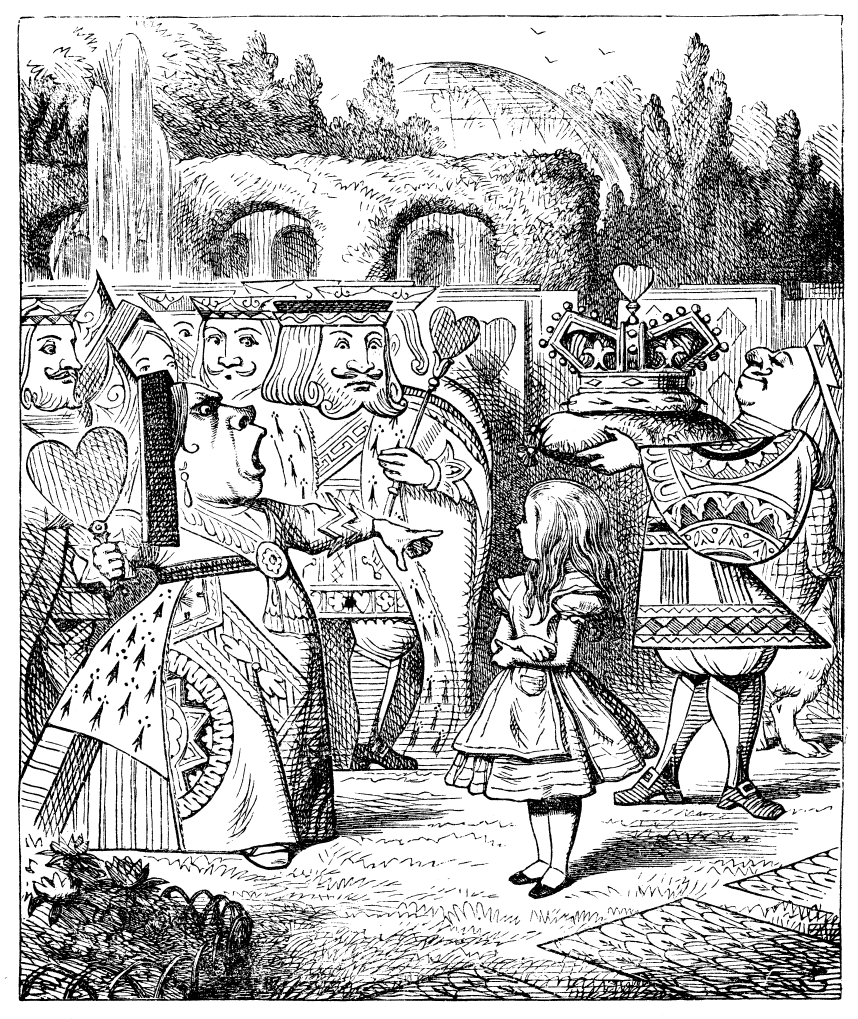
Regarding the anonymous nursery rhyme, "The Queen of Hearts" (published 1782), Katherine Elwes Thomas claims, in The Real Personage of Mother Goose, that the Queen of Hearts was based on Elizabeth of Bohemia. Benham, in his book Playing Cards: History of the Pack and Explanations of its Many Secrets, notes that French playing cards from the mid-17th century have Judith from the Hebrew Bible as the Queen of Hearts. See also: Queen of Hearts (Alice's Adventures in Wonderland).
In Unicode
The queens are included in the Playing Cards:
References
References
- [http://www.snopes.com/history/world/cardking.asp "The Four King Truth"] at the [[Urban Legends Reference Pages]]
- [http://i-p-c-s.org/faq/history_12.php Who are the court figures?] at the [[International Playing-Card Society]]. Retrieved 22 October 2016.
- (1980). "The Game of Tarot". Duckworth.
- Thomas, Katherine Elwes (1930). ''[https://archive.org/details/in.ernet.dli.2015.75797 The Real Personage of Mother Goose]''. Lothrop, Lee & Shepard Co. {{pre-ISBN}}.
- "Eclipse :: Mother Goose". School of Communication, Information and Library Studies, [[Rutgers University]].
- (2020). "Playing Cards - The Unicode Standard, Version 13.0". Unicode.
This article was imported from Wikipedia and is available under the Creative Commons Attribution-ShareAlike 4.0 License. Content has been adapted to SurfDoc format. Original contributors can be found on the article history page.
Ask Mako anything about Queen (playing card) — get instant answers, deeper analysis, and related topics.
Research with MakoFree with your Surf account
Create a free account to save articles, ask Mako questions, and organize your research.
Sign up freeThis content may have been generated or modified by AI. CloudSurf Software LLC is not responsible for the accuracy, completeness, or reliability of AI-generated content. Always verify important information from primary sources.
Report