From Surf Wiki (app.surf) — the open knowledge base
Queen of Heaven (antiquity)
Title given to ancient sky goddesses

Title given to ancient sky goddesses
Queen of Heaven was a title given to several ancient sky goddesses worshipped throughout the ancient Mediterranean and the ancient Near East. Goddesses known to have been referred to by the title include Inanna, Anat, Isis, Nut, Astarte, and possibly Asherah (by the prophet Jeremiah). In Greco-Roman times, Hera and Juno bore this title. Forms and content of worship varied.
Inanna
Main article: Inanna
Inanna is the Sumerian goddess of love and war. Despite her association with mating and fertility of humans and animals, Inanna was not a mother goddess and is rarely associated with childbirth. Inanna was also associated with rain and storms and with the planet Venus. The Venus tablet of Ammisaduqa, believed to have been compiled around the mid-seventeenth century BCE, referred to the planet Venus in the tablet as the "bright queen of the sky" or "bright Queen of Heaven".
Although the title of Queen of Heaven was often applied to many different goddesses throughout antiquity, Inanna is the one to whom the title is given the most number of times. In fact, Inanna's name is commonly derived from Nin-anna which literally means "Queen of Heaven" in ancient Sumerian (It comes from the words NIN meaning "lady" and AN meaning "sky"), although the cuneiform sign for her name (Borger 2003 nr. 153, U+12239 𒈹) is not historically a ligature of the two.
In several myths, Inanna is described as being the daughter of Nanna, the ancient Sumerian god of the Moon. In other texts, however, she is often described as being the daughter of either Enki or An. These difficulties have led some early Assyriologists to suggest that Inanna may have been originally a Proto-Euphratean goddess, possibly related to the Hurrian mother goddess Hannahannah, accepted only latterly into the Sumerian pantheon, an idea supported by her youthfulness, and that, unlike the other Sumerian divinities, she at first had no sphere of responsibilities.
The view that there was a Proto-Euphratean substrate language in Southern Iraq before Sumerian is not widely accepted by modern Assyriologists. In Sumer Inanna was hailed as "Queen of Heaven" in the third millennium BC. In Akkad to the north, she was worshipped later as Ishtar. In the Sumerian Descent of Inanna, when Inanna is challenged at the outermost gates of the underworld, she replies:
On my way to the East}}
Her cult was deeply embedded in Mesopotamia and among the Canaanites to the west. F. F. Bruce describes a transformation from a Venus as a male deity to Ishtar, a female goddess by the Akkadians. He links Ishtar, Tammuz, Innini, Ma (Cappadocia), Mami, Dingir-Mah, Cybele, Agdistis, Pessinuntica and the Idaean Mother to the cult of a great mother goddess.
Astarte
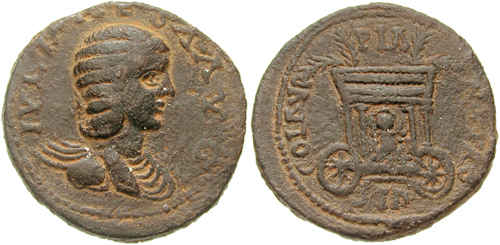
The goddess, the Queen of Heaven, whose worship Jeremiah so vehemently opposed, may have been possibly Astarte. Astarte is the name of a goddess as known from Northwestern Semitic regions, cognate in name, origin and functions with the goddess Ishtar in Mesopotamian texts. Another transliteration is ‘Ashtart; other names for the goddess include Hebrew עשתרת (transliterated Ashtoreth), Ugaritic ‘ṯtrt (also ‘Aṯtart or ‘Athtart), Akkadian DAs-tar-tú (also Astartu) and Etruscan Uni-Astre (Pyrgi Tablets).
Astarte was connected with fertility, sexuality, and war. Her symbols were the lion, the horse, the sphinx, the dove, and a star within a circle indicating the planet Venus. Pictorial representations often show her naked. Astarte was accepted by the Greeks under the name of Aphrodite. The island of Cyprus, one of Astarte's greatest faith centers, supplied the name Cypris as Aphrodite's most common byname.
Hebrew Bible references
The "Queen of Heaven" is mentioned in the Hebrew Bible and has been associated with different goddesses by different scholars, including: Anat, Astarte or Ishtar, Ashtoreth, or as a composite figure. The worship of a "Queen of Heaven" () is recorded in the Book of Jeremiah, in the context of the prophet condemning such religious worship and it being the cause of Yahweh declaring that he would remove his people from the land.
In Jeremiah 44:15–18:
There was a temple of Yahweh in Egypt at that time, the 6th–7th centuries BCE, that was central to the Jewish community at Elephantine in which Yahweh was worshipped in conjunction with the goddess Anath (also named in the temple papyri as Anath-Bethel and Anath-Iahu).
The goddesses Asherah, Anat, and Astarte first appear as distinct and separate deities in the tablets discovered in the ruins of the library of Ugarit (modern Ras Shamra, Syria). Most biblical scholars{{Citation | publication-date =2002 | publication-place =Grand Rapids WI
Isis
Main article: Isis
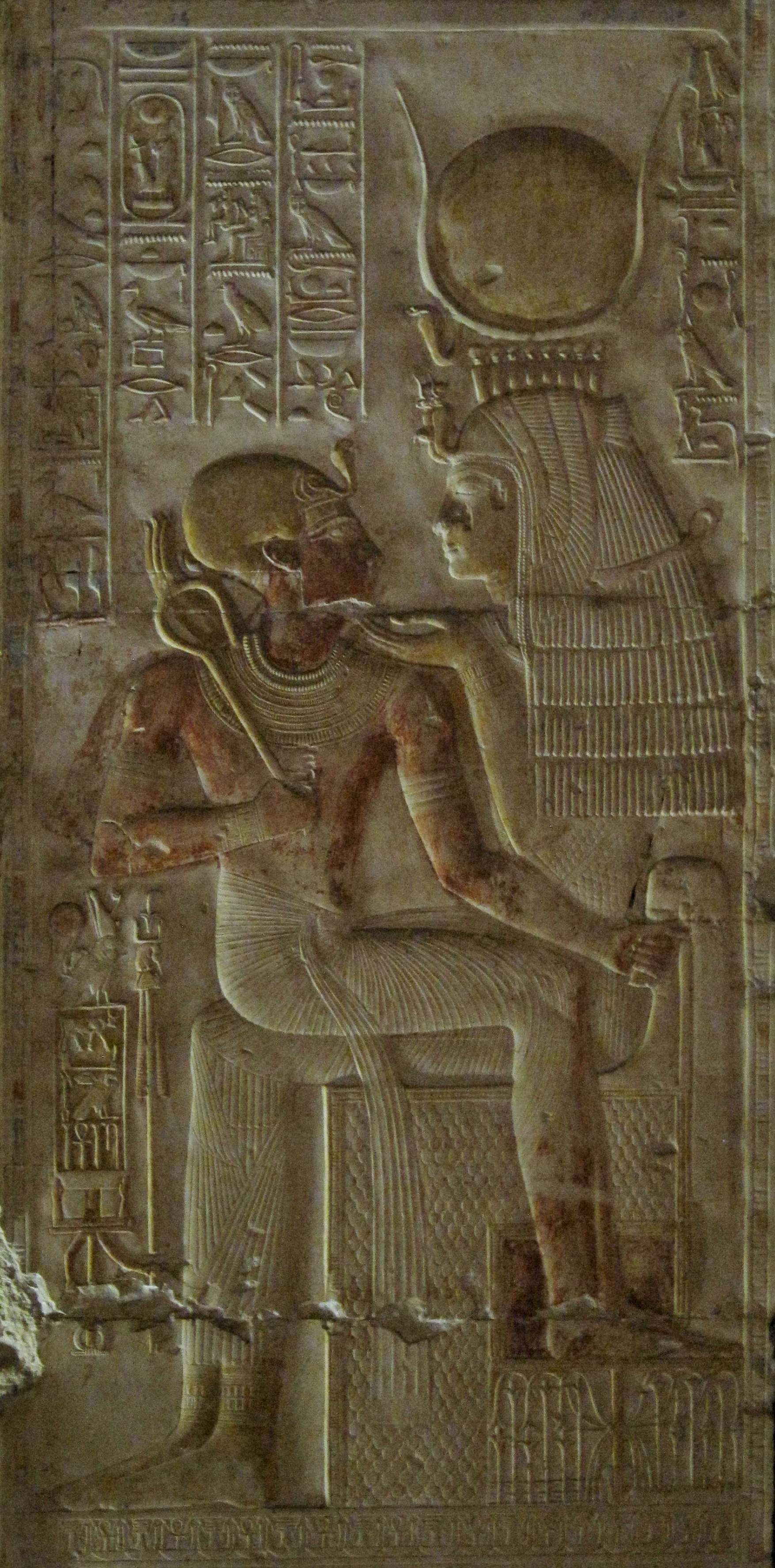
Isis was venerated first in Egypt. As per the Greek historian Herodotus, writing in the fifth century BC, Isis was the only goddess worshiped by all Egyptians alike, and whose influence was so widespread by that point, that she had become syncretic with the Greek goddess Demeter. It is after the conquest of Egypt by Alexander the Great, and the Hellenization of the Egyptian culture initiated by Ptolemy I Soter, that she eventually became known as 'Queen of Heaven'. Apuleius confirms this in Book 11, Chap 47 of his novel, The Golden Ass, in which his character prays to the "Queen of Heaven". The goddess herself responds to his prayer, delivering a lengthy monologue in which she explicitly identifies herself as both the Queen of Heaven and Isis.
Thus the divine shape breathing out the pleasant spice of fertile Arabia, disdained not with her divine voice to utter these words unto me: Behold Lucius I am come, thy weeping and prayers has moved me to succor thee. I am she that is the natural mother of all things, mistress and governess of all the elements, the initial progeny of worlds, chief of powers divine, Queen of Heaven... and the Egyptians which are excellent in all kind of ancient doctrine, and by their proper ceremonies accustomed to worship me, do call me Queen Isis.}}
References
References
- Fiore, Silvestro. ''Voices From the Clay: the development of Assyro-Babylonian Literature''. University of Oklahoma Press, Norman, 1965.
- Jacobsen, Thorkild. ''The Treasures of Darkness: a History of Mesopotamian Religion.'' Yale University Press, New Haven and London, 1976.
- Hobson, Russell. (2009). "The Exact Transmission of Texts in the First Millennium B.C.E.". [[University of Sydney]], Department of Hebrew, Biblical and Jewish Studies.
- Waerden, Bartel. (1974). "Science awakening II: the birth of astronomy". Springer.
- (2017). "Worlds Fantastic, Worlds Familiar: A Guided Tour of the Solar System". Cambridge University Press.
- (1977). "Scientists confront Velikovsky". Cornell University Press.
- (2004). "The Transits of Venus". University of Michigan.
- (2008). "The Dawn of Astrology: The ancient and classical worlds". [[Continuum International Publishing Group.
- (1992). "Dilmun Culture". [[National Council of Culture and the Arts]].
- Wolkstein, Diane and Noah Kramer, Samuel, "Inanna: Queen of Heaven and Earth" - a modern, poetic reinterpretation of Inanna myths
- Wolkstein, Diane, and Samuel Noah Kramer. ''Inanna: Queen of Heaven and Earth: Her Stories and Hymns from Sumer''. Harper &Row, Publishers, 1983, New York.
- "Inana's descent to the nether world: Translation".
- "Inana and Enki: Translation".
- "Inana and Ebih: Translation".
- Harris, Rivkah (1991), "Inanna-Ishtar as Paradox and a Coincidence of Opposites" (History of Religions, Vol. 30, No. 3 (Feb., 1991)), pp. 261-278
- Rubio, Gonzalo (1999), "On the Alleged "Pre-Sumerian Substratum" (Journal of Cuneiform Studies, Vol. 51, 1999 (1999)), pp. 1-16
- Wolkstein, Diane and Samuel Noah Kramer. ''Inanna: Queen of Heaven and Earth: Her Stories and Hymns from Sumer''. Harper and Row, Publishers, 1983, New York. (Page 55)
- Bruce, F. F. (1941), "Babylon and Rome" (The Evangelical Quarterly, Vol. 13, (Oct. 15, 1941)), pp. 241-261
- (29 May 2018). "Jeremiah 26-52, Volume 27". Zondervan Academic.
- {{bibleverse. Jeremiah. 7:18. HE
- J. A. Thompson. (12 September 1980). "A Book of Jeremiah". Wm. B. Eerdmans Publishing.
- {{bibleverse. Jer. 44:15–18
- Christopher D. Stanley. (1 September 2009). "The Hebrew Bible: A Comparative Approach". Fortress Press.
- Dr. Raphael Patai: "The Hebrew Goddess": Duke University Press: third edition
- [[William G. Dever]], "[[Did God Have a Wife?]]" (Eerdmans, {{ISBN. 0-8028-2852-3, 2005) - see reviews of this book by [https://web.archive.org/web/20071023103740/http://www.bookreviews.org/pdf/4910_6305.pdf Patrick D. Miller], [http://www.bookreviews.org/pdf/4910_5127.pdf Yairah Amit] {{cbignore
- Histories 2.42
- Histories 2.156
- R.E Witt, "Isis in the Ancient World", 1997, {{ISBN. 0-8018-5642-6
- "The Golden Asse of Apuleius: The Eleventh Booke: The Forty-seventh Chapter". Sacred-texts.com.
This article was imported from Wikipedia and is available under the Creative Commons Attribution-ShareAlike 4.0 License. Content has been adapted to SurfDoc format. Original contributors can be found on the article history page.
Ask Mako anything about Queen of Heaven (antiquity) — get instant answers, deeper analysis, and related topics.
Research with MakoFree with your Surf account
Create a free account to save articles, ask Mako questions, and organize your research.
Sign up freeThis content may have been generated or modified by AI. CloudSurf Software LLC is not responsible for the accuracy, completeness, or reliability of AI-generated content. Always verify important information from primary sources.
Report