From Surf Wiki (app.surf) — the open knowledge base
Quasiperiodic function
Class of functions behaving "like" periodic functions
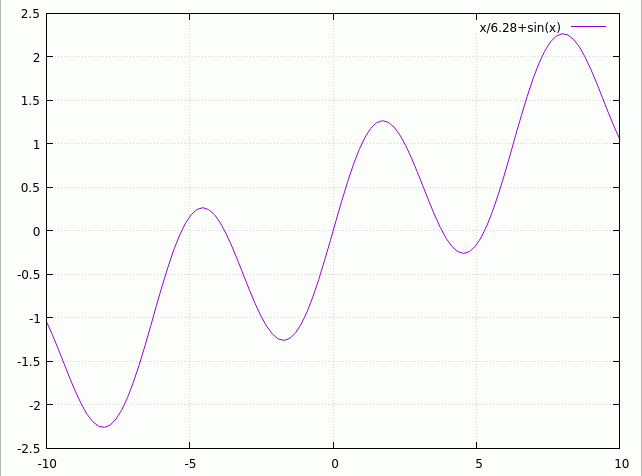
Class of functions behaving "like" periodic functions
In mathematics, a quasiperiodic function is a function that has a certain similarity to a periodic function. A function f is quasiperiodic with quasiperiod \omega if f(z + \omega) = g(z,f(z)), where g is a "simpler" function than f. What it means to be "simpler" is vague.
A simple case (sometimes called arithmetic quasiperiodic) is if the function obeys the equation:
:f(z + \omega) = f(z) + C
Another case (sometimes called geometric quasiperiodic) is if the function obeys the equation:
:f(z + \omega) = C f(z)
An example of this is the Jacobi theta function, where
:\vartheta(z+\tau;\tau) = e^{-2\pi iz - \pi i\tau}\vartheta(z;\tau),
shows that for fixed \tau it has quasiperiod \tau; it also is periodic with period one. Another example is provided by the Weierstrass sigma function, which is quasiperiodic in two independent quasiperiods, the periods of the corresponding Weierstrass ℘ function. Bloch's theorem says that the eigenfunctions of a periodic Schrödinger equation (or other periodic linear equations) can be found in quasiperiodic form, and a related form of quasi-periodic solution for periodic linear differential equations is expressed by Floquet theory.
Functions with an additive functional equation
: f(z + \omega) = f(z)+az+b \ are also called quasiperiodic. An example of this is the Weierstrass zeta function, where
: \zeta(z + \omega, \Lambda) = \zeta(z , \Lambda) + \eta (\omega , \Lambda) \
for a z-independent η when ω is a period of the corresponding Weierstrass ℘ function.
In the special case where f(z + \omega)=f(z) we say f is periodic with period ω in the period lattice \Lambda.
Quasiperiodic signals
Quasiperiodic signals in the sense of audio processing are not quasiperiodic functions in the sense defined here; instead they have the nature of almost periodic functions and that article should be consulted. The more vague and general notion of quasiperiodicity has even less to do with quasiperiodic functions in the mathematical sense.
A useful example is the function:
:f(z) = \sin(Az) + \sin(Bz)
If the ratio is rational, this will have a true period, but if is irrational there is no true period, but a succession of increasingly accurate "almost" periods.
References
References
- Mitropolsky, Yu A.. (1993). "Systems of Evolution Equations with Periodic and Quasiperiodic Coefficients". Springer Netherlands.
This article was imported from Wikipedia and is available under the Creative Commons Attribution-ShareAlike 4.0 License. Content has been adapted to SurfDoc format. Original contributors can be found on the article history page.
Ask Mako anything about Quasiperiodic function — get instant answers, deeper analysis, and related topics.
Research with MakoFree with your Surf account
Create a free account to save articles, ask Mako questions, and organize your research.
Sign up freeThis content may have been generated or modified by AI. CloudSurf Software LLC is not responsible for the accuracy, completeness, or reliability of AI-generated content. Always verify important information from primary sources.
Report