From Surf Wiki (app.surf) — the open knowledge base
Quasiconvex function
Mathematical function with convex lower level sets
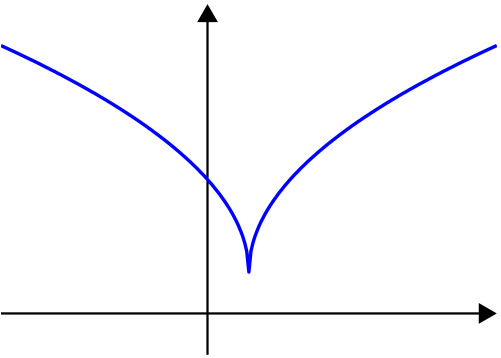
Mathematical function with convex lower level sets
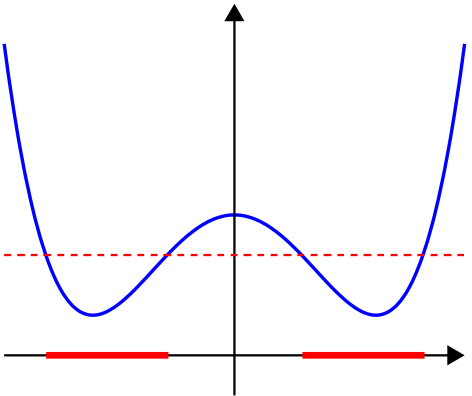


In mathematics, a quasiconvex function is a real-valued function defined on an interval or on a convex subset of a real vector space such that the inverse image of any set of the form (-\infty,a) is a convex set. For a function of a single variable, along any stretch of the curve the highest point is one of the endpoints. The negative of a quasiconvex function is said to be quasiconcave.
Quasiconvexity is a more general property than convexity in that all convex functions are also quasiconvex, but not all quasiconvex functions are convex. Univariate unimodal functions are quasiconvex or quasiconcave, however this is not necessarily the case for functions with multiple arguments. For example, the 2-dimensional Rosenbrock function is unimodal but not quasiconvex and functions with star-convex sublevel sets can be unimodal without being quasiconvex.
Definition and properties
A function f:S \to \mathbb{R} defined on a convex subset S of a real vector space is quasiconvex if for all x, y \in S and \lambda \in [0,1] we have
: f(\lambda x + (1 - \lambda)y)\leq\max\big{f(x),f(y)\big}.
In words, if f is such that it is always true that a point directly between two other points does not give a higher value of the function than both of the other points do, then f is quasiconvex. Note that the points x and y, and the point directly between them, can be points on a line or more generally points in n-dimensional space.
If the inequality is strict, i.e. : f(\lambda x + (1 - \lambda)y) for all x \neq y and \lambda \in (0,1), then f is strictly quasiconvex. That is, strict quasiconvexity requires that a point directly between two other points must give a lower value of the function than one of the other points does.

An alternative way (see introduction) of defining a quasi-convex function f(x) is to require that each sublevel set S_\alpha(f) = {x\mid f(x) \leq \alpha} is a convex set.
A quasiconcave function is a function whose negative is quasiconvex, and a strictly quasiconcave function is a function whose negative is strictly quasiconvex. Equivalently a function f is strictly quasiconcave if and only if
: f(\lambda x + (1 - \lambda)y)\geq\min\big{f(x),f(y)\big}.
A (strictly) quasiconvex function has (strictly) convex lower contour sets, while a (strictly) quasiconcave function has (strictly) convex upper contour sets. Unimodal probability distributions like the Gaussian distribution are common examples of quasi-concave functions that are not concave.
A function that is both quasiconvex and quasiconcave is quasilinear, and satisfies : \min\big{f(x),f(y)\big} \leq f(\lambda x + (1 - \lambda)y)\leq\max\big{f(x),f(y)\big} For a quasilinear function defined on a plane, the level sets are always lines. More generally, the level sets of a quasilinear function over \mathbb{R}^n are n-1-dimensional planes.
Applications
Quasiconvex functions have applications in mathematical analysis, in mathematical optimization, and in game theory and economics.
Mathematical optimization
In nonlinear optimization, quasiconvex programming studies iterative methods that converge to a minimum (if one exists) for quasiconvex functions. Quasiconvex programming is a generalization of convex programming.: {{cite journal |editor1-first=Siegfried|editor1-last=Schaible|editor2-first=William T.|editor2-last=Ziemba|publisher=Academic Press, Inc. [Harcourt Brace Jovanovich, Publishers]|location=New York|year=1981|pages=281–298|isbn=0-12-621120-5|mr=652702}} In theory, quasiconvex programming and convex programming problems can be solved in reasonable amount of time, where the number of iterations grows like a polynomial in the dimension of the problem (and in the reciprocal of the approximation error tolerated); however, such theoretically "efficient" methods use "divergent-series" step size rules, which were first developed for classical subgradient methods. Classical subgradient methods using divergent-series rules are much slower than modern methods of convex minimization, such as subgradient projection methods, bundle methods of descent, and nonsmooth filter methods.
Economics and partial differential equations: Minimax theorems
In microeconomics, quasiconcave utility functions imply that consumers have convex preferences. Quasiconvex functions are important also in game theory, industrial organization, and general equilibrium theory, particularly for applications of Sion's minimax theorem. Generalizing a minimax theorem of John von Neumann, Sion's theorem is also used in the theory of partial differential equations.
Preservation of quasiconvexity
Operations preserving quasiconvexity
- maximum of quasiconvex functions (i.e. f = \max \left\lbrace f_1 , \ldots , f_n \right\rbrace ) is quasiconvex. Similarly, maximum of strict quasiconvex functions is strict quasiconvex.{{cite thesis |access-date=26 October 2016}} Similarly, the minimum of quasiconcave functions is quasiconcave, and the minimum of strictly-quasiconcave functions is strictly-quasiconcave.
- composition with a non-decreasing function : g : \mathbb{R}^{n} \rightarrow \mathbb{R} quasiconvex, h : \mathbb{R} \rightarrow \mathbb{R} non-decreasing, then f = h \circ g is quasiconvex. Similarly, if g : \mathbb{R}^{n} \rightarrow \mathbb{R} quasiconcave, h : \mathbb{R} \rightarrow \mathbb{R} non-decreasing, then f = h \circ g is quasiconcave.
- minimization (i.e. f(x,y) quasiconvex, C convex set, then h(x) = \inf_{y \in C} f(x,y) is quasiconvex)
Operations not preserving quasiconvexity
- The sum of quasiconvex functions defined on the same domain need not be quasiconvex: In other words, if f(x), g(x) are quasiconvex, then (f+g)(x) = f(x) + g(x) need not be quasiconvex. For example, \pm \operatorname{sign}(x \pm 1) are quasiconvex (in fact, quasilinear) functions whose sum is not quasiconvex.
- The sum of quasiconvex functions defined on different domains (i.e. if f(x), g(y) are quasiconvex, h(x,y) = f(x) + g(y)) need not be quasiconvex. Such functions are called "additively decomposed" in economics and "separable" in mathematical optimization. For example, f(x) = x^2 and g(y) = (y - 1)^2 are quasiconvex (in fact, convex), but h(x, y) = f(x) + g(y) is not quasiconvex.
Examples
- Every convex function is quasiconvex.
- A concave function can be quasiconvex. For example, x \mapsto \log(x) is both concave and quasiconvex.
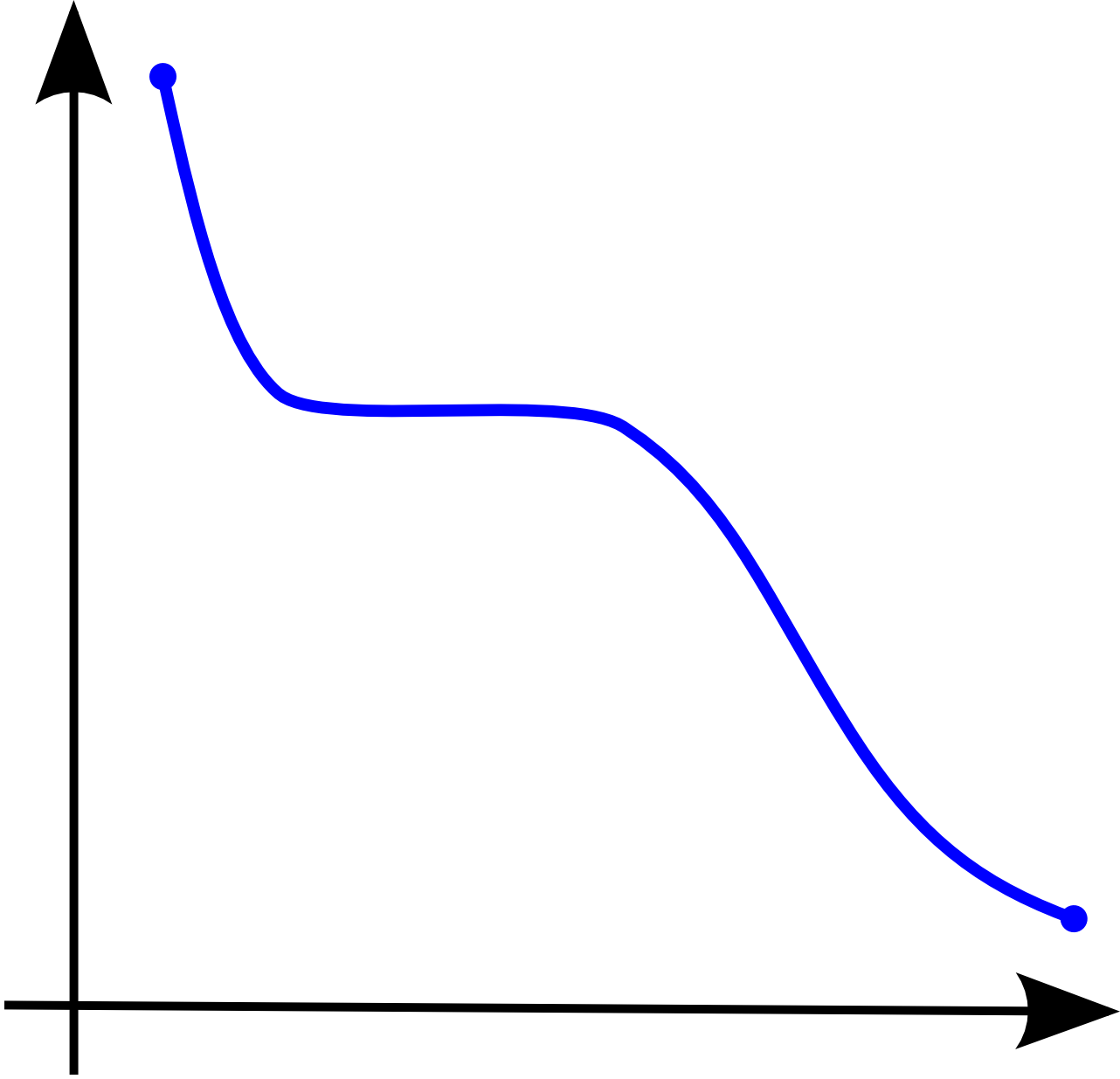
- Any monotonic function is both quasiconvex and quasiconcave. More generally, a function which decreases up to a point and increases from that point on is quasiconvex (compare unimodality).
- The floor function x\mapsto \lfloor x\rfloor is an example of a quasiconvex function that is neither convex nor continuous.
References
- Avriel, M., Diewert, W.E., Schaible, S. and Zang, I., Generalized Concavity, Plenum Press, 1988.
- Singer, Ivan Abstract convex analysis. Canadian Mathematical Society Series of Monographs and Advanced Texts. A Wiley-Interscience Publication. John Wiley & Sons, Inc., New York, 1997. xxii+491 pp.
References
- Kiwiel, Krzysztof C.. (2001). "Convergence and efficiency of subgradient methods for quasiconvex minimization". Springer.
This article was imported from Wikipedia and is available under the Creative Commons Attribution-ShareAlike 4.0 License. Content has been adapted to SurfDoc format. Original contributors can be found on the article history page.
Ask Mako anything about Quasiconvex function — get instant answers, deeper analysis, and related topics.
Research with MakoFree with your Surf account
Create a free account to save articles, ask Mako questions, and organize your research.
Sign up freeThis content may have been generated or modified by AI. CloudSurf Software LLC is not responsible for the accuracy, completeness, or reliability of AI-generated content. Always verify important information from primary sources.
Report