From Surf Wiki (app.surf) — the open knowledge base
Quarter note
Musical note duration

Musical note duration
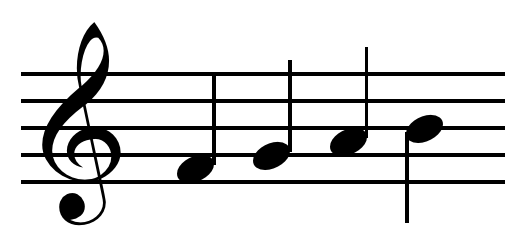
A quarter note (AmE) or crotchet (BrE) () is a musical note played for one quarter of the duration of a whole note (or semibreve). Quarter notes are notated with a filled-in oval note head and a straight, flagless stem. The stem usually points upwards if it is below the middle line of the staff, and downwards if it is on or above the middle line. An upward stem is placed on the right side of the notehead, a downward stem is placed on the left (see image). The Unicode symbol is U+2669 (♩).
A quarter rest (or crotchet rest) denotes a silence of the same duration as a quarter note or crotchet. It is notated with the symbol [[File:crotchet rest alt plain-svg.svg|x20px]]. In some older music it was notated with symbol [[File:crotchet rest plain-svg.svg|x14px]].
History
The quarter note equates to the semiminima ('half minim') of mensural notation. The word "crotchet" comes from Old French crochet, meaning 'little hook', diminutive of , 'hook', because of the hook used on the note in black notation of the medieval period.
As the name implies, a quarter note's duration is one quarter that of a whole note, half the length of a half note, and twice that of an eighth note. It represents one beat in a bar of time. The term "quarter note" is a calque (loan-translation) of the German term Viertelnote.
In the Romance languages of Catalan, French, Galician, and Spanish, the name of this note and its equivalent rest is derived from the Latin negra meaning 'black'—as the semiminima was the longest note to be colored in mensural white notation. This is still true of the note's modern form. The Bulgarian, Chinese, Croatian, Czech, Japanese, Korean, Norwegian, Polish, Russian, Serbian and Slovak names mean "quarter" (for the note) and "quarter's pause" (for the rest).
Notes
References
References
- ''Rudiments and Theory of Music'' Associated Board of the Royal Schools of Music, London 1958. I,33 and III,25. The former section shows both forms without distinction, the latter the "old" form only. The book was the Official ABRSM theory manual in the UK up until at least 1975. The "old" form was taught as a manuscript variant of the printed form.
This article was imported from Wikipedia and is available under the Creative Commons Attribution-ShareAlike 4.0 License. Content has been adapted to SurfDoc format. Original contributors can be found on the article history page.
Ask Mako anything about Quarter note — get instant answers, deeper analysis, and related topics.
Research with MakoFree with your Surf account
Create a free account to save articles, ask Mako questions, and organize your research.
Sign up freeThis content may have been generated or modified by AI. CloudSurf Software LLC is not responsible for the accuracy, completeness, or reliability of AI-generated content. Always verify important information from primary sources.
Report