From Surf Wiki (app.surf) — the open knowledge base
Qoph
Nineteenth letter of many Semitic alphabets

Nineteenth letter of many Semitic alphabets
the Semitic letter
Qoph is the nineteenth letter of the Semitic abjads, including Phoenician qōp 𐤒, Hebrew qūp̄ , Aramaic qop 𐡒, Syriac qōp̄ ܩ, and Arabic qāf . It is also related to the Ancient North Arabian 𐪄, South Arabian 𐩤, and Geʽez ቀ.
Its original sound value was a West Semitic emphatic stop, presumably . In Maltese the q is an explosive stop sound e.g. qalb, qattus, baqq. In Hebrew numerals, it has the numerical value of 100.
Origins
The origin of the glyph shape of qōp ([[File:Phoenician_qoph.svg|12px]]) is uncertain. It is usually suggested to have originally depicted either a sewing needle, specifically the eye of a needle (Hebrew קוף quf and Aramaic קופא qopɑʔ both refer to the eye of a needle), or the back of a head and neck (qāf in Arabic meant "nape"). Travers Wood, Henry Craven Ord Lanchester, A Hebrew Grammar, 1913, p. 7. A. B. Davidson, Hebrew Primer and Grammar, 2000, p. 4. The meaning is doubtful. "Eye of a needle" has been suggested, and also "knot" Harvard Studies in Classical Philology vol. 45. According to an older suggestion, it may also have been a picture of a monkey and its tail (the Hebrew קוף means "monkey"). Isaac Taylor, History of the Alphabet: Semitic Alphabets, Part 1, 2003, p. 174: "The old explanation, which has again been revived by Halévy, is that it denotes an 'ape,' the character Q being taken to represent an ape with its tail hanging down. It may also be referred to a Talmudic root which would signify an 'aperture' of some kind, as the 'eye of a needle,' ... Lenormant adopts the more usual explanation that the word means a 'knot'.
Besides Aramaic Qop, which gave rise to the letter in the Semitic abjads used in classical antiquity, Phoenician qōp is also the origin of the Latin letter Q and Greek Ϙ (qoppa) and Φ (phi). Qop may have been assigned the sound value /kʷʰ/ in early Greek; as this was allophonic with /pʰ/ in certain contexts and certain dialects, the letter qoppa continued as the letter phi. C. Brixhe, "History of the Alpbabet", in Christidēs, Arapopoulou, & Chritē, eds., 2007, A History of Ancient Greek.
Arabic qāf
The Arabic letter ق is named قاف ar. It is written in several ways depending on its position in the word:{{Infobox grapheme
- , , , (dialectal) Traditionally in the scripts of the Maghreb it is written with a single dot, similarly to how the letter fā ف is written in Mashreqi scripts:
It is usually transliterated into Latin script as q, though some scholarly works use ḳ.
Pronunciation
According to Sibawayh, author of the first book on Arabic grammar, the letter is pronounced voiced (maǧhūr), although some scholars argue, that Sibawayh's term maǧhūr implies lack of aspiration rather than voice. As noted above, Modern Standard Arabic has the voiceless uvular plosive as its standard pronunciation of the letter, but dialectal pronunciations vary as follows:
The three main pronunciations:
- : in most of Tunisia, Algeria and Morocco, Southern and Western Yemen and parts of Oman, Northern Iraq, parts of the Levant (especially the Alawite and Druze dialects). In fact, it is so characteristic of the Alawites and the Druze that Levantines invented a verb "yqaqi" /jqæqi/ that means "speaking with a /q/". However, most other dialects of Arabic will use this pronunciation in learned words that are borrowed from Standard Arabic into the respective dialect or when Arabs speak Modern Standard Arabic.
- : in most of the Arabian Peninsula, Northern and Eastern Yemen and parts of Oman, Southern Iraq, some parts within Jordan, eastern Syria and southern Palestine, Upper Egypt (Ṣaʿīd), Sudan, Libya, Mauritania and to lesser extent in some parts of Tunisia, Algeria, and Morocco but it is also used partially across those countries in some words.
- : in most of the Levant and Egypt, as well as some North African towns such as Tlemcen and Fez.
Other pronunciations:
- : In Sudanese and some forms of Yemeni, even in loanwords from Modern Standard Arabic or when speaking Modern Standard Arabic.
- : In rural Palestinian it is often pronounced as a voiceless velar plosive , even in loanwords from Modern Standard Arabic or when speaking Modern Standard Arabic.
Marginal pronunciations:
- : In some positions in Najdi, though this pronunciation is fading in favor of .{{cite thesis |degree=MA |last=Lewis |first=Robert Jr. |date=2013 |title=Complementizer Agreement in Najdi Arabic
- : Optionally in Iraqi and in Gulf Arabic, it is sometimes pronounced as a voiced postalveolar affricate , even in loanwords from Modern Standard Arabic or when speaking Modern Standard Arabic.
- ~ : in Sudanese and some Yemeni dialects (Yafi'i), and sometimes in Gulf Arabic by Persian influence, even in loanwords from Modern Standard Arabic or when speaking Modern Standard Arabic.
Velar gāf
It is not well known when the pronunciation of qāf as a velar occurred or the probability of it being connected to the pronunciation of jīm as an affricate , but the Arabian peninsula, there are two sets of pronunciations, either the represents a and represents a which is the main pronunciation in most of the peninsula except for western and southern Yemen and parts of Oman where represents a and represents a .
The Standard Arabic (MSA) combination of as a and as a does not occur in any natural modern dialect in the Arabian peninsula, which shows a strong correlation between the palatalization of to and the pronunciation of the as a as shown in the table below:
Pronunciation across other languages
| Language | Dialect(s) / Script(s) | Pronunciation (IPA) | Azeri | Arabic alphabet | Kurdish | Sorani | Malay | Jawi | Pashto | Persian | Dari | Iranian | Punjabi | Shahmukhi | Urdu | Uyghur |
|---|---|---|---|---|---|---|---|---|---|---|---|---|---|---|---|---|
| or | ||||||||||||||||
| or | ||||||||||||||||
| ~ or | ||||||||||||||||
| or | ||||||||||||||||
| or |
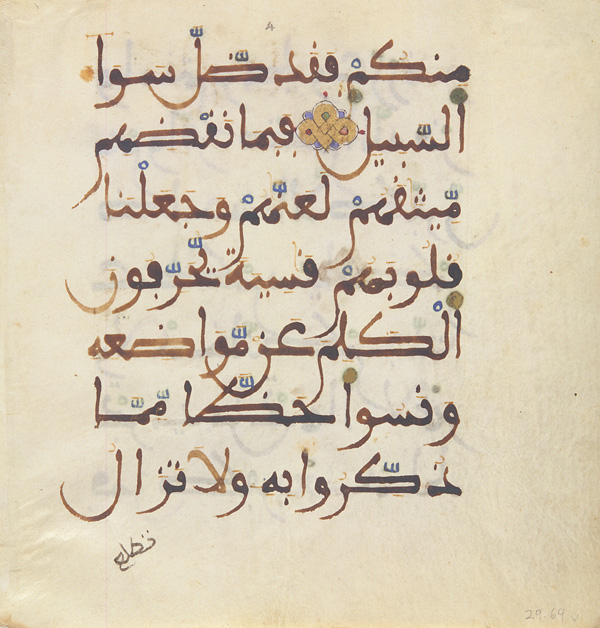
السَّبِيِل فَبِمَا نَقْضِهِم مِّيثـٰقَهُمْ لَعَنَّـٰهُمْ وِجَعَلْنَا
قُلُوبَهُمْ قَـٰسِيةً يُحَرِّفُونَ
الْكَلِمَ عَنْ مَّوَاضِعِهِ
وَنَسُوا حَظٍّا مِّمَّا
ذُكِّرُوا بِهِ وَلاَتَزَالُ }}]]
Maghrebi variant
The Maghrebi style of writing ar is different: having only a single point (dot) above; when the letter is isolated or word-final, it may sometimes become unpointed.
| Isolated | Final | Medial | Initial |
|---|---|---|---|
| Position in word: | |||
| Form of letter: | |||
The earliest Arabic manuscripts show ar in several variants: pointed (above or below) or unpointed. Then the prevalent convention was having a point above for ar and a point below for ar; this practice is now only preserved in manuscripts from the Maghribi, with the exception of Libya and Algeria, where the Mashriqi form (two dots above: ق) prevails.
Within Maghribi texts, there is no possibility of confusing it with the letter ar, as it is instead written with a dot underneath () in the Maghribi script.
Hebrew qof
The Oxford Hebrew-English Dictionary transliterates the letter Qoph () as he or he; and, when word-final, it may be transliterated as he. The English spellings of Biblical names (as derived via Latin from Biblical Greek) containing this letter may represent it as c or k, e.g. Cain for Hebrew Qayin, or Kenan for Qenan (Genesis 4:1, 5:9).
| Orthographic variants | Various print fonts | Cursive | ||||||
|---|---|---|---|---|---|---|---|---|
| Hebrew | Rashi | |||||||
| script | Serif | Sans-serif | Monospaced | |||||
| ק | ק | ק | [[File:Hebrew letter Kuf handwriting.svg | 22px]] | [[File:Kuf (Rashi-script - Hebrew letter).svg | 40px]] |
Pronunciation
In modern Israeli Hebrew the letter is also called he. The letter represents ; i.e., no distinction is made between the pronunciations of Qof and Kaph with Dagesh (in modern Hebrew).
However, many historical groups have made that distinction, with Qof being pronounced by Iraqi Jews and other Mizrahim, or even as by Yemenite Jews influenced by Yemeni Arabic.
Qoph is consistently transliterated into classical Greek with the unaspirated〈κ〉/k/, while Kaph (both its allophones) is transliterated with the aspirated〈χ〉/kʰ/. Thus Qoph was unaspirated /k/ where Kaph was /kʰ/, this distinction is no longer present. Further we know that Qoph is one of the emphatic consonants through comparison with other Semitic languages, and most likely was ejective /kʼ/. In Arabic the emphatics are pharyngealised and this causes a preference for back vowels, this is not shown in Hebrew orthography. Though the gutturals show a preference for certain vowels, Hebrew emphatics do not in Tiberian Hebrew (the Hebrew dialect recorded with vowels) and therefore were most likely not pharyngealised, but ejective, pharyngealisation being a result of Arabisation.
Numeral
Qof in Hebrew numerals represents the number 100. Sarah is described in Genesis Rabba as , literally "At Qof years of age, she was like Kaph years of age in sin", meaning that when she was 100 years old, she was as sinless as when she was 20.
Syriac qop
Unicode
|05E7|name1=Hebrew Letter Qof |0642|name2=Arabic Letter Qaf |06A7|name3=Arabic Letter Qaf with Dot Above |08BC|name4=Arabic Letter African Qaf |0729|name5=Syriac Letter Qaph |0812|name6=Samaritan Letter Quf
|10396|name1=Ugaritic Letter Qopa |10852|name2=Imperial Aramaic Letter Qoph |10912|name3=Phoenician Letter Qof
References
References
- al-Banduri, Muhammad. (2018-11-16). "الخطاط المغربي عبد العزيز مجيب بين التقييد الخطي والترنح الحروفي".
- ''e.g.'', ''The Encyclopaedia of Islam'', Second Edition
- [[Kees Versteegh]], ''The Arabic Language'', pg. 131. [[Edinburgh]]: [[Edinburgh University Press]], 2001. Paperback edition. {{ISBN. 9780748614363
- Al-Jallad, Ahmad. (2020). "A Manual of the Historical Grammar of Arabic (Draft)".
- (10 March 2015). "Historical Dictionary of the Druzes". Rowman & Littlefield.
- This variance has led to the [[Muammar al-Gaddafi#Name. confusion over the spelling]] of [[Libya]]n leader [[Muammar al-Gaddafi]]'s name in Latin letters. In Western Arabic dialects the sound {{IPAblink. q is more preserved but can also be sometimes pronounced {{IPAblink. ɡ or as a simple {{IPAblink. k under [[Berber languages. Berber]] and [[French language. French]] influence.
- Bruce Ingham. (1 January 1994). "Najdi Arabic: Central Arabian". John Benjamins Publishing.
- al Nassir, Abdulmunʿim Abdulamir. (1985). "Sibawayh the Phonologist". University of New York.
- (1989). ["Some notes on Maghrebi script"](http://www.islamicmanuscripts.info/reference/articles/boogert_notes_maghribi_script.PDF}} p. 38 shows ''{{Transliteration). Manuscript of the Middle East.
- Gacek, Adam. (2008). "The Arabic Manuscript Tradition". Brill.
- Gacek, Adam. (2009). "Arabic Manuscripts: A Vademecum for Readers". Brill.
- Muhammad Ghoniem, M S M Saifullah, cAbd ar-Rahmân Robert Squires & cAbdus Samad, [http://www.islamic-awareness.org/Quran/Text/Scribal/scribal.html Are There Scribal Errors In The Qur'ân?], see ''{{Transliteration. ar. DIN. qif'' on a traffic sign written {{script/Arabic. ڧڢ which is written elsewhere as {{lang. ar. قف, Retrieved 2011-August-27
- Rabbi Ari Kahn. (20 October 2013). "A deeper look at the life of Sarah.". aish.com.
This article was imported from Wikipedia and is available under the Creative Commons Attribution-ShareAlike 4.0 License. Content has been adapted to SurfDoc format. Original contributors can be found on the article history page.
Ask Mako anything about Qoph — get instant answers, deeper analysis, and related topics.
Research with MakoFree with your Surf account
Create a free account to save articles, ask Mako questions, and organize your research.
Sign up freeThis content may have been generated or modified by AI. CloudSurf Software LLC is not responsible for the accuracy, completeness, or reliability of AI-generated content. Always verify important information from primary sources.
Report