From Surf Wiki (app.surf) — the open knowledge base
Qilin
Legendary creature in Chinese mythology

Legendary creature in Chinese mythology
| Field | Value |
|---|---|
| name | Qilin |
| image | Qilin-shaped incense burner 1 CAC.JPG |
| caption | Qilin-shaped incense burner (Qing dynasty, ) |
| Grouping | Legendary creature |
| Sub_Grouping | Chimera |
| Country | China |
| First_Attested | 5th century BCE |
| Similar_entities | kirin, kỳ lân, gilen |
the legendary creature
The qilin ( ; ) is a legendary hooved chimerical creature that appears in Chinese mythology, and is said to appear with the imminent arrival or death of a sage or illustrious ruler. Qilin are a specific type of the lin mythological family of one-horned beasts. The qilin also appears in the mythologies of other Chinese-influenced cultures.
Origins
麟之定,振振公姓,于嗟麟兮。 麟之角,振振公族,于嗟麟兮。 The feet of the Qilin, the noble sons of our lord. Ah, the Qilin! The forehead of the Qilin, the noble kinsmen of our lord. Ah, the Qilin! The horn of the Qilin, the noble clansmen of our lord. Ah, the Qilin!|attr2=}}
Spring and Autumn Annals mentioned that a lin (麟) was captured in the 14th year of Duke Ai of Lu (魯哀公) (481 BCE); Zuo Zhuan credited Confucius with identifying the lin as such.
The bisyllabic form qilin (麒麟 ~ 騏驎), which carries the same generic meaning as lin alone, is attested in works dated to the Warring States period (475–221 BCE). Qi denotes the male and lin denotes the female according to Shuowen Jiezi.
The legendary image of the qilin became associated with the image of the giraffe in the Ming dynasty. The identification of the qilin with giraffes began after Zheng He's 15th-century voyage to East Africa (landing, among other places, Ma-lin (麻林): Malindi (in modern-day Kenya).). While The Ming Dynasty according to Ma Huan, the interpreter who accompanied Zheng He, notes the products of Mogadishu and Barawa, modern-day Somalia (including ivory, ambergris, and camels), he specifically credits Malindi as the source of the qilin (giraffe). His account solidifies the geographic identification. Zheng He's fleet brought back two giraffes to Nanjing. The official court chronicles record the arrival of the giraffe in 1414 (the 12th year of the Yongle Emperor's reign) and they were mistaken by the emperor for the mythical creature. Somalia (Mogadishu) also sent a giraffe, but later and with less fanfare. The records indicate that Mogadishu also sent a giraffe as tribute, but in a later voyage (1415-1417). This giraffe did not capture the court's imagination in the same way as the first one from Malindi, which had already been successfully identified with the mythical qilin. The identification of qilin with giraffes has had a lasting influence: even today, the same word is used for the mythical animal and the giraffe in both Korean and Japanese.

Axel Schuessler reconstructs Old Chinese pronunciation of as . Finnish linguist Juha Janhunen tentatively compares to an etymon reconstructed as , denoting "whale"; and represented in the language isolate Nivkh and four different language families Tungusic, Mongolic, Turkic and Samoyedic, wherein *kalay(ә)ng means "whale" (in Nenets) and *kalVyǝ "mammoth" (in Enets and Nganasan). As even aborigines "vaguely familiar with the underlying real animals" often confuse the whale, mammoth, and unicorn: they conceptualized the mammoth and whale as aquatic, as well as the mammoth and unicorn possessing a single horn; for inland populations, the extant whale "remains... an abstraction, in this respect being no different from the extinct mammoth or the truly mythical unicorn." However, Janhunen cautiously remarks that "[t]he formal and semantic similarity between *kilin
Description
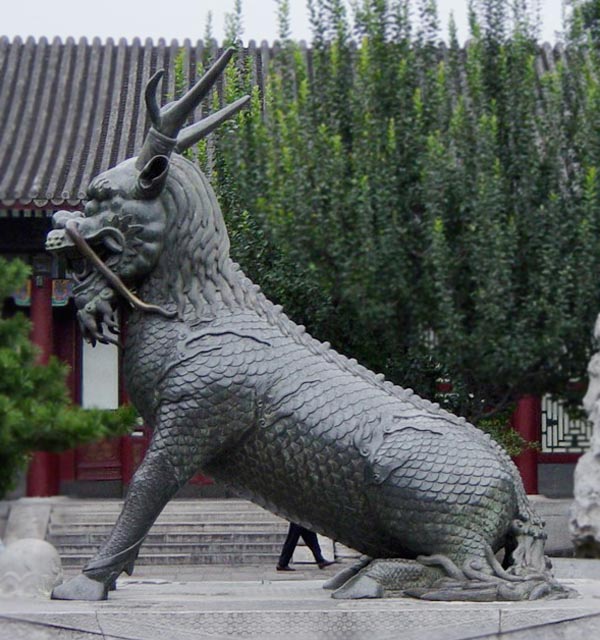
Qilin generally have Chinese dragon-like features: similar heads with antlers, eyes with thick eyelashes, manes that always flow upward, and beards. The body is fully or partially scaled and often shaped like an ox, deer, or horse, or more commonly a goat. They are always shown with cloven hooves. While dragons in China (and thus qilin) are also most commonly depicted as golden, qilin may be of any color or even various colors, and can be depicted as bejeweled or exhibiting a jewel-like brilliance.
The qilin is depicted throughout a wide range of Chinese art, sometimes with parts of their bodies on fire.
Legends tell that qilin have appeared in the garden of the legendary Yellow Emperor and in the capital of Emperor Yao; both events bore testimony to the benevolent nature of the rulers. It has also been told that the birth of the great sage Confucius was foretold by the arrival of a qilin.
Qilin as unicorns
.jpg)
In modern times, the depictions of qilin have often fused with the Western concept of unicorns, and qilin (麒麟) is often translated into English as "unicorn". The Han dynasty dictionary Shuowen Jiezi describes qi as single-horned, and it can sometimes be depicted as having a single horn. The translation, however, may be misleading, as qilin can also be depicted as having two horns. In modern Chinese, "one-horned beast" () is used for "unicorns". A number of different Chinese mythical creatures can be depicted with a single horn, and a qilin depicted with one horn may be called a "one-horned qilin" in Chinese.
Nevertheless, the mythical and etymological connections between the creatures have been noted by various cultural studies
Other cultural representations
Japan
Kirin, which has also come to be used as the modern Japanese word for a giraffe, are similar to qilin. Japanese art tends to depict the kirin as more deer-like than in Chinese art. Alternatively, it is depicted as a dragon shaped like a deer, but with an ox's tail instead of a lion's tail. They are also often portrayed as partially unicorn-like in appearance, but with a backwards curving horn.
Korea
Girin or kirin (기린) is the Korean form of qilin. It is described as a maned creature with the torso of a deer, an ox tail with the hooves of a horse. The girin were initially depicted as more deer-like, however over time they have transformed into more horse-like. They were one of the four divine creatures along with the dragon, phoenix, and turtle. Girin were extensively used in Korean royal and Buddhist arts.
In modern Korean, the term "girin" is used for "giraffe".
Thailand
In Thailand, the qilin is known as "gilen" (), and is a member of the pantheon of Thai Himapant forest mythical animals. It is most probable that the Gilen was introduced into the pantheon under the influence of the Tai Yai who came down from Southern China to settle in Siam in ancient times, and the legend was probably incorporated into the Himapant legends of Siam in this manner. The Gilen is a mixture of various animals which come from differing elemental environments, representing elemental magical forces present within each personified creature. Many of the Himapant animals actually represent gods and devas of the Celestial Realms, and bodhisattvas, who manifest as personifications which represent the true nature of each creature deity through the symbolism of the various body parts amalgamated into the design of the Mythical creature.
In Phra Aphai Mani, the masterpiece epic poem of Sunthorn Phu, a renowned poet of the 18th century, there is a monster that is Sudsakorn's steed, one of the main characters in the epic. This creature was called "Ma Nin Mangkorn" (, "ceylonite dragon horse") and is depicted as having diamond fangs, ceylonite scales, and a birthmark on the tongue. It was a mixture of horse, dragon, deer antlers, fish scales, and Phaya Nak tail, and has black sequins all over. Its appearance resembles a qilin.
Qilin Dance
The Qilin dance is traditionally performed by the Hakka people. The Qilin is a mythical creature believed to symbolize good fortune, prosperity, and harmony, and performers wear ornate Qilin costumes with vibrant colors and intricate details to resemble the mythical creature.
The Qilin costume features a single horn in the middle, with finned ridges lined with fur. The dance involves graceful and synchronized movements that mimic cats and tigers. The performance routine typically tells of a Qilin exiting its lair, playfully move round, and looking for vegetable to eat. After eating from the vegetable, it spits it out, and it also spits a jade book, before moving around and returning back to its lair.
The dance is accompanied by music played on traditional Chinese instruments, including drums, flutes, and cymbals. Today, similar to the Chinese Lion and Dragon dances, the Qilin dance is commonly performed during important Chinese celebrations and festivals, such as Chinese New Year and weddings, it is also performed to preserve cultural traditions and enhance community cohesion.
Gallery
File:Kinesiskt lyckobådande fabeldjur med drakhuvud, hjortkropp med fjäll, oxsvans från cirka 1750 - Hallwylska museet - 95453.tif|Porcelain qilin with the head and scaly body of a dragon, tail of a lion and cloven hoofs like a deer, its body enveloped in sacred flames (Qing dynasty, ) File:Qilin with Rider, c. 1800-1894.jpg|Qilin with rider (Qing dynasty, ) File:Grote schotel met een qilin Schotel met een qilin bij een rots tussen planten, AK-RBK-1965-88.jpg|Plate with a qilin in the center (Yuan dynasty, ) File:MET DP227291.jpg|Embroidered qilin buzi (Qing dynasty, 19th century) File:Restored Le-Nguyen Dynasty, 17th-19th Century (9735558859).jpg|Ceramic Kỳ lân statue (Later Lê or Nguyen dynasty, ) File:Lion, ch’i-lin, and dragon set in floral sprays.jpg|Qilin, dragon and lion set in floral sprays (Ottoman empire, mid-16th century) File:Simorgh und Qilin im Gulistan RAS 258, Fol. 82v.png|An illustration of qilin and simurgh in Gulistan (1582) File:MET LC-2016 243-004.jpg|Bronze qilin paperweight (Ming dynasty, ) File:Imperial Encyclopaedia - Animal Kingdom - pic151 - 麒麟圖.png|Qilin depicted in the Gujin Tushu Jicheng (Qing dynasty, ) File:焦秉贞画历朝贤后故事册1.png|Tai Si encountering a qilin, depicted in Jiao Bingzhen's Virtuous Empresses and Empresses Dowager in Successive Dynasties (Qing dynasty, 18th century) File:Queen Mother of the West Riding a Kirin by Kanō Kyūseki.JPG|Queen Mother of the West Riding a Kirin, Kanō Kyūseki (Edo period, early 18th century) File:MingQilinDragonFish.jpg|A qilin at the Ming tombs in the dragon, fish, and ox style (Ming dynasty, )
References
References
- "qilin (Chinese mythology)". Encyclopædia Britannica.
- ''Classic of Poetry'' [https://ctext.org/book-of-poetry/lin-zhi-zhi "Airs of Zhou and the South – Lin's Feet"] translated by James Legge
- Durrant, Li, & Schaberg (translators) (2016). ''Zuo tradition: Commentary on the Spring and Autumn Annals''. Seattle & London: University of Washington Press. p. 1920, n. 292. quote: "It is significant that the earliest source known to mention the lin itself is “Lin zhi zhi” {{lang. zh. 麟之趾, or “The Foot of the Lin"
- Kong, Qiu. Eds.(2016). {{lang. zh. 诗经 {{bracket. The She King (Legge, J. & Shi J.H. Transl.). {{lang. zh. 中州古籍出版社 {{bracket. Zhongzhou Ancient Books Publishing House. {{ISBN. 978-7-5348-6422-3.
- [http://engine.cqvip.com/content/tu/98575x/2001/000/002/gc13_tu1_5337044.pdf {{lang. zh. 古建上的主要装饰纹样――麒麟 古建园林技术-作者:徐华铛] {{webarchive. link. (30 September 2007)
- ''Zuozhuan'' "Duke Ai – 14th year – [https://zh.wikisource.org/wiki/%E6%98%A5%E7%A7%8B%E5%B7%A6%E6%B0%8F%E5%82%B3/%E5%93%80%E5%85%AC#%E7%B6%93_14 jing] & [https://zh.wikisource.org/wiki/%E6%98%A5%E7%A7%8B%E5%B7%A6%E6%B0%8F%E5%82%B3/%E5%93%80%E5%85%AC#%E5%82%B3_14 zhuan]"'
- Durrant, Li, & Schaberg (translators) (2016). ''Zuo tradition: Commentary on the Spring and Autumn Annals''. pp. 1919–1921
- [http://www.chinaknowledge.de/History/Myth/personsqilin.html ChinaKnowledge.de]
- ''SWJZ'' [https://ctext.org/shuo-wen-jie-zi/lu-bu1#n32769 Radical 鹿]" quote: "{{lang. zh. 麟:大牝鹿也。……麒:仁獸也。麋身牛尾,一角。……麐:牝麒也。" translation: "'''''Lín'' ({{lang. zh. 麟)''': a large female deer. {{bracket. ... '''''Qí'' ({{lang. zh. 麒)''': a humane beast. With [[elaphure]]'s body, ox's tail, and one horn. {{bracket. ... '''''Lín'' ({{lang. zh. 麐)''': female ''qí''."
- Parker, Jeannie Thomas (2018) ''The Mythic Chinese unicorn''. [[Victoria, British Columbia. Victoria]]: Friesen Press. p. 44
- [http://www.chinanews.com.cn/news/2004year/2004-05-31/26/442822.shtml {{lang. zh. 此“麟”非彼“麟”专家称萨摩麟并非传说中麒麟]
- (2004). "What Kind of Animal Was the Questing Beast?". Arthuriana.
- Wilson, Samuel M.. (December 1992). "The Emperor's Giraffe".
- Parker, J. T.: "The Mythic Chinese Unicorn"
- Janhunen, J. (2011). "Unicorn, Mammoth, Whale: mythological and etymological connections of zoonyms in North and East Asia". ''Linguistics, Archaeology and the Human Past'', Occasional Paper, 12, 189–222.
- "Хирс in Bolor dictionary".
- "Charger with a qilin, anonymous, c. 1350".
- Liscomb, Kathyln. (2016). "The Zoomorphic Imagination in Chinese Art and Culture". University of Hawai'i Press.
- Bush, Susan. (2016). "The Zoomorphic Imagination in Chinese Art and Culture". University of Hawai'i Press.
- Yoshida, Masako. (2014). "Trade Stories: Chinese Export Embroideries in the Metropolitan Museum". Metropolitan Museum Journal.
- "5 Yuan, China". Numista.
- Griffis, William Elliot. (2007). "The Religions of Japan". Bibliobazaar.
-
-
- ko. 기린 : 네이버캐스트]
-
- "Taep Payatorn Riding Qilin Himapant Lion Hlang Yant – Nuea Pong Maha Sanaeh Luan – Ajarn Warut – Wat Pong Wonaram". Buddha Magic Multimedia & Publications.
- Pralongchoeng, Gilen. (20 September 2014). "ม้ามังกร". Thai Rath.
- "The people of Wufu are prosperous and the auspicious beasts are coming─ Talking about the Hakka Kirin Dance".
- Lo, Wai Ling. (1 June 2022). "Recreating Local Tradition: The Study of the Hang Hau Hakka Unicorn Dance in Hong Kong". Asian Studies, the Twelfth International Convention of Asia Scholars (ICAS 12).
- "What Is The Qilin Dance?".
This article was imported from Wikipedia and is available under the Creative Commons Attribution-ShareAlike 4.0 License. Content has been adapted to SurfDoc format. Original contributors can be found on the article history page.
Ask Mako anything about Qilin — get instant answers, deeper analysis, and related topics.
Research with MakoFree with your Surf account
Create a free account to save articles, ask Mako questions, and organize your research.
Sign up freeThis content may have been generated or modified by AI. CloudSurf Software LLC is not responsible for the accuracy, completeness, or reliability of AI-generated content. Always verify important information from primary sources.
Report