From Surf Wiki (app.surf) — the open knowledge base
Qahtanite
Term referring to southern Arabs
.svg)
Term referring to southern Arabs
| Field | Value |
|---|---|
| name | Banu Qahtan |
| بنو قحطان | |
| Al 'Arab Al 'Ariba | |
| العرب العاربة | |
| type | Qahtanite, Children of Qahtan/Joktan |
| image | Dhamar Ali Yahbur (bust).jpg |
| image_size | 250px |
| caption | A bronze statue of Dhamar Ali Yahbur II, a Himyarite king who probably reigned in the late 3rd or early 4th century AD. Displayed in the National Museum of Yemen |
| nisba | al-Qahtani (masculine) |
| al-Qahtaniyyah (feminine) | |
| location | The southern region of the Arabian Peninsula, e.g. Hadhramaut, Yemen |
| descended | Yarub bin Qahtan |
| religion | Arabian mythology, Islam, Nestorian Christianity, Judaism, Aksumite polytheism, Nicene and Miaphysite Christianity |
بنو قحطان Al 'Arab Al 'Ariba العرب العاربة al-Qahtaniyyah (feminine)
The Qahtanites (; ), also known as Banu Qahtan () or by their nickname al-Arab al-Ariba (), are the Arabs who originate from modern-day Hadhramaut, Yemen. The term "Qahtan" is mentioned in multiple Ancient South Arabian inscriptions found in Yemen. Some Arab traditions believe that the Qahtanites are the original Arabs.
In some Judeo-Christian-Islamic traditions, the Qahtanite Arabs descend from Jokshan, a son of Abraham through Keturah and half brother of Ishmael son of Abraham through Hagar.
Traditional Arab genealogy
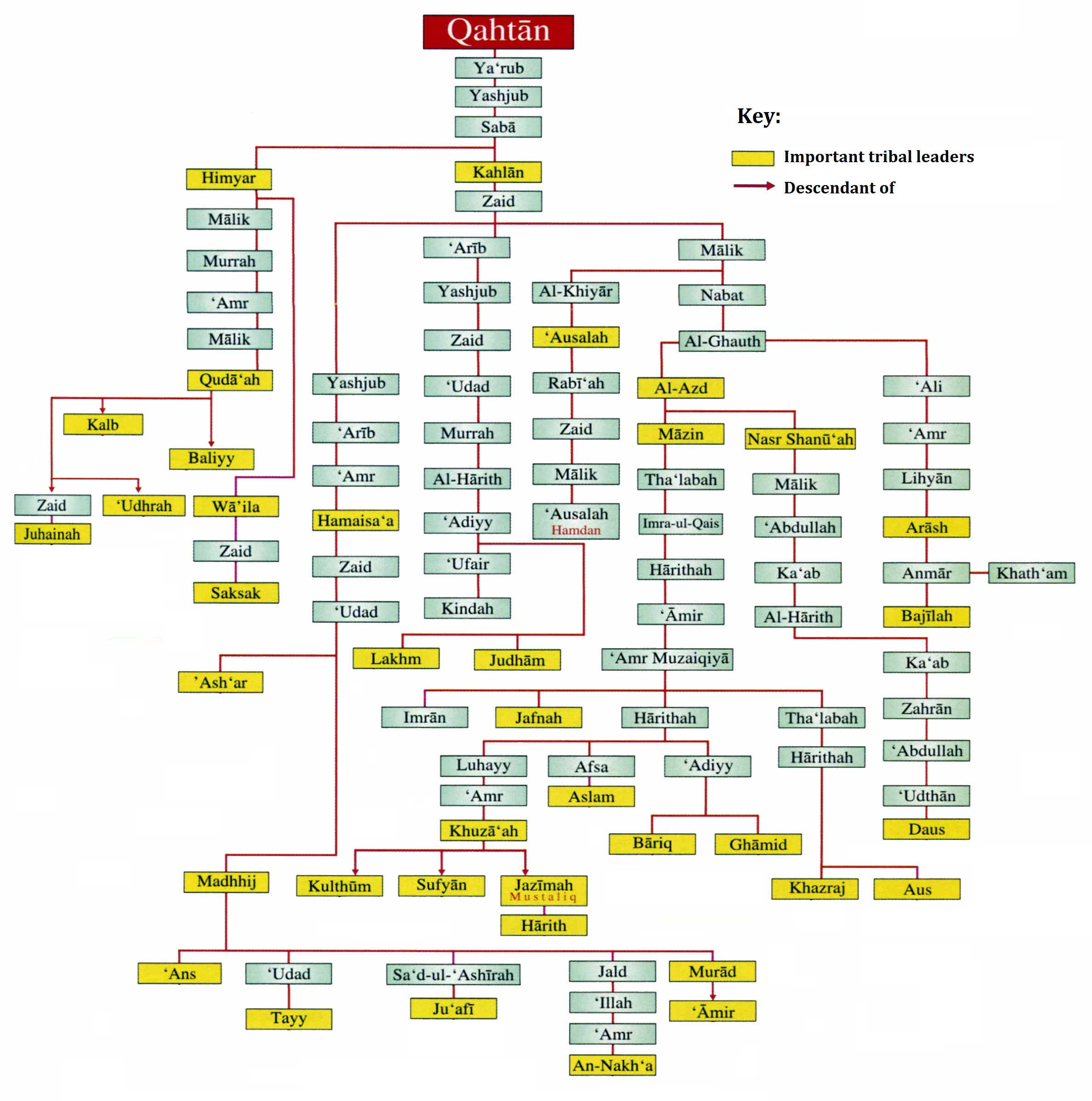
According to Arab tradition, the Qahtanites are from South Arabia, unlike the Adnanites who are from the north of Arabia descended from Ishmael through Adnan. Arab tradition maintains that a semi-legendary ancestral figure named Qahtan and his 24 sons are the progenitors of Yemen who controlled the Arabian Peninsula known as Qahtani.
The genealogists disagree about the pedigree of Qahțān [himself]. Some trace him back to Ismā'īl b. Ibrāhīm, saying that his [name] was Qahṭān b. al - Hamaysa ' b. Tayman b. Nabt b. Ismā'īl b. Ibrāhīm. Wahb ibn Munabbih and Hishām b. Muhammad al-Kalbi held this genealogy (as true). Hisham ibn al-Kalbi quoted his father as saying that he had been contemporaneous with [older] scholars and genealogists who traced Qahțān's pedigree in this way. Other [genealogists] argue that the [name] was Qahţăn b. 'Abir b. Shalakh, equating Qahtan with the Yoqtan (Joktan) son of Eber (Hūd) in the Hebrew Bible (Genesis 10:25–29). Others still equate him with the similarly named Jokshan, son of Abraham and Keturah (Genesis 25:2–3).
Among the sons of Qahtan are noteworthy figures like A'zaal (believed by Arabs to have been the original name of Sanaa), Hadhramaut and Jurhum whose descendants formed the second Jurhum tribe from which Ishmael is traditionally believed to have learned Arabic by some. Another son is Ya'rub, and his son Yashjub is the father of Saba'. All Yemenite tribes trace their ancestry back to this "Saba", either through Himyar or Kahlan, his two sons.
The Qahtani people are divided into the two sub-groups of Himyar and Kahlan, who represent the settled Arabs of the south and their nomadic kinsmen (nomads). The Kahlan division of Qahtan consists of four subgroups: the Ta' or Tayy, the Azd group which invaded Oman, the 'Amila-Judham group of Palestine, and the Hamdan-Madhhij group who mostly remain in Yemen.
The Kahlan branch includes the following tribes: Azd (Aus and Khazraj, Bariq, Ghassan, Khuza'a and Daws), Hamdan, Khath'am, Bajila, Madhhij, Murad, Zubaid, Ash'ar, Lakhm, Tayy (Shammar), and Kinda.
Pre-Islamic Qahtani migration out of Arabia
Early Semites who developed civilizations throughout the Ancient Near East gradually relinquished their geopolitical superiority to surrounding cultures and neighboring imperial powers, usually due to either internal turmoil or outside conflict. This climaxed with the arrival of the Babylonians, and subsequently the rivaling Medes and Persians, during the 7th and 6th centuries BCE, respectively. Though the Semites lost geopolitical influence, the Aramaic language emerged as the lingua franca of much of the Near East. However, Aramaic usage declined after the defeat of the Persians and the arrival of the Hellenic armies around 330 BCE.
The Ghassanids (ca. 250 CE) were the last major non-Islamic Semitic migration northward out of Yemen. They revived the Semitic presence in the then Roman-controlled Syria. They initially settled in the Hauran region, eventually spreading to Palestine, and Jordan, briefly securing governorship of Syria away from the Nabataeans.
After the rise of Islam
Between the 7th and 14th centuries, the Qahtanites became involved in the Arab conquests, migrating to the newly conquered territories and intermingling with the local populations. In the Umayyad era, a blood feud broke out between Qahtanites and the Adnanite tribes of Qays, which continued in various forms and degrees till the 19th century in what has become known as the Qays–Yaman rivalry.
Notes
References
References
- "ص29 - كتاب الإنباه على قبائل الرواة ت الإبياري - قحطان - المكتبة الشاملة".
- (2009). "Qaḥṭān".
- O'Leary, De Lacy. (2001). "Arabia Before Muhammad". Psychology Press.
- "Epigraph details: Gr 24".
- (July 2025). "Epigraph details: Ja 2360".
- "Epigraph details: DAI Barʾān 2000-1".
- "Epigraph details: Ja 635".
- "كتاب الرحيق المختوم".
- Parolin, Gianluca P.. (2009). "Citizenship in the Arab World: Kin, Religion and Nation-State". Amsterdam University Press.
- "ص40 - كتاب الإيناس بعلم الأنساب - الياء - المكتبة الشاملة".
- al-Ṭabarī, Abū Jaʿfar Muḥammad ibn Jarīr. (January 1, 1998). "The History of al-Ṭabarī Vol. 39: Biographies of the Prophet's Companions and Their Successors: al-Ṭabarī's Supplement to His History". SUNY Press.
- Maalouf, Tony. (2003). "Arabs in the Shadow of Israel: The Unfolding of God's Prophetic Plan for Ishmael's Line". [[Kregel Academic]].
- Maqsood, Ruqaiyyah Waris. "Adam to the Banu Khuza'ah".
- Leaman, Oliver. (2006). "The Qur'an: An Encyclopedia". Taylor & Francis.
- Abd al-Wahhab, Muhammad ibn. (2006). "Short Biography of the Prophet". [[Darussalam Publishers.
- Lyall, C. J.. (1878). "The Mo'allaqah of Zuheyr, rendered into English, with an introduction and notes". [[Journal of the Asiatic Society of Bengal]].
- Zaydān, Jirjī. (1907). "Umayyads and ʻAbbásids: Being the Fourth Part of Jurjí Zaydán's History of Islamic Civilization, Volume 4". [[E. J. Brill]].
This article was imported from Wikipedia and is available under the Creative Commons Attribution-ShareAlike 4.0 License. Content has been adapted to SurfDoc format. Original contributors can be found on the article history page.
Ask Mako anything about Qahtanite — get instant answers, deeper analysis, and related topics.
Research with MakoFree with your Surf account
Create a free account to save articles, ask Mako questions, and organize your research.
Sign up freeThis content may have been generated or modified by AI. CloudSurf Software LLC is not responsible for the accuracy, completeness, or reliability of AI-generated content. Always verify important information from primary sources.
Report