From Surf Wiki (app.surf) — the open knowledge base
Qaanaaq
.jpg)
| Field | Value | |||
|---|---|---|---|---|
| name | Qaanaaq | |||
| other_name | New Thule | |||
| image_skyline | Qaanaaq, Greenland.jpg | |||
| imagesize | 250px | |||
| image_caption | Qaanaaq | |||
| pushpin_map | Greenland#Arctic | |||
| pushpin_map_caption | Location within Greenland | |||
| pushpin_mapsize | 200 | |||
| subdivision_type | Sovereign state | |||
| subdivision_name | Kingdom of Denmark | |||
| subdivision_type1 | Autonomous country | |||
| subdivision_name1 | Greenland | |||
| subdivision_type2 | Municipality | |||
| subdivision_name2 | Avannaata | |||
| subdivision_name3 | Qaanaaq Municipality | |||
| established_title | First settled | |||
| established_date | 2000 BC | |||
| population_as_of | 2025 | |||
| population_total | 591{{cite book | |||
| title | Population in Localities January 1st by place of birth, gender, locality and time | |||
| url | http://bank.stat.gl/pxweb/en/Greenland/Greenland__BE__BE01__BE0120/BEXST4.PX/table/tableViewLayout1/?rxid=95c5d7b2-e6c0-4f44-a642-7f2f44a82f69 | |||
| publisher | Statistics Greenland | |||
| isbn | 978-87-986787-7-9 | |||
| issn | 1602-5709 | |||
| access-date | 6 September 2013 | |||
| }}{{Dead link | date | July 2025 | bot=InternetArchiveBot | fix-attempted=yes }} |
| timezone1 | Western Greenland Time | |||
| utc_offset1 | −02:00 | |||
| timezone1_DST | Western Greenland Summer Time | |||
| utc_offset1_DST | −01:00 | |||
| coordinates | ||||
| postal_code_type | Postal code | |||
| postal_code | 3971 |
|access-date = 6 September 2013
Qaanaaq (), formerly known as New Thule, is the main town in the northern part of the Avannaata municipality in northwestern Greenland. The town has a population of 646 as of 2020. The population was forcibly relocated from its former, traditional home, which was expropriated for the construction of a United States Air Force base (Thule Air Base, now Pituffik Space Base) in 1953. The inhabitants of Qaanaaq speak the local Inuktun language and many also speak Kalaallisut and Danish.
Qaanaaq is one of the northernmost towns in the world. Within Greenland, it is the northernmost major town and the third northernmost public settlement, after nearby Qeqertat and Siorapaluk.
Geography
Qaanaaq is located in the northern entrance of the Inglefield Fjord. The village of Qeqertat is located in the Harvard Islands, near the head of the fjord.
History

The Qaanaaq area in northern Greenland was first settled around 2000 BCE by Paleo-Eskimos migrating from the Canadian Arctic. These people were displaced by the Thule culture, which followed the same migration route around 1100 CE. By 1600, climatic effects of the Little Ice Age caused the semi-nomadic Thule culture in Greenland to fragment into isolated groups, with inhabitants of the northwest diverging as the Inughuit. As they lost access to open water due to thickening sea ice, they lost the ability to build boats and had limited hunting opportunities.{{cite book
In 1818, Sir John Ross's expedition made first contact with nomadic Inuktun (Polar Eskimos) in the area. In 1910 explorers Knud Rasmussen and Peter Freuchen established a missionary and trading post at North Star Bay. They called the site "Thule" after classical ultima Thule; the Inuit called it Umanaq or Uummannaq ("heart-shaped"), and the site is commonly called "Dundas" today. The United States abandoned its territorial claims in the area in 1917 in connection with the purchase of the Virgin Islands. Denmark assumed control of the village in 1937.
A cluster of huts known as Pituffik stood on the wide plain where Thule Air Base was built in 1951. The affected locals moved across the bay to the historical Thule settlement, which was connected to the base by an ice road. The joint Danish-American defense area, designated by treaty, also occupies considerable inland territory in addition to the air base itself.{{cite web |access-date=2012-07-13 |archive-date=24 May 2011 |archive-url=https://web.archive.org/web/20110524145000/http://pubs.aina.ucalgary.ca/arctic/Arctic29-2-83.pdf |url-status=dead
In a Danish Supreme Court judgment of 28 November 2003 the relocation was considered an expropriative intervention. During the proceedings it was recognized by the Danish government that it was a serious interference and an unlawful act against the local population. The Thule tribe was awarded damages of 500,000 kroner, and the individual members of the tribe who had been exposed to the transfer were granted compensation of 15,000 or 25,000 each. A Danish radio station continued to operate at Dundas, and the abandoned houses remained. The USAF only used that site for about a decade, and it has since returned to civilian use.
Culture
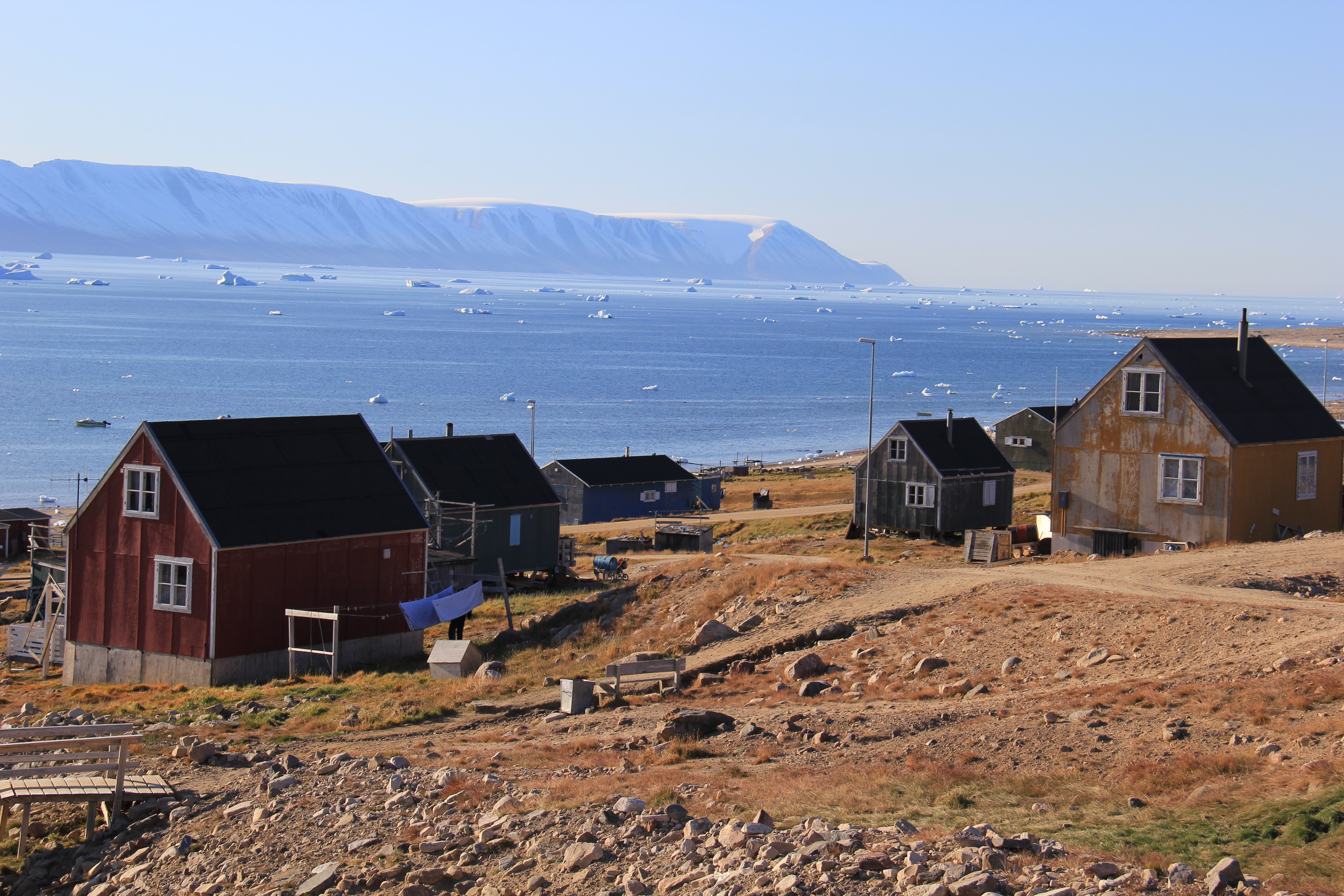
Ways of living so far north and in such severe climatic conditions are passed on from generation to generation, and this ability to adapt has contributed to the survival of this small settlement. When the sea becomes open sometime around August, large dinghies with powerful engines are used for both hunting trips and ordinary journeys. There is still sunlight twenty-four hours a day at this time—the midnight sun lasts from the middle of April to the end of August. Scarcity of resources requires they use every part of a harvested animal: the skins are used for clothing and covering the kayaks; the flesh and offal are eaten by humans and domestic animals; the narwhal and walrus tusks are carved into finely-worked figures, jewellery and hunting implements; and feathers can be used in handicrafts.
Government
The town is part of the region of Avannaata, which is represented by a 17-member council and mayor.
Population
With 646 inhabitants as of 2020, Qaanaaq is the largest settlement in the far north of the country. Its population has been relatively stable with only minor fluctuations since the mid-1990s.
The city, with its relatively low population and tradition of hunting, currently has more huskies than human residents.
Climate
Qaanaaq has a cold tundra climate (Köppen climate classification ET), and hence it has long, cold winters. July and August are the warmest months, and peak high temperatures rarely exceeding 20 C occur in June and July.
| Jan record high C = 7.1 | Feb record high C = 4.1 | Mar record high C = 9.8 | Apr record high C = 6.0 | May record high C = 14.0 | Jun record high C = 20.9 | Jul record high C = 20.3 | Aug record high C = 17.6 | Sep record high C = 13.3 | Oct record high C = 12.5 | Nov record high C = 9.0 | Dec record high C = 8.3 | year record high C = | Jan record low C = -40.5 | Feb record low C = -40.0 | Mar record low C = -41.2 | Apr record low C = -33.0 | May record low C = -23.1 | Jun record low C = -6.4 | Jul record low C = -3.0 | Aug record low C = -6.7 | Sep record low C = -15.4 | Oct record low C = -29.8 | Nov record low C = -32.5 | Dec record low C = -36.9 | year record low C = | access-date = 14 February 2013 | archive-date = 14 March 2023 | archive-url = https://web.archive.org/web/20230314025744/https://www.ncei.noaa.gov/pub/data/normals/WMO/1961-1990/RA-VI/GL/04202.TXT | url-status = dead | access-date = 14 February 2013 | archive-date = 14 March 2023 | archive-url = https://web.archive.org/web/20230314025742/https://www.ncei.noaa.gov/pub/data/normals/WMO/1961-1990/RA-VI/GL/00034204.TXT | url-status = dead
Infrastructure
Qaanaaq Airport is 5 km along the coast from the town. Air Greenland operates fixed-wing aircraft services to and from Upernavik Airport, with further connections to Ilulissat Airport and Qaarsut Airport. Settlement flights operate to Siorapaluk, sporadically to Moriusaq, and to Savissivik via Pituffik Space Base.
There are a few unpaved dirt roads in Qaanaaq. Only the road to the airport leaves the town. Pickup trucks and SUVs are found, but skis, dogsleds and walking are better alternatives for getting around.
There is a small hospital (built in the 1950s and rebuilt in 1996) with basic health care offered. More advanced care requires transfer to other medical centers in Greenland by air. Dental care is offered in the form of a dentist who visits the town twice a year. Qaanaaq Hospital falls under the Avannaa health region.
A small local fire brigade is assisted by firefighters from the Pituffik Space Base.
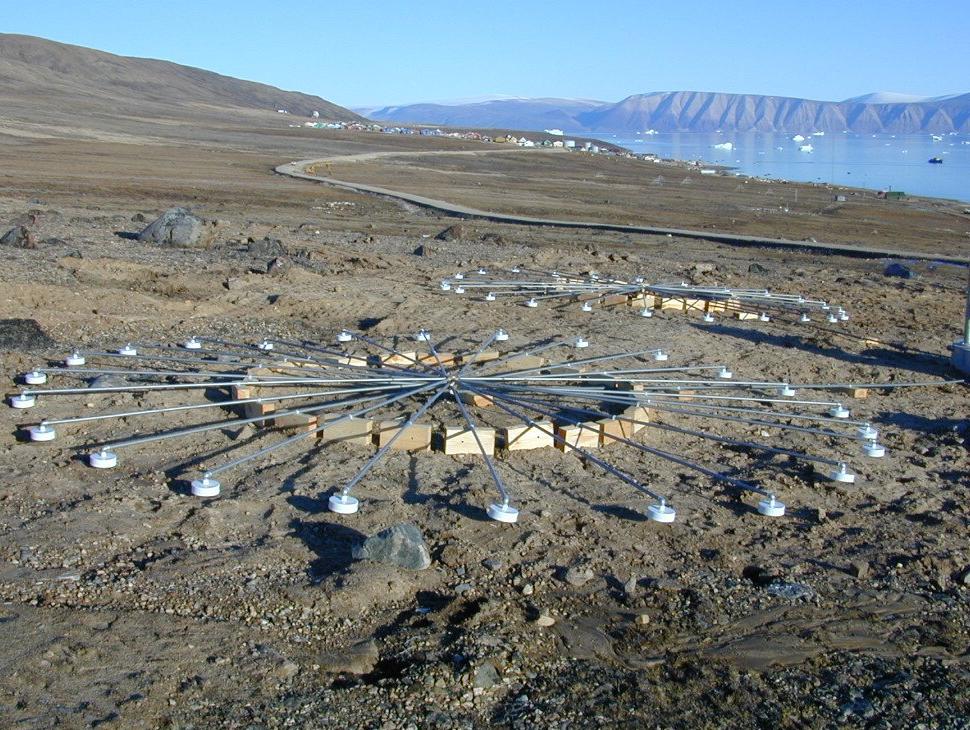
Qaanaaq is home to a remote CTBTO infrasound listening station called IS-18, which uses an array of barometric sensors to detect possible nuclear tests around the world. The station is maintained by the Danish Meteorological Institute, and as of 2016 the current operator is Svend Erik Ascanius.
Education
The local school, Avanersuup Atuarfia, has around 120 pupils in forms 1 to 10. There is also a boarding school which holds about 20 students from surrounding settlements. The town kindergarten has a capacity of 34 children while the day nursery can hold up to 12.
References
References
- "Qaanaaq". Mapcarta.
- Fortescue, Michael. ''Language Relations Across Bering Strait: Reappraising the Archaeological and Linguistic Evidence''. Open Linguistic Press, Cassell, 1998. {{ISBN. 0-304-70330-3
- [[Statistics Greenland]], [http://bank.stat.gl/Dialog/varval.asp?ma=BEEST4&path=../Database/Greenland/Population/Population%20in%20Greenland/&lang=1 Population in localities]
- "Climatological Standard Normals 1991–2020 – Greenland".
- . (20 December 2021). ["04205: Mittarfik Qaanaaq (Greenland)"](https://ogimet.com/cgi-bin/gsynres?ind=04205&ano=2021&mes=12&day=21&hora=12&min=0&ndays=30). *OGIMET*.
- "Booking system". Air Greenland.
- [http://www.greenland.com/en/explore-greenland/nordgroenland/qaanaaq/practical-info.aspx Practical info – The Official Tourism Site of Greenland]
- "Qaanaaq, Greenland".
- "IS18, Qaanaaq, Greenland, Denmark: CTBTO Preparatory Commission".
- Scott, Tom. (12 September 2016). "Listening for Nuclear Tests at the Top of the World". YouTube.
- Administrator, Odeum. "Qaanaaq".
This article was imported from Wikipedia and is available under the Creative Commons Attribution-ShareAlike 4.0 License. Content has been adapted to SurfDoc format. Original contributors can be found on the article history page.
Ask Mako anything about Qaanaaq — get instant answers, deeper analysis, and related topics.
Research with MakoFree with your Surf account
Create a free account to save articles, ask Mako questions, and organize your research.
Sign up freeThis content may have been generated or modified by AI. CloudSurf Software LLC is not responsible for the accuracy, completeness, or reliability of AI-generated content. Always verify important information from primary sources.
Report