From Surf Wiki (app.surf) — the open knowledge base
Pyraminx
Variant of Rubik's Cube

Variant of Rubik's Cube
The Pyraminx () is a regular tetrahedron puzzle in the style of Rubik's Cube. It was made and patented by Uwe Mèffert after the original 3 layered Rubik's Cube by Ernő Rubik, and introduced by Tomy Toys of Japan (then the 3rd largest toy company in the world) in 1981.
Optimal solutions
The maximum number of twists required to solve the Pyraminx is 11. There are 933,120 different positions (disregarding the trivial rotation of the tips), a number that is sufficiently small to allow a computer search for optimal solutions. The table below summarizes the result of such a search, stating the number p of positions that require n twists to solve the Pyraminx:
:{| class="wikitable" !n |0||1||2 ||3 ||4 ||5 ||6 ||7 ||8 ||9 ||10 ||11 |- !p |1||8||48||288||1728||9896||51808||220111||480467||166276||2457||32 |}
Records

The world record single solve is 0.73 seconds, set by Simon Kellum of the United States at Middleton Meetup Thursday 2023. The world record average of five solves (excluding fastest and slowest) is 1.14 seconds, set by Lingkun Jiang (姜凌坤) of China at Zhengzhou Zest 2025.
Top 10 solvers by single solve
| Rank | Name | Result | Competition |
|---|---|---|---|
| 1 | USA Simon Kellum | 0.73s | USA Middleton Meetup Thursday 2023 |
| 2 | USA Elijah Brown | 0.75s | USA Berkeley Winter A 2023 |
| 3 | USA Tucker Chamberlain | 0.87s | USA Georgetown Side Events 2025 |
| 4 | MYS Ng Jia Quan | 0.78s | SGP Singapore Small and Sides Feb 2025 |
| 5 | SGP Jovan Lee | 0.80s | |
| 6 | NZL Connor Johnson | 0.82s | NZL Groundhog Day in Somerfield 2024 |
| 7 | NZL Jasper Murray | 0.83s | |
| 8 | SVK Jakub Drobný | 0.84s | SVK Banská Bystrica Open 2024 |
| 9 | SGP Lim Jia Ying | 0.86s | SGP Singapore Small and Sides Feb 2025 |
| CHN Lingkun Jiang (姜凌坤) | CHN Shenyang Spring 2025 | ||
| CHN Lishui Open 2025 |
Top 10 solvers by [[Olympic average]] of 5 solves
| Rank | Name | Result | Competition | Times |
|---|---|---|---|---|
| 1 | CHN Lingkun Jiang (姜凌坤) | 1.14s | CHN Zhengzhou Zest 2025 | 1.04, (3.22), (0.97), 1.21, 1.16 |
| 2 | AUS Sebastian Lee | 1.15s | AUS Maitland Spring 2024 | 1.15, (1.53), 1.22, (1.01), 1.09 |
| 3 | NZL Jasper Murray | 1.40s | NZL A New Year in Auckland 2025 | (1.09), (2.11), 1.60, 1.35, 1.26 |
| 4 | USA Michael Nielsen | 1.41s | USA Virginia Championship 2025 | 1.31, 1.35, 1.56, (1.15), (3.10) |
| 5 | USA Parker Trager | 1.42s | USA Saint Mike's Cube Fest VT 2025 | 1.48, 1.39, 1.40, (1.69), (1.38) |
| 6 | USA Ezra Shere | 1.45s | USA Washtenaw Fast 'n Late Fall 2023 | (1.82), 1.42, 1.42, 1.50, (1.38) |
| 7 | CHN Owen Yepeng Sun (孙叶芃) | 1.47s | USA Mission Viejo Fall 2025 | 1.41, 1.16, (1.14), 1.84, (4.22) |
| RUS Alexey Tsvetkov | SVN Prlekija Open 2026 | 1.44, 1.41, (1.91), (1.19), 1.55 | ||
| 9 | NZL Elyas Eyou | 1.48s | NZL New Zealand Cubing Decathlon 2024 | 1.50, 1.42, 1.51, (2.83), (1.36) |
| 10 | USA Carson Clark (张卡森) | 1.51s | USA Bowling Green Fall 2025 | (1.13), 1.42, 1.69, (2.11), 1.41 |
Methods
There are many methods for solving a Pyraminx. They can be split up into two main groups.
-
V First Methods - In these methods, two or three edges are solved first, and a set of algorithms, also called LL (last layer) algorithms, are used to solve the remainder of the puzzle.
-
Top First Methods- In these methods, three edges around a center piece are solved first, and the remainder of the puzzle is solved using a set of algorithms.
Common V first methods-
a) Layer by Layer - In this method, a face with all edges permuted is solved, and then the remaining puzzle is solved by a single algorithm from a set of 5.
b) Algorithmic L4E and Intuitive L4E - L4E or last 4 edges is somewhat similar to Layer by Layer. The only difference is that only two edges are solved around three centers. Both of these methods solve the last four edges in the same step, hence the name. The difference is that Intuitive L4E requires a lot of visualization and "intuition" to solve the last four edges while algorithmic L4E uses algorithms. Algorithmic L4E is generally used more at higher levels, although there are very fast Intuitive L4E users. It is also easy to transition between Intuitive L4E and Algorithmic L4E.
Common top first methods-
a) One Flip - This method uses two edges around one center solved and the third edge flipped. There are a total of six cases after this step, for which algorithms are memorized and executed. The third step involves using a common set of algorithms for all top first methods, also called Keyhole last layer, which involves 5 algorithms, four of them being the mirrors of each other.
b) Keyhole - This method uses two edges in the right place around one center, and the third edge placed elsewhere on the puzzle. The centers of the fourth color are then solved using the slot formed by the non-permuted edge. The last step is solved using Keyhole last layer algorithms.
c) OKA - In this method, one edge is oriented around two edges in the wrong place, but one of the edges that is in the wrong place belongs to the block itself. The last edge is found on the bottom layer, and a very simple algorithm is executed to get it in the right place, followed by keyhole last layer algorithms.
Some other common top first methods are WO and Nutella.
Many top Pyraminx speedsolvers only use V-first methods, as top-first methods are extremely clunky and outdated due to hardware.
Variations

There are several variations of the puzzle. The simplest, Tetraminx, is equivalent to the (3x) Pyraminx but without the tips (see photo), resembling a truncated tetrahedron. There also exist "higher-order" versions, such as the 4x Master Pyraminx (see photos) and the 5x Professor's Pyraminx.

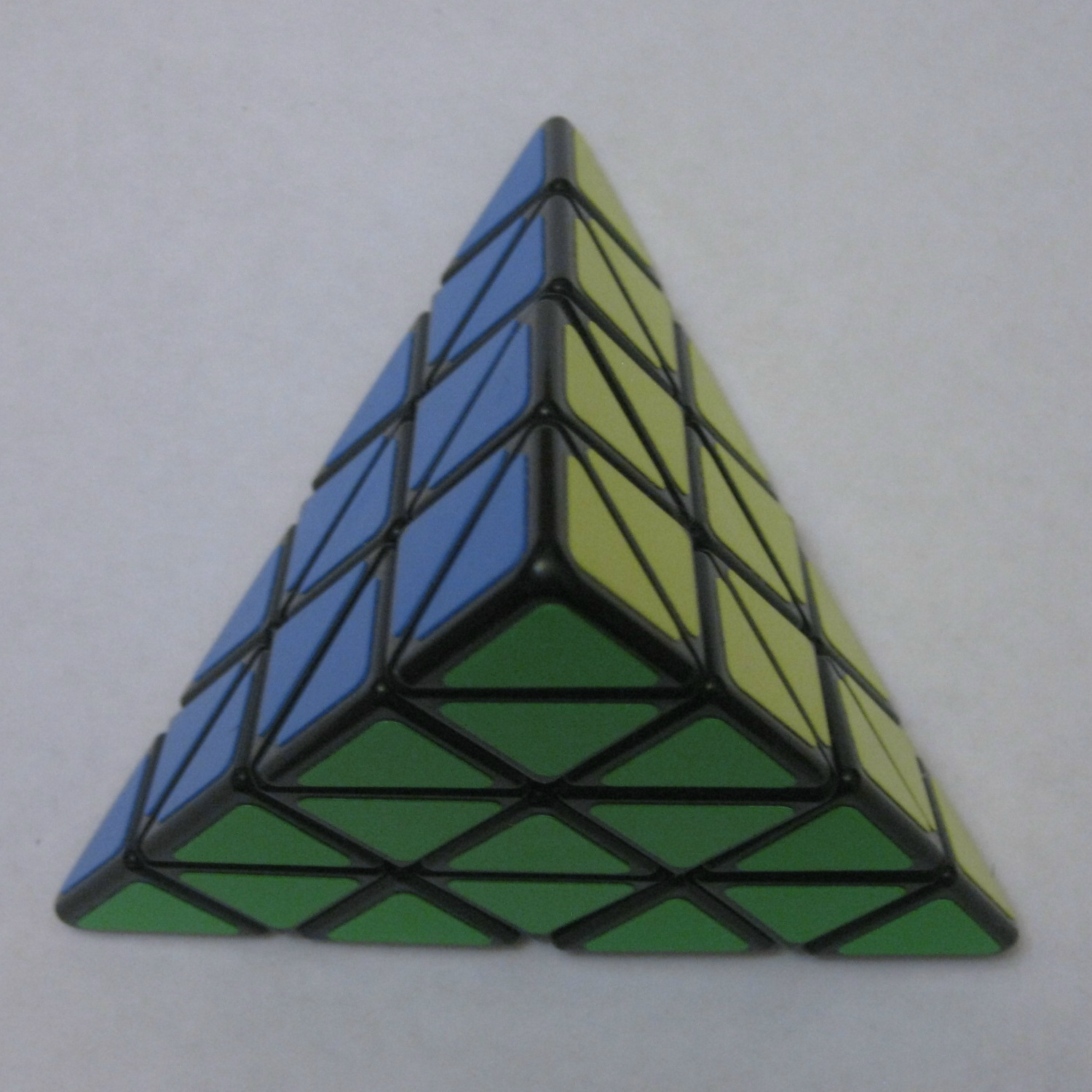
The Master Pyraminx has 4 layers and 16 triangles-per-face (compared to 3 layers and 9 triangles-per-face of the original), and is based on the Skewb Diamond mechanism. This version has about 2.6817 × 10¹⁵ combinations. The Master Pyraminx has
- 4 "tips" (same as the original Pyraminx)
- 4 "middle axials" (same as the original Pyraminx)
- 4 "centers" (similar to Rubik's Cube, none in the original Pyraminx)
- 6 "inner edges" (similar to Rubik's Cube, none in the original Pyraminx)
- 12 "outer edges" (2-times more than the 6 of the original Pyraminx) In summary, the Master Pyraminx has 30 "manipulable" pieces. However, like the original, 8 of the pieces (the tips and middle axials) are fixed in position (relative to each other) and can only be rotated in place. Also, the 4 centers are fixed in position and can only rotate (like the Rubik's Cube). So there are only 18 (30-8-4) "truly movable" pieces; since this is 10% fewer than the 20 "truly movable" pieces of the Rubik's Cube, it should be no surprise that the Master Pyraminx has about 10,000-times fewer combinations than a Rubik's Cube (43 quintillion in the short scale or 43 trilion in the long scale). The Master Pyraminx can be solved in numerous ways: one is layer by layer like the original one or reducing it to a Jing pyraminx.
Reviews
- Games
References
References
- "Puzzles, Pyraminx, Twisting puzzles, Kokonotsu-Super-Sudoku, Megaminx, 5x5x5 cube".
- [https://www.jaapsch.net/puzzles/pyraminx.htm Pyraminx] - Jaap's Puzzle Page
- "Pyraminx - Official World Records (Single and Average)".
- [[World Cube Association]] [https://www.worldcubeassociation.org/results/rankings/pyram/single? Official Pyraminx Ranking Single]
- [[World Cube Association]] [https://www.worldcubeassociation.org/results/rankings/pyram/average? Official Pyraminx Ranking Average]
- "Full List of Puzzles".
- "Notes on Twisty Puzzles". Michael Gottlieb.
- Martin Schönert ''[http://www.gap-system.org/Doc/Examples/rubik.html "Analyzing Rubik's Cube with GAP"]'': the [[permutation group]] of Rubik's Cube is examined with [[GAP computer algebra system]]
- (May 1982). "GAMES Magazine #29".
This article was imported from Wikipedia and is available under the Creative Commons Attribution-ShareAlike 4.0 License. Content has been adapted to SurfDoc format. Original contributors can be found on the article history page.
Ask Mako anything about Pyraminx — get instant answers, deeper analysis, and related topics.
Research with MakoFree with your Surf account
Create a free account to save articles, ask Mako questions, and organize your research.
Sign up freeThis content may have been generated or modified by AI. CloudSurf Software LLC is not responsible for the accuracy, completeness, or reliability of AI-generated content. Always verify important information from primary sources.
Report