From Surf Wiki (app.surf) — the open knowledge base
Purus River
| Field | Value | ||||
|---|---|---|---|---|---|
| name | Purus River | ||||
| image | Purus.jpg | ||||
| image_size | 300 | ||||
| image_caption | Purus River | ||||
| map | Purusrivermap.png | ||||
| map_size | 300 | ||||
| map_caption | Map of the Amazon Basin with the Purus River highlighted | ||||
| pushpin_map_size | 300 | ||||
| subdivision_type1 | Country | ||||
| subdivision_name1 | Brazil, Peru | ||||
| length | 3,361.02 km 3,382 km | ||||
| discharge1_location | Confluencia of Solimões, Amazonas State (near mouth) | ||||
| discharge1_avg | (Period: 1973–1990)10,970 m3/s | ||||
| (Period: 1979–2015){{cvt | 11,206.9 | m3/s | cuft/s | abbr | on}} |
| source1 | Confluence of Cujar and Curiuja rivers | ||||
| source1_location | Ucayali Region, Peru | ||||
| source1_coordinates | |||||
| source1_elevation | 330 m | ||||
| source2 | Most distant source approximate area. Headwaters of Cujar River. | ||||
| source2_location | Ucayali Region, Peru | ||||
| source2_coordinates | |||||
| source2_elevation | 498 m | ||||
| {{cvt | 520 | m | abbr | on}} | |
| mouth_coordinates | |||||
| mouth_elevation | 11 m | ||||
| progression | Amazon → Atlantic Ocean | ||||
| river_system | Solimões | ||||
| basin_size | 371,042 km2 to 376,600 km2 | ||||
| tributaries_left | Inauini, Pauini, Tapauá | ||||
| tributaries_right | Chandless, Iaco, Acre, Sepatini, Ituxi, Mucuim, Itaparaná | ||||
| discharge2_location | Arumã-Jusante, Amazonas State (359,853 km2 | ||||
| discharge2_avg | (Period of data: 1970–1996)10,469 m3/s | ||||
| discharge3_location | Lábrea, Amazonas State (Basin size: 220,351 km2 | ||||
| discharge3_avg | (Period of data: 1970–1996)5,569 m3/s |
(Period: 1979–2015)11,206.9 m3/s 520 m
The Purus River (Portuguese: Rio Purus; Spanish: Río Purús) is a tributary of the Amazon River in South America. Its drainage basin is 371,042 km2, and the mean annual discharge is 11,207 m3/s. The river shares its name with the Alto Purús National Park and the Purús Province (and its conformed Purús District), one of the four provinces of Peru in the Ucayali Region.
Geography
The Purus River rises in Peru. It defines the boundary between Peru and Brazil in the centre of the state of Acre, then runs for a short distance along the boundary of the 231555 ha Santa Rosa do Purus National Forest, a sustainable use conservation unit created in 2001, after it is joined by the Santa Rosa River. The Purus then flows north east through Manoel Urbano{{citation|ref=|language=pt It runs through a continuous forest at the bottom of the great depression, lying between the Madeira River, which skirts the edge of the Brazilian sandstone plateau, and the Ucayali River, which hugs the base of the Andes.
In the state of Amazonas the river runs through the 133637 ha Arapixi Extractive Reserve, created in 2006, and past the town of Boca do Acre at the end of the BR-317 highway. Further down, it forms the west boundary of the 256000 ha Purus National Forest, created in 1988.{{citation|ref=|language=pt From the town of Pauini down to the town of Lábrea the river is bordered by the 604209 ha Médio Purus Extractive Reserve, created in 2008. Below this it runs through the 197,986 ha Canutama Extractive Reserve along the stretch between the towns of Lábrea and Canutama. In the lowest reaches the river flows through the 1008167 ha Piagaçu-Purus Sustainable Development Reserve, established in 2003, which holds a large part of its floodplain. It enters the Amazon River west of the Madeira River, which it parallels as far south as the falls of the latter stream.
William Chandless found its elevation above sea level to be only 107 ft 590 mi from its mouth. It is one of the most crooked streams in the world, and its length in a straight line is less than half of its length following its curves. It is practically only a drainage ditch for the half-submerged, lake-flooded district it crosses. Its width is very uniform for 1000 mi up, and for 800 mi its depth is never less than 45 ft.
Biodiversity
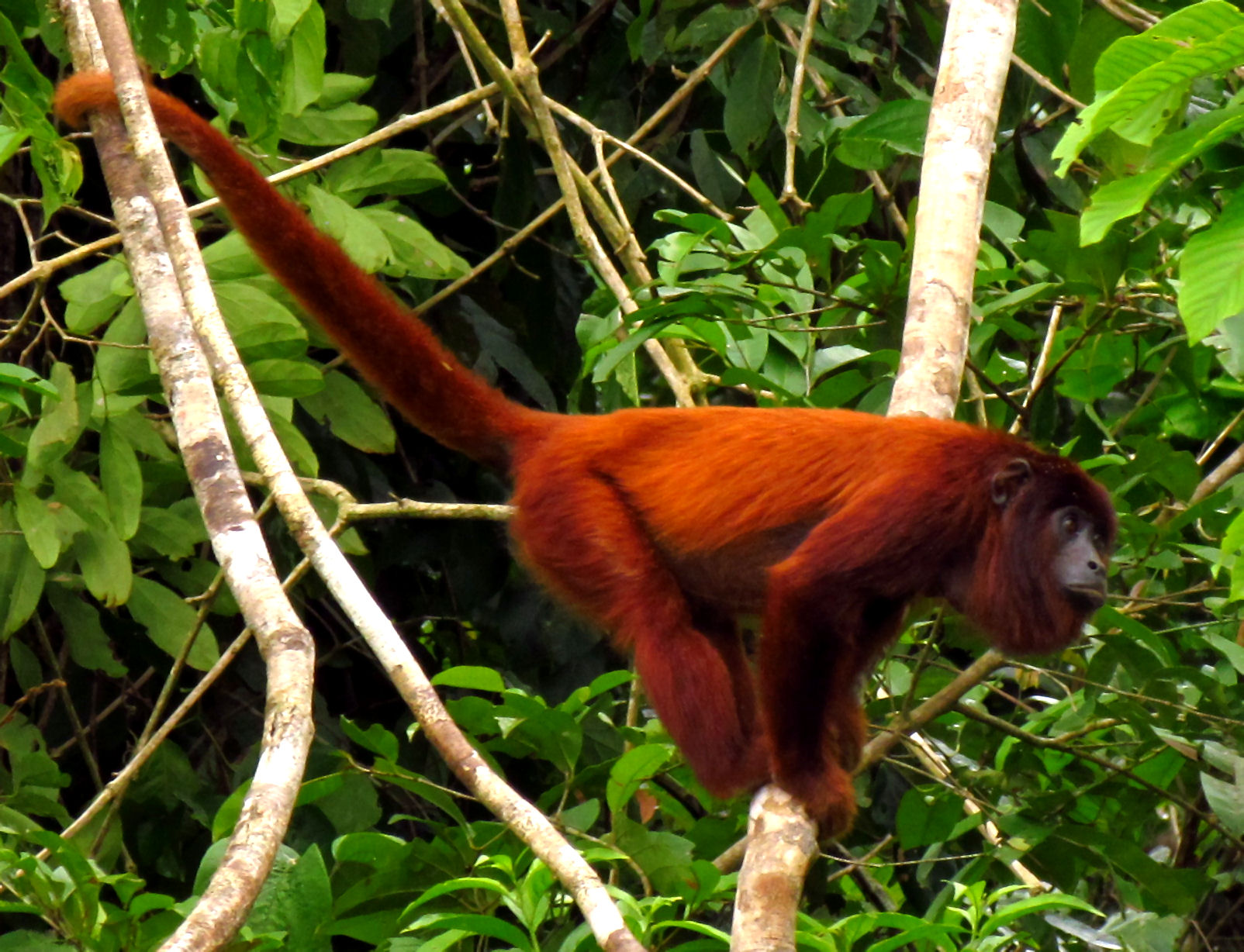
The Purús red howler (Alouatta puruensis) is a species of howler monkey native to Brazil, Peru and north of Bolivia. Peckoltia brevis, a kind of catfish, is found in the middle and upper Amazon within the Purus river basin.
Most of the central and lower sections of the river flow through the Purus várzea ecoregion.{{citation|ref= In the municipality of Tapauá, Amazonas, the river flows through the 233864 ha Abufari Biological Reserve, a strictly protected area.
Earthworks discovery
In 2008, a previously unknown pre-Columbian civilization was discovered in the upper region of the river close to the Bolivian border. After much of the forest in the region was cleared for agricultural use, satellite pictures revealed the remains of large geometric earthworks.
References
- Purus River. (2010). In Encyclopædia Britannica. Retrieved January 12, 2010, from Encyclopædia Britannica Online.
References
- (2022). "Perú: Anuario de Estadistícas Ambientales 2022".
- (Jan 2019). "PLANO ESTADUAL DE RECURSOS HÍDRICOS DO AMAZONAS, (PERH/AM) - RT 03 - DIAGNÓSTICO, PROGNÓSTICO E CENÁRIOS FUTUROS DO RECURSOS HÍDRICOS DO ESTADO - TOMO III".
- (23 Aug 2002). "Long-term simulations of discharge and floods in the Amazon Basin".
- "RESEX Arapixi". ISA: Instituto Socioambiental.
- "RESEX Médio Purus". ISA: Instituto Socioambiental.
- "RESEX Canutama". ISA: Instituto Socioambiental.
- "RDS Piagaçu-Purus". ISA: Instituto Socioambiental.
- Cornejo, F.M.. (2021). "''Alouatta puruensis''".
- "Planet catfish".
- "Fish Base".
- "Unidade de Conservação: Reserva Biológica do Abufari". MMA: Ministério do Meio Ambiente.
- Martti Pärssinen, Denise Schaan, Alceu Ranzi: [http://antiquity.ac.uk/ant/083/ant0831084.htm ''Pre-Columbian geometric earthworks in the upper Purús: a complex society in western Amazonia'']. Antiquity, Volume 83, 2009, p. 1084–1095
This article was imported from Wikipedia and is available under the Creative Commons Attribution-ShareAlike 4.0 License. Content has been adapted to SurfDoc format. Original contributors can be found on the article history page.
Ask Mako anything about Purus River — get instant answers, deeper analysis, and related topics.
Research with MakoFree with your Surf account
Create a free account to save articles, ask Mako questions, and organize your research.
Sign up freeThis content may have been generated or modified by AI. CloudSurf Software LLC is not responsible for the accuracy, completeness, or reliability of AI-generated content. Always verify important information from primary sources.
Report