From Surf Wiki (app.surf) — the open knowledge base
Purple roller
Species of bird
Species of bird
:The name "purple roller" can also refer to the azure dollarbird (Eurystomus azureus) of Indonesia.
- Coracias noevia
- Coracias noevius
The purple roller (Coracias naevius), or rufous-crowned roller, is a medium-sized bird widespread in sub-Saharan Africa. Compared with other rollers its colours are rather dull and its voice harsh and grating.
Taxonomy and systematics
The purple roller was formally described in 1800 by the French zoologist François Marie Daudin under the binomial name Coracias naevia. Daudin's description was based on a specimen collected in Senegal. The specific epithet is from Latin naevius meaning "spotted" or "marked". A molecular phylogenetic study published in 2018 found that the purple roller was most closely related to the racket-tailed roller (Coracias spatulatus).
Two subspecies are recognised:
- Lilac-throated roller (C. n. naevius) – Daudin, 1800: The common name for this subspecies is also used as an alternate name for the lilac-breasted roller. Found from Senegal and Gambia to Somalia and northern Tanzania
- C. n. mosambicus – Dresser, 1890: Originally described as a separate species. Found from Angola and southern Democratic Republic of Congo to Namibia northern South Africa
Description
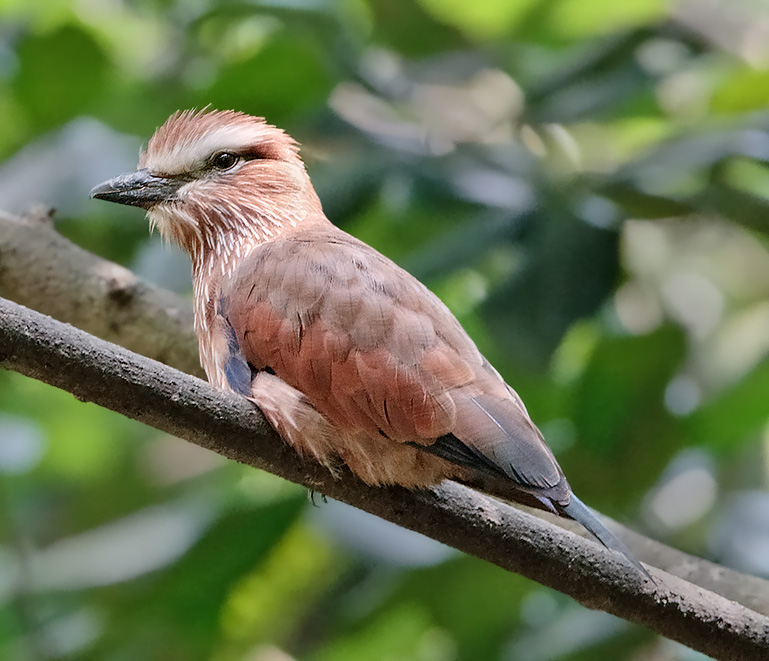
The purple roller is the largest of the rollers, growing to a length of 35 to. Adults weigh from 145 to with an average weight of 168 g. From a distance it appears a dull brownish bird with a white stripe over the eye, a patch of white on the nape and a dark tail. Northern populations tend to have a rufus crown while southern populations have a more olive-green crown. The underparts are purplish-pink streaked with white. The wings are long and rounded while the tail is square-cut. The voice is a rather grating "ka" or "gaa", repeated rapidly and evenly.
Behaviour and ecology
Its preferred habitat is dry thornveld where it spends long periods perched at the top of thorn trees or poles, watching for food items such as insects, spiders, scorpions and small lizards on the ground. It rocks to-and-fro about its longitudinal axis during display flights, calling raucously all the while; starting from above the treetops it plummets towards the ground in rolling flight. It is territorial, and during the breeding season will drive off other rollers, small hawks and crows.
This species seems to be an opportunist breeder, possibly linked to rains, as its breeding season varies from place to place. It nests in natural hollows in trees or uses old woodpecker holes, or in cliffs, riverbanks, pipes, or holes in masonry, usually laying three white eggs. The young are fed and incubated by both parents.
References
- Roberts' Birds of Southern Africa, 6th edition (John Voelcker Fund, 1993)
References
- BirdLife International. (2016). "''Coracias naevius''".
- Daudin, François Marie. (1800). "Traité élémentaire et complet d'ornithologie, ou, Histoire naturelle des oiseaux". Chez L'Auteur.
- Jobling, James A.. (2010). "The Helm Dictionary of Scientific Bird Names". Christopher Helm.
- (2018). "Phylogenetic relationships of rollers (Coraciidae) based on complete mitochondrial genomes and fifteen nuclear genes". Molecular Phylogenetics and Evolution.
- (January 2021). "Rollers, ground rollers, kingfishers". International Ornithologists' Union.
- (2008). "CRC Handbook of Avian Body Masses". CRC Press.
- (2010). "Kingfishers, Bee-eaters and Rollers". Bloomsbury Publishing.
This article was imported from Wikipedia and is available under the Creative Commons Attribution-ShareAlike 4.0 License. Content has been adapted to SurfDoc format. Original contributors can be found on the article history page.
Ask Mako anything about Purple roller — get instant answers, deeper analysis, and related topics.
Research with MakoFree with your Surf account
Create a free account to save articles, ask Mako questions, and organize your research.
Sign up freeThis content may have been generated or modified by AI. CloudSurf Software LLC is not responsible for the accuracy, completeness, or reliability of AI-generated content. Always verify important information from primary sources.
Report