From Surf Wiki (app.surf) — the open knowledge base
Puno
City in south-eastern Peru
.JPG)
City in south-eastern Peru
| Field | Value | |
|---|---|---|
| official_name | Puno | |
| other_name | San Carlos de Puno | |
| native_name | ||
| nickname | Ciudad del Lago | |
| (City of the lake) | ||
| image_skyline | {{Photomontage | |
| photo1a | Vista de Puno y el Titicaca, Perú, 2015-08-01, DD 63.JPG | |
| photo2a | Historico Barco Yavari de Puno.jpg | |
| photo2b | Lago Titicaca, Puno 02.jpg | |
| photo3a | Jezero Titicaca - plovoucí ostrovy Uros - panoramio (1).jpg | |
| photo3b | Puno - katedrála - panoramio.jpg | |
| border | 0 | |
| color | white | |
| spacing | 2 | |
| size | 270 | position = center |
| image_caption | Puno and the Titicaca, Historical ship Yavari, Titicaca lake, Floating islands of Uros and Puno Cathedral | |
| image_flag | Flag of Puno.svg | |
| flag_size | 125px | |
| image_seal | Escudo_de_Puno.png | |
| seal_size | 75px | |
| mapsize | 250px | |
| map_caption | Location in Peru | |
| pushpin_map | Peru | |
| pushpin_label_position | ||
| coordinates | ||
| subdivision_type | Country | |
| subdivision_name | Peru | |
| subdivision_type1 | Region | |
| subdivision_name1 | Puno | |
| subdivision_type2 | Province | |
| subdivision_name2 | Puno | |
| subdivision_type3 | Founded | |
| subdivision_name3 | November 4, 1668 | |
| leader_title1 | Mayor | |
| leader_name1 | Javier Ponce Roque | |
| (2023-2026) | ||
| established_title | ||
| established_title2 | ||
| established_title3 | ||
| unit_pref | ||
| area_total_km2 | 20.28 | |
| population_as_of | 2017 | |
| settlement_type | ||
| pop_est_as_of | 2015 | |
| pop_est_footnotes | ||
| population_est | 140839 | |
| population_total | 128637 | |
| population_density_km2 | auto | |
| timezone | UTC-5 | |
| elevation_footnotes | tags-- | |
| elevation_m | 3830 | |
| elevation_ft | 12556 | |
| postal_code_type | ||
| area_code | 51 | |
| website | https://portal.munipuno.gob.pe |
(City of the lake) (2023-2026) Puno (Aymara and ) is a city in southeastern Peru, located on the shore of Lake Titicaca. It is the capital city of the Puno Region and the Puno Province with a population around 140,839 (2015 estimate). The city was established in 1668 by viceroy Pedro Antonio Fernández de Castro as capital of the province of Paucarcolla with the name San Juan Bautista de Puno. The name was later changed to San Carlos de Puno, in honor of king Charles II of Spain. Puno has several churches dating back from the colonial period; they were built to service the Spanish population and evangelize the Quechua people.
Overview
Puno is an important agricultural and livestock region; important livestock are llamas and alpacas, which graze on its immense plateaus and plains. Much of the city economy relies on the black market, fueled by cheap goods smuggled in from Bolivia. Puno is served by the Inca Manco Capac International Airport in nearby Juliaca.
Puno is situated between the shores of Lake Titicaca and the mountains surrounding the city. Less than two miles of flat land lie between the shores and the foothills, which has caused the growing city to continue to expand upwards onto the hillsides. As a result, the town's less developed and poorest areas, which are high on the hillsides, often have very steep streets, which are generally unpaved and cannot be accessed by automobile. Up one of these streets is the Kuntur Wasi viewpoint, which has a large metal sculpture of a condor. Some 700 steps must be climbed to reach the sculpture.
Puno's access to Lake Titicaca is surrounded by 41 floating islands. To this day, the Uros people maintain and live on these man-made islands, depending on the lake for their survival, and are a large tourist destination. Dragon boat racing, an old tradition in Puno, is a very popular activity among tourists.
Puno is the first major hub in the constant migration of indigenous peoples of the Andes to the larger cities of Peru. It is the largest city in the southern Altiplano and is the recipient of new residents from surrounding smaller agricultural communities of people seeking better opportunities for education and employment. As such, Puno is served by several small institutes of technology, education, and other technical or junior college-type facilities. Additionally, it is home to the Universidad Nacional del Altiplano de Puno (UNAP), which was founded in 1856.
Climate
Puno features a subtropical highland climate (Köppen: Cwb, Trewartha: Cwlk).
As Puno is located at such a high elevation, it experiences more extreme weather conditions than would be expected for its tropical latitude. The average annual temperature is about 8.4 °C, and the weather never gets overly warm. During the winter from June to August, night-time temperatures usually drop below 0 °C. At this high altitude, the rays of the sun are very strong. Most of the annual precipitation falls during the Southern Hemisphere summer, with the winters being very dry.

| archive-url = https://web.archive.org/web/20230821192714/https://www.senamhi.gob.pe/?p=normales-estaciones | archive-date = 21 August 2023 | access-date = 25 October 2023}}
Folklore
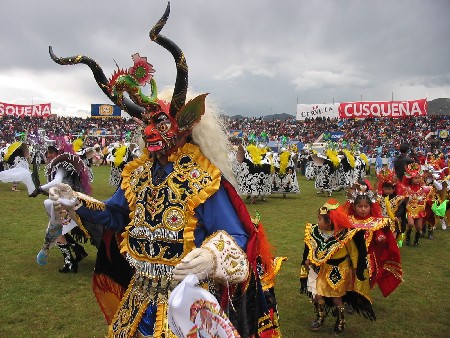
Music and dance are typical parts of the Puno folklore. The most important dances are the Wifala de Asillo, the Ichu Carnival, the Tuntuna, the Khashua de Capachica, the Machu-tusuj, the Kcajelo, and the Pandilla Puneña.
Gallery
File:Puno-PERU.jpg|Plaza de Armas. File:Lago Titicaca, Puno, Perú, 2015-08-01, DD 13.JPG|Lake Titicaca as seen from the shore File:Amanecer en el lago Titicaca, Puno, Perú, 2015-08-01, DD 02.JPG|Sunrise in the Titicaca File:Puno cityscape.jpg|Puno and Titicaca. File:Palacio de Justicia, Plaza Republicana, Puno, Perú, 2015-08-01, DD 52.JPG|Justice Palace File:Vista de Puno y el Titicaca, Perú, 2015-08-01, DD 61.JPG|View of Puno from the north File:Vista de Puno, Perú, 2015-08-01, DD 10.JPG|View of Puno from Titicaca
References
References
- (March 2012). "Perú: Población estimada al 30 de junio y tasa de crecimiento de las ciudades capitales, por departamento, 2011 y 2015". Instituto Nacional de Estadística e Informática.
- "En el siglo XVI evangelizaron a puneños con catecismo en quechua".
- "Puno climate: Average Temperature, weather by month, Puno weather averages - Climate-Data.org".
This article was imported from Wikipedia and is available under the Creative Commons Attribution-ShareAlike 4.0 License. Content has been adapted to SurfDoc format. Original contributors can be found on the article history page.
Ask Mako anything about Puno — get instant answers, deeper analysis, and related topics.
Research with MakoFree with your Surf account
Create a free account to save articles, ask Mako questions, and organize your research.
Sign up freeThis content may have been generated or modified by AI. CloudSurf Software LLC is not responsible for the accuracy, completeness, or reliability of AI-generated content. Always verify important information from primary sources.
Report