From Surf Wiki (app.surf) — the open knowledge base
Puning Temple (Hebei)
Buddhist temple in Chengde, China

Buddhist temple in Chengde, China
| Field | Value |
|---|---|
| name | Puning Temple |
| native_name | 普宁寺 |
| native_name_lang | zh |
| image | Chengde, China - 022.jpg |
| caption | Puning Temple |
| map_type | China Hebei |
| coordinates | |
| religious_affiliation | Buddhism |
| location | Chengde, Hebei, China |
| sect | Tibetan Buddhism–Gelug |
| festival | |
| architecture_style | Tibetan architecture |
| founded_by | Qianlong Emperor |
| established | 1755 |
| date_demolished | |
| elevation_m |
The Puning Temple (), commonly called the Big Buddha Temple, is a Buddhist temple complex in Chengde, Hebei province, China. It was built in 1755 during the reign of the Qianlong Emperor in the Qing dynasty. It is near the Chengde Mountain Resort and alongside the equally famed Putuo Zongcheng Temple. Puning is one of the "Eight Outer Temples" of Chengde.
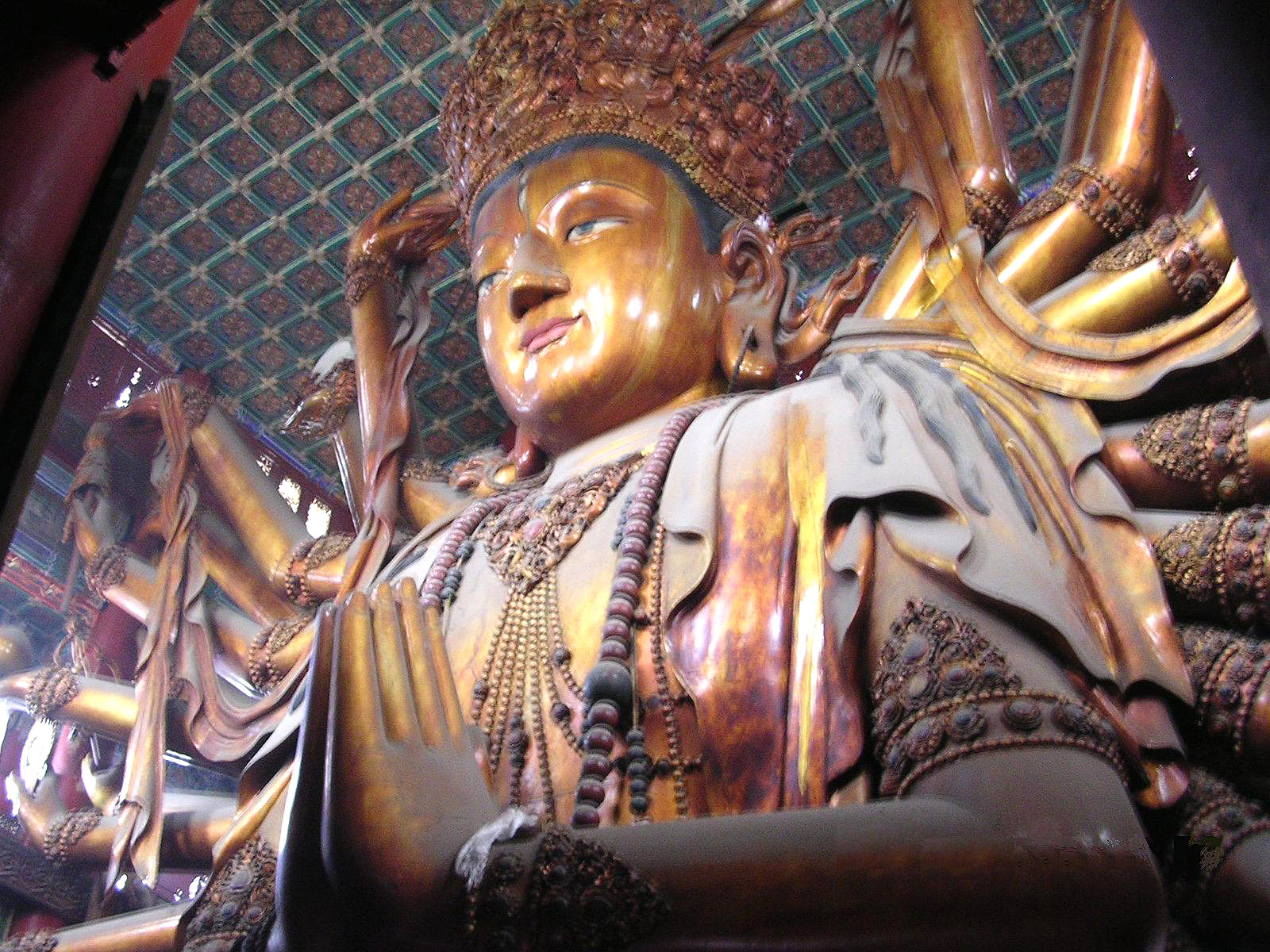
The Puning Temple was modeled after the Samye Monastery, the sacred Buddhist site in Tibet (much as the Putuo Zongcheng Temple was modeled after the Potala Palace in Lhasa). The front temple was constructed in the Chinese style, although the temple complex follows both Chinese and Tibetan architectural styles. The Puning Temple houses the world's tallest wooden sculpture of the Bodhisattva Avalokiteśvara (22.28-meter-high and 110 ton), hence it is often nicknamed the "Big Buddha Temple". The complex features temple halls, pavilions, drum towers and bell towers.
History
Since the 18th century, during the Qing dynasty, the Dzungar people of northwestern modern China (Xinjiang) were engaged in war against Qing empire invasion. The Qianlong Emperor of the Qing dynasty dispatched an army to Yili to suppress their resistance against Qing rule. The Qing army attacked Kulja (Yining) and captured the ruling Dzungar khan. After the conquest, the Qianlong Emperor personally inscribed his writing on a tablet that is in the stele pavilion of the Puning Temple. This stele of 1755, called the Puning Sibei, commemorated the founding of the temple and the victory over the Dzungars. The Qianlong Emperor ordered the building of this new Temple of Universal Peace, a symbol of his ambition to maintain peace among ethnic minorities and a stable environment in the northwestern regions. The historian Waley-Cohen calls Chengde "a crucial location for the exhibition of Manchu power and the representation of Qing imperial knowledge," being the location of the summer capital. Since the Dzungars were followers of Tibetan Buddhism, the temple was built in imitation of Samye monastery in Tibet.
The large wooden Buddhist statue of the Bodhisattva Avalokiteśvara in the main hall of the Puning Temple is one of its most renowned features. It shows a thousand different eyes and a thousand different arms stretched out from its frame (in various sizes). The statue itself is made from five kinds of wood, including pine, cypress, elm, fir, and linden.
As of 1994, the Chengde Mountain Resort and Chengde's Eight Outer Temples (including the Puning Temple) were established as UNESCO World Heritage Sites. Today, the Puning Temple remains a site of tourist attraction and local festivities.
Gallery
Image:Dafuosi.jpg|Main hall housing the Bodhisattva Image:Chengde, China - 016.jpg|Looking up at the Bodhisattva Image:Chengde, China - 011.jpg|Temple grounds Image:Chengde, China - 008.jpg|Main temple Image:Chengde, China - 021.jpg|Temple grounds Image:Dafuosi3.jpg|Turning wheels of the Buddha's doctrine at Puning Temple, a modern addition. Image:Dafuosi4.jpg|A courtyard of Puning Temple Image:Chengde, China - 006.jpg|A Chinese pavilion of Puning Temple Image:Puning Temple entrance.jpg|Temple entrance Image:Puning Temple, Hall of Mahayana.jpg|Hall housing the Bodhisattva Image:Puning Temple, Place in front of hall of Mahayana.jpg|Area in front of the Bodhisattva hall
References
References
- "China Stamps...". Xabusiness.com.
- "Puning Temple - Jongo Knows - Encyclopedia of China". Knows.Jongo.com.
- "China Philatelic Information - World of Chinese Stamps". CPI.com.cnm.
- Waley-Cohen, Joanna. "Commemorating War in Eighteenth-Century China," ''Modern Asian Studies'' (Volume 30, Number 4, Special Issue: War in Modern China, 1996): 869–899.
- Waley-Cohen, 880.
This article was imported from Wikipedia and is available under the Creative Commons Attribution-ShareAlike 4.0 License. Content has been adapted to SurfDoc format. Original contributors can be found on the article history page.
Ask Mako anything about Puning Temple (Hebei) — get instant answers, deeper analysis, and related topics.
Research with MakoFree with your Surf account
Create a free account to save articles, ask Mako questions, and organize your research.
Sign up freeThis content may have been generated or modified by AI. CloudSurf Software LLC is not responsible for the accuracy, completeness, or reliability of AI-generated content. Always verify important information from primary sources.
Report