From Surf Wiki (app.surf) — the open knowledge base
Pulmonary artery
Artery in pulmonary circulation carrying deoxygenated blood from heart to lungs

Artery in pulmonary circulation carrying deoxygenated blood from heart to lungs
| Field | Value |
|---|---|
| Name | Pulmonary artery |
| Latin | arteria pulmonalis |
| Image | Diagram of the human heart (cropped).svg |
| Caption | Anterior (frontal) view of the opened heart. White arrows indicate normal blood flow. (Pulmonary artery labelled at upper right.) |
| BranchFrom | Right ventricle |
| System | Cardiovascular, respiratory |
| Precursor | Truncus arteriosus |
A pulmonary artery is an artery in the pulmonary circulation that carries deoxygenated blood from the right side of the heart to the lungs. The largest pulmonary artery is the main pulmonary artery or pulmonary trunk from the heart, and the smallest ones are the arterioles, which lead to the capillaries that surround the pulmonary alveoli.
Structure
The pulmonary arteries are blood vessels that carry systemic venous blood from the right ventricle of the heart to the microcirculation of the lungs. Unlike in other organs where arteries supply oxygenated blood, the blood carried by the pulmonary arteries is deoxygenated, as it is venous blood returning to the heart. The main pulmonary arteries emerge from the right side of the heart and then split into smaller arteries that progressively divide and become arterioles, eventually narrowing into the capillary microcirculation of the lungs where gas exchange occurs.
Pulmonary trunk
In order of blood flow, the pulmonary arteries start as the pulmonary trunk that leaves the fibrous pericardium (parietal pericardium) of the ventricular outflow tract of right ventricle (also known as infundibulum or conus arteriosus. The outflow track runs superiorly and to the left, posterior to the pulmonary valve. The pulmonary trunk bifurcates into right and left pulmonary arteries below the arch of aorta and in front of the left main bronchus. Pulmonary trunk is short and wideapproximately 5 cm in length and 2 cm-3 cm in diameter.
The pulmonary trunk splits into the right and the left main pulmonary artery. The left main pulmonary artery is shorter than the right, passes behind and downwards the descending aorta and above the left main bronchus to the root of the left lung. Above, the left main pulmonary artery is connected to the concavity of the proximal descending aorta by the ligamentum arteriosum. The right pulmonary artery pass across the midline of the body, below the carina of trachea, and comes in front of the right main bronchus.
Branches
The left main pulmonary artery then divides into two lobar arteries, one for each lobe of the left lung.
At the right root of the lung, it bifurcates into artery that supplies the right upper lobe of the lung, in front of the right upper lobe bronchus, and interlobar artery that supplies the right middle and inferior lobes of the lung, running together with bronchus intermedius.
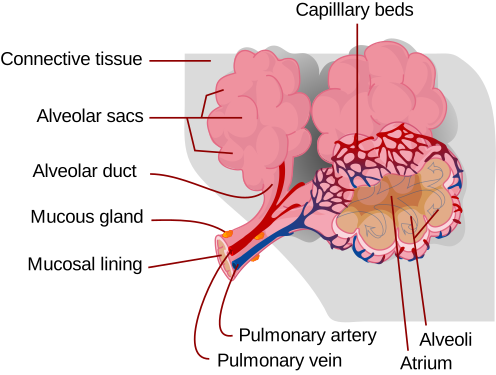
The right and left main pulmonary (lungs) arteries give off branches that supplies the corresponding lung lobes. In such cases it is termed lobar arteries. The lobar arteries branch into segmental arteries (roughly 1 for each segment). Segmental arteries run together with segmental bronchi, at the posterolateral surfaces of the bronchi. These in turn branch into subsegmental pulmonary arteries. These eventually form intralobular arteries. The pulmonary arteries supply the alveoli of the lungs. In contrast, bronchial arteries, that has different origins, supply the bronchi of the lungs.
Development
The pulmonary arteries originate from the truncus arteriosus and the sixth pharyngeal arch. The truncus arteriosus is a structure that forms during the development of the heart as a successor to the conus arteriosus.
By the third week of development, the endocardial tubes have developed a swelling in the part closest to the heart. The swelling is known as the bulbus cordis and the upper part of this swelling develops into the truncus arteriosus. The structure is ultimately mesodermal in origin. During development of the heart, the heart tissues undergo folding, and the truncus arteriosus is exposed to what will eventually be both the left and right ventricles. As a septum develops between the two ventricles of the heart, two bulges form on either side of the truncus arteriosus. These progressively enlarge until the trunk splits into the aorta and pulmonary arteries. Failure of these processes can lead to pulmonary artery agenesis.
During early development, the ductus arteriosus connects the pulmonary trunk and the aortic arch, allowing blood to bypass the lungs.
Function
The pulmonary artery carries deoxygenated blood from the right ventricle to the lungs. The blood here passes through capillaries adjacent to alveoli and becomes oxygenated as part of the process of respiration.
In contrast to the pulmonary arteries, the bronchial arteries supply nutrition to the lungs themselves.
Pressure
Pulmonary artery pressure The pulmonary artery pressure (PA pressure) is a measure of the blood pressure found in the main pulmonary artery. This is measured by inserting a catheter into the main pulmonary artery. The mean pressure is typically 9–18 mmHg, and the wedge pressure measured in the left atrium may be 6–12 mmHg. The wedge pressure may be elevated in left heart failure,
Clinical significance
The pulmonary artery is relevant in a number of clinical states. Pulmonary hypertension is used to describe an increase in the pressure of the pulmonary artery, and may be defined as a mean pulmonary artery pressure of greater than 25 mmHg. In chest X-rays, a diameter of more than 16 mm for the right descending pulmonary artery is also an indicator for pulmonary hypertension. This may occur as a result of heart problems such as heart failure, lung or airway disease such as COPD or scleroderma, or thromboembolic disease such as pulmonary embolism or emboli seen in sickle cell anaemia.
Pulmonary embolism refers to an embolus that lodges in the pulmonary circulation. This may arise from a deep venous thrombosis, especially after a period of immobility. A pulmonary embolus is a common cause of death in patients with cancer and stroke.
_(14579121368).jpg)
Several animal models have been utilized for investigating pulmonary artery related pathologies. Porcine model of pulmonary artery is the most frequently used and it was recently found that their mechanical properties vary with every subsequent branching.
Additional images
File:Relations of the aorta, trachea, esophagus and other heart structures.png|Image showing main pulmonary artery coursing ventrally to the aortic root and trachea, and the right pulmonary artery passes dorsally to the ascending aorta, while the left pulmonary artery passes ventrally to the descending aorta. File:Illu pulmonary circuit.jpg|Pulmonary circuit File:Gray503.png|Transverse section of thorax, showing relations of pulmonary artery. File:Slide16444 (1).jpg|alt=Original image from Anatomist 90|Pulmonary artery File:Slide44uru.JPG|Pulmonary artery.Deep dissection.Anterior view. File:Computed tomograph of pulmonary vessels.jpg|CT scan of a normal lung, with different levels of pulmonary arteries. File:Bronchial anatomy.jpg|Bronchial anatomy
References
References
- (2011). "Anatomy for diagnostic imaging". Elsevier Ltd..
- (1998-10-01). "CT measurement of main pulmonary artery diameter.". The British Journal of Radiology.
- (2012-01-01). "Reference Values for Normal Pulmonary Artery Dimensions by Noncontrast Cardiac Computed Tomography". Circulation: Cardiovascular Imaging.
- (2013). "Pulmonary Vasculature".
- (2011). "Cardiology: An Illustrated Textbook". JP Medical Ltd..
- (June 2018). "Pulmonary vascular anatomy & anatomical variants". Cardiovascular Diagnosis and Therapy.
- (2013). "Pulmonary Artery Anatomy".
- (2008). "Imaging of pulmonary emphysema: a pictorial review". International Journal of Chronic Obstructive Pulmonary Disease.
- (2009). "Larsen's human embryology". Churchill Livingstone/Elsevier.
- (1992). "Heart Disease: A Textbook of Cardiovascular Medicine". W.B. Sanders.
- "22.4 Gas Exchange – Anatomy and Physiology".
- "Exchanging Oxygen and Carbon Dioxide – Lung and Airway Disorders".
- (2010). "Davidson's Principles and Practice of Medicine.". Churchill Livingstone/Elsevier.
- "Normal Hemodynamic Parameters – Adult". Edwards Lifesciences LLC.
- (April 2008). "Prevalence and risk factors of elevated pulmonary artery pressures in children with sickle cell disease". Pediatrics.
- (December 1965). "The normal roentgenographic measurement of the right descending pulmonary artery in 1,085 cases and its clinical application. II. Clinical application of the measurement of the right descending pulmonary artery in the radiological diagnosis of pulmonary hypertensions from various causes". Nagoya Journal of Medical Science.
- (January 2021). "''Ex Vivo'' Regional Mechanical Characterization of Porcine Pulmonary Arteries". Experimental Mechanics.
This article was imported from Wikipedia and is available under the Creative Commons Attribution-ShareAlike 4.0 License. Content has been adapted to SurfDoc format. Original contributors can be found on the article history page.
Ask Mako anything about Pulmonary artery — get instant answers, deeper analysis, and related topics.
Research with MakoFree with your Surf account
Create a free account to save articles, ask Mako questions, and organize your research.
Sign up freeThis content may have been generated or modified by AI. CloudSurf Software LLC is not responsible for the accuracy, completeness, or reliability of AI-generated content. Always verify important information from primary sources.
Report