From Surf Wiki (app.surf) — the open knowledge base
Public Policy Polling
U.S. Democratic polling firm
U.S. Democratic polling firm
| Field | Value |
|---|---|
| name | Public Policy Polling |
| logo | File:2022 Public Policy Polling logo.png |
| logo_size | 200px |
| type | Private |
| foundation | |
| Raleigh, North Carolina, U.S. | |
| founder | Dean Debnam |
| location_city | 2912 Highwoods Boulevard, Suite 201 |
| Raleigh, North Carolina | |
| location_country | U.S. |
| key_people | Tom Jensen (Director) |
| area_served | United States |
| industry | Opinion polling |
| homepage | publicpolicypolling.com |
Raleigh, North Carolina, U.S. Raleigh, North Carolina
Public Policy Polling (PPP) is an American polling firm affiliated with the Democratic Party. Founded in 2001 by businessman Dean Debnam, the firm is based in Raleigh, North Carolina. Debnam died in 2024. Tom Jensen serves as the firm's director.
In addition to political issues, PPP has conducted polling on comical topics. These include surveys of whether Republican voters believe Barack Obama would be eligible to enter heaven in the event of the Rapture, whether hipsters should be subjected to a special tax for being annoying, and whether Ted Cruz is the Zodiac Killer.
Elections
2008
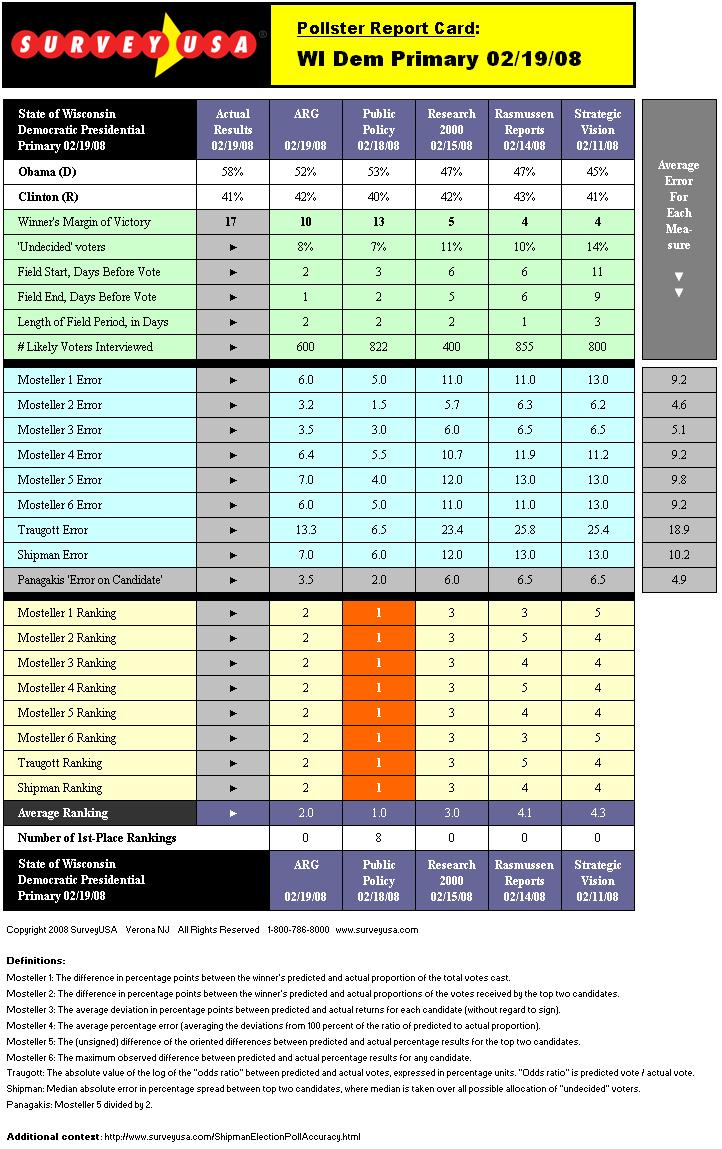
PPP first entered prominence through its performance in the 2008 Democratic primaries between Barack Obama and Hillary Clinton. The company performed well, producing accurate predictions in states ranging from South Carolina to Wisconsin, many of which featured inaccurate results by other pollsters. After the November election, PPP was ranked by the Wall Street Journal as one of the two most accurate firms, among those who were most active in the presidential swing states.
2010
PPP was the first pollster to find Scott Brown with a lead over Martha Coakley in the Massachusetts Senate special election; Brown ultimately won in a major comeback, and PPP's final poll in that race predicted Brown's winning margin exactly.
2011
PPP was praised in two articles from politico.com for its accuracy in polling the 2011 primaries and special elections, which are notoriously hard to predict. The contests they accurately predicted include the West Virginia gubernatorial primaries, special elections in New York and California, as well as all eight Wisconsin recall elections.
2012
A study by Fordham University found that, of 28 firms studied, PPP had the most accurate poll on the presidential national popular vote, both its independently conducted poll and the one it does in collaboration with the Daily Kos and the SEIU. PPP correctly called the winner of the presidential election in all 19 states it polled in the final week of the election, as well as the winners of all the U.S. Senate and gubernatorial races it surveyed.
2014
Political research firm YouGov found PPP's gubernatorial polls to have the lowest average margin of error among national firms that polled in at least five gubernatorial races in the month preceding the election.
2016
In the 2016 Presidential Election, PPP's final polls widely missed the mark in several key swing states, including New Hampshire, North Carolina, Pennsylvania, and Wisconsin. Their polls also significantly underestimated President Trump's lead in Ohio, and incorrectly predicted Hillary Clinton to win Florida.
Methodology and reception
The company's surveys use Interactive Voice Response (IVR), an automated questionnaire used by other polling firms such as SurveyUSA and Rasmussen Reports. The journalist Nate Cohn has criticized the company's methodology as being "unscientific".
In 2013 columnist Nate Cohn described PPP as a liberal pollster. Statistician Nate Silver stated that PPP had a tendency to slightly lean Democratic by 1% as of January 2022. As of January 2022, Silver's website, FiveThirtyEight, gave PPP a A− grade in its pollster ranking.
References
References
- Pathé, Simone. (March 23, 2016). "Not Your Average Pollster: He Says Phones Are Out and Trump Is Credible". [[Roll Call]].
- Sarlin, Benjy. (August 22, 2011). "How PPP Became The 'It' Democratic Pollster". [[Talking Points Memo]].
- Kraushaar, Josh. (June 23, 2009). "Sen. launches attack -- on polling firm". [[Politico]].
- "Dean Debnam Obituary - Raleigh, NC".
- [http://www.publicpolicypolling.com/aboutppp/about-us-bios.html "About Us"] {{Webarchive. link. (2012-11-22 , ''Public Policy Polling'', 2012. Retrieved on 6 December 2012.)
- Rosenbaum, Ron. (July 19, 2011). "Only 19 Percent of Republicans Think Obama Would Be Raptured". Slate.
- (13 May 2013). "Hipster Tax For Being 'So Annoying' Backed By 27 Percent Of Americans: Poll". The Huffington Post.
- (26 February 2016). "Is Ted Cruz the Zodiac Killer? Maybe, Say 38 Percent of Florida Voters".
- "Trump Leads Rubio in Florida- Even Head to Head". Public Policy Polling.
- (January 26, 2008). "PPP: most accurate numbers in the country for South Carolina". Public Policy Polling.
- "Archived copy".
- Taylor, Jessica. (January 9, 2010). "Poll: Scott Brown ahead of Martha Coakley by 1 point". Politico.
- Catanese, David. (July 14, 2011). "The polling is right: Why PPP deserves props". Politico.
- Isenstadt, Alex. (25 May 2011). "NY-26: The winners and losers". Politico.
- Leighton, Kyle. (7 November 2012). "Fordham Study: Public Policy Polling Deemed Most Accurate National Pollster In 2012". Talking Points Memo.
- Easley, Jonathan. (7 November 2012). "Study finds PPP was the most accurate pollster in 2012". The Hill.
- Mahtesian, Charles. (7 November 2012). "PPP nailed it". Politico.
- Bialik, Carl. (7 November 2012). "How did pollsters fare on election night?". Wall Street Journal.
- Lauter, David. (8 November 2012). "Which pollsters did best: Non-traditional methods were standouts". Los Angeles Times.
- Enten, Harry. (7 November 2012). "How the pollsters won the 2012 US election, mostly". The Guardian.
- LoGiurato, Brett. (12 November 2012). "How a three-man polling team completely nailed their election prediction". Business Insider.
- "YouGov {{!}} YouGov poll performance in the 2014 Governor elections".
- "Archived copy".
- "Archived copy".
- "Archived copy".
- "Archived copy".
- ((PublicPolicyPolling)). (7 November 2016). "Post Labor Day we haven't done a single Ohio poll that had either candidate up by more than 1".
- ((PublicPolicyPolling)). (7 November 2016). "Think Hillary will win both but more confident about Florida".
- Bialik, Carl. (November 6, 2008). "Polls Foresaw Future, Which Looks Tough for Polling". [[The Wall Street Journal]].
- Cohn, Nate. (2013-09-12). "There's Something Wrong With America's Premier Liberal Pollster".
- "PPP Polling Methodology: Opaque, Flawed | New Republic".
- Silver, Nate. (2016-06-02). "FiveThirtyEight's Pollster Ratings".
This article was imported from Wikipedia and is available under the Creative Commons Attribution-ShareAlike 4.0 License. Content has been adapted to SurfDoc format. Original contributors can be found on the article history page.
Ask Mako anything about Public Policy Polling — get instant answers, deeper analysis, and related topics.
Research with MakoFree with your Surf account
Create a free account to save articles, ask Mako questions, and organize your research.
Sign up freeThis content may have been generated or modified by AI. CloudSurf Software LLC is not responsible for the accuracy, completeness, or reliability of AI-generated content. Always verify important information from primary sources.
Report