From Surf Wiki (app.surf) — the open knowledge base
Pteruges
Decorative leather or fabric strips worn by Roman and Greek soldiers

Decorative leather or fabric strips worn by Roman and Greek soldiers
Pteruges (also spelled pteryges; ) are strip-like defences for the upper parts of limbs attached to armor of the Greco-Roman world.
Appearance and variation
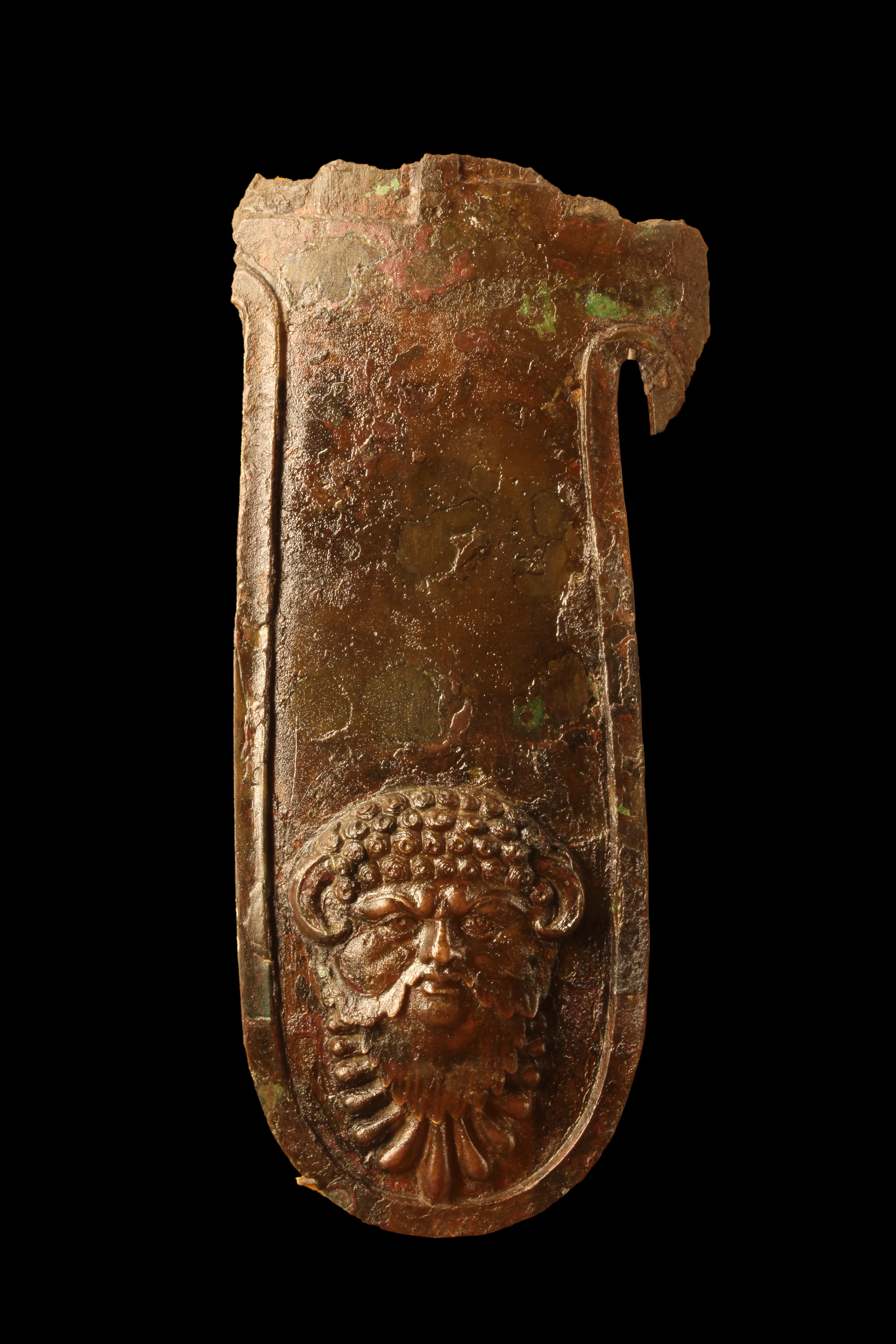
Pteruges formed a defensive skirt of leather or multi-layered fabric (linen) strips or lappets worn hanging from the waists of Roman and Greek cuirasses of warriors and soldiers, defending the hips and thighs. Similar defenses, epaulette-like strips, were worn on the shoulders, protecting the upper arms. Both sets of strips are usually interpreted as belonging to a single garment worn under a cuirass, though in a linen cuirass (linothorax) they may have been integral. The cuirass itself could be variously constructed: of plate-bronze (muscle cuirass), linothorax, scale, lamellar or mail. Pteruges could be arranged as a single row of longer strips or in two or more layers of shorter, overlapping lappets of graduated length.
Possible later use
During the Middle Ages, especially in the Byzantine Empire and in the Middle East, such strips are depicted descending from the back and sides of helmets, to protect the neck while leaving it reasonably free to move. However, no archaeological remains of leather strip defenses for helmets have been found. Artistic depictions of such strip-like elements can also be interpreted as vertically-stitched quilted textile defenses.
References
Bibliography
- {{cite book
References
- Aldrete ''et al.'', cited throughout
- Dawson, Timothy: Byzantine Infantryman, Oxford (2007), pp. 20–21
This article was imported from Wikipedia and is available under the Creative Commons Attribution-ShareAlike 4.0 License. Content has been adapted to SurfDoc format. Original contributors can be found on the article history page.
Ask Mako anything about Pteruges — get instant answers, deeper analysis, and related topics.
Research with MakoFree with your Surf account
Create a free account to save articles, ask Mako questions, and organize your research.
Sign up freeThis content may have been generated or modified by AI. CloudSurf Software LLC is not responsible for the accuracy, completeness, or reliability of AI-generated content. Always verify important information from primary sources.
Report