From Surf Wiki (app.surf) — the open knowledge base
Pterion
Meeting point between the frontal, parietal, temporal, and sphenoid bones of the skull
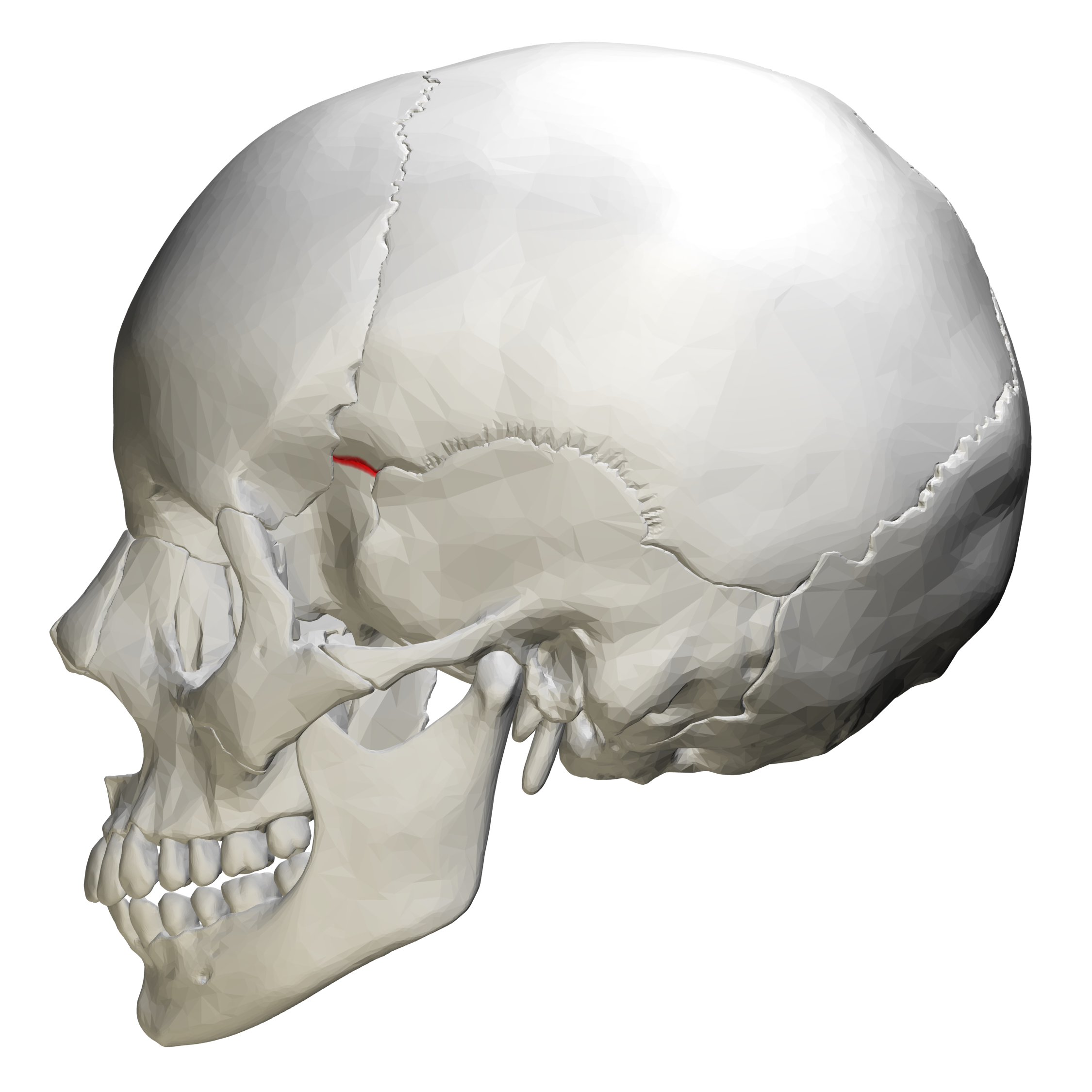
Meeting point between the frontal, parietal, temporal, and sphenoid bones of the skull
| Field | Value |
|---|---|
| Name | Pterion |
| Latin | pterion |
| Image | Pterion.PNG |
| Caption | Side view of head, showing surface relations of bones (Pterion labeled at center) |
| Image2 | Gray188-Sphenoparietal suture.png |
| Caption2 | Side view of the skull with arrow pointing to the Pterion |
The pterion is the region where the frontal, parietal, temporal, and sphenoid bones join. It is located on the side of the skull, just behind the temple. It is also considered to be the weakest part of the skull, which makes it clinically significant, as if there is a fracture around the pterion it could be accompanied by an epidural hematoma.
Structure
The pterion is located in the temporal fossa, approximately 2.6 cm behind and 1.3 cm above the posterolateral margin of the frontozygomatic suture.
It is the junction between four bones:
- the parietal bone.
- the squamous part of temporal bone.
- the greater wing of sphenoid bone.
- the frontal bone.
These bones are typically joined by five cranial sutures:
- the sphenoparietal suture joins the sphenoid and parietal bones.
- the coronal suture joins the frontal bone to the sphenoid and parietal bones.
- the squamous suture joins the temporal bone to the sphenoid and parietal bones.
- the sphenofrontal suture joins the sphenoid and frontal bones.
- the sphenosquamosal suture joins the sphenoid and temporal bones.
Clinical significance
Hematoma
The pterion is known as the weakest part of the skull. The anterior division of the middle meningeal artery runs underneath the pterion. Consequently, a traumatic blow to the pterion may rupture the middle meningeal artery causing an epidural haematoma. The pterion may also be fractured indirectly by blows to the top or back of the head that place sufficient force on the skull to fracture the pterion.
Surgery
The pterion is a structural landmark for neurosurgical approach to middle cerebral artery aneurysms.
Etymology
The pterion receives its name from the Ancient Greek root πτερόν pteron, meaning 'wing'. In Greek mythology, Hermes, messenger of the gods, was enabled to fly by winged sandals, and wings on his head, which were attached at the pterion.
References
References
- R.M. McMinn.Last's anatomy regional and applied, 9th edition. Edinburgh (UK): Churchill Livingstone; 1994. Page 645
- Siyan, MA. (April 2012). "Reappraising the surface anatomy of the pterion and its relationship to the middle meningeal artery". Clinical Anatomy.
- (2004). "Questions for the MRCS Vivas".
- Weston, Gabriel. (22 August 2011). "Mapping the Body: The Temple". The Guardian.
- (2003-04-01). "Morphological variability of pterion in the human skull". Italian Journal of Anatomy and Embryology = Archivio Italiano di Anatomia ed Embriologia.
This article was imported from Wikipedia and is available under the Creative Commons Attribution-ShareAlike 4.0 License. Content has been adapted to SurfDoc format. Original contributors can be found on the article history page.
Ask Mako anything about Pterion — get instant answers, deeper analysis, and related topics.
Research with MakoFree with your Surf account
Create a free account to save articles, ask Mako questions, and organize your research.
Sign up freeThis content may have been generated or modified by AI. CloudSurf Software LLC is not responsible for the accuracy, completeness, or reliability of AI-generated content. Always verify important information from primary sources.
Report