From Surf Wiki (app.surf) — the open knowledge base
Psychological torture
Type of torture

Type of torture
Psychological torture, mental torture or emotional torture is a type of torture that relies primarily on psychological effects and only secondarily on any physical harm inflicted. Although not all psychological torture involves the use of physical violence, there is a continuum between psychological torture and physical torture. The two are often used in conjunction with one another and often overlap in practice, with the fear and pain induced by physical torture often resulting in long-term psychological effects and many forms of psychological torture involving some form of pain or coercion.
United Nations Convention against Torture
The Convention against Torture and Other Cruel, Inhuman or Degrading Treatment or Punishment (commonly known as the United Nations Convention against Torture) is an international human rights treaty, under the review of the United Nations, that aims to prevent torture and other acts of cruel, inhuman, or degrading treatment or punishment around the world. The Convention requires states to take effective measures to prevent torture in any state under their jurisdiction and forbids states to transport people to any country where there is a reason to believe torture could occur.
The text of the Convention was adopted by the United Nations General Assembly on 10 December 1984 and following ratification by the 20th state party, it came into force on 26 June 1987. 26 June is now recognized as the International Day in Support of Victims of Torture, in honor of the Convention. As of May 2015, the Convention has 158 state parties.
The Convention gave for the first time in history a definition of psychological torture:
The Optional Protocol to such Convention (OPCAT, 2006) is an important addition to the United Nations Convention. The Committee Against Torture (CAT) is a body of independent experts that monitors implementation of the Convention by State parties. All-State parties are obliged under the Convention to submit regular reports to the CAT on how the rights are being implemented. Upon ratifying the Convention, States must submit a report within one year, after which they are obliged to report every four years. The Committee examines each report and addresses its concerns and recommendations to the State party in the form of "concluding observations". Under certain circumstances, the CAT may consider complaints or communications from individuals claiming that their rights under the Convention have been violated. The CAT usually meets in May and November each year in Geneva.
A contemporary definition of psychological torture are those processes that "involve attacking or manipulating the inputs and processes of the conscious mind that allow the person to stay oriented in the surrounding world, retain control and have the adequate conditions to judge, understand and freely make decisions which are the essential constitutive ingredients of an unharmed self". The Torturing Environment Scale is the first scale to measure Torturing Environments based on this model.
Types of psychological torture
Many forms of psychological torture methods attempt to destroy the subject's normal self-image by removing them from any kind of control over their environment, isolation, monopolising of perception, impression of almightiness, creating a state of learned helplessness, psychological regression and depersonalization. Other techniques include humiliation, forced nudity and head shaving, exhausting by sleep deprivation, hooding and other forms of sensory deprivation.
A strictly fear-inducing method is the mock execution. Various threats operate on the same fear-inducing principle.
Torture methods can also be indirect, in which a victim is forced to witness the torture of another person, often a loved one. This preys on the victim's affection for and loyalty to a partner, relative, friend, comrade-in-arms, etc, whose real pain induces vicarious suffering in the targeted psychological victim, who is thus loaded with guilt but spared physical harm that might affect their ability to comply.
The publicly known systematics were developed in 1956 by the American psychiatrist Albert Biderman who examined several U.S. soldiers tortured by North Korean and Chinese secret services during the Korean war. He defined three basic actions to break the victims as dependence, debility, and dread. His work was further developed for the CIA.{{Cite journal|last=Fricke|first=Hanes|title="The liquidation of the particular": On Anxiety, the Misuse of Trauma Theory, Bourgeois Coldness, the Absence of Self-Reflection of Literary Theory, and "something uncomfortable and dangerous" in Connection with Stefan Zweig's Schachnovelle |journal=Journal of Literary Theory |url-status=live
White torture
White torture, often referred to as white room torture, is a technique aimed at complete sensory deprivation and isolation. A prisoner is held in a cell that is devoid of any color besides white, this method of torture is designed to deprive the prisoner of all senses and identity.
Visually, the prisoner is deprived of all colour. Guards stand in silence, wearing padded shoes to avoid making any noise. Typically, prisoners will become depersonalized by losing personal identity for extended periods of isolation. Other effects can include hallucinations or psychosis.
Effect of torture
While psychological torture may not leave any lasting physical damage—indeed, this is often one of the motivations for using psychological rather than physical torture—it can result in similar levels of permanent mental damage to its victims.
Psychological torture methods were devised by, and in conjunction with, doctors and psychologists. Medical participation in torture has taken place throughout the world and was a prominent feature of the US interrogation practice in military and Central Intelligence Agency (CIA) facilities.
Incidents of torture
Iran
In Iran, white torture () has been practiced on political prisoners by the Islamic republic. Most political prisoners who experience this type of torture are journalists held in the Evin prison. "Amir Fakhravar, the Iranian white room prisoner, was tortured at Evin prison for 8 months in 2004. He still has trauma regarding his times in the white room." According to Hadi Ghaemi, such tortures in Evin are not necessarily authorized directly by the Iranian government.
It can include prolonged periods of solitary confinement, the use of continual illumination to deprive sleep (listed in the Geneva Convention on Basic Human Rights, 1949) often in detention centers outside the control of the prison authorities, including Section 209 of Evin Prison.
Ahmed Shaheed, the United Nations special human rights reporter in Iran, mentioned in a statement that human rights activist Vahid Asghari was psychologically tortured by means of long-term detention in solitary confinement and with threats to arrest, torture or rape his family members. He was also reportedly tortured with severe beatings for the purpose of eliciting confessions.
A 2004 Amnesty International report documented the use of white torture on Amir Fakhravar by the Revolutionary Guards, the first known example of white torture in Iran. It states that "his cells had no windows, and the walls and his clothes were white. His meals consisted of white rice on white plates. To use the toilet, he had to put a white piece of paper under the door. He was forbidden to speak, and the guards reportedly wore shoes that muffled sound". Upon his arrival in the US, Fakhravar confirmed this report in an interview with Christian Broadcasting Network.
In a telephone call to the Human Rights Watch in 2004, the Iranian journalist Ebrahim Nabavi said:
Since I left Evin, I have not been able to sleep without sleeping pills. It is terrible. The loneliness never leaves you, long after you are 'free.' Every door that is closed on you.... This is why we call it 'white torture.' They get what they want without having to hit you. They know enough about you to control the information that you get: they can make you believe that the president has resigned, that they have your wife, that someone you trust has told them lies about you. You begin to break. And once you break, they have control. And then you begin to confess.
United States
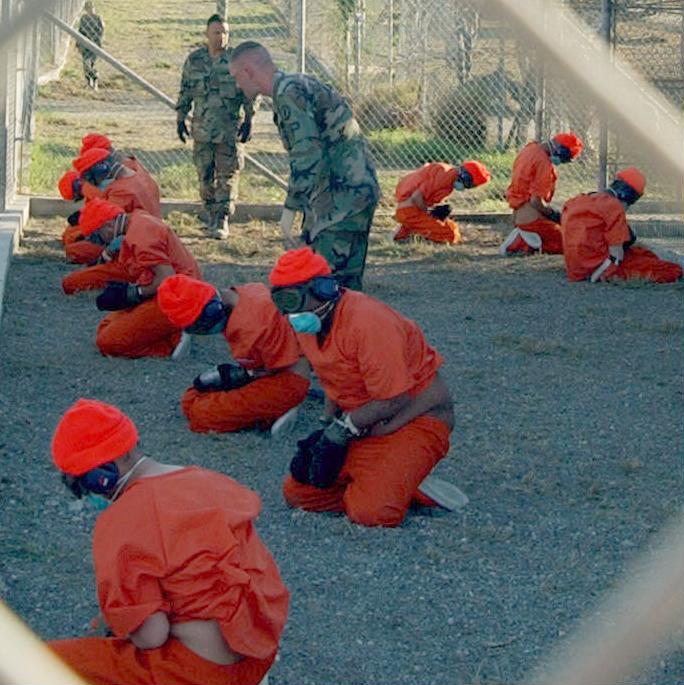
The United States made extensive use of psychological torture techniques at Guantanamo Bay and other sites subsequent to the 9/11 attacks. The United States has held Guantanamo Bay detention camp prisoners under sensory deprivation, with their ears and eyes covered, hands and feet tied, hands in thick gloves, and held in cages without any privacy, always observed under a light that is on day and night. The organization of European Democratic Lawyers (EDL) said that this constitutes white torture and has accused the United States of violating prisoners' fundamental rights. Prisoners are also held in "extreme isolation", confined to windowless cells, going days "without seeing daylight" suffering what Amnesty International and other international human rights organizations have said are torture techniques approved by the George W. Bush administration under the euphemism "enhanced interrogation". Rainer Mausfeld, a researcher in the field of psychology and cognitive science, has criticized the practice.
Venezuela
According to human rights organizations and other NGOs, the Bolivarian Intelligence Service (SEBIN) of the Venezuelan government holds political prisoners in the lower levels of SEBIN's headquarters, which has been deemed by government officials La Tumba "The Tomb". The cells are 2 by with a cement bed, white walls, and security barriers between one another so that there is no interaction between prisoners. Such conditions have caused prisoners to become very ill, but they are denied medical treatment. Bright lights in the cells are kept on so prisoners lose their sense of time and the temperature is below freezing, with the only sounds heard being from the nearby Caracas Metro trains. Reports of torture in La Tumba, specifically white torture, are also common, with some prisoners attempting to commit suicide. Such conditions according to the NGO Justice and Process are to make prisoners plead guilty to the crimes that they are accused of.
References
References
- (2007). "The World Rule of Law Movement and Russian Legal Reform". Justitsinform.
- (10 December 1984). "Convention against Torture". [[United Nations Human Rights Council]].
- Pérez-Sales, Pau. (2017). "Psychological torture : definition, evaluation and measurement". Routledge.
- Reyes, Hernán. (2007). "The worst scars are in the mind: psychological torture". [[International Review of the Red Cross]].
- Cesereanu, Ruxandra. (Summer 2006). "An Overview of Political Torture in the Twentieth Century". Journal for the Study of Religions and Ideologies.
- Canadian Centre for Victims of Torture (CCVT). (2004). "In Our Midst: Educational Aids to Work with Survivors of Torture and Organized Violence".
- (31 March 2004). "Helping to break the Silence: Urgent Actions on Iran". [[Amnesty International]].
- Beehner, Lionel. (9 August 2006). "Iran's Waning Human Rights". [[Council on Foreign Relations]] (CFR).
- (April 2023)
- Khamsi, Roxanne. (5 March 2007). "Psychological torture 'as bad as physical torture'". [[New Scientist]].
- (February 11, 2008). "Psychological torture: a CIA history". Mind Hacks.
- (2018-02-02). "Clinical care and complicity with torture". [[The BMJ]].
- (November 2012). "The role of doctors in investigation, prevention and treatment of torture". Journal of the Royal Society of Medicine.
- (15 July 2009). "NCRI Women's Committee calls for release of Taraneh Mousavi".
- Vick, Karl. (June 7, 2004). "Report Cites 'Climate of Fear' in Iran". [[The Washington Post]].
- (March 15, 2005). "UN human rights commission urged to sanction Iran". [[Reporters Without Borders]].
- (January 10, 2007). "Iran:... Kianoosh Sanjari". Amnesty International.
- Saunders, Doug. (February 19, 2007). "Few know who is held behind the tiled walls of Tehran's Evin prison". [[The Globe and Mail]].
- "Vahid Asghari was beaten to make confess". Human Rights Group in US.
- "United Nations Report".
- Baxter, Sarah. (May 21, 2006). "Fugitive pleads with US to 'liberate' Iran". [[The Sunday Times (UK).
- (March 6, 2007). "Country Reports on Human Rights Practices - Iran in 2006". Bureau of Democracy, Human Rights, and Labor; [[United States Department of State]].
- McCann, Cathy. (March 17, 2004). "Student/Journalist Ill-treated in Jail". NEAR International.
- Lake, Eli. (May 9, 2006). "Iranian Dissident to Seek Support For Opposition". [[The New York Sun]].
- (June 2004). "Like the Dead...Crushing of dissidents in Iran". [[Human Rights Watch]].
- John Hickman. 2013. ''Selling Guantanamo: Exploding the Propaganda Surrounding America's Most Notorious Military Prison''. University Press of Florida. {{ISBN. 978-0813044552 pp. 180-181.
- Klein, Naomi. (23 February 2007). "The US psychological torture system is finally on trial". The Guardian.
- Alfred W. McCoy. (June 11, 2009). "The CIA's secret history of psychological torture". Salon.com.
- (July 2004). "European Democratic Lawyers (EDL) statement on Guantanamo Bay and other detention centres".
- [http://news.bbc.co.uk/2/hi/americas/6526589.stm Guantanemo conditions 'worsening'] [[BBC News]] April 4, 2007
- [http://hrw.org/english/docs/2004/12/21/usint9925.htm US: Did President Bush Order Torture] Human Rights Watch, Dec. 21, 2004
- "These Are The 13 'Enhanced Interrogation Techniques' The CIA Used On Detainees". Business Insider.
- Mausfeld, Rainer. (2009). "Psychologie, 'weiße Folter' und die Verantwortlichkeit von Wissenschaftlern". Psychologische Rundschau.
- (2015). "Un calabozo macabro".
- "Statement of Santiago A. Canton Executive Director, RFK Partners for Human Rights Robert F. Kennedy Human Rights".
- (10 February 2015). ""La tumba", siete celdas de tortura en el corazón de Caracas".
- (25 July 2015). "Political protesters are left to rot in Venezuela's secretive underground prison".
This article was imported from Wikipedia and is available under the Creative Commons Attribution-ShareAlike 4.0 License. Content has been adapted to SurfDoc format. Original contributors can be found on the article history page.
Ask Mako anything about Psychological torture — get instant answers, deeper analysis, and related topics.
Research with MakoFree with your Surf account
Create a free account to save articles, ask Mako questions, and organize your research.
Sign up freeThis content may have been generated or modified by AI. CloudSurf Software LLC is not responsible for the accuracy, completeness, or reliability of AI-generated content. Always verify important information from primary sources.
Report