From Surf Wiki (app.surf) — the open knowledge base
Pseudoconvex function
Type of function

Type of function
In convex analysis and the calculus of variations, both branches of mathematics, a pseudoconvex function is a function that behaves like a convex function with respect to finding its local minima, but need not actually be convex. Informally, a differentiable function is pseudoconvex if it is increasing in any direction where it has a positive directional derivative. The property must hold in all of the function domain, and not only for nearby points.
Formal definition
Consider a differentiable function f:X \subseteq \mathbb{R}^{n} \rightarrow \mathbb{R}, defined on a (nonempty) convex open set X of the finite-dimensional Euclidean space \mathbb{R}^n. This function is said to be pseudoconvex if the following property holds:
: for all x,y \in X: \quad \nabla f(x) \cdot (y-x) \geq 0 \Rightarrow f(y) \geq f(x).
Equivalently:
: for all x,y \in X: \quad f(y)
Here \nabla f is the gradient of f, defined by: \nabla f = \left(\frac{\partial f}{\partial x_1},\dots,\frac{\partial f}{\partial x_n}\right).
Note that the definition may also be stated in terms of the directional derivative of f, in the direction given by the vector v=y-x. This is because, as f is differentiable, this directional derivative is given by:
: \frac{\partial f}{\partial v}(x) = \nabla f(x) \cdot v = \nabla f(x) \cdot (y-x).
Properties
Relation to other types of "convexity"
Every convex function is pseudoconvex, but the converse is not true. For example, the function f(x) = x + x^{3} is pseudoconvex but not convex. Similarly, any pseudoconvex function is quasiconvex; but the converse is not true, since the function f(x) = x^{3} is quasiconvex but not pseudoconvex. This can be summarized schematically as:
: convex \Rightarrow pseudoconvex \Rightarrow quasiconvex
To see that f(x) = x^{3} is not pseudoconvex, consider its derivative at x = 0: f^{\prime}(0) = 0. Then, if f(x) = x^{3} was pseudoconvex, we should have:
: f^{\prime}(0) (y-0) = 0 \geq 0 \Rightarrow f(y) \geq f(0), \quad \forall , y \in \mathbb{R}.
In particular it should be true for y=-1. But it is not, as: f(-1) = (-1)^{3} = -1 .
Sufficient optimality condition
For any differentiable function, we have the Fermat's theorem necessary condition of optimality, which states that: if f has a local minimum at x^{} in an open domain, then x^{} must be a stationary point of f (that is: \nabla f(x^{*}) = 0).
Pseudoconvexity is of great interest in the area of optimization, because the converse is also true for any pseudoconvex function. That is: if x^{} is a stationary point of a pseudoconvex function f, then f has a global minimum at x^{}. Note also that the result guarantees a global minimum (not only local).
This last result is also true for a convex function, but it is not true for a quasiconvex function. Consider for example the quasiconvex function:
: f(x)=\frac{e^{x}}{x^{2}+1} + \frac{1}{e^{x}}.
This function is not pseudoconvex, but it is quasiconvex. Also, the point x=0 is a critical point of f, as f^{\prime}(0)=0. However, f does not have a global minimum at x=0 (not even a local minimum).

Finally, note that a pseudoconvex function may not have any critical point. Take for example the pseudoconvex function: f(x)=x^{3}+x, whose derivative is always positive: f^{\prime}(x)=3x^{2}+10, , \forall , x \in \mathbb{R}.
Examples
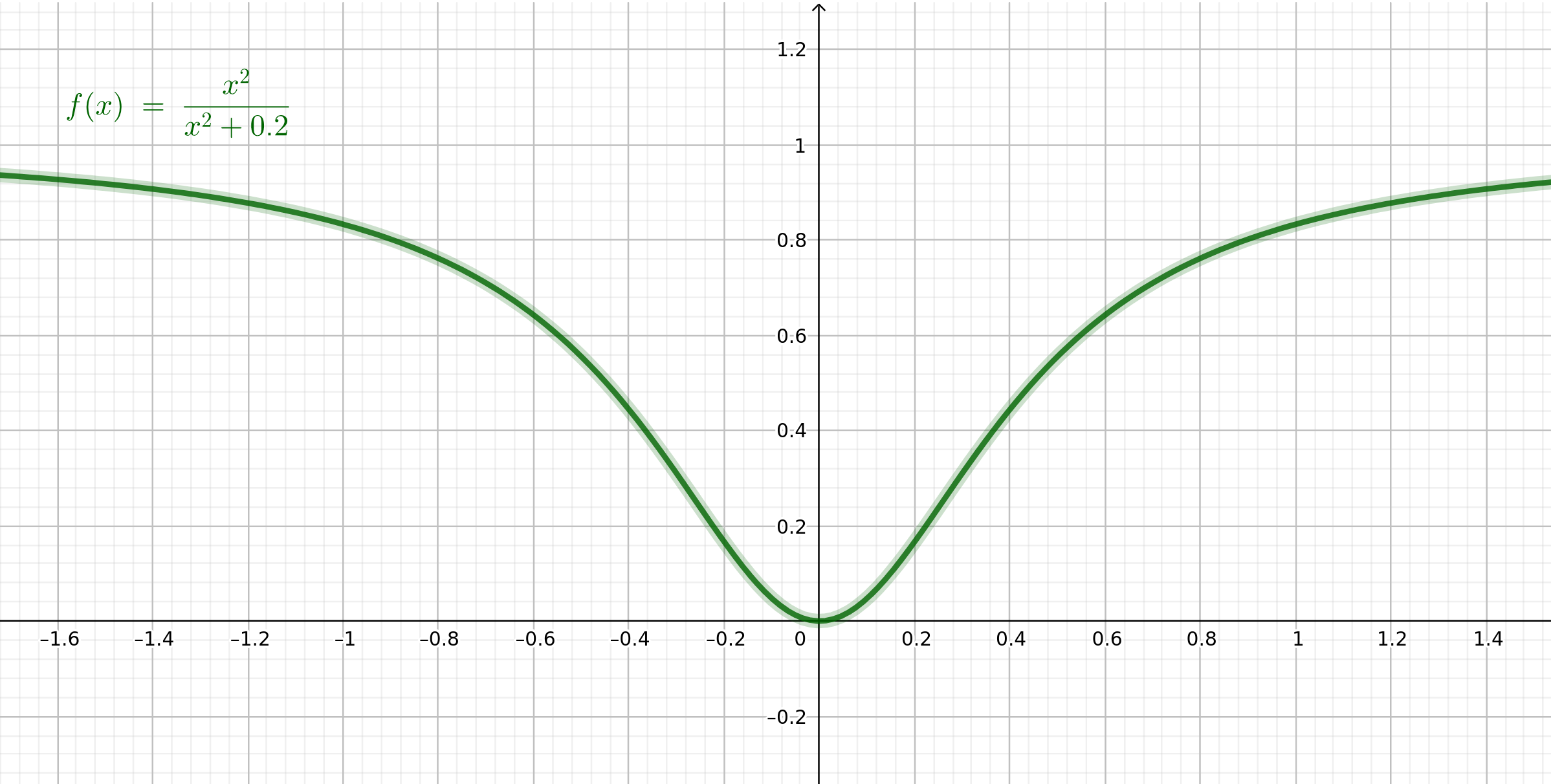
An example of a function that is pseudoconvex, but not convex, is: f(x)=\frac{x^{2}}{x^{2}+k}, , k 0. The figure shows this function for the case where k=0.2. This example may be generalized to two variables as:
: f(x)=\frac{x^{2}+y^{2}}{x^{2}+y^{2}+k}, , k 0.
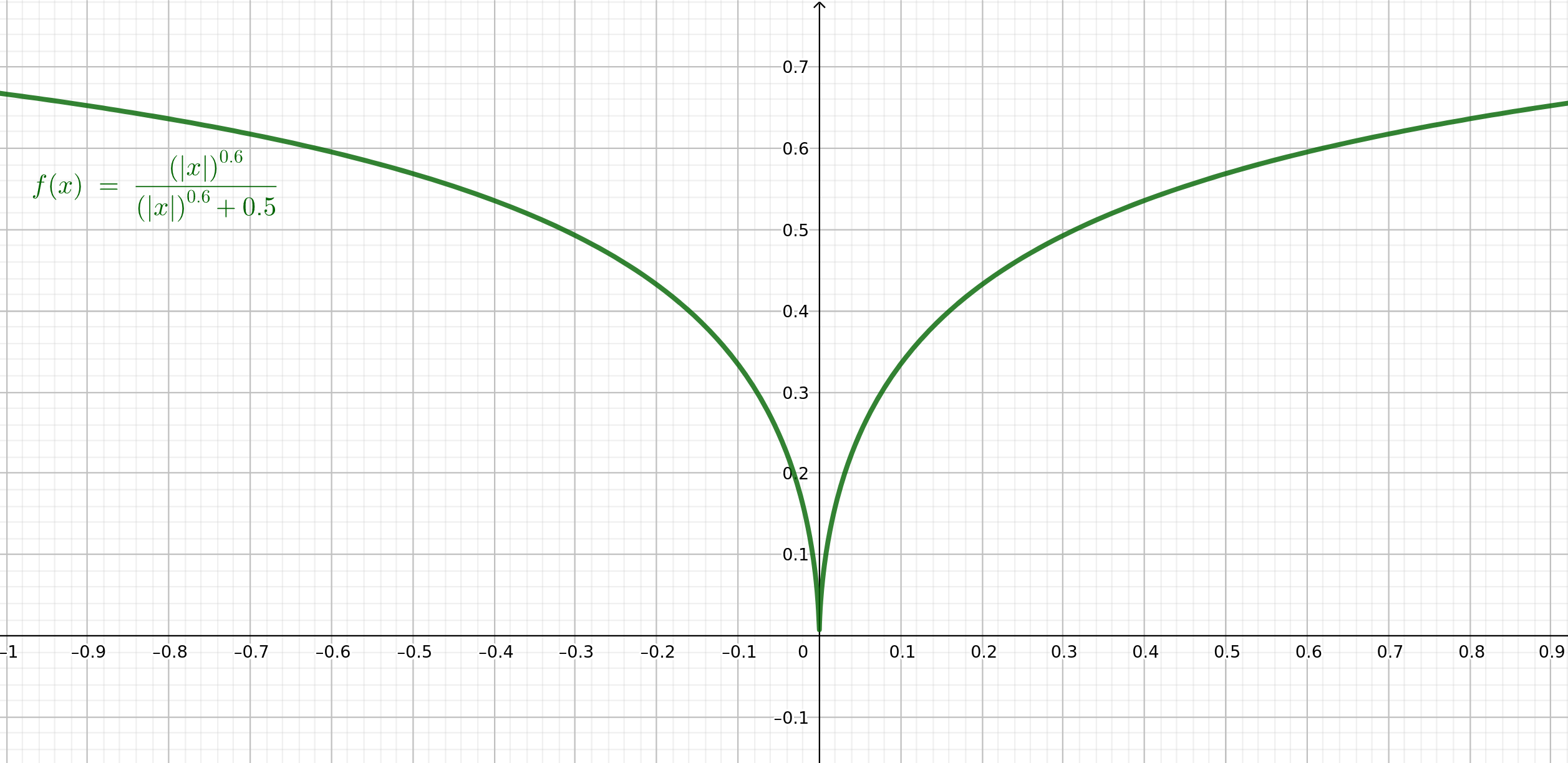
The previous example may be modified to obtain a function that is not convex, nor pseudoconvex, but is quasiconvex:
: f(x)=\frac{|x|^{p}}{|x|^{p}+k}, , k 0, , p \in (0,1).
The figure shows this function for the case where k=0.5, p=0.6. As can be seen, this function is not convex because of the concavity, and it is not pseudoconvex because it is not differentiable at x=0.
Generalization to nondifferentiable functions
The notion of pseudoconvexity can be generalized to nondifferentiable functions as follows. Given any function f:X \rightarrow \mathbb{R}, we can define the upper Dini derivative of f by:
: f^{+}(x,u) = \limsup_{ h \to 0^{+} } \frac{f(x+hu) - f(x)}{h};
where u is any unit vector. The function is said to be pseudoconvex if it is increasing in any direction where the upper Dini derivative is positive. More precisely, this is characterized in terms of the subdifferential \partial f as follows:
: For all x, y \in X: if x^* \in \partial f(x) is such that \langle x^* , y - x \rangle \geq 0, then f(x) \leq f(z), for all z \in [x,y];
where [x,y] denotes the line segment adjoining x and y.
Notes
References
- .
- .
References
- {{harvnb. Mangasarian. 1965
- {{harvnb. Mangasarian. 1965
- {{harvnb. Floudas. Pardalos. 2001
- {{harvnb. Rapcsak. 1991
- (2013). "Generalized Convexity, Nonsmooth Variational Inequalities, and Nonsmooth Optimization". CRC Press.
- (2008). "Invexity and Optimization". Springer Science & Business Media.
This article was imported from Wikipedia and is available under the Creative Commons Attribution-ShareAlike 4.0 License. Content has been adapted to SurfDoc format. Original contributors can be found on the article history page.
Ask Mako anything about Pseudoconvex function — get instant answers, deeper analysis, and related topics.
Research with MakoFree with your Surf account
Create a free account to save articles, ask Mako questions, and organize your research.
Sign up freeThis content may have been generated or modified by AI. CloudSurf Software LLC is not responsible for the accuracy, completeness, or reliability of AI-generated content. Always verify important information from primary sources.
Report