From Surf Wiki (app.surf) — the open knowledge base
Psalm 146
146th psalm of the book of psalms
146th psalm of the book of psalms
| Field | Value | |
|---|---|---|
| subtitle | "Praise ye the LORD. Praise the LORD, O my soul." | |
| name | Psalm 146 | |
| image | Folio 85r - Psalm CXLV.jpg | |
| image_upright | 1.2 | |
| caption | Psalm 146 in Les Très Riches Heures du duc de Berry | |
| language | Hebrew (original) | |
| other_name | {{plainlist |
- Psalm 145
- "Lauda anima mea Dominum" Psalm 146 is the 146th psalm of the Book of Psalms, beginning in English in the King James Version, "Praise ye the LORD. Praise the LORD, O my soul". In Latin, it is known as "Lauda anima mea Dominum".
In the slightly different numbering system used in the Greek Septuagint version of the Bible, and in the Latin Vulgate/Vulgata Clementina, this psalm is Psalm 145.
Psalm 146 is used as a regular part of Jewish, Catholic, Lutheran, Anglican and other Protestant liturgies. It has often been set to music, paraphrased in hymns such as Paul Gerhardt's German "Du meine Seele singe" (You my soul sing), and used in cantatas such as Bach's early Lobe den Herrn, meine Seele, BWV 143 (Praise the Lord, my soul).
Background
Psalm 146 is the first of five final concluding praise Psalms in the Book of Psalms. These psalms are not attributed to David; in the Septuagint, Psalms 145 (this psalm) to 148 are given the title "of Haggai and Zechariah". Psalms 146 and 147 are seen by some as twin Psalms. Both psalms draw on images from Isaiah 61 (which Jesus takes as applying to himself in Luke 4), such as setting captives free and opening blind eyes in Psalm 147, and healing the brokenhearted in Psalm 148. Besides Isaiah 61, the themes in this Psalm are also found on Leviticus 25 (the year of Jubilee). This is one of six Psalms involving preaching to self, with the evocative phrase "O my soul" being used. Preaching to self was highly recommended by Welsh Minister Martyn Lloyd-Jones as he said "Have you realized that most of your unhappiness in life is due to the fact that you are listening to yourself instead of talking to yourself?"
Uses
New Testament
- Verse 6 is quoted in the New Testament in Acts ; Acts
Judaism
- The psalm in its entirety is recited during Pesukei Dezimra, the initial section of the daily morning prayer service.
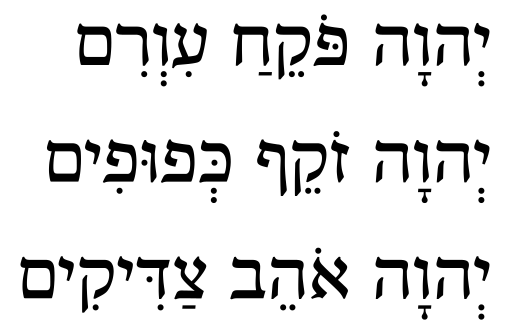
- The blessings Pokeiakh Ivrim ("gives sight to the blind"), Matir asurim ("releases the bound"), Zokef kefufim ("straightens the bent"), from the Birkat HaShachar are derived from Psalm 146:7-8.
- Verse 10 is part of Kedusha, and is a part of the third blessing of the High Holidays Amidah.
Catholic Church
- Since the Middle Ages, this psalm was recited or sung during the vespers office on Thursday, according to the Rule of St. Benedict, established in 530 AD. In the modern Roman Catholic Liturgy of the Hours, Psalm 139 is recited at Vespers, and also Wednesdays in the fourth and final week of the cycle of liturgical prayers. In the liturgy of the Mass, it is played or sung for the feast of St. John the Baptist.
Book of Common Prayer
In the Church of England's Book of Common Prayer, this psalm is appointed to be read on the morning of the thirtieth day of the month.
Coptic Orthodox Church
In the Agpeya, the Coptic Church's book of hours, this psalm is prayed in the office of Compline and the third watch of the Midnight office. It is also in the prayer of the Veil, which is generally prayed only by monks.
Musical settings
Psalm 146 was paraphrased in Paul Gerhardt's hymn in German "Du meine Seele singe" (You my soul sing), published in 1667 with a melody by Johann Georg Ebeling in the collection Pauli Gerhardi Geistliche-Andachten (Spiritual devotions by Paul Gerhardt).
Heinrich Schütz composed a four-part setting of a metric German version for the Becker Psalter, "Mein Seel soll loben Gott den Herrn (My soul shall praise God the Lord), SWV 251. Johann Sebastian Bach based an early church cantata, Lobe den Herrn, meine Seele, BWV 143 (Praise the Lord, my soul), on verses from the psalm. Carl Philipp Emanuel Bach included a setting for voice and in his collection of 42 psalms, Psalmen mit Melodien, H. 733, completed in 1774. The psalm is titled "Es werde Gott von uns erhoben!" (God shall be exsultet by us).
Alan Hovhaness set portions of this text, along with portions of Psalms 33 and 150, for his work Praise the Lord with Psaltery. Norma Wendelburg set the psalm to music in 1973, as Praise the Lord for mixed chorus and optional organ. Peter Heeren wrote a setting for mixed choir and piano in 2012, Der 146. Psalm.
Text
The following table shows the Hebrew text of the Psalm with vowels, alongside the Koine Greek text in the Septuagint and the English translation from the King James Version. Note that the meaning can slightly differ between these versions, as the Septuagint and the Masoretic Text come from different textual traditions.A 1917 translation directly from Hebrew to English by the Jewish Publication Society can be found here or here, and an 1844 translation directly from the Septuagint by L. C. L. Brenton can be found here. Both translations are in the public domain. In the Septuagint, this psalm is numbered Psalm 145.
| # | Hebrew | English | Greek |
|---|---|---|---|
| 1 | Praise ye the LORD. Praise the LORD, O my soul. | ᾿Αλληλούϊα· ᾿Αγγαίου καὶ Ζαχαρίου. - ΑΙΝΕΙ, ἡ ψυχή μου, τὸν Κύριον· | |
| 2 | While I live will I praise the LORD: I will sing praises unto my God while I have any being. | αἰνέσω Κύριον ἐν τῇ ζωῇ μου, ψαλῶ τῷ Θεῷ μου ἕως ὑπάρχω. | |
| 3 | Put not your trust in princes, nor in the son of man, in whom there is no help. | μὴ πεποίθατε ἐπ᾿ ἄρχοντας, ἐπὶ υἱοὺς ἀνθρώπων, οἷς οὐκ ἔστι σωτηρία. | |
| 4 | His breath goeth forth, he returneth to his earth; in that very day his thoughts perish. | ἐξελεύσεται τὸ πνεῦμα αὐτοῦ. καὶ ἐπιστρέψει εἰς τὴν γῆν αὐτοῦ· ἐν ἐκείνῃ τῇ ἡμέρᾳ ἀπολοῦνται πάντες οἱ διαλογισμοὶ αὐτοῦ. | |
| 5 | Happy is he that hath the God of Jacob for his help, whose hope is in the LORD his God: | μακάριος οὗ ὁ Θεὸς ᾿Ιακὼβ βοηθὸς αὐτοῦ, ἡ ἐλπὶς αὐτοῦ ἐπὶ Κύριον τὸν Θεὸν αὐτοῦ | |
| 6 | Which made heaven, and earth, the sea, and all that therein is: which keepeth truth for ever: | τὸν ποιήσαντα τὸν οὐρανὸν καὶ τὴν γῆν, τὴν θάλασσαν καὶ πάντα τὰ ἐν αὐτοῖς· τὸν φυλάσσοντα ἀλήθειαν εἰς τὸν αἰῶνα, | |
| 7 | Which executeth judgment for the oppressed: which giveth food to the hungry. The LORD looseth the prisoners: | ποιοῦντα κρῖμα τοῖς ἀδικουμένοις, διδόντα τροφὴν τοῖς πεινῶσι. Κύριος λύει πεπεδημένους, | |
| 8 | The LORD openeth the eyes of the blind: the LORD raiseth them that are bowed down: the LORD loveth the righteous: | Κύριος σοφοῖ τυφλούς, Κύριος ἀνορθοῖ κατερραγμένους, Κύριος ἀγαπᾷ δικαίους, | |
| 9 | The LORD preserveth the strangers; he relieveth the fatherless and widow: but the way of the wicked he turneth upside down. | Κύριος φυλάσσει τοὺς προσηλύτους· ὀρφανὸν καὶ χήραν ἀναλήψεται καὶ ὁδὸν ἁμαρτωλῶν ἀφανιεῖ. | |
| 10 | The LORD shall reign for ever, even thy God, O Zion, unto all generations. Praise ye the LORD. | βασιλεύσει Κύριος εἰς τὸν αἰῶνα, ὁ Θεός σου, Σιών, εἰς γενεὰν καὶ γενεάν. |
Verse 2
:While I live I will praise the Lord; :I will sing praises to my God while I have my being. The wording of Psalm 104:33 is "almost identical".
Notes
References
| author-link = Pamela Dellal | access-date = 27 February 2014
| access-date = 12 June 2015
References
- (2 May 2019). "Parallel Latin/English Psalter / Psalmus 145 (146)". medievalist.net.
- Henry, Matthew. "Psalms 147". Bible Study Tools.
- [[Alexander Kirkpatrick. Kirkpatrick, A.]], [https://biblehub.com/commentaries/cambridge/psalms/146.htm Cambridge Bible for Schools and Colleges] on Psalm 146, accessed 6 July 2022
- Brodersen, A. (2017), The End of the Psalter: Psalms 146-150 in the Masoretic Text, the Dead Sea Scrolls, and the Septuagint
- Lloyd-Jones, Martyn. (1965). "Spiritual Depression: Its Causes and Its Cure". Pickering & Inglis.
- Kirkpatrick, A. F.. (1901). "The Book of Psalms: with Introduction and Notes". At the University Press.
- The Complete Artscroll Siddur, page 70
- The Complete Artscroll Siddur, page 18
- The Complete Artscroll Siddur, page 100
- The Complete Artscroll Machzor for Rosh Hashanah, page 67
- Prosper Guéranger, Règle de saint Benoît, (traduction de Prosper Guéranger, réimpressin 2007)
- Psautier latin-français du bréviaire monastique, 1938/2003 p 519.
- Church of England, [https://www.churchofengland.org/sites/default/files/2019-10/The%20Book%20of%20Common%20Prayer%201662.pdf Book of Common Prayer: The Psalter] as printed by [[John Baskerville]] in 1762, p. 307
- "Compline". agpeya.org.
- "Midnight". agpeya.org.
- "Veil". agpeya.org.
- {{IMSLP. Psalmen mit Melodien, H.733 (Bach, Carl Philipp Emanuel)
- "Alan Hovhaness List of Works by Opus Number".
- {{IMSLP. Der 146. Psalm (Heeren, Peter)
- "Psalms – Chapter 146". Mechon Mamre.
- "Psalms 146 - JPS 1917". [[Sefaria.
- "Psalm 145 - Septuagint and Brenton's Septuagint Translation". Ellopos.
- {{bibleverse. Psalm. 146:2. NKJV: [[New King James Version]]
This article was imported from Wikipedia and is available under the Creative Commons Attribution-ShareAlike 4.0 License. Content has been adapted to SurfDoc format. Original contributors can be found on the article history page.
Ask Mako anything about Psalm 146 — get instant answers, deeper analysis, and related topics.
Research with MakoFree with your Surf account
Create a free account to save articles, ask Mako questions, and organize your research.
Sign up freeThis content may have been generated or modified by AI. CloudSurf Software LLC is not responsible for the accuracy, completeness, or reliability of AI-generated content. Always verify important information from primary sources.
Report