From Surf Wiki (app.surf) — the open knowledge base
PS General Slocum
Passenger steamboat; sank in New York City in 1904

Passenger steamboat; sank in New York City in 1904
| Field | Value |
|---|---|
| section1 | {{Infobox ship/image |
| image | PS General Slocum.jpg |
| image_caption | PS General Slocum |
| section2 | {{Infobox ship/career |
| name | General Slocum |
| owner | Knickerbocker Steamship Company |
| registry | United States |
| namesake | Henry Warner Slocum |
| builder | Divine Burtis, Jr., of Brooklyn, New York, U.S. |
| laid_down | December 23, 1890 |
| launched | April 18, 1891 |
| maiden_voyage | June 25, 1891 |
| fate | *Burned and sank June 15, 1904 |
| section3 | {{Infobox ship/characteristics |
| class | Sidewheeler passenger ship |
| tonnage | 1,284 grt |
| length | 264 ft |
| beam | 37.5 ft |
| draft | 7.5 ft unloaded; 8 ft - 8.5 ft loaded |
| depth | 12.3 ft |
| decks | three decks |
| power | 1 × 53 in bore, 12 ft stroke single cylinder vertical beam steam engine |
| propulsion | Sidewheel boat; each wheel had 26 paddles and was 31 ft in diameter. |
| speed | 16 kn |
| crew | 22 |
- Salvaged and converted into barge Maryland
- Foundered December 4, 1911
'*PS *General Slocum'''''"PS" stands for "Paddle Steamer" was an American sidewheel passenger steamboat built in Brooklyn, New York, in 1891. During her service history, she was involved in a number of mishaps, including multiple groundings and collisions.
On June 15, 1904, General Slocum caught fire and sank in the East River of New York City. At the time of the disaster, she was on a chartered run carrying members of St. Mark's Evangelical Lutheran Church (German Americans from Little Germany, Manhattan) to a church picnic. An estimated 1,021 out of the 1,342 people on board died.
The General Slocum disaster was the worst maritime disaster of the 20th century until the sinking of the RMS Titanic surpassed it eight years later in 1912. It remains the worst maritime disaster in New York City history, and the second-worst on U.S. waterways, after the explosion and sinking of the steamboat Sultana, and until the September 11 attacks in 2001 was the deadliest manmade disaster of any sort in the New York area.
The events surrounding the General Slocum fire have been explored in a number of books, plays, and movies.
Construction and design
The hull of General Slocum was built by Divine Burtis Jr., a Brooklyn boatbuilder who was awarded the contract on February 15, 1891; the superstructure was built by John E. Hoffmire & Son. and had a hull depth of 12.3 ft. She was constructed with three decks (main, promenade and hurricane), three watertight compartments and 250 electric lights. She drew 7.5 ft unladen and was 250 ft long overall.
General Slocum was powered by a single-cylinder, surface-condensing vertical-beam steam engine with a 53 in bore and 12 foot stroke, built by W. & A. Fletcher Company of Hoboken, New Jersey. General Slocum was a sidewheel boat. Each wheel had 26 paddles and was 31 ft in diameter. Her maximum speed was about 16 kn. The ship was usually crewed by a contingent of 22, including Captain William H. Van Schaick and two pilots. She had a legal capacity of 2,500 passengers.
Cabins, storeroom, and machinery spaces were below the main deck. Crew quarters were the second compartment aft from the bow, with a hatch and ladder leading to the main deck. Aft of the quarters was the "forward cabin", also fitted with a companionway to the main deck; it was originally intended to be a cabin space, but had been used as a storeroom and lamp room. The forward cabin also housed the ship's steering engine and dynamo. The forward cabin, measuring approximately 30 × (length × width), was used for general storage and to store and refuel the ship's lamps from oil barrels kept there. Oil had been spilled on the deck of the Lamp Room numerous times, and it was frequented by crew who habitually used open flames in the room. Aft of the forward cabin was the machinery space for engines and boilers. The stern compartment below the main deck (aft of the machinery) was used as an aftersaloon.
The forward section of the main deck was enclosed just in front of the companionway leading to the forward cabin. The promenade deck, located above the main deck, was open except for a small section amidships. The hurricane deck, situated above the promenade, was where the lifeboats and life rafts were stored. The pilot house was positioned above the hurricane deck, with a small stateroom immediately behind it.
Service history
General Slocum was named for Civil War General and New York Congressman Henry Warner Slocum. She was owned by the Knickerbocker Steamboat Company. She operated in the New York City area as an excursion steamer for the next 13 years under the same ownership.
General Slocum experienced a series of mishaps following her launch in 1891. Four months after her launching, she ran aground off Rockaway. Tugboats had to pull her free.
A number of incidents occurred during 1894. On July 29, while returning from Rockaway with about 4,700 passengers, General Slocum struck a sandbar with enough force to knock out her electrical generator. The next month, General Slocum ran aground off Coney Island during a storm. Passengers had to be transferred to another ship. In September 1894, General Slocum collided with the tug R. T. Sayre in the East River, causing substantial damage to General Slocum's steering.
In July 1898, General Slocum collided with the Amelia near Battery Park. On August 17, 1901, while carrying what was described as 900 intoxicated anarchists from Paterson, New Jersey, some of the passengers started a riot on board and tried to take control of the vessel. The crew fought back and kept control of the ship. The captain docked the ship at the police pier, and police took 17 men into custody.
In June 1902, General Slocum ran aground with 400 passengers aboard. Passengers had to camp out overnight while the ship remained stuck.
1904 disaster

General Slocum worked as a passenger ship, taking people on excursions around New York City. On Wednesday, June 15, 1904, the ship had been chartered for $350 by St. Mark's Evangelical Lutheran Church in the Little Germany district of Manhattan. This was an annual rite for the group, which had made the trip for 17 consecutive years. Nearly 1,400 passengers, mostly women and children, boarded General Slocum, which was to sail up the East River and then eastward across the Long Island Sound to Locust Grove, a picnic site in Eatons Neck, Long Island. The official post-disaster report stated there were 1,358 passengers and 30 officers and crew; fewer than 150 of the passengers were estimated to be adult males over 21. Of those on board, there were 957 deaths and 180 injuries. Less than twenty minutes elapsed between the start of the fire and the collapse of the hurricane deck.
The fire
The ship got under way from the recreation pier at Third Street on the East River at 9:30 am; it passed west of Blackwell Island (now Roosevelt Island) and turned east, remaining south of Wards Island. the third compartment aft from the bow under the main deck; the fire was possibly caused by a discarded cigarette or match. The disastrous fire was fueled by the straw, oily rags, and lamp oil strewn around the room. The first notice of a fire was at 10 a.m.; eyewitnesses claimed the initial blaze began in various locations, including a paint locker filled with flammable liquids and a cabin filled with gasoline. Passengers on the main deck were aware of the fire at the entrance to Hell Gate. Captain Van Schaick was not notified until 10 minutes after the fire was discovered. A 12-year-old boy had tried to warn him earlier, but was not believed. After he was notified of the fire, Van Schaick ordered full speed ahead; approximately 30 seconds later, he directed the pilot to beach the ship on North Brother Island. Following this last command, Van Schaick descended to the hurricane deck and remained there until he was able to jump into shallow water after the ship was beached.
Although the captain was ultimately responsible for the safety of passengers, the owners had made no effort to maintain or replace the ship's safety equipment. The main deck was equipped with a standpipe connected to a steam pump, but the fire hose attached to the forward end of the standpipe, a 100 ft length of "cheap unlined linen," had been allowed to rot and burst in several places. When the crew tried to put out the fire; they were unable to attach a rubber hose because the coupling of the linen hose remained attached to the standpipe. The ship was also equipped with hand pumps and buckets, but they were not used during the disaster; the crew gave up firefighting efforts after failing to attach the rubber hose. The crew had not practiced a fire drill that year, and the lifeboats were tied up and inaccessible. Some claimed the lifeboats were wired and painted in place.
Survivors reported that the life preservers were useless and fell apart in their hands, while desperate mothers placed life jackets on their children and tossed them into the water, only to watch in horror as their children sank instead of floating. Most of those on board were women and children who, like most Americans of the time, could not swim; victims found that their heavy wool clothing absorbed water and weighed them down in the river.
It was discovered that Nonpareil Cork Works, supplier of cork materials to manufacturers of life preservers, placed 8 oz iron bars inside the cork materials to meet minimum content requirements (6 lb of "good cork") at the time. Nonpareil's deception was revealed by David Kahnweiler's Sons, who inspected a shipment of 300 cork blocks. Many of the life preservers had been filled with cheap and less effective granulated cork and brought up to proper weight by the inclusion of the iron weights. Canvas covers, rotted with age, split and scattered the powdered cork. Managers of the company (Nonpareil Cork Works) were indicted but not convicted. The life preservers on the Slocum had been manufactured in 1891 and had hung above the deck, unprotected from the elements, for 13 years.
File:EM NOVA-YORK. A grande catastrophe do vapor de passeio General Slocum. Morte horrível de 1.200 pessoas!.jpg|The great catastrophe of the passenger steamboat General Slocum (Angelo Agostini, O Malho, 1904) File:Victims of the General Slocum (1904).jpg|Victims of General Slocum washed ashore at North Brother Island File:Recovery of victims from the General Slocum.jpg|Carrying away a body from North Brother Island
Beaching on North Brother Island
Captain Van Schaick decided to continue his course rather than run the ship aground or stop at a nearby landing. By going into headwinds and failing to immediately ground the ship, he fanned the fire and promoted its spread from fore to aft; the investigating commission later faulted Van Schaick for passing up opportunities to beach the vessel in Little Hell Gate (west of the Sunken Meadows) or the Bronx Bills (east of the Sunken Meadows), which also would have put the prevailing winds astern, keeping flames from spreading along the length of the ship. Van Schaick later argued he was trying to avoid having the fire spread to riverside buildings and oil tanks. Flammable paint also helped the fire spread out of control, driven aft mainly along the port side of the ship; passengers, who were on the upper promenade and hurricane decks, were forced into the aft starboard quarter.
|shape-color1=#008 |shape-outline1=#fff |mark-size1=15 |mark-coord1 = |mark-title1 =0930: departs 3rd St Recreation Pier |mark-coord2 = |mark-title2 =approx. 1000: fire breaks out near Hell Gate |mark-coord3 = |shape3=n-cross |mark-title3 =approx. 1010: ship grounded on North Brother Island |mark-coord4 = |shape4=n-square |mark-title4 =Intended destination: Locust Grove, Eatons Neck |fullscreen-option=1 |auto-caption=1
Ten minutes after the ship was beached, the fire had essentially engulfed the vessel; no more than twenty minutes had elapsed since the first flames came up from the Lamp Room. The commission estimated that 400 to 600 people drowned after the ship was beached, as they jumped off the aft portion of the boat into deep water; those jumping off the bow landed in shallower water.
General Slocum remained beached on North Brother Island for approximately 90 minutes before breaking free and drifting east for approximately 1 mi; by the time she sank in shallow water off the Bronx shore at Hunts Point, an estimated 1,021 people, including 2 of the 30 crew members, had either burned to death or drowned. There were 431 survivors. The actions of two tugboats which arrived a few minutes after the Slocum was beached were credited with saving between 200 and 350 people.
The 1904 Coast Guard Report estimated the following figures for casualties of a total of 1,388 persons involved in the disaster:
| Status | Passengers | Crew |
|---|---|---|
| Total on board | 1,358 | 30 |
| Adults | 613 | – |
| Children | 745 | – |
| Dead | 955 | 2 |
| Identified dead | 893 | 2 |
| Missing & unidentified dead | 62 | 0 |
| Injured | 175 | 5 |
| Uninjured | 228 | 23 |
The captain lost sight in one eye owing to the fire. Reports indicate that Captain Van Schaick deserted General Slocum as soon as it settled, jumping into a nearby tug, along with several crew. He was hospitalized at Lebanon Hospital.
Many acts of heroism were performed by the passengers, witnesses, and emergency personnel. Staff and patients from the hospital on North Brother Island participated in the rescue efforts, forming human chains and pulling victims from the water, and also used ladders that belonged to construction crews working on repairing the hospital building.
Aftermath
Eight people were indicted by a federal grand jury after the disaster: the captain, two inspectors, and the president, secretary, treasurer, and commodore of the Knickerbocker Steamship Company.
Most boatmen felt that Van Schaick "was unjustly made a scapegoat for the resulting tragedy, instead of the owners of the steamer or the effectiveness of the life saving and fire fighting equipment then required — and the inspections of it by government inspectors". He was the only person convicted. He was found guilty on one of three charges: criminal negligence, for failing to maintain proper fire drills and fire extinguishers. The jury could not reach a verdict on the other two counts of manslaughter. He was sentenced to 10 years imprisonment. He spent three years and six months at Sing Sing prison before he was paroled. President Theodore Roosevelt declined to pardon Van Schaick. Van Schaick was finally released when the federal parole board under the William Howard Taft administration voted to free him on August 26, 1911. He was pardoned by President Taft on December 19, 1912; the pardon became effective on Christmas Day. After his death in 1927, Schaick was buried in Oakwood Cemetery (Troy, New York).
The Knickerbocker Steamship Company, which owned the ship, paid a relatively small fine despite evidence that they might have falsified inspection records. The disaster motivated federal and state regulation to improve the emergency equipment on passenger ships.
The neighborhood of Little Germany, which had been in decline for some time before the disaster as residents moved uptown, almost disappeared afterward. With the trauma and arguments that followed the tragedy and the loss of many prominent settlers, most of the Lutheran Germans remaining on the Lower East Side eventually moved uptown. The church whose congregation chartered the ship for the fateful voyage was converted to a synagogue in 1940 after the area was settled by Jewish residents.
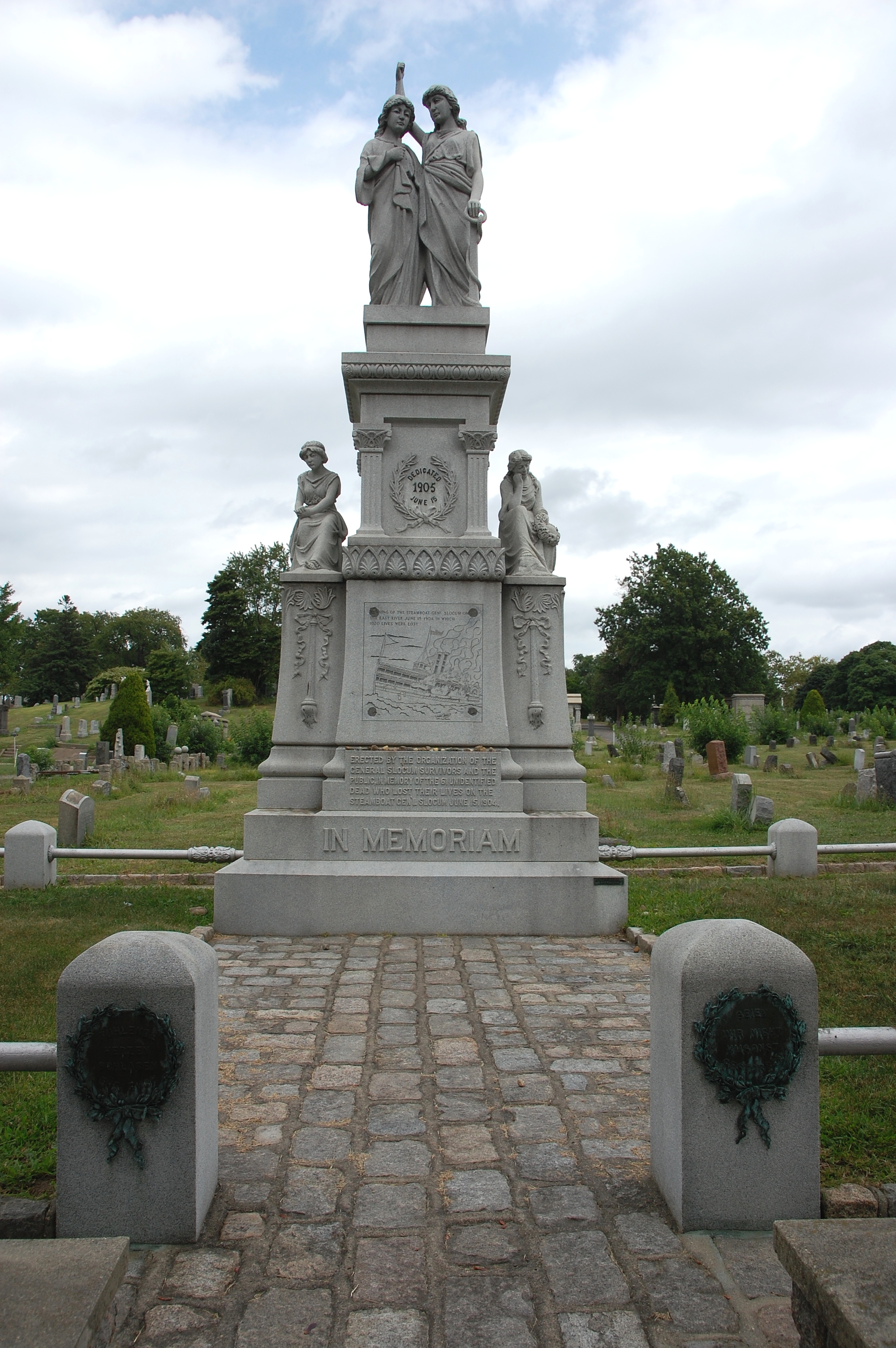
The victims were interred in cemeteries around New York, with 58 identified victims buried in the Cemetery of the Evergreens, and 46 identified victims buried in Green-Wood Cemetery, both in Brooklyn. Many victims were buried at Lutheran Cemetery in Middle Village, Queens (now Lutheran All Faiths Cemetery) where an annual memorial ceremony is held at the historical marker.
In 1906, a marble memorial fountain was erected in the north central part of Tompkins Square Park in Manhattan by the Sympathy Society of German Ladies, with the inscription: "They are Earth's purest children, young and fair."
The sunken remains of General Slocum were salvaged and converted into a 625-gross register ton barge named Maryland, which sank in the South River in 1909 and again in the Atlantic Ocean off the southeast coast of New Jersey near Strathmere and Sea Isle City during a storm on December 4, 1911, while carrying a cargo of coal. All four people aboard Maryland survived the sinking.
The victims included one Emily Ziegler, the girlfriend of a saloonkeeper named John Flammang Schrank who later suffered a mental breakdown culminating in an attempted assassination of Theodore Roosevelt.
Survivors
On January 26, 2004, the last surviving passenger from General Slocum, Adella Wotherspoon (née Liebenow), died at the age of 100. At the time of the disaster, she was a six-month-old infant. Wotherspoon was the youngest survivor of the tragedy that took the lives of her two older sisters. When she was one year old, she unveiled the Steamboat Fire Mass Memorial on June 15, 1905, at Lutheran All Faiths Cemetery, in Middle Village, Queens. | access-date =June 26, 2007 Before Wotherspoon's death, the previous oldest survivor was Catherine Connelly (née Uhlmyer) (1893–2002) who was 11 years old at the time of the disaster.
File:Youngest Slocum Survivor crop.jpg|Adella Wotherspoon (June 16, 1905)
In popular culture


Literature
- 1922 – A few references are made to the disaster in James Joyce's Ulysses, the events of which take place on the following day (June 16, 1904).
- 1925 – A few references to the disaster occur in John Dos Passos' novel Manhattan Transfer.
- 1939 – Journalist Nat Ferber's autobiography, I Found Out: A Confidential Chronicle of the Twenties, begins with his reporting on the General Slocum tragedy.
- 1975 – Robert Shea and Robert Anton Wilson's satirical The Illuminatus! Trilogy briefly mentions the disaster as attributable to the 23 enigma, since 19+04=23. Cartwright alleges that the disaster was an Illuminati technique for "transcendental illumination" through human sacrifice.
- 1996 – Eric Blau's novel The Hero of the Slocum Disaster is based on the disaster; it was later adapted by Patrick Tull and Emily King into a one-person play.
- 2000 – The story of General Slocum was described as an "Avoidable Catastrophe" in Bob Fenster's book, Duh! The Stupid History of the Human Race, in Part One, which discusses stories involving stupidity.
- 2003 – Ship Ablaze by Edward O'Donnell is a detailed history of the event.
- 2003 – The disaster is featured in one of the chapters of author Clive Cussler's book The Sea Hunters 2 when he finds the wreckage of the barge Maryland, which was the converted Slocum after she was salvaged.
- 2003 – The protagonist of Pete Hamill's Forever: A Novel describes the event both as the worst disaster in New York's history at its time, and the point at which Germans left Kleindeutschland for Yorkville, effectively vacating the present-day Lower East Side, which was then adopted by Central European Jews.
- 2004 – The 2005 Hugo Award-nominated novella Time Ablaze by Michael A. Burstein (Analog, June 2004) concerns a time traveler who comes to record the disaster. The story was published to commemorate the 100th anniversary of the disaster.
- 2006 – The General Slocum disaster is at the center of the novel Kiss Me, I'm Dead, by J.G. Sandom, also published as The Unresolved using the pen name of T.K. Welsh.
- 2008 – The General Slocum disaster plays a prominent role in Richard Crabbe's novel Hell's Gate.
- 2009 – The General Slocum tragedy is described in detail in Glenn Stout's 2009 biography of Gertrude Ederle, Young Woman and the Sea. Stout uses the incident, in which many women and young children drowned, to help explain the history of how women, including Ederle, were afforded opportunities to learn to swim during the early part of the century.
- 2010–2012 – The disaster plays a prominent role in the novels In the Shadow of Gotham (2010) and Secret of the White Rose (2012) by Stefanie Pintoff.
- 2011 – The sinking and the spirits of the dead near the site of the sinking at the Hell Gate Bridge are a major plot line in the supernatural novel Dead Waters by Anton Strout.
- 2013 – In the Dean Koontz novel Innocence, deaths caused by the sinking of General Slocum prompted the construction of secret rooms dedicated to the memory of a family lost.
Film, television, music
- 1904 – The Slocum Disaster - This silent American Mutoscope and Biograph Company (#2932) documentary short filmed by G. W. Bitzer features footage of the collecting of bodies on North Brother Island, the temporary morgue at the offices of Public Charites, and mourners at St. Marks German Evangelical Lutheran Church, taken on June 16 and 17, 1904 and released that same month on the 22nd.
- 1904 – The American composer Charles Ives (1874–1954) wrote the tone poem "The General Slocum", a musical portrait of the disaster.
- 1915 – Regeneration is an early gangster film directed by Raoul Walsh and produced by William Fox. The film was lost until the 1970s. It has a lengthy scene in which an excursion picnic ship burns in dramatic fashion while passengers jump overboard, an obvious reference to the General Slocum disaster. Walsh shot the scene in New York, not far from where the real disaster occurred.
- 1934 – The first scenes of the film Manhattan Melodrama recreated the disaster.
- 1998 – German television produced and aired Die Slocum brennt! (The Slocum is on Fire!), an hour-long documentary by Christian Baudissin about the disaster and its impact on the German community of New York.
- 2001 – A description of the disaster and the following events, in comparison with the September 11 attacks, is given by David Rakoff in an episode of the radio program This American Life.
- 2002 – The General Slocum disaster was featured in the documentary My Father's Gun.
- 2004 – Ship Ablaze was a documentary made by History Channel, with production help from NFL Films, featuring a filmed reenactment of the disaster along with interviews of the two remaining General Slocum survivors. The documentary takes its name from the book by Edward O'Donnell, who is interviewed in it.
- 2004 – Fearful Visitation, New York's Great Steamboat Fire of 1904, produced by Philip Dray and Hank Linhart, running time 53 minutes, premiered at the New-York Historical Society for the 100-year commemoration in 2004, and was broadcast on PBS. It features interviews with the last two living survivors and historians Ed O'Donnell, Kenneth T. Jackson, and Lucy Sante.
- 2012 – The disaster was featured in Season 4, Episode 3 of the program Mysteries at the Museum.
- 2017 – The American Housewife TV series episode on May 2 featured child cast member Julia Butters (seasons 1–4) as Anna-Kat Otto. Her character had a morbid fear of water which was derived from reading about the sinking of General Slocum. She cited several facts about the event.
- 2017 – History Retold: Fire at Sea is a documentary that describes the disaster among other disasters involving ships catching fire at sea.
- 2022 – The folk music group The Longest Johns reference the sinking in their song "Downed and Drowned."
Notes
References
Further reading
References
- (June 16, 1904). "The General Slocum An Unlucky Craft. Has Had Collisions And Accidents by the Score. Has Run Ashore Many Times. She Was a Crack Harbor Boat Thirteen Years Ago. Capt. Van Schaick's Good Record". [[The New York Times]].
- Sante, Luc. (2003). "Low life: lures and snares of old New York". Farrar, Straus Giroux.
- Kleinfield, N. R.. (September 2, 2007). "A Debate Rises: How Much 9/11 Tribute Is Enough?". [[The New York Times]].
- Ogilvie, J.S.. (June 21, 2007). "History of the General Slocum Disaster".
- {{rp. 3 Her [[keel]] was {{convert. 235. ft. m long and the [[hull (watercraft). hull]] was {{convert. 37.5. ft. m wide constructed of [[white oak]] and [[Pinus classification. yellow pine]]. ''General Slocum'' measured 1,284 [[gross register tonnage. link. (November 9, 2010)
- Jackson, Kenneth T. "General Slocum" in {{cite enc-nyc2, p.499
- (October 8, 1904). "Report of the United States Commission of Investigation upon the Disaster to the Steamer "General Slocum"". Government Printing Office.
- Bauman, Valerie. (June 10, 2017). "1904 steamboat disaster anniversary marked".
- "Captain van Schaick of the "General Slocum"".
- Robinson, Eric. [[New-York Historical Society]] Library
- Staff. (December 20, 1912). "Van Schaick Pardoned. Captain of the Ill-Fated Slocum Is Restored to Full Citizenship.". [[The New York Times]].
- "The General Slocum Disaster".
- [https://www.green-wood.com/2015/illustration-of-the-general-slocum-steamship-disaster-le-petit-parisien-july-3-1904/ Illustration of the General Slocum Steamship Disaster, Le Petit Parisien, July 3, 1904] Green-Wood Cemetery
- link. (October 18, 2015 International Historic Marker Database)
- Wingfield, Valerie. (June 13, 2011). "The General Slocum Disaster of June 15, 1904". The New York Public Library.
- (March 7, 1909). "Old Boat General Slocum Went Under". Chico Record.
- Anonymous, ''Shipwrecks of the Mid-Atlantic: Maryland, Delaware & Southern New Jersey'' (poster), Sealake Products USA, undated.
- "General Slocoum / Maryland".
- [https://babel.hathitrust.org/cgi/pt?id=uc1.b3330075&view=1up&seq=430 Department of Commerce and Labor Bureau of Navigation ''Forty-Fourth Annual List of Merchant Vessels of the United States for the Year Ending June 30, 1912'', Washington, D.C.: Government Printing Office, 1912, p. 421.]
- Donovan, Robert J. (1962). "The First Pillar". The Assassins. New York: Popular Library. pp. 104
- (15 June 2004). "Remembering the General Slocum". [[WNYC]], [[New York Public Radio]].
- (1939). "I Found Out: A Confidential Chronicle of the Twenties". The Dial Press.
- (1975). "The Illuminatus! Trilogy". Dell Trade Paperback.
- [https://web.archive.org/web/20140619192728/http://www.nytheatre.com/Review/lee-ramsey-2002-8-15-the-hero-of-the-slocum Review of the play "The Hero of the Slocum"], nytheatre.com archive, August 15, 2002. Retrieved July 16, 2016
- (5 May 2003). "Nonfiction Book Review: SHIP ABLAZE: The Tragedy of the Steamboat General Slocum by Edward T. O'Donnell, Author. ISBN 978-0-7679-0905-1". [[Publishers Weekly]].
- Wells, Howard Lamar (1952) [https://www.gutenberg.org/files/56966/56966-h/56966-h.htm ''Motion Pictures 1894–1912: Identified from the Records of the United States Copyright Office''] Copyright Office, [[Library of Congress]], via [[Project Gutenberg]]
- {{AFI film. 32943. The Slocum Disaster
- [https://collections.new.oscars.org/Details/FilmWorks/1030137 "Academy Collections: The Slocum Disaster"] [[Academy of Motion Picture Arts and Sciences]]
- [https://www.encyclopedia.com/arts/culture-magazines/cinema-flourishes-within-its-existing-commercial-framework-1904-1905 "Cinema Flourishes Within Its Existing Commercial Framework: 1904–1905"] [[Encyclopedia.com]]
- (2011). "The Pauper and the Prince: Transformative Masculinity in Raoul Walsh's Regeneration (1915)". Indiana University Press.
- "Die Slocum brennt!: Eine Schiffskatastrophe löscht ein deutsches Viertel in New York aus - Dokumentation 21.06., 21:00 auf ARD-alpha- TV.de".
- Rakoff, David. (September 21, 2001). "Episode 194: Before and After: Act Two: Watching From The River's Edge.". [[This American Life]].
This article was imported from Wikipedia and is available under the Creative Commons Attribution-ShareAlike 4.0 License. Content has been adapted to SurfDoc format. Original contributors can be found on the article history page.
Ask Mako anything about PS General Slocum — get instant answers, deeper analysis, and related topics.
Research with MakoFree with your Surf account
Create a free account to save articles, ask Mako questions, and organize your research.
Sign up freeThis content may have been generated or modified by AI. CloudSurf Software LLC is not responsible for the accuracy, completeness, or reliability of AI-generated content. Always verify important information from primary sources.
Report