From Surf Wiki (app.surf) — the open knowledge base
Provinces and territories of Canada
Top-level subdivisions of Canada
Top-level subdivisions of Canada
| Field | Value | ||
|---|---|---|---|
| name | |||
| map | [[File:Political map of Canada.svg | 350px | A map of Canada showing its 10 provinces and 3 territories]] |
| category | Federated state | ||
| current_number | |||
| government | Constitutional monarchy | subdivision= |
Canada has ten provinces and three territories that are sub-national administrative divisions under the jurisdiction of the Canadian Constitution. In the 1867 Canadian Confederation, three provinces of British North America—New Brunswick, Nova Scotia, and the Province of Canada (which upon Confederation was divided into Ontario and Quebec)—united to form a federation, becoming a fully independent country over the next century. Over its history, Canada's international borders have changed several times as it has added territories and provinces, making it the world's second-largest country by area.
The major difference between a Canadian province and a territory is that provinces receive their power and authority from the Constitution Act, 1867 (formerly called the British North America Act, 1867). Territories are federal territories whose territorial governments have powers delegated to them by the Parliament of Canada. Powers are divided between the Government of Canada (the federal government) and the provincial governments by the Constitution Act, either exclusively or concurrently. A change to the division of powers between the federal government and the provinces requires a constitutional amendment. A similar change affecting the territories can be performed unilaterally by the government or Parliament of Canada.
In modern Canadian constitutional theory, the provinces are considered to be co-sovereign, based on the division of responsibility between the provincial and federal governments within the Constitution Act, 1867; each province thus has its own representative, the lieutenant governor, of the Canadian Crown. The territories are not sovereign but have their authorities and responsibilities devolved from the federal level; as a result, each has a commissioner who represents the federal government.
Provinces
| Name and postal abbreviation | Cities | Became a province in Canada | Official | |||||||||||||||||||||||
|---|---|---|---|---|---|---|---|---|---|---|---|---|---|---|---|---|---|---|---|---|---|---|---|---|---|---|
| language(s) | Population | Area (km2) | Seats | Capital | Largest | 2021 census | Q1 2025 | |||||||||||||||||||
| estimates | Land | Water | Total | Commons | Senate | Ontario | Quebec | Nova Scotia | New Brunswick | Manitoba | British Columbia | Prince Edward Island | Saskatchewan | Alberta | Newfoundland and Labrador | Total provinces | ||||||||||
| ON | Toronto | English | 122 | 24 | ||||||||||||||||||||||
| QC | Quebec City | Montreal | French | 78 | 24 | |||||||||||||||||||||
| NS | Halifax | English | 11 | 10 | ||||||||||||||||||||||
| NB | Fredericton | Moncton | English, French | 10 | 10 | |||||||||||||||||||||
| MB | Winnipeg | English | 14 | 6 | ||||||||||||||||||||||
| BC | Victoria | Vancouver | English | 43 | 6 | |||||||||||||||||||||
| PE | Charlottetown | English | 4 | 4 | ||||||||||||||||||||||
| SK | Regina | Saskatoon | English | 14 | 6 | |||||||||||||||||||||
| AB | Edmonton | Calgary | English | 37 | 6 | |||||||||||||||||||||
| NL | St. John's | English | 7 | 6 |
Territories
There are three territories in Canada. Unlike the provinces, the territories of Canada have no inherent sovereignty and have only those powers delegated to them by the federal government. They include all of mainland Canada north of latitude 60° north and west of Hudson Bay, and all islands north of the Canadian mainland, from those in James Bay to the Queen Elizabeth Islands. They cover 40% of Canada's land, but contain only 0.3% of the population.
Another territory, the District of Keewatin, existed from October 7, 1876, to September 1, 1905, when it rejoined the Northwest Territories and became the Keewatin Region. It occupied the area that is now the Kenora District of Ontario, northern Manitoba, and mainland Nunavut. The government of Keewatin was based in Winnipeg, Manitoba. The territory did not have any representation in federal parliament.
The Northwest Territories has varied in size substantially through the years. In 1880, it covered 7.1 e6km2, and from 1925 to 1999, it covered 3.4 e6km2.
| Name and postal abbreviation | Cities | Became a territory in Canada | Official languages | Population | Area (km2) | Seats | Capital | Largest | 2021 census | Q1 2025 | ||||||||
|---|---|---|---|---|---|---|---|---|---|---|---|---|---|---|---|---|---|---|
| estimates | Land | Water | Total | Commons | Senate | Total territories | 3 | 3 | ||||||||||
| Northwest Territories | NT | Yellowknife | Chipewyan, Cree, English, French, Gwichʼin, Inuinnaqtun, Inuktitut, Inuvialuktun, North Slavey, South Slavey, Tłįchǫ | 1 | 1 | |||||||||||||
| Yukon | YT | Whitehorse | English, French | 1 | 1 | |||||||||||||
| Nunavut | NU | Iqaluit | Inuinnaqtun, Inuktitut, English, French | 1 | 1 |
Population
Main article: Population of Canada by province and territory
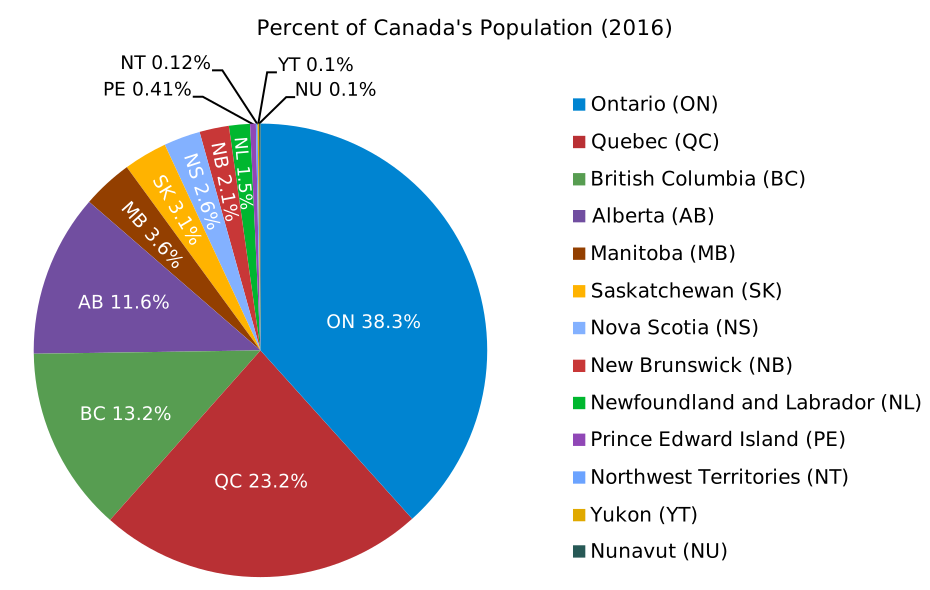
The vast majority of Canada's population is concentrated in areas close to the Canada–US border. Its four largest provinces by area (Quebec, Ontario, British Columbia and Alberta) are (with Quebec and Ontario switched in order) its most populous. Together they account for 86% of Canada's population. The territories (the Northwest Territories, Nunavut and Yukon) account for over a third of Canada's area but are only home to 0.3% of its population, which skews the national population density value.
Canada's population grew by 5.0% between the 2006 and 2011 censuses. Except for New Brunswick, all territories and provinces increased in population during this time. In terms of percent change, the fastest-growing province or territory was Nunavut with an increase of 12.7% between 2011 and 2016, followed by Alberta with 11.6% growth, while New Brunswick's population decreased by 0.5%.
Generally, Canadian provinces have steadily grown in population along with Canada. However, some provinces such as Saskatchewan, Prince Edward Island and Newfoundland and Labrador have experienced long periods of stagnation or population decline. Ontario and Quebec have always been the two biggest provinces in Canada, with together over 60% of the population at any given time. The population of the West relative to Canada as a whole has steadily grown over time, while that of Atlantic Canada has declined.
Territorial evolution
Main article: Territorial evolution of Canada
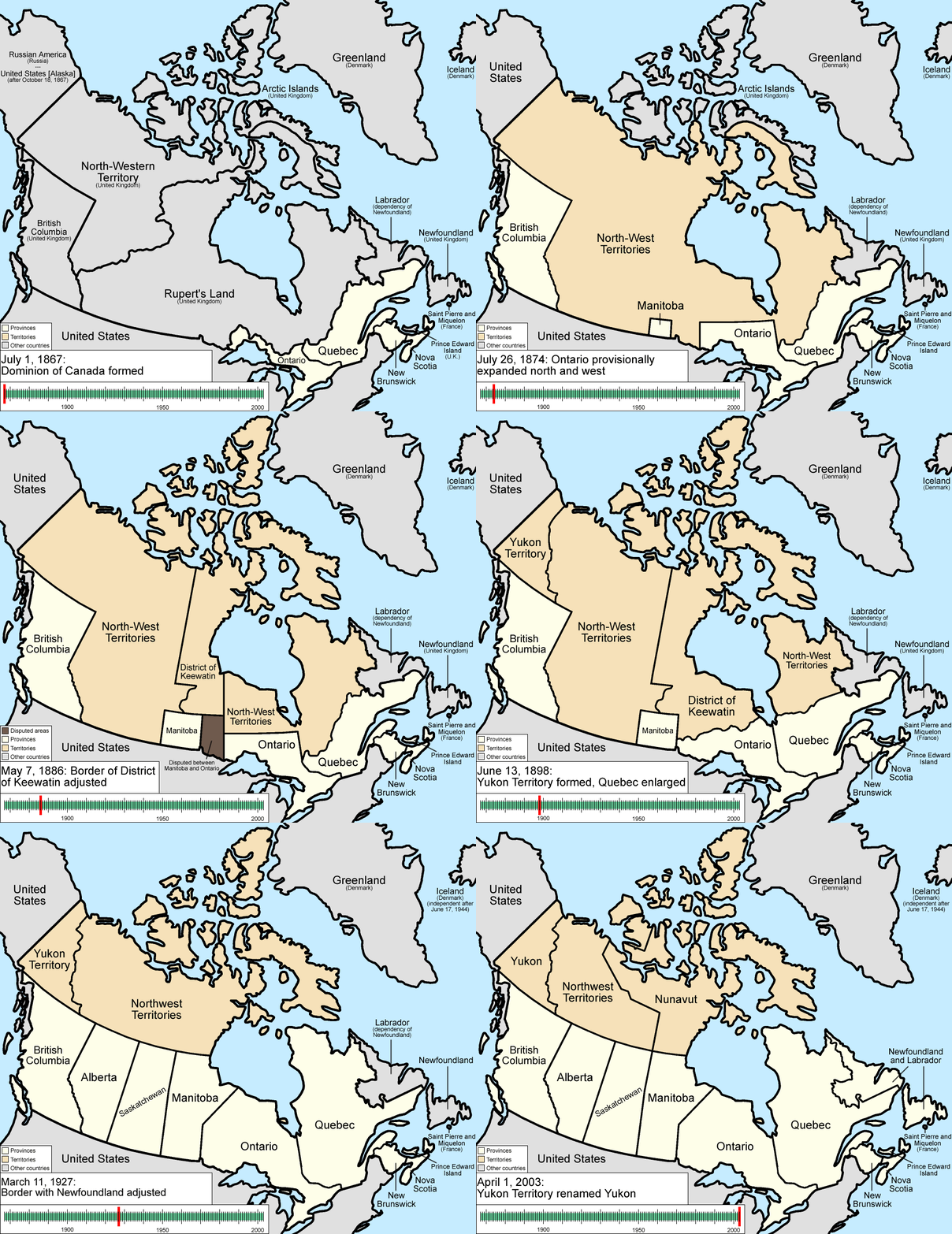

Ontario, Quebec, New Brunswick, and Nova Scotia were the original provinces, formed when three British North American colonies federated on July 1, 1867, into the Dominion of Canada and by stages began accruing the indicia of sovereignty from the United Kingdom. (Ontario and Quebec had been united as the Province of Canada from 1841 to 1867.) Over the next six years, Manitoba (1870), British Columbia (1871), and Prince Edward Island (1873) joined as provinces.
The British Crown had claimed two large areas, known as Rupert's Land and the North-Western Territory, northwest of the original Dominion and assigned them to the Hudson's Bay Company. In 1870, the company relinquished its claims for £300,000 (CND$1.5 million), assigning the vast territory to the government of Canada. The area entered confederation as the Province of Manitoba and the North-West Territories.
The North-West Territories encompassed all of current northern and western Canada except for the British holdings in the Arctic islands, the Colony of British Columbia, and the original Province of Manitoba, a small area in the south of today's province (which expanded to its present size in 1912). It also included the northern two-thirds of Ontario and Quebec.
In 1880, the British claims to the Arctic islands were transferred to Canada, adding to the size of the North-West Territories. In 1898, the Yukon Territory, renamed "Yukon" in 2003, was carved from the area surrounding the Klondike gold fields. In September 1905, a portion of the North-West Territories south of the 60th parallel north became the provinces of Alberta and Saskatchewan. In 1912, the boundaries of Quebec, Ontario, and Manitoba were expanded northward: Manitoba's to the 60° parallel, Ontario's to Hudson Bay and Quebec's to encompass the District of Ungava.
In 1869, the people of Newfoundland voted to remain a British colony over fears that taxes would increase with Confederation, and that the economic policy of the Canadian government would favour mainland industries. In 1907, Newfoundland acquired dominion status. In the middle of the Great Depression in Canada, Newfoundland underwent a prolonged economic crisis, and the legislature turned over political control to the Newfoundland Commission of Government in 1933. Following Canada's participation in the Second World War, in a 1948 referendum, a narrow majority of Newfoundland citizens voted to enter into Confederation, and on March 31, 1949, Newfoundland became Canada's tenth province. The province was renamed Newfoundland and Labrador in 2001.
Bermuda, the last British North American colony, which had been somewhat subordinated to Nova Scotia, was one of two Imperial fortress colonies in British North America the other being Nova Scotia, and more particularly the city of Halifax. Halifax and Bermuda were the sites of the Royal Navy's North America Station main bases, dockyards, and Admiralty Houses (called variously the River St. Lawrence and Coast of America and North America and West Indies Station, the North America and Newfoundland Station, the North America and West Indies Station, and the America and West Indies Station). The squadron of the station was based at Royal Naval Dockyard, Halifax, during the summers and Royal Naval Dockyard, Bermuda, in the winters. In the 1820s, Bermuda, which was better located to control the Atlantic Seaboard of the United States, impossible to attack over land, and almost impregnable against attack over water, became the main base year round.
A large British Army garrison in Bermuda, which fell under the commander-in-chief in Nova Scotia, existed to defend the colony as a naval base, and to prevent it becoming as useful a base to the navy of an adversary, and to support amphibious operations throughout the region, such as the Chesapeake campaign during the American War of 1812. Bermuda was consequently the most important British naval and military base in the Americas.
Canadian confederation resulted in the Canadian Militia becoming responsible for the defence of the Maritimes, the abolition of the British Army's commander-in-chief there, and the reduction of British military forces in the Maritimes to a small garrison for the protection of the Halifax dockyard, which was withdrawn when the dockyard was handed over to the Dominion government in 1905 for use by the new Canadian naval service. Britain retained control of Bermuda as an imperial fortress, with the governor and commander-in-chief of Bermuda (a military officer previously ranking between lieutenant-colonel and major-general) becoming a lieutenant-general termed a general officer commanding and the Bermuda garrison becoming a command in its own right.
Bermuda was consequently left out of Canadian confederation. It retained naval links with Halifax. The state church (or established church), the Church of England, continued to place Bermuda under the bishop of Newfoundland until 1919. Bermuda also remained linked to the Maritimes under the Methodist and Roman Catholic churches.
In 1903, resolution of the Alaska Panhandle Dispute fixed British Columbia's northwestern boundary, the first of only two provincial reductions in Canada. In 1927, the second reduction occurred when a boundary dispute between Canada and the Dominion of Newfoundland saw Labrador (part of the Dominion of Newfoundland) enlarged at Quebec's expense. (In 1949, this land returned to Canada as part of the province of Newfoundland.) In 1999, Nunavut was created from the northern and eastern portions of the Northwest Territories.
The three territories are the most sparsely populated region in Canada, combined covering {{#expr:1346106+482443+2093190}} km2 in land area. For much of the Northwest Territories' early history, it was divided into several districts for ease of administration. The District of Keewatin was created as a separate territory from 1876 to 1905, after which, as the Keewatin Region, it became an administrative district of the Northwest Territories. In 1999, it was dissolved when it became part of Nunavut.
Government
Main article: Canadian federalism
Theoretically, provinces have a great deal of power relative to the federal government, with jurisdiction over many public goods such as health care, education, welfare, and intra-provincial transportation. They receive "transfer payments" from the federal government to pay for these, as well as exacting their own taxes. In practice, however, the federal government can use these transfer payments to influence these provincial areas. For instance, in order to receive healthcare funding under Medicare, provinces must agree to meet certain federal mandates, such as universal access to required medical treatment.
Provincial and territorial legislatures have no second chamber like the Canadian Senate. Originally, most provinces had such bodies, known as legislative councils, with members titled councillors. These upper houses were abolished one by one, Quebec's being the last in 1968. In most provinces, the single house of the legislature is known as the Legislative Assembly. The exceptions are Nova Scotia and Newfoundland and Labrador, where the chamber is called the House of Assembly, and Quebec where it is called the National Assembly. Ontario has a legislative assembly but its members are called members of the Provincial Parliament or MPPs.
The legislative assemblies use a procedure similar to that of the House of Commons of Canada. The head of government of each province, called the premier, is generally the head of the party with the most seats. This is also the case in Yukon, but the Northwest Territories and Nunavut have no political parties at the territorial level. The King's representative in each province is the lieutenant governor. In each of the territories there is an analogous commissioner, but they represent the federal government rather than the monarch.
| Jurisdiction | Legislature | Lower house | Members of lower house | Superior court | Head of government | Viceroy | Canada | Ontario | Quebec | Nova Scotia | New Brunswick | Manitoba | British Columbia | Prince Edward Island | Saskatchewan | Alberta | Newfoundland and Labrador | Northwest Territories | Yukon | Nunavut |
|---|---|---|---|---|---|---|---|---|---|---|---|---|---|---|---|---|---|---|---|---|
| Parliament | House of Commons | Member of Parliament (MP) | Federal Court | Prime minister | Governor general | |||||||||||||||
| Parliament | Legislative Assembly | Member of the Provincial Parliament (MPP) | Superior Court of Justice | Premier | Lieutenant governor | |||||||||||||||
| Legislature | National Assembly | Member of the National Assembly (MNA) | Superior Court | |||||||||||||||||
| General Assembly | House of Assembly | Member of the Legislative Assembly (MLA) | Supreme Court | |||||||||||||||||
| Legislature | Legislative Assembly | Court of King's Bench | ||||||||||||||||||
| Parliament | Supreme Court | |||||||||||||||||||
| General Assembly | ||||||||||||||||||||
| Legislature | Court of King's Bench | |||||||||||||||||||
| General Assembly | House of Assembly | Member of the House of Assembly (MHA) | Supreme Court | |||||||||||||||||
| Assembly | Legislative Assembly | Member of the Legislative Assembly | Supreme Court | Premier | Commissioner | |||||||||||||||
| Legislature | ||||||||||||||||||||
| Assembly | Court of Justice |
Provincial legislature buildings
2011 Alberta Legislature Building 03.jpg|Alberta Legislature Building British Columbia Parliament Buildings - panoramio.jpg|British Columbia Parliament Buildings Parliamentwinnipeg manitoba.jpg|Manitoba Legislative Building New Brunswick Legislature.png|New Brunswick Legislative Building Confederation Building (front), St. John's, Newfoundland, Canada.jpg|Newfoundland and Labrador Confederation Building Province House (Nova Scotia).jpg|Nova Scotia Province House Ontario Legislative Building, Toronto, South view 20170417 1.jpg|Ontario Legislative Building 282 - Birthplace of Canada Charlottetown PEI.JPG|Prince Edward Island Province House Quebec City (14765614666).jpg|Quebec Parliament Building Saskatchewan legislative building.jpg|Saskatchewan Legislative Building
Territorial legislature buildings
Northwest Territories Legislative Building.jpg|Northwest Territories Legislative Building Leg Building Iqaluit 2000-08-27.jpg|Nunavut Legislative Building Yukon Legislature main entrance.jpg|Yukon Legislative Building
Map
Provincial political parties
Most provinces have rough provincial counterparts to major federal parties. However, these provincial parties are not usually formally linked to the federal parties that share the same name. For example, no provincial Conservative or Progressive Conservative Party shares an organizational link to the federal Conservative Party of Canada, and neither do provincial Green Parties to the Green Party of Canada.
Provincial New Democratic Parties, on the other hand, are fully integrated with the federal New Democratic Party—meaning that provincial parties effectively operate as sections, with common membership, of the federal party.
The Liberal Party of Canada shares such an organizational integration with Atlantic Canada provincial Liberals in New Brunswick, Newfoundland and Labrador, Nova Scotia, and Prince Edward Island. Other provincial Liberal parties are unaffiliated with their federal counterpart.
Some provinces have provincial political parties with no clear federal equivalent, such as the Saskatchewan Party.
The provincial political climate of Quebec is different: the main split is between sovereignty, represented by the Parti Québécois and Québec solidaire, and federalism, represented primarily by the Quebec Liberal Party. The Coalition Avenir Québec, meanwhile, takes an abstentionist position on the question and does not support or oppose sovereignty.
Provincial/territorial governments
| Province/territory | Premier | Party in government | Party main ideology | Party political position | Majority/minority | Party in Opposition | Lieutenant governor / commissioner | Last election | Next election | Alberta | British Columbia | Manitoba | New Brunswick | Newfoundland and Labrador | Nova Scotia | Ontario | Prince Edward Island | Quebec | Saskatchewan | Northwest Territories | Nunavut | Yukon | |
|---|---|---|---|---|---|---|---|---|---|---|---|---|---|---|---|---|---|---|---|---|---|---|---|
| United Conservative | Conservatism (Canadian) | Right-wing | Majority | New Democratic | 2023 | 2027 | |||||||||||||||||
| New Democratic | Social democracy | Centre-left | Majority | Conservative | 2024 | 2028 | |||||||||||||||||
| New Democratic | Social democracy | Centre-left | Majority | Progressive Conservative | 2023 | 2027 | |||||||||||||||||
| Liberal | Liberalism (Canadian) | Centre to centre-left | Majority | Progressive Conservative | 2024 | 2028 | |||||||||||||||||
| Progressive Conservative | Progressive conservatism | Centre-right | Majority | Liberal | 2025 | 2029 | |||||||||||||||||
| Progressive Conservative | Red Toryism | Centre-right | Majority | New Democratic | 2024 | 2029 | |||||||||||||||||
| Progressive Conservative | Conservatism (Canadian) | Centre-right | Majority | New Democratic | 2025 | 2029 | |||||||||||||||||
| Progressive Conservative | Progressive conservatism | Centre to centre-right | Majority | Liberal | 2023 | 2027 | |||||||||||||||||
| Coalition Avenir Québec | Quebec nationalism | Centre-right | Majority | Liberal | 2022 | 2026 | |||||||||||||||||
| Saskatchewan Party | Conservatism (Canadian) | Centre-right to right-wing | Majority | New Democratic | 2024 | 2028 | |||||||||||||||||
| Nonpartisan consensus government}} | N/A | 2023 | 2027 | ||||||||||||||||||||
| Nonpartisan consensus government}} | N/A | 2025 | 2029 | ||||||||||||||||||||
| Yukon Party | Conservatism (Canadian) | Centre-right | Majority | New Democratic | 2025 | 2029 |

Ceremonial territory
The Canadian National Vimy Memorial, near Vimy, Pas-de-Calais, and the Beaumont-Hamel Newfoundland Memorial, near Beaumont-Hamel, both in France, are ceremonially considered Canadian territory. In 1922, the French government donated the land used for the Vimy Memorial "freely, and for all time, to the Government of Canada the free use of the land exempt from all taxes".
In 1921, the site of the Somme battlefield near Beaumont-Hamel site was purchased by the people of the Dominion of Newfoundland. These sites do not enjoy extraterritorial status and are subject to French law.
Proposed provinces and territories
Main article: List of proposed provinces and territories of Canada
Since Confederation in 1867, there have been several proposals for new Canadian provinces and territories. The Constitution of Canada requires an amendment for the creation of a new province. The creation of a new territory requires only an act of Parliament, a legislatively simpler process.
In late 2004, Prime Minister Paul Martin surprised some observers by expressing his personal support for all three territories gaining provincial status "eventually". He cited their importance to Canada as a whole and the ongoing need to assert sovereignty in the Arctic, particularly as global warming could make that region more open to exploitation, leading to more complex international waters disputes.
Notes
References
References
- Name changed only in Canada by the [[Canada Act 1982]] (UK), s. 1
- Reader's Digest Association (Canada). (2004). "The Canadian Atlas: Our Nation, Environment and People". Douglas & McIntyre.
- (2012). "Official Language Policies of the Canadian Provinces". Fraser Institute.
- (2005). "Land and freshwater area, by province and territory". Statistics Canada.
- (2010-10-27). "Table 15.7 Land and freshwater area, by province and territory".
- (2012). "Guide to the Canadian House of Commons". Parliament of Canada.
- (2013). "Census Profile". Statistic Canada.
- (October 11, 2022). "Population and dwelling counts: Canada, provinces and territories". [[Statistics Canada]].
- (March 22, 2025). "Population estimates, quarterly". [[Statistics Canada]].
- {{Cite canlaw. (2014)
- {{Cite canlaw. (2002)
- {{Cite canlaw. (1993)
- Affairs, Intergovernmental. (2017-08-21). "Provinces and territories".
- (2015-03-04). "Historical Boundaries of Canada".
- Illustrated atlas of the Dominion of Canada containing authentic and complete maps of all the provinces (1880), p. xix https://babel.hathitrust.org/cgi/pt?id=aeu.ark:/13960/t9z03t60q&seq=46&q1=%22square+miles%22
- {{Cite canlaw. (1988)
- {{Cite canlaw. (2002)
- {{Cite canlaw
- [http://www.statcan.gc.ca/pub/11-516-x/pdf/5500092-eng.pdf Series A2-14. Population of Canada] by province, census dates, 1851 to 1976
- (2016). "2016 Census profiles".
- Ajzenstat, Janet. (2003). "Canada's Founding Debates". University of Toronto Press.
- (1996). "Historical Dictionary of the British Empire: A-J". Greenwood Publishing Group.
- Atlas of Canada. "Territorial evolution".
- (2000). "Confederation Rejected: Newfoundland and the Canadian Confederation, 1864–1869: Newfoundland and Labrador Heritage". Newfoundland and Labrador Heritage.
- Clarke, Sandra. (2010). "Newfoundland and Labrador English". Edinburgh University Press.
- (2010). "Canadian Society in the Twenty-first Century: An Historical Sociological Approach". Canadian Scholars' Press.
- Blake, Raymond Benjamin. (1994). "Canadians at Last: Canada Integrates Newfoundland As a Province". University of Toronto Press.
- Shelley, Fred M.. (2013). "Nation Shapes: The Story behind the World's Borders". ABC-CLIO.
- . (1812). "Civil List of the Province of Lower-Canada 1828: Governor". *Neilson and Cowan, No. 3 Mountain Street*.
- . (1812). "STAFF of the ARMY in the Provinces of Nova-Scotia, New-Brunswick, and their Dependencies, including the Island of Newfoundland, Cape Breton, Prince Edward and Bermuda". *Neilson and Cowan, No. 3 Mountain Street*.
- . (1890). "Meteorological Observations at the Foreign and Colonial Stations of the Royal Engineers and the Army Medical Department 1852—1886.". *Meteorological Council. HMSO*.
- Young, Douglas MacMurray. (1961). "The Colonial Office in The Early Nineteenth Century". Published for the Royal Commonwealth Society by Longmans.
- Keith, Arthur Berriedale. (1909). "Responsible Government in The Dominions". Stevens and Sons Ltd.
- May, Lieutenant-Colonel Sir Edward Sinclair. (1903). "Principles and Problems of Imperial Defence". Swan Sonnenschein & Co..
- Stranack, Royal Navy, Lieutenant-Commander B. Ian D. (1977). "The Andrew and The Onions: The Story of The Royal Navy in Bermuda, 1795–1975". Island Press Ltd .
- . (). ["World Heritage List: Historic Town of St George and Related Fortifications, Bermuda"](https://whc.unesco.org/en/list/983/multiple=1&unique_number=1147). *UNESCO*.
- Ingham-Hind, Jennifer M.. (1992). "Defence, Not Defiance: A History Of The Bermuda Volunteer Rifle Corps". The Island Press.
- Harris, Edward C.. (1997). "Bermuda Forts 1612–1957". The Bermuda Maritime Museum Press.
- Harris, Edward Cecil. (January 21, 2012). "Bermuda's role in the Sack of Washington". The Royal Gazette.
- Grove, Tim. (January 22, 2021). "Fighting The Power". Chesapeake Bay Media, LLC.
- Willock [[United States Marine Corps, Lieutenant-Colonel Roger. (1988). "Bulwark Of Empire: Bermuda's Fortified Naval Base 1860–1920". The Bermuda Maritime Museum Press.
- Gordon, Donald Craigie. (1965). "The Dominion Partnership in Imperial Defense, 1870-1914". Johns Hopkins Press.
- MacFarlane, Thomas. (1891). "Within the Empire; An Essay on Imperial Federation". James Hope & Co..
- Kennedy, R.N., Captain W. R.. (July 1, 1885). "An Unknown Colony: Sport, Travel and Adventure in Newfoundland and the West Indies". William Blackwood & Sons.
- VERAX, (anonymous). (May 1, 1889). "The Defense of Canada. (From Colburn's United Service Magazine)". LR Hamersly & Co..
- (1898). "MacMillan's Geographical Series: Elementary Geography of the British Colonies". MacMillan and Co..
- . (). ["Our Churches: Pembroke Parish"](http://www.anglican.bm/index.php/worship/our-churches.html).
- . (). ["Our History"](https://anglicanenl.net/home/our-history). *Anglican Diocese of Eastern Newfoundland and Labrador*.
- Piper, Liza. (2000). "The Church of England". Newfoundland and Labrador Heritage Web Site.
- . ["A History Of Our Church"](https://www.romancatholicbermuda.bm/about-us). *The Diocese of Hamilton in Bermuda*.
- Laxer, James. (2010). "The Border: Canada, the US and Dispatches From the 49th Parallel". Doubleday Canada.
- Cukwurah, A. Oye. (1967). "The Settlement of Boundary Disputes in International Law". Manchester University Press.
- Nuttall, Mark. (2012). "Encyclopedia of the Arctic". Routledge.
- Organisation for Economic Co-operation and Development. (2002). "Oecd Territorial Reviews: Canada". OECD Publishing.
- (2009). "Atlas of the North American Indian". Infobase Publishing.
- (2001). "North America: The Historical Geography of a Changing Continent". Rowman & Littlefield.
- Mahler, Gregory S.. (1987). "New Dimensions of Canadian Federalism: Canada in a Comparative Perspective". Fairleigh Dickinson Univ Press.
- Peach, Ian. (2007). "Constructing Tomorrows Federalism: New Perspectives on Canadian Governance". Univ. of Manitoba Press.
- Maclure, Jocelyn. (2003). "Quebec Identity: The Challenge of Pluralism". McGill-Queen's Press – MQUP.
- Tidridge, Nathan. (2011). "Canada's Constitutional Monarchy: An Introduction to Our Form of Government". Dundurn.
- Pinto, Laura Elizabeth. (2012). "Curriculum Reform in Ontario: 'Common-Sense' Policy Processes and Democratic Possibilities". University of Toronto Press.
- Barnhart, Gordon. (2004). "Saskatchewan Premiers of the Twentieth Century". University of Regina Press.
- Zellen, Barry Scott. (2009). "On Thin Ice: The Inuit, the State, and the Challenge of Arctic Sovereignty". Lexington Books.
- Tidridge, Nathan. (2011). "Canada's Constitutional Monarchy". Dundurn.
- (2011). "Canadian Symbols of Authority: Maces, Chains, and Rods of Office". Dundurn.
- Cross, William. (2011). "Political Parties". UBC Press.
- Gagnon, Alain-Gustave. (2000). "The Canadian Social Union Without Quebec: 8 Critical Analyses". IRPP.
- "Premiers". Parliament of Canada.
- "Lieutenant Governors and Territorial Commissioners". Parliament of Canada.
- Wilson, John. (2012). "Failed Hope: The Story of the Lost Peace". Dundurn.
- (August 8, 1998). "Design and Construction of the Vimy Ridge Memorial". Veteran Affairs Canada.
- An amendment to the Constitution of Canada in relation to the following matters may be made only in accordance with subsection 38(1)...notwithstanding any other law or practice, the establishment of new provinces.
- Nicholson, Norman L.. (1979). "The boundaries of the Canadian Confederation". McGill-Queen's Press – MQUP.
- (November 23, 2004). "Northern territories 'eventually' to be given provincial status". CBC News.
- Gough, Barry M.. (2010). "Historical Dictionary of Canada". Wilfrid Laurier University.
- (2013). "Governance and Public Policy in Canada: A View from the Provinces". University of Toronto Press.
This article was imported from Wikipedia and is available under the Creative Commons Attribution-ShareAlike 4.0 License. Content has been adapted to SurfDoc format. Original contributors can be found on the article history page.
Ask Mako anything about Provinces and territories of Canada — get instant answers, deeper analysis, and related topics.
Research with MakoFree with your Surf account
Create a free account to save articles, ask Mako questions, and organize your research.
Sign up freeThis content may have been generated or modified by AI. CloudSurf Software LLC is not responsible for the accuracy, completeness, or reliability of AI-generated content. Always verify important information from primary sources.
Report