From Surf Wiki (app.surf) — the open knowledge base
Province of Tarragona
Province of Spain
Province of Spain
| Field | Value |
|---|---|
| name | Province of Tarragona |
| native_name | ca |
| es | |
| native_name_lang | |
| type | Province |
| image_flag | Bandera actual de la provincia de Tarragona (alternate).svg |
| image_shield | Coat of Arms of the Tarragona Province.svg |
| image_map | Tarragona in Spain (plus Canarias).svg |
| map_caption | Map of Spain with Province of Tarragona highlighted |
| coordinates | |
| subdivision_type | Country |
| subdivision_name | Spain |
| subdivision_type1 | Autonomous community |
| subdivision_name1 | Catalonia |
| seat_type | Capital |
| seat | Tarragona |
| governing_body | Provincial Deputation of Tarragona |
| leader_party | ERC |
| leader_title | President |
| leader_name | Noemí Llauradó |
| area_total_km2 | 6,283 |
| area_rank | Ranked |
| blank_name_sec1 | Official language(s) |
| blank_info_sec1 | Catalan and Spanish |
| population_total | 822,309 |
| population_rank | Ranked |
| population_density_km2 | auto |
| blank_name_sec2 | Parliament |
| blank_info_sec2 | Cortes Generales |
| Parliament of Catalonia | |
| blank1_name_sec2 | Congress seats |
| blank2_name_sec2 | Senate seats |
| website |
es Parliament of Catalonia
Tarragona (; ) is a province of eastern Spain, in the southern part of the autonomous community of Catalonia. It is bordered by the provinces of Castellón, Teruel, Zaragoza, Lleida and Barcelona and by the Mediterranean Sea.
The province's population is 795,902 (2018), about one fifth of whom live in the capital, Tarragona. Some of the larger cities and towns in Tarragona province include Reus, Salou, El Vendrell, Tortosa, Valls, Amposta. This province has 183 municipalities. The province includes several World Heritage Sites and is a popular tourist destination. There are Roman Catholic cathedrals in Tarragona and Tortosa.
History
After the Umayyad conquest of Hispania in the late eighth century, this part of Spain came under the control of the Umayyad Caliphate and most of the Iberian peninsula was known as Al-Andalus, and was dominated by Muslim rulers. Abd al-Rahman I founded an independent dynasty that survived in the region until the 11th century.
After the Muslim conquest, the bishopric of Tarragona came under the jurisdiction of the metropolitans of Narbonne or Auch in southern France. In 1089, this was reorganised, and it came under the jurisdiction of the bishopric of Vich, and in 1118, after Tarragona had been reconquered, the Roman Catholic Archdiocese of Tarragona was established.
Geography
The province of Tarragona is in the northeast of Spain with a coast on the Mediterranean Sea. Much of the province is hilly or mountainous and the main feature is the broad valley of the River Ebro and the coastal plain which is backed by the Catalan ranges. In general, industrial development is on the coast and inland is predominantly forest and agricultural land. The Mediterranean Sea lies to the southeast of the province, the province of Barcelona lies to the northeast, Lleida lies to the north, Zaragoza to the northwest, Teruel to the west and Castellón to the southwest. The climate is Mediterranean with hot, dry summers and warm, wet winters.
The area of the province is 6500 km2. The main crops are cereals, grapes, fruit, olives, hemp, and silk. The province has some mineral resources; copper, lead and silver are found and limestone and marble are quarried. Quarrying for aggregate has caused groundwater levels to fall and the environment has been adversely affected by the arrival of invasive species such as the zebra mussel in the Riba-roja d'Ebre reservoir on the Ebro, the invasive fish Gambusia in the Ebro delta and chemical contamination in the Flix reservoir beside which is a chemical works and a hydro-electric plant.
Population
The historical population is given in the following chart:
| Nationality | Population (2022) | |
|---|---|---|
| Morocco | ||
| Romania | ||
| Colombia | ||
| Italy | ||
| Pakistan | ||
| China |
Colors= id:lightgrey value:gray(0.9) id:darkgrey value:gray(0.7) id:sfondo value:rgb(1,1,1)
ImageSize = width:600 height:auto barincrement:28 PlotArea = left:40 bottom:40 top:20 right:20 DateFormat = x.y Period = from:0 till:820 TimeAxis = orientation:horizontal AlignBars = late ScaleMajor = gridcolor:darkgrey increment:100 start:0 ScaleMinor = gridcolor:lightgrey increment:20 start:0 BackgroundColors = canvas:sfondo
PlotData= color:skyblue width:20 shift:(-50,-5) fontsize:M anchor:till bar:1877 from:0 till:333 text:333,468 bar:1887 from:0 till:349 text:348,606 bar:1900 from:0 till:343 text:343,400 bar:1910 from:0 till:343 text:343,127 bar:1920 from:0 till:359 text:359,334 bar:1930 from:0 till:352 text:351,698 bar:1940 from:0 till:346 text:346,433 bar:1950 from:0 till:357 text:356,864 bar:1960 from:0 till:363 text:363,472 bar:1970 from:0 till:433 text:433,138 bar:1980 from:0 till:513 text:513,050 bar:1990 from:0 till:542 text:542,004 bar:2000 from:0 till:610 text:609,673 bar:2010 from:0 till:807 text:807,044 bar:2020 from:0 till:817 text:816,772
TextData= pos:(35,20) fontsize:M text:"Source: Instituto Nacional de Estadística, INE"
Tourism
As well as the port city of Tarragona, the province has much to offer for the tourist. There are Catalan villages to visit, historic sites, sandy beaches, rocky shores, crags, rivers and woodlands and several wildlife reserves. The area has been publicised under the Costa Daurada (golden coast) brand.

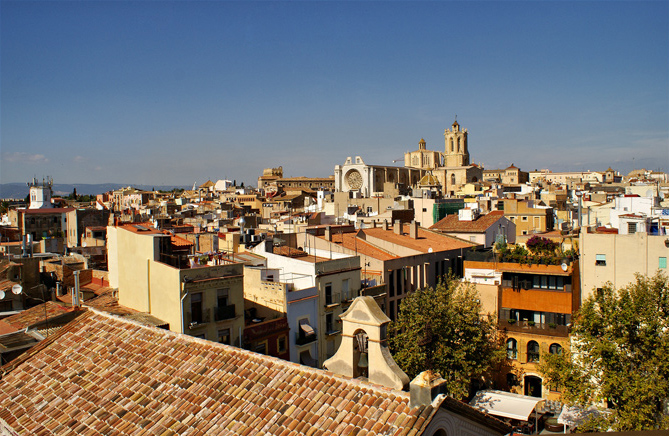
The city of Tarragona may have been founded by the Phoenicians and was a major city in Roman times that they called Tarraco. There are many archaeological remains from that period but little remains of the second century amphitheatre; after the collapse of the Western Roman Empire, the abandoned structure was quarried to provide stone for building. The Les Ferreres Aqueduct dates from the same period and has survived intact. The city also houses a cathedral, dating from the twelfth and thirteenth centuries, which combines Romanesque and Gothic architectural features. There are also many historic churches and convents.
The Catalan authorities have designated four villages as "family holiday destinations". These are Calafell, Cambrils, La Pineda and nearby Vila-seca, and Salou. Salou is the site of the PortAventura World (PortAventura Park, the most visited theme park in Spain, Ferrari Land and also the PortAventura Caribe Aquatic Park).
The Costa Daurada is served by Reus Airport which receives tourist traffic from passengers journeying to the beach resorts of Salou and Cambrils as well as those travelling to Barcelona. It is a destination of low-cost flights provider Ryanair, and planes fly to Reus from many different European and North African locations. The province also has good road and rail links to Barcelona and southwards to Valencia, Murcia and Andalusia along the coastal strip, and high-speed rail services from Tarragona to Madrid started in 2008.
There are several monasteries in the province that can be visited by following the "Cistercian Monastery Route". The best known is the Cistercian monastery of Poblet in the comarca of Conca de Barberà, which is a UNESCO World Heritage site. Other monasteries on the route include the Santes Creus, in the municipality of Aiguamúrcia, and Vallbona de les Monges.
Other attractions of the province include the food and wine. The "Penedès Wine and Cava Route" is a tourist trail offering wine-related activities. There are also festivals celebrating local fare, where local gastronomic specialities are eaten, including calçots (grilled spring onions) in Valls, and Xató a sauce served with fish or an endive salad.
Transport
The only airport in the province is Reus Airport which provides direct routes to some European destinations. However, Josep Tarradellas Barcelona–El Prat Airport is also frequently used by air travellers from the province which provides more domestic and international destinations. The airport is located 86 km which is an hour drive south west of Tarragona.
References
References
- O'Callaghan, Joseph F.. (2013). "A History of Medieval Spain". Cornell University Press.
- (1973). "Philip's Modern School Atlas". George Philip & Son.
- Lewis, Lowell. (July 2013). "Catalonia and California: Sister States". Author House.
- Bozman, E.F.. (1966). "Everyman's Encyclopaedia: Volume 11". J.M. Dent and Sons.
- "Spain: Province of Tarragona". TripAdvisor.
- "Tarragona (Province)". Spain Tourism.
- "Aqueduct of las Ferreras (Tarraco), at Tarragone". The History of Spanish Architecture.
- "Archaeological Ensemble of Tárraco". UNESCO World Heritage Centre.
- (2012). "Catedral Basilica de Tarragona". Cabildo de la Catedral de Tarragona.
- (27 October 2014). "Tarragona Province Travel Guide". Catalonia and Valencia.
- Themed Entertainment Association. (2013). "Global Attractions Attendance Report". AECOM.
This article was imported from Wikipedia and is available under the Creative Commons Attribution-ShareAlike 4.0 License. Content has been adapted to SurfDoc format. Original contributors can be found on the article history page.
Ask Mako anything about Province of Tarragona — get instant answers, deeper analysis, and related topics.
Research with MakoFree with your Surf account
Create a free account to save articles, ask Mako questions, and organize your research.
Sign up freeThis content may have been generated or modified by AI. CloudSurf Software LLC is not responsible for the accuracy, completeness, or reliability of AI-generated content. Always verify important information from primary sources.
Report