From Surf Wiki (app.surf) — the open knowledge base
Province of Foggia
Province of Italy

Province of Italy
| Field | Value |
|---|---|
| name | Province of Foggia |
| native_name | it |
| nap | |
| settlement_type | Province |
| image_skyline | Ex_Palazzo_provincia_(Foggia).JPG |
| image_caption | Palazzo Dogana, the provincial seat |
| image_shield | Provincia di Foggia-Stemma.svg |
| image_map | Foggia in Italy.svg |
| map_caption | Map highlighting the location of the province of Foggia in Italy |
| subdivision_type | Country |
| subdivision_name | Italy |
| subdivision_type1 | Region |
| subdivision_name1 | Apulia |
| seat_type | Capital(s) |
| seat | Foggia |
| parts_type | Comuni |
| parts_style | para |
| p1 | 61 |
| leader_title | President |
| leader_name | Nicola Gatta |
| unit_pref | Metric |
| area_total_km2 | 7007.54 |
| population_total | 627102 |
| population_as_of | 30 April 2017 |
| population_density_km2 | auto |
| demographics_type2 | GDP |
| demographics2_footnotes | |
| demographics2_title1 | Total |
| demographics2_info1 | €10.670 billion (2015) |
| demographics2_title2 | Per capita |
| demographics2_info2 | €16,874 (2015) |
| timezone1 | CET |
| utc_offset1 | +1 |
| timezone1_DST | CEST |
| utc_offset1_DST | +2 |
| postal_code_type | Postal code |
| postal_code | 71100 |
| area_code_type | Telephone prefix |
| area_code | 0881 |
| registration_plate | FG |
| blank_name_sec1 | ISTAT |
| blank_info_sec1 | 071 |
| website |
nap
The province of Foggia (, ; ) is a province in the Italian region Apulia.
This province is also known as Daunia, after the Daunians, an Iapygian pre-Roman tribe living in Tavoliere plain, and as Capitanata, derived from Catapanata, since the area was governed by a catepan as part of the Catepanate of Italy during the High Middle Ages. Its capital is the city of Foggia.
History
Geography
The province of Foggia can be divided in three parts: one centered on its capital called Tavoliere, another along the Apennines named Daunian Mountains and the third on the spur of the boot-shaped Italian peninsula called Gargano.
The Tavoliere is an important agricultural area: grapefruit, olives, durum wheat and tomato are the chief products. It is called "the granary of Italy" because of its significant wheat production.
Daunian Mountains lie along the border with Molise and Campania. Scattered with small villages, the mountains are covered by forests and pastures, with the main produce being hams and caciocavallo cheese. Faetar, a language descended from Franco-Provençal, is spoken in two villages: Faeto and Celle di San Vito.
The Gargano peninsula is partially mountainous and partially forested, Foresta Umbra with vegetation typical of Central Europe, the only part of the ancient black forest remaining in Italy. Its name comes from the word ombra (shadow) because of its density that prevents light from entering. The coast of Gargano has many beaches and tourist facilities. In the north are two major salt lakes Lesina and Varano. It produces olives, olive oil and typical mountain and seafood items.
Population
It has an area of 7007 km2 and a total population of 627,102 (2012). There are currently 61 comuni (singular: comune) in the province, see Comuni of the Province of Foggia.
Population centers
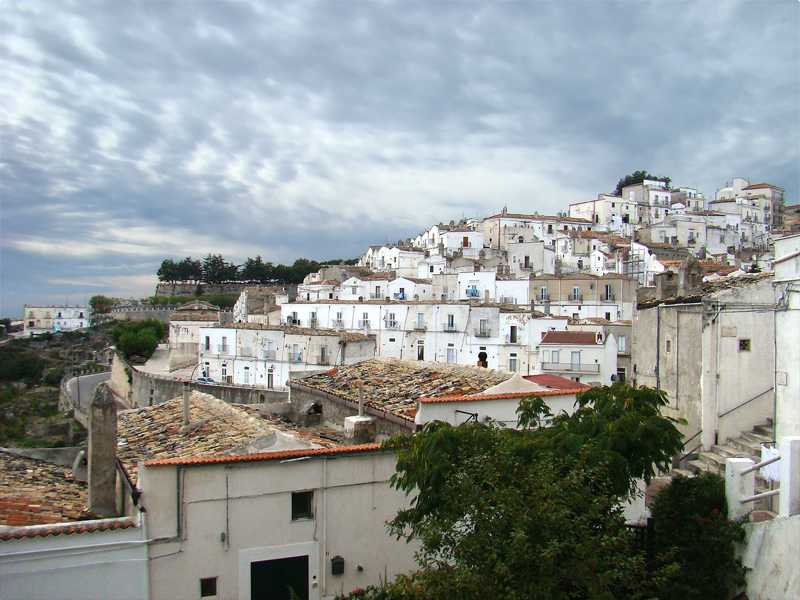
.JPG)
Main centers in the province are:
- Foggia, the capital and hometown of opera composer Umberto Giordano. Favourite residence in Apulia of Frederick II at the beginning of the 13th century. During his reign it was the most important town of the province and to alternate periods of the Empire.
- San Severo, the former capital, and hometown of comics artist Andrea Pazienza.
- San Giovanni Rotondo, home of Padre Pio and place of the church devoted to him.
- Manfredonia and Vieste, archiepiscopal see of Apulia.
- Vieste, Mattinata and Peschici, notable seaside resorts.
- Lucera, one of the residences of Frederick II.
Other centers of interest are:
- Cerignola, hometown of philologist Nicola Zingarelli, founder of the Zingarelli Italian dictionary and syndicalist Giuseppe Di Vittorio
- Torremaggiore, hometown of Nicola Sacco
- Troia, site of a 10th-century cathedral, refounded by Byzantine Katepan Basil Boioannes in the early 11th Century.
- Celle di San Vito and Faeto, two towns where an extremely rare daughter language of the Franco-Provençal language has been spoken since the 14th century. The dialect, Faetar-Cigliàje, is only spoken by less than 1,400 people in the world.
Economy
Although less important today, the agricultural sector remains the mainstay of Foggia's economy; it is nicknamed the "granary of Italy". The few industries present are mostly devoted to food processing.
Most peeled tomatoes in Europe come from Foggia. Every year, two million tons of tomatoes are produced but farmers receive only eight cents per kilo. To survive in the free market, most tomato farmers recruit illegal immigrants.
Tourism
Foggia receives many Catholic pilgrims each year to locations such as the Sanctuary of Saint Michael the Archangel in Monte Sant'Angelo, which was visited by Pope John Paul II in 1987, and to nearby San Giovanni Rotondo, the home of Saint Pio of Pietrelcina from 1916 until his death in 1968. As the number of pilgrims to San Giovanni Rotondo kept increasing over the years, in 2004 a new shrine near the church was built. The sanctuary has a capacity of around 6,000 people and its parvis has a 30,000 people capacity.
References
References
- [https://stats.oecd.org/ Regions and Cities > Regional Statistics > Regional Economy > Regional Gross Domestic Product (Small regions TL3)], OECD.Stats. Accessed on 16 November 2018.
- {{in lang. nl Angelo van Schaik, [http://www.radio1.nl/contents/18996-bureau-buitenland-de-italiaanse-tomaat "Bureau Buitenland: de Italiaanse tomaat,"] ''Villa VPRO'' Radio1 (26 August 2010).
This article was imported from Wikipedia and is available under the Creative Commons Attribution-ShareAlike 4.0 License. Content has been adapted to SurfDoc format. Original contributors can be found on the article history page.
Ask Mako anything about Province of Foggia — get instant answers, deeper analysis, and related topics.
Research with MakoFree with your Surf account
Create a free account to save articles, ask Mako questions, and organize your research.
Sign up freeThis content may have been generated or modified by AI. CloudSurf Software LLC is not responsible for the accuracy, completeness, or reliability of AI-generated content. Always verify important information from primary sources.
Report