From Surf Wiki (app.surf) — the open knowledge base
Prototile
Basic shape(s) used in a tessellation
.svg)
Basic shape(s) used in a tessellation
In mathematics, a prototile is one of the shapes of a tile in a tessellation.
Definition
A tessellation of the plane or of any other space is a cover of the space by closed shapes, called tiles, that have disjoint interiors. Some of the tiles may be congruent to one or more others. If S is the set of tiles in a tessellation, a set R of shapes is called a set of prototiles if no two shapes in R are congruent to each other, and every tile in S is congruent to one of the shapes in R.
It is possible to choose many different sets of prototiles for a tiling: translating or rotating any one of the prototiles produces another valid set of prototiles. However, every set of prototiles has the same cardinality, so the number of prototiles is well defined. A tessellation is said to be monohedral if it has exactly one prototile.
Aperiodicity
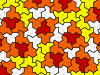
A set of prototiles is said to be aperiodic if every tiling with those prototiles is an aperiodic tiling. In March 2023, four researchers, Chaim Goodman-Strauss, David Smith, Joseph Samuel Myers and Craig S. Kaplan, announced the discovery of an aperiodic monohedral prototile (monotile) and a proof that the tile discovered by David Smith is an aperiodic monotile, i.e. a solution to a longstanding open einstein problem.
In higher dimensions, the problem had been solved earlier: the Schmitt-Conway-Danzer tile is the prototile of a monohedral aperiodic tiling of three-dimensional Euclidean space, and cannot tile space periodically.
References
References
- Cederberg, Judith N.. (2001). "A Course in Modern Geometries". Springer-Verlag.
- Kaplan, Craig S.. (2009). "Introductory Tiling Theory for Computer Graphics". Morgan & Claypool Publishers.
- Roberts, Siobhan. (2023-03-28). "Elusive 'Einstein' Solves a Longstanding Math Problem". The New York Times.
- (2024). "An aperiodic monotile". Combinatorial Theory.
This article was imported from Wikipedia and is available under the Creative Commons Attribution-ShareAlike 4.0 License. Content has been adapted to SurfDoc format. Original contributors can be found on the article history page.
Ask Mako anything about Prototile — get instant answers, deeper analysis, and related topics.
Research with MakoFree with your Surf account
Create a free account to save articles, ask Mako questions, and organize your research.
Sign up freeThis content may have been generated or modified by AI. CloudSurf Software LLC is not responsible for the accuracy, completeness, or reliability of AI-generated content. Always verify important information from primary sources.
Report