From Surf Wiki (app.surf) — the open knowledge base
Protoplast
Cell stripped of cell-wall
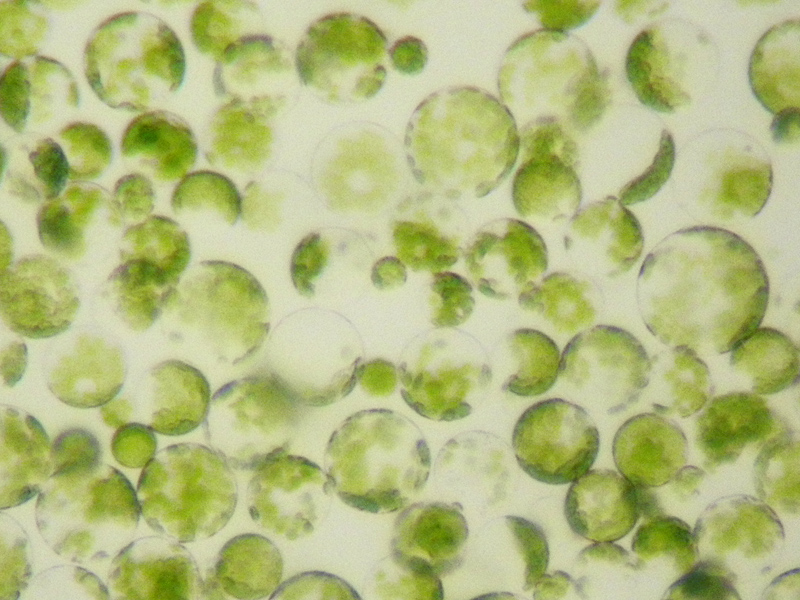
Cell stripped of cell-wall

Protoplast (), is a biological term coined by Hanstein in 1880 to refer to the entire cell, excluding the cell wall. Protoplasts can be generated by stripping the cell wall from plant, bacterial, or fungal cells by mechanical, chemical or enzymatic means.
Protoplasts differ from spheroplasts in that their cell wall has been completely removed. Spheroplasts retain part of their cell wall. In the case of Gram-negative bacterial spheroplasts, for example, the peptidoglycan component of the cell wall has been removed but the outer membrane component has not.
Enzymes for the preparation of protoplasts
Cell walls are made of a variety of polysaccharides. Protoplasts can be made by degrading cell walls with a mixture of the appropriate polysaccharide-degrading enzymes:
| Type of cell | Enzyme | |||||||||
|---|---|---|---|---|---|---|---|---|---|---|
| Plant cells | Cellulase, pectinase, xylanase | |||||||||
| Gram-positive bacteria | Lysozyme, N,O-diacetylmuramidase, lysostaphin | |||||||||
| Fungal cells | vauthors = Dahiya N, Tewari R, Hoondal GS | title = Biotechnological aspects of chitinolytic enzymes: a review | journal = Applied Microbiology and Biotechnology | volume = 71 | issue = 6 | pages = 773–782 | date = August 2006 | pmid = 16249876 | doi = 10.1007/s00253-005-0183-7 | s2cid = 852042 }} |
During and subsequent to digestion of the cell wall, the protoplast becomes very sensitive to osmotic stress. This means cell wall digestion and protoplast storage must be done in an isotonic solution to prevent rupture of the plasma membrane.
Uses for protoplasts
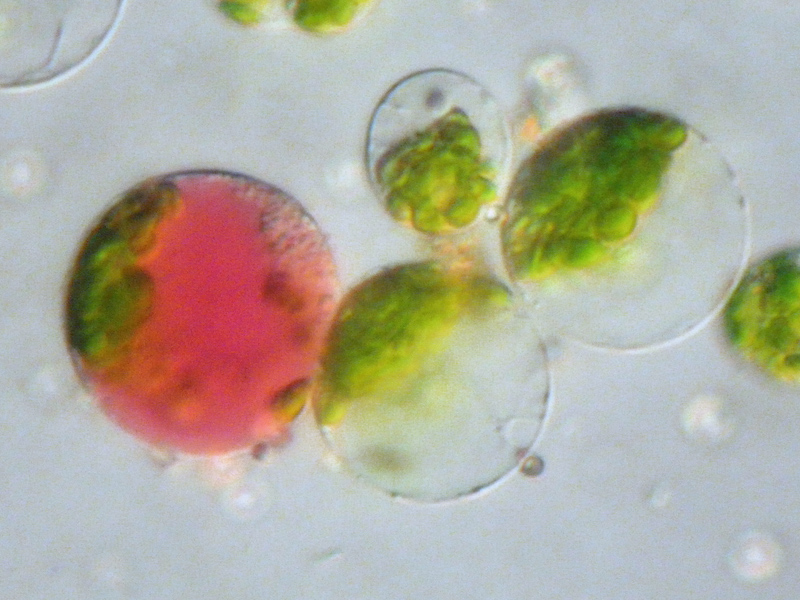
Protoplasts can be used to study membrane biology, including the uptake of macromolecules and viruses . These are also used in somaclonal variation.
Protoplasts are widely used for DNA transformation (for making genetically modified organisms), since the cell wall would otherwise block the passage of DNA into the cell. In the case of plant cells, protoplasts may be regenerated into whole plants first by growing into a group of plant cells that develops into a callus and then by regeneration of shoots (caulogenesis) from the callus using plant tissue culture methods. Growth of protoplasts into callus and regeneration of shoots requires the proper balance of plant growth regulators in the tissue culture medium that must be customized for each species of plant. Unlike protoplasts from vascular plants, protoplasts from mosses, such as Physcomitrella patens, do not need phytohormones for regeneration, nor do they form a callus during regeneration. Instead, they regenerate directly into the filamentous protonema, mimicking a germinating moss spore.
Protoplasts may also be used for plant breeding, using a technique called protoplast fusion. Protoplasts from different species are induced to fuse by using an electric field or a solution of polyethylene glycol. This technique may be used to generate somatic hybrids in tissue culture.
Additionally, protoplasts of plants expressing fluorescent proteins in certain cells may be used for Fluorescence Activated Cell Sorting (FACS), where only cells fluorescing a selected wavelength are retained. Among other things, this technique is used to isolate specific cell types (e.g., guard cells from leaves, pericycle cells from roots) for further investigations, such as transcriptomics.
References
References
- (1880). "Das Protoplasma als Träger der pflanzlichen und thierischen Lebensverrichtungen für Laien und Fachgenossen.". Selbstverlag.
- (1921). "An introduction to cytology.". McGraw-Hill book Company, Incorporated.
- (December 2016). "Morphological and ultrastructural changes in bacterial cells as an indicator of antibacterial mechanism of action". Cellular and Molecular Life Sciences.
- (2016). "Protoplasts and spheroplasts". Encyclopedia.com.
- (2019). "Definition of spheroplast". Merriam-Webster.
- (August 2006). "Biotechnological aspects of chitinolytic enzymes: a review". Applied Microbiology and Biotechnology.
- (March 2005). "Plant protoplasts: status and biotechnological perspectives". Biotechnology Advances.
- (October 2007). "History of plant tissue culture". Molecular Biotechnology.
- (16 November 2021). "Establishment of an Efficient Protoplast Regeneration and Transfection Protocol for Field Cress (Lepidium campestre)". Frontiers in Genome Editing.
- (2021-07-07). "Efficient Protoplast Regeneration Protocol and CRISPR/Cas9-Mediated Editing of Glucosinolate Transporter (GTR) Genes in Rapeseed (Brassica napus L.)". Frontiers in Plant Science.
- Bhatla SC, Kiessling J, [[Ralf Reski
- (May 1985). "Uptake, integration, expression and genetic transmission of a selectable chimaeric gene by plant protoplasts.". Molecular and General Genetics MGG.
This article was imported from Wikipedia and is available under the Creative Commons Attribution-ShareAlike 4.0 License. Content has been adapted to SurfDoc format. Original contributors can be found on the article history page.
Ask Mako anything about Protoplast — get instant answers, deeper analysis, and related topics.
Research with MakoFree with your Surf account
Create a free account to save articles, ask Mako questions, and organize your research.
Sign up freeThis content may have been generated or modified by AI. CloudSurf Software LLC is not responsible for the accuracy, completeness, or reliability of AI-generated content. Always verify important information from primary sources.
Report