From Surf Wiki (app.surf) — the open knowledge base
Propylhexedrine
Topical nasal decongestant

Topical nasal decongestant
| Field | Value | |
|---|---|---|
| Verifiedfields | changed | |
| Watchedfields | changed | |
| verifiedrevid | 464217507 | |
| drug_name | Propylhexedrine | |
| IUPAC_name | (±)-1-cyclohexyl-N-methylpropan-2-amine | |
| image | Propylhexedrine.svg | |
| image_class | skin-invert-image | |
| imageL | Propylhex_3d.png | |
| image_classL | bg-transparent | |
| imageR | Propylhex_3d (R).png | |
| image_classR | bg-transparent | |
| captionLR | Left: (S)-Propylhexedrine | |
| Right: (R)-Propylhexedrine | ||
| <!--Clinical data--> | tradename | Benzedrex, Obesin, Dristan Inhaler, and others |
| Drugs.com | ||
| pregnancy_category | C | |
| legal_AU | S4 | |
| legal_BR | B1 | |
| legal_CA | Unscheduled | |
| legal_DE | Prescription Only | |
| legal_US | OTC | |
| legal_UN | Unscheduled | |
| legal_UK | P | |
| routes_of_administration | Medical: Intranasal (inhaler) | |
| Recreational: Oral, parenteral | ||
| elimination_half-life | 4 ± 1.5 hours | |
| excretion | ||
| index2_label | hydrochloride | |
| CAS_number_Ref | ||
| CAS_number | 101-40-6 | |
| CAS_number2_Ref | ||
| CAS_number2 | 1007-33-6 | |
| ATC_prefix | N06BA | |
| PubChem | 7558 | |
| DrugBank_Ref | ||
| DrugBank | DB06714 | |
| ChemSpiderID_Ref | ||
| ChemSpiderID | 7277 | |
| UNII_Ref | ||
| UNII | LQU92IU8LL | |
| UNII2_Ref | ||
| UNII2 | 064LUN7NZ5 | |
| KEGG_Ref | ||
| KEGG | D05637 | |
| synonyms | 1-cyclohexyl-2-methylaminopropane | |
| C | 10 | |
| H | 21 | |
| N | 1 | |
| SMILES | N(C(CC1CCCCC1)C)C | |
| StdInChI_Ref | ||
| StdInChI | 1S/C10H21N/c1-9(11-2)8-10-6-4-3-5-7-10/h9-11H,3-8H2,1-2H3 | |
| StdInChIKey_Ref | ||
| StdInChIKey | JCRIVQIOJSSCQD-UHFFFAOYSA-N | |
| chirality | Racemic mixture |
Right: (R)-Propylhexedrine
| Drugs.com = Recreational: Oral, parenteral
| elimination_half-life = 4 ± 1.5 hours
Propylhexedrine, sold under the brand name Benzedrex among others, is an alkylamine primarily utilized as a topical decongestant. Its main indications are relief of congestion due to colds, allergies, and allergic rhinitis. Propylhexedrine was first used medically in 1949, with the release of Benzedrex by Smith, Kline & French, and it has been used, mainly within the United States, since then.
Medical use
Propylhexedrine is used to treat acute nasal congestion related to the common cold, allergies, and hay fever. For nasal congestion, the dosage is listed as four inhalations (two inhalations per nostril) every two hours for adults and children 6–12 years of age. Each inhalation delivers 0.4 to 0.5 mg (400 to 500 μg) in 800 mL of air. Use is not to exceed three days.
Historically, it has also been used for weight loss in oral tablet preparations at a dose of 25 mg. No medications containing propylhexedrine are currently approved for weight loss in any country since roughly 1976.
Contraindications
Propylhexedrine should not be used if a MAOI has been used in the past 14 days or is currently in use by a person.
Unlike other topical decongestants, propylhexedrine is not required to carry a warning against use in individuals with hypertension.
Propylhexedrine is not recommended in individuals younger than six years of age. There is at least one case of reported accidental poisoning resulting from child access to a propylhexedrine product.
Adverse effects
When used as an inhaler, the most common adverse effects warned about for propylhexedrine are temporary discomfort (e.g., stinging or burning sensations) or rebound congestion. The sharing of propylhexedrine inhalers may spread infection. The occurrence of these adverse effects is uncommon as propylhexedrine is generally recognized as safe and effective. However, the use of propylhexedrine products in manners not intended by their labeling can result in severe adverse effects not typically encountered in therapeutic settings. The outcomes of improperly using propylhexedrine products can include hospitalization, disability, or even death. Public health agencies such as the Food and Drug Administration (FDA) have advised propylhexedrine products only be used in the manners directed on their label.
Overdose
Reports of overdoses from propylhexedrine have been documented, but they are uncommon. Most instances of overdoses attributed to propylhexedrine have been the result of improper use of a propylhexedrine product in a manner not intended by its labeling for (non-medical) recreational purposes. As noted by the FDA, the most common symptoms of propylhexedrine overdose are the following: "[r]apid heart rate, agitation, high blood pressure, chest pain, tremor, hallucinations, delusions, confusion, nausea, and vomiting." The use of propylhexedrine products in manners inconsistent with their labeling has proven fatal in some cases. Propylhexedrine products are considered to be safe and effective if used as intended. Regardless, medical attention should be sought in the case of suspected overdose.
Interactions
Most of propylhexedrine's interactions with other medications have to do with its ability to constrict blood vessels. Propylhexedrine's most serious interaction is with monoamine oxidase inhibitors (MAOIs), which are contraindicated. Monoamine oxidase inhibitors are used, albeit uncommonly, as an antidepressant. Nonetheless, caution should be exercised when administering propylhexedrine concurrently with other medicines.
Pharmacology
Mechanism of action
Propylhexedrine works mainly as an adrenergic agonist, when used at therapeutic doses in an inhaler dosage form. This restricts the blood vessels in the nose and reduces swelling; thereby, it relieves nasal congestion. At higher doses, propylhexedrine affects the central nervous system as a norepinephrine–dopamine releasing agent (NDRA). Propylhexedrine likely exerts such effects in a manner similar to related alkylamines such as cyclopentamine, methylhexanamine, and tuaminoheptane. Propylhexedrine also exhibits antihypotensive effects.
Pharmacokinetics
Propylhexedrine undergoes metabolism via N-demethylation, C-oxidation, N-oxidation, dehydrogenation, and hydrolysis to form various metabolites such as norpropylhexedrine, cyclohexylacetoxime, cyclohexylacetone, and 4-hydroxypropylhexedrine.
Chemistry

Freebase propylhexedrine is a volatile, oily liquid at room temperature. The slow evaporation of freebase propylhexedrine allows it to be administered via inhalation. The evaporation of the freebase also accounts for the limited shelf-life of propylhexedrine inhalers. Many of the salts of propylhexedrine are stable, clear to off-white crystalline substances that readily dissolve in water.
Propylhexedrine is similar in chemical structure to phenylethylamines. Phenylethylamines and substituted phenethylamines are found in the core of many trace amines and sympathomimetic drugs. The main difference is the presence of an alicyclic cyclohexyl group instead of the aromatic phenyl group of a phenethylamine. :[[File:CycloalkylamineSim.svg|class=skin-invert-image|300px]]
Propylhexedrine is a chiral compound. The active ingredient contained in Benzedrex inhalers is racemic (RS)-propylhexedrine as the free base. (S)-Propylhexedrine, also known as levopropylhexedrine, is the more biologically active isomer of the two. The dextrorotatory counterpart, which is mainly unused, is dextropropylhexedrine.
Synthesis
Propylhexedrine can be synthesized from cyclohexylacetone through the reductive amination of an intermediary imine over an aluminum-mercury amalgam in the presence of a hydrogen source. :[[File:Propylhexedrine synthesis from cyclohexylacetone.svg|class=skin-invert-image|450px]]
However, propylhexedrine is more commonly prepared by the catalytic hydrogenation of methamphetamine over Adams' catalyst. This transforms methamphetamine's phenyl ring to a cyclohexyl moiety. :[[File:Propylhexedrine synthesis.svg|class=skin-invert-image|300px]]
The selective synthesis of enantiopure levopropylhexedrine can be accomplished through the initial Wenker synthesis of an intermediate aziridine followed by catalytic hydrogenation. :[[File:Synthesis of levopropylhexedrine.svg|class=skin-invert-image|450px]]
Detection in bodily fluids
Administration of propylhexedrine can lead to false positives for phenethylamine derivatives on urinalysis panels. Propylhexedrine can be differentiated upon further analysis.
History
Propylhexedrine's medical use as a decongestant evolved from desires to find safer alternatives to previous agents. After searching for such an agent, Dr. Glenn E. Ullyot patented propylhexedrine as a decongestant in 1948. This patent was issued for benefit of Smith, Kline & French. Before it was sold nationally in the United States, propylhexedrine underwent market trials in California. These market trials began on July 15, 1949. Propylhexedrine (under the brand name Benzedrex) was first introduced into commerce on August 4, 1949.

Approval for use in the United Kingdom soon followed in 1956. Later, approval for use in Canada was granted in 1998. In 2023, B. F. Ascher & Co. decreased the amount of propylhexedrine in the Benzedrex inhaler from its historic 250 milligrams down to 175 milligrams.
Barbexaclone, an anticonvulsant containing propylhexedrine, was used in Turkey until its withdrawal from the market in 2009. Barbexaclone's former niche in Turkish medicine is now largely occupied by levetiracetam.
Manufacturing
The manufacture of propylhexedrine products for therapeutic use is typically performed based on guidelines established in government regulations and pharmacopeia monographs.
The illicit manufacture or diversion of propylhexedrine by clandestine chemists for use as a recreational drug has been documented in academic literature. Similar to when opioids are manufactured clandestinely for recreational use, it is unlikely that propylhexedrine produced by clandestine chemists adheres to the standards for purity, identity, and strength required of therapeutic products.
Society and culture
Legal status
International control
Propylhexedrine was placed under international control by the Convention on Psychotropic Substances in 1985. This action was reversed in 1991.
Australia
Propylhexedrine is an S4 substance in Australia.
Brazil
Propylhexedrine is a Class B1 substance in Brazil.
Canada
Propylhexedrine was formerly a Schedule V substance in Canada. In 2022, this status changed and propylhexedrine has since been removed from control under the Controlled Drugs and Substances Act.
Germany
Propylhexedrine is regulated as a prescription medicine in Germany. Initially, propylhexedrine products were available over-the-counter. However, this changed in the 1970s and propylhexedrine is now regulated as a prescription product in Germany.
United Kingdom
Propylhexedrine was formerly a Class C substance in the United Kingdom, but was deregulated in 1995. Propylhexedrine was used recreationally during a brief period in the 1970s after increased government regulation on earlier decongestants.
United States
On the 4th of April 1988, propylhexedrine was designated a controlled substance (Schedule V) in the United States. This was done to satisfy U.S. compliance with an international treaty. However, in 1991, this action was reversed and propylhexedrine was removed from control under the Controlled Substances Act. This was based on the opinion of the Drug Enforcement Administration that propylhexedrine did not warrant control. The substance has remained unregulated under the Controlled Substances Act in the United States ever since. Furthermore, pursuant to DEA regulations, certain Benzedrex inhalers are specifically exempt from the Controlled Substances Act. Propylhexedrine remains regulated under the laws of several U.S. states. These states include the states of Alaska, Arizona, Florida, Georgia, Idaho, Kansas, and Rhode Island.
Recreational use
Multiple public health agencies (most notably within the United States) have warned against the recreational use of propylhexedrine and advised for its use only as directed by a product's labeling; nonetheless it has been reported, through the literature as early as 1959, that propylhexedrine products have been used for recreational purposes. Recreational use is potentially fatal, its risks are magnified when administering the substance through injection means, and the adverse effects of recreational propylhexedrine are more severe when compared to related substances. The undesirable side effects of propylhexedrine at recreational doses are less tolerable compared to other substances that produce similar effects; consequently, propylhexedrine is less desirable for recreational use. The fact that propylhexedrine is less potent than comparable substances has also limited recreational use. Even in areas with prevalent substance use, the use of propylhexedrine was reported as non-significant; nonetheless, the recreational use of nasal decongestant, anorectic, and anticonvulsant preparations of propylhexedrine has been reported. The recreational use of propylhexedrine products has been on the rise since the early 2000s.
In 2021, the Food and Drug Administration (FDA) issued the following warning in regard to recreational use of propylhexedrine products in manners inconsistent with their labeling:
That same year, the Indian Health Service issued the following statement in reference to the recreational use of propylhexedrine products:
A year later, in 2022, the U.S. Army published the following guidance on propylhexedrine. The guidance states that recreational use of propylhexedrine is not permissible by service-members, can open its participants up to disciplinary action, and carries potentially fatal risks:
Put briefly, the Food and Drug Administration, Indian Health Service, and United States Army all advise individuals not to use propylhexedrine products for recreational purposes.
Economics
Propylhexedrine, under the brand name Benzedrex, is sold online by retailers such as Amazon, eBay, and Walmart. Propylhexedrine has been sold in some countries as an anorectic or as part of an anticonvulsant preparation; however, such products are not sold freely to consumers and require a physician's prescription.
Brand names
Benzedrex inhaler
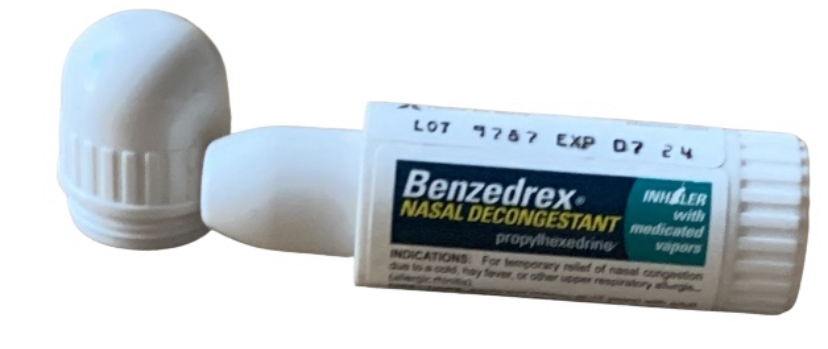
Propylhexedrine, as a nasal decongestant, is currently marketed under the brand name Benzedrex. The name was initially trademarked by Smith, Kline & French in 1944. The brand was passed onto Menley James Laboratories (through a subsidiary, NuMark Laboratories) in 1990, and was finally acquired by B. F. Ascher & Co. in 1998.
Dristan inhaler
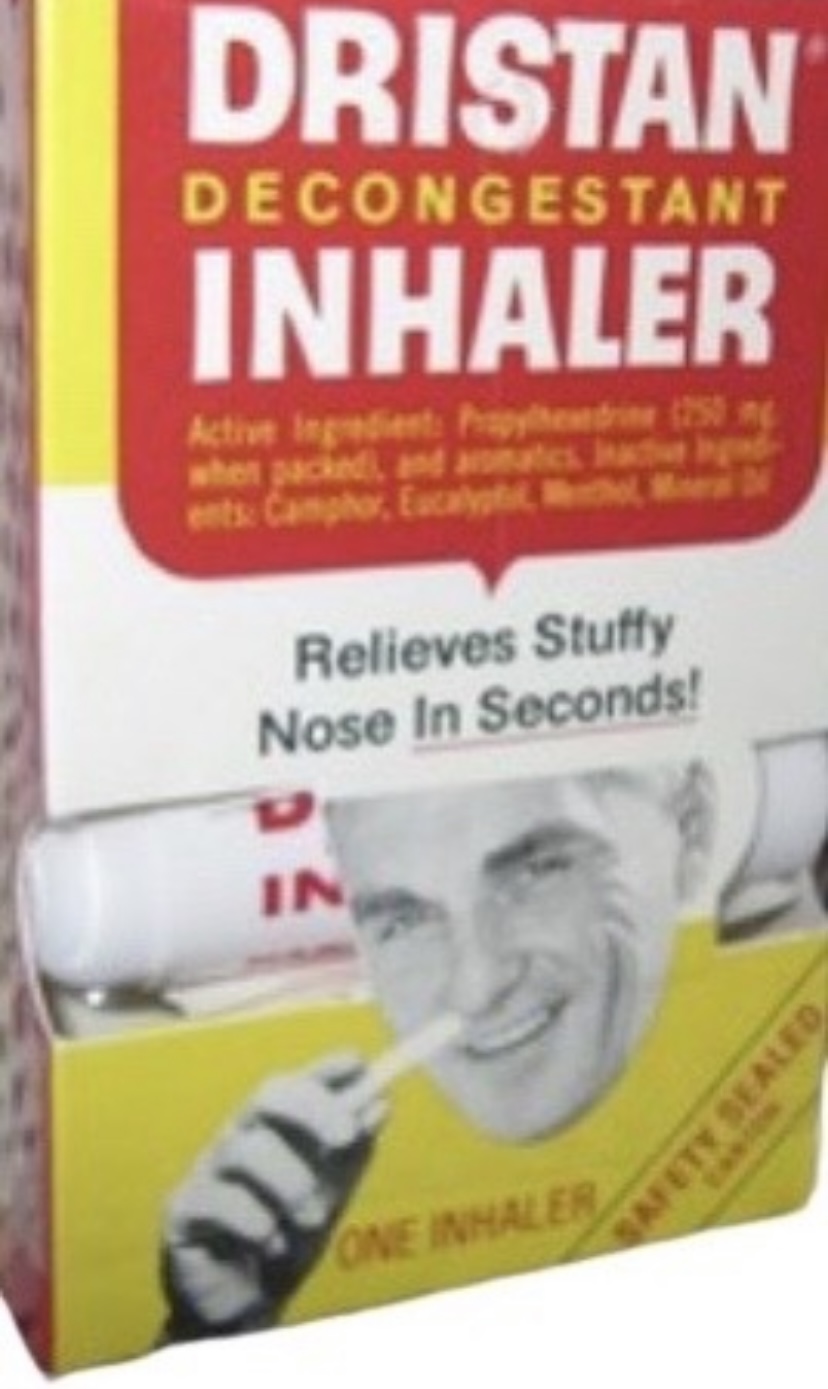
Propylhexedrine was also sold in inhaler form by Whitehall Laboratories (Wyeth) under the Dristan brand name as an inhaler. In January 1966, propylhexedrine replaced mephentermine as the active ingredient in the product. The Dristan inhaler has since been discontinued. Furthermore, Wyeth was acquired by Pfizer in 2009. All products currently sold under the Dristan brand are manufactured by Foundation Consumer Brands; Foundation Consumer Brands acquired the Dristan brand in 2020. Foundation Consumer Brands is itself owned by Kelso & Company.
Obesin
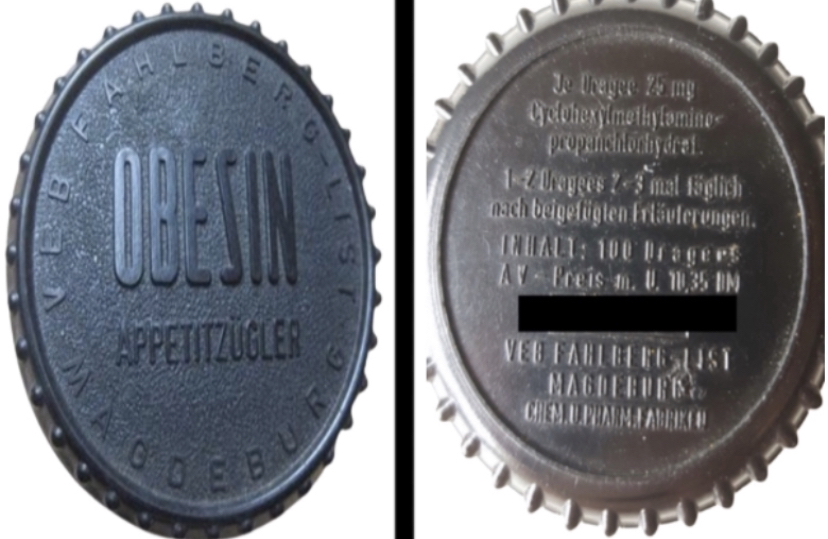
Propylhexedrine has also seen use in Europe as an appetite suppressant, under the brand name Obesin. Obesin has been referenced in literature dating back to the 1950s. Obesin was manufactured by Fahlberg-List in East Germany from 1958 to around 1976. The discontinuation of Obesin was the result of increased regulatory restrictions on over-the-counter anorectics. These restrictions began to be imposed in 1974. Fahlberg-List itself dissolved in 1995.
Maliasin

Propylhexedrine (in the form of levopropylhexedrine) is a component in the anticonvulsant preparation barbexaclone. It is included for the purpose of offsetting the barbiturate-induced sedation from phenobarbital. Barbexaclone has been known under the brand name of Maliasin, manufactured by Abbott Laboratories, as early as 1965. Maliasin has also been manufactured by Knoll Pharmaceuticals; Knoll is a company acquired by Abbott Laboratories. In 2010, Abbott discontinued sale of its barbexaclone preparation in many countries.
Eventin
Levopropylhexedrine has been used as an appetite suppressant under the brand name Eventin. Eventin's use has been documented as early as 1958.
References
References
- (June 7, 2023). "Cold, Cough, Allergy, Bronchodilator, and Antiasthmatic Drug Products for Over-the-Counter Human Use".
- "BENZEDREX 09-19-2014- propylhexedrine inhalant". U.S. National Library of Medicine.
- (June 2008). "Pharmacology of stimulants prohibited by the World Anti-Doping Agency (WADA)". British Journal of Pharmacology.
- (December 20, 2017). "Decongestants and Hypertension: Making Wise Choices When Selecting OTC Medications".
- "Propylhexedrine". Memorial Sloan Kettering Cancer Center.
- (March 25, 2021). "Benzedrex (propylhexedrine): Drug Safety Communication".
- Center for Drug Evaluation and Research. (2021-04-15). "FDA warns that abuse and misuse of the nasal decongestant propylhexedrine causes serious harm". U.S. Food and Drug Administration.
- (1985-09-22). "Rise In Nasal Inhaler Abuse Worries Officials". [[The New York Times]].
- "Monoamine oxidase inhibitors".
- "Propylhexedrine". DrugBank.
- (2017-10-18). "Decongestants".
- (August 2023). "The Alkylamine Stimulant 1,3-Dimethylamylamine Exhibits Substrate-Like Regulation of Dopamine Transporter Function and Localization". The Journal of Pharmacology and Experimental Therapeutics.
- (July 1964). "A Nonsympathomimetic Effect of Cyclopentamine and Beta-Mercaptoethylamine in the Rabbit Ileum". The Journal of Pharmacology and Experimental Therapeutics.
- (August 1990). "Effect of tuamine, heptaminol and two analogues on uptake and release of catecholamines in cultured chromaffin cells". Biochemical Pharmacology.
- (April 1947). "The pharmacologic activity of N-methyl-beta-cyclohexyl-isopropylamine hydrochloride". The Journal of Pharmacology and Experimental Therapeutics.
- (October 1974). "Identification of the major metabolites of propylhexedrine in vivo (in man) and in vitro (in guinea pig and rabbit)". Xenobiotica; the Fate of Foreign Compounds in Biological Systems.
- (August 1993). "Pulmonary hypertension associated with long-term inhalation of "crank" methamphetamine". Chest.
- "Nasal Inhaler".
- (1983). "Tissue injuries associated with parenteral propylhexedrine abuse". Journal of Toxicology. Clinical Toxicology.
- (1977). "Organic Chemistry of Drug Synthesis". Wiley.
- (May 1947). "Preparation of some primary and secondary beta-cyclohexylalkylamines". Journal of the American Chemical Society.
- Haberl, R.. (1958-11-01). "Über eine neue Bildungsweise des 1,2-Dimethyl-3-phenyl-äthylenimins". Monatshefte für Chemie und verwandte Teile anderer Wissenschaften.
- (1992). "Distinguishing sympathomimetic amines from amphetamine and methamphetamine in urine by gas chromatography/mass spectrometry". Journal of Analytical Toxicology.
- (October 1992). "A Clandestine Laboratory Extracting Propylhexedrine from Benzedrex Inhalers". Journal of the Clandestine Laboratory Investigating Chemists Association.
- "Sniffing Benzedrine Inhalers". [[McGill University]].
- "Cyclohexylalkylamines".
- (August 4, 1949). "Extension of remarks by representative Grant on H.R. 2969 - Bezedrine Inhalers". [[Government Publishing Office]].
- "Propylhexedrine - NAPRA".
- "Benzedrex- propylhexedrine inhalant (06/23/2023)". U.S. National Library of Medicine.
- (September 2013). "End of the barbexaclone era: an experience of treatment withdrawal". Epileptic Disorders.
- (September 9, 1976). "Federal Register Vol. 41, No. 176".
- "USP Monographs: Propylhexedrine Inhalant".
- (September 2013). "Street versions of opioids more potent and dangerous". CMAJ.
- (September 28, 1990). "Expert Committee on Drug Dependence's Twenty-Seventh Report". Expert Committee on Drug Dependence.
- "Therapeutic Goods (Poisons Standard—June 2024)".
- Anvisa. (2023-03-31). "RDC Nº 784 - Listas de Substâncias Entorpecentes, Psicotrópicas, Precursoras e Outras sob Controle Especial". [[Diário Oficial da União]].
- "Erowid Propylhexedrine (Benzedrex) Vault: Law".
- Government of Canada, Public Works and Government Services Canada. (2022-08-31). "Canada Gazette, Part 2, Volume 156, Number 18: Order Amending Schedule V to the Controlled Drugs and Substances Act (Novel Fentanyl Precursors)".
- "Anlage 1 AMVV - Einzelnorm".
- "The Misuse of Drugs Act 1971 (Modification) Order 1995". Office of Public Sector Information.
- (2016-03-23). "The blanket drugs ban is necessary, but won't solve the bigger problem – as I know from personal experience".
- (April 4, 1988). "Schedules of Controlled Substances: Placement of Propylhexedrine and Pyrovalerone into Schedule V". [[Drug Enforcement Administration]].
- (December 3, 1991). "Schedules of Controlled Substances: Removal of Propylhexedrine From Control". [[Drug Enforcement Administration]].
- "Sec. 1308.22 Excluded substances.". [[Drug Enforcement Administration]].
- (January 11, 1989). "Excluded Non-narcotic Over-the-counter Substances". [[Drug Enforcement Administration]].
- "2014 Alaska Statutes :: Title 11 - Criminal Law :: Chapter 11.71 - Controlled Substances :: Article 02 - Standards and Schedules :: Sec. 11.71.180 Schedule VA.".
- "2005 Arizona Revised Statutes - :: Revised Statutes §13-3401 Definitions".
- "2011 Florida Statutes :: Title XLVI — Crimes :: Chapter 893 — Drug Abuse Prevention and Control :: 893.03 — Standards and schedules.".
- "2022 Georgia Code :: Title 16 - Crimes and Offenses :: Chapter 13 - Controlled Substances :: Article 2 - Regulation of Controlled Substances :: Part 1 - Schedules, Offenses, and Penalties :: § 16-13-29.1. Nonnarcotic Substances Excluded From Schedules of Controlled Substances".
- "2010 Idaho Code :: Title 37 Food, Drugs, and Oil :: Chapter 27 Uniform Controlled Substances :: Article Ii :: 37-2713 Schedule V.".
- "2017 Kansas Statutes :: Chapter 65 Public Health :: Article 41 Controlled Substances :: 65-4113 Substances included in schedule V.".
- "2021 Rhode Island General Laws :: Title 21 - Food and Drugs :: Chapter 21-28 - Uniform Controlled Substances Act :: Section 21-28-2.08 - Contents of schedules.".
- (September 1959). "Arzneimittelsucht durch Mißbrauch von sogenannten Appetitzüglern (Obesin)". Archiv für Toxikologie.
- (November 1986). "Intravenous abuse of propylhexedrine (Benzedrex) and the risk of brainstem dysfunction in young adults". The Canadian Journal of Neurological Sciences. Le Journal Canadien des Sciences Neurologiques.
- (January 2011). "A drug toxicity death involving propylhexedrine and mitragynine". Journal of Analytical Toxicology.
- "Propylhexedrine (Benzedrex)".
- (May 1970). "Propylhexedrine (Benzedrex) psychosis". The New Zealand Medical Journal.
- (July 1974). "Two propylhexedrine-associated fatalities: Benzedrine revisited". Journal of Forensic Sciences.
- ""Future Synthetic Drugs of Abuse"". [[Drug Enforcement Administration]].
- (1975). "Editorial: Propylhexadrine - a new dangerous drug?". Clinical Toxicology.
- (1988-10-01). "An epidemiological and clinical analysis of propylhexedrine abuse in the United States". Journal of Psychoactive Drugs.
- (September 5, 1985). "Abuse of Potentially Fatal Nasal Inhaler Medication by Injection Called Widespread". [[LA Times]].
- (October 2010). "Barbexaclone abuse in a cannabis ex-user". Substance Abuse.
- (October 2020). "Abuse, Toxicology and the Resurgence of Propylhexedrine: A Case Report and Review of Literature". Cureus.
- (2021). "Abuse and Misuse of Propylhexedrine Nasal Decongestant Causes Serious Harm". [[Indian Health Service]].
- (October 26, 2022). "FDA issues drug misuse guidance".
- "Benzedrex Inhaler".
- "Benzedrex Trademark of B.F. Ascher & Company Inc - Registration Number 0896775 - Serial Number 72340742".
- (February 17, 2004). "Prince v. B.F. Ascher Company, Inc., 90 P.3d 1020 (Okla. Civ. App. 2004)".
- (March 1, 1999). "B.F. Ascher marks 50th year.". Chain Drug Review.
- (November 24, 1989). "Action in Respect of International Conventions on Narcotic Drugs and Psychotropic Substances".
- (March 1970). "Mephentermine psychosis: misuse of the Wyamine inhaler". The American Journal of Psychiatry.
- (October 1, 2020). "Foundation Consumer Healthcare to Add Seven Over-the-Counter Brands to Expanding Portfolio of Healthcare Products". [[Kelso & Company]].
- (June 1986). "Propylhexdrine". Drug and Alcohol Dependence.
- (February 1965). "Über eine Vergiftung mit dem Appetitzügler Propylhexedrin "Obesin", bei einem 3 Ährigen Kinde". Archiv für Toxikologie.
- (1976). "Bemerkungen zu Drogenmißbrauch und -abhängigkeit vom Amphetamin- Typ unter besonderer Berücksichtigung des Amphetaminils (Aponeuron (R) )". Psychiatrie, Neurologie und medizinische Psychologie.
- (April 1965). "[Clinical Communication on the Therapy of Epilepsy With Maliasin]". Die Medizinische Welt.
- "MALIASIN Trademark - Registration Number 0797076 - Serial Number 72213021".
- (January 31, 2011). "Parliamentary question {{!}} Maliasin {{!}} P-001035/2011 {{!}} European Parliament".
- (April 1958). "[Therapeutic experiences with the appetite depressant eventin]". Wiener Medizinische Wochenschrift.
This article was imported from Wikipedia and is available under the Creative Commons Attribution-ShareAlike 4.0 License. Content has been adapted to SurfDoc format. Original contributors can be found on the article history page.
Ask Mako anything about Propylhexedrine — get instant answers, deeper analysis, and related topics.
Research with MakoFree with your Surf account
Create a free account to save articles, ask Mako questions, and organize your research.
Sign up freeThis content may have been generated or modified by AI. CloudSurf Software LLC is not responsible for the accuracy, completeness, or reliability of AI-generated content. Always verify important information from primary sources.
Report