From Surf Wiki (app.surf) — the open knowledge base
Proof without words
Mathematical proof expressed visually

Mathematical proof expressed visually
In mathematics, a proof without words (or visual proof) is an illustration of an identity or mathematical statement which can be demonstrated as self-evident by a diagram without any accompanying explanatory text. Such proofs can be considered more elegant than formal or mathematically rigorous proofs due to their self-evident nature. When the diagram demonstrates a particular case of a general statement, to be a proof, it must be generalisable.
A proof without words is not the same as a mathematical proof, because it omits the details of the logical argument it illustrates. However, it can provide valuable intuitions to the viewer that can help them formulate or better understand a true proof.
Examples
Sum of odd numbers

The statement that the sum of all positive odd numbers up to 2n − 1 is a perfect square—more specifically, the perfect square n2—can be demonstrated by a proof without words.
In one corner of a grid, a single block represents 1, the first square. That can be wrapped on two sides by a strip of three blocks (the next odd number) to make a 2 × 2 block: 4, the second square. Adding a further five blocks makes a 3 × 3 block: 9, the third square. This process can be continued indefinitely.
Pythagorean theorem
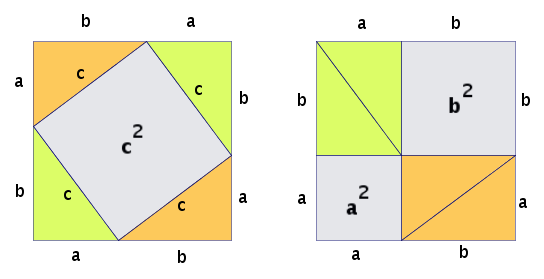
The Pythagorean theorem that a^2 + b^2 = c^2 can be proven without words.
One method of doing so is to visualise a larger square of sides a+b, with four right-angled triangles of sides a, b and c in its corners, such that the space in the middle is a diagonal square with an area of c^2. The four triangles can be rearranged within the larger square to split its unused space into two squares of a^2 and b^2.
Jensen's inequality

Jensen's inequality can also be proven graphically. A dashed curve along the X axis is the hypothetical distribution of X, while a dashed curve along the Y axis is the corresponding distribution of Y values. The convex mapping Y(X) increasingly "stretches" the distribution for increasing values of X.
Usage
Mathematics Magazine and The College Mathematics Journal run a regular feature titled "Proof without words" containing, as the title suggests, proofs without words. The Art of Problem Solving and USAMTS websites run Java applets illustrating proofs without words.
Compared to formal proofs
For a proof to be accepted by the mathematical community, it must logically show how the statement it aims to prove follows totally and inevitably from a set of assumptions. A proof without words might imply such an argument, but it does not make one directly, so it cannot take the place of a formal proof where one is required. Rather, mathematicians use proofs without words as illustrations and teaching aids for ideas that have already been proven formally.
Notes
References
- {{citation | editor-last = Shure | editor-first = Loren
References
- {{Harvnb. Dunham. 1994
- "Proof without Words".
- {{Harvnb. Dunham. 1994
- {{Harvnb. Nelsen. 1997
- Benson, Donald. ''[https://books.google.com/books?id=8_vbuzxrpfIC&pg=PA172 The Moment of Proof : Mathematical Epiphanies]'', pp. 172–173 (Oxford University Press, 1999).
- (1937). "Jensen's Inequality". American Mathematical Society.
- "Gallery of Proofs". Art of Problem Solving.
- "Gallery of Proofs". USA Mathematical Talent Search.
- Lang, Serge. (1971). "Basic Mathematics". Addison-Wesley Publishing Company.
- (October 6, 2004). "Facilitator's Guide to Ways to Think About Mathematics". Corwin Press.
- Spivak, Michael. (2008). "Calculus". Publish or Perish, Inc..
- (October 6, 2004). "Facilitator's Guide to Ways to Think About Mathematics". Corwin Press.
- Schulte, Tom. (January 12, 2011). "Proofs without Words: Exercises in Visual Thinking (review)". The Mathematical Association of America.
This article was imported from Wikipedia and is available under the Creative Commons Attribution-ShareAlike 4.0 License. Content has been adapted to SurfDoc format. Original contributors can be found on the article history page.
Ask Mako anything about Proof without words — get instant answers, deeper analysis, and related topics.
Research with MakoFree with your Surf account
Create a free account to save articles, ask Mako questions, and organize your research.
Sign up freeThis content may have been generated or modified by AI. CloudSurf Software LLC is not responsible for the accuracy, completeness, or reliability of AI-generated content. Always verify important information from primary sources.
Report