From Surf Wiki (app.surf) — the open knowledge base
Promised Land
Land given by God to Abraham's descendants in the Bible
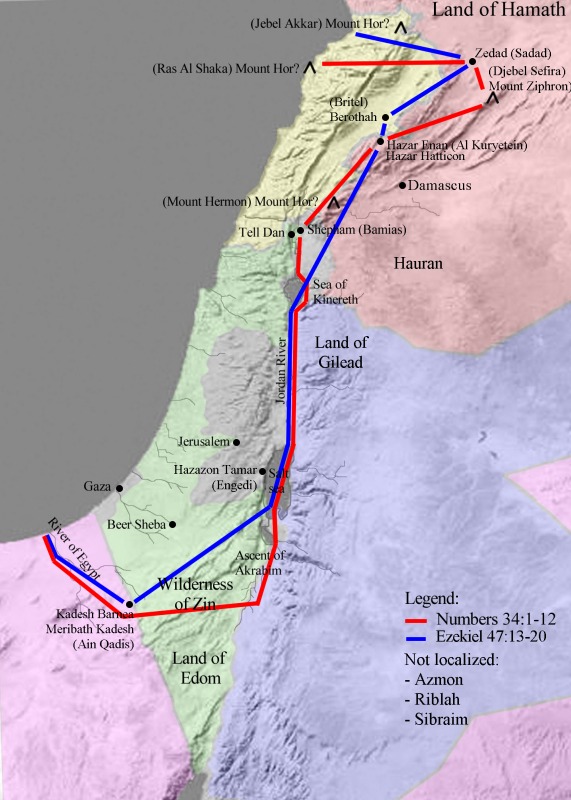
Land given by God to Abraham's descendants in the Bible
the concept in the Abrahamic religions
In the Abrahamic religions, the "Promised Land" () refers to an area in the Levant that God chose to bestow upon, via a series of covenants, to the family and descendants of Abraham.
In the context of the Hebrew Bible, these descendants are originally understood to have been the Israelites, whose forefather was Jacob, who was a son of Abraham's son Isaac. The concept of the Promised Land largely overlaps with the Land of Israel (Zion) or the Holy Land in a biblical/religious sense and with Canaan or Palestine in a secular/geographic sense. Although the Book of Numbers provides some definition for the Promised Land's boundaries, they are not delineated with precision, but it is universally accepted that the core areas lie in and around Jerusalem. According to the biblical account, the Promised Land was not inherited until the Israelite conquest of Canaan, which took place shortly after the Exodus.
These promises were given prior to the birth of Abraham's sons. Abraham's family tree includes both the Ishmaelite tribes—the claimed ancestry of Arabs and of the Islamic prophet Muhammad—through Abraham's first son Ishmael and the Israelite tribes—the claimed ancestry of Jews and Samaritans—through Abraham's second son Isaac.
Biblical narrative
The concept of the Promised Land is first mentioned in the Book of Genesis, which is the first book of the Torah, which collectively refers to the first five books of the Hebrew Bible.
God's covenant with Abraham
God is claimed to have spoken the following promises to Abraham in several verses of Genesis (the first book of the Torah), which a modern English Bible translates to: :The LORD had said to Abram, "Leave your country, your people and your father's household and go to the land I will show you." – :The LORD appeared to Abram and said, "To your offspring [or seed] I will give this land." –
Later in what is called the covenant of the pieces, a verse is said to describe what are known as "borders of the Land" (Gevulot Ha-aretz): :On that day the Lord made a covenant with Abram and said, "To your descendants I give this land, from the Wadi of Egypt to the great river, the Euphrates – the land of the Kenites, Kenizzites, Kadmonites, Hittites, Perizzites, Rephaites, Amorites, Canaanites, Girgashites and Jebusites." –
These allegedly divine promises were given prior to the birth of Abraham's sons.
Subsequent confirmations
God later confirms the promise to Abraham's son Isaac (), and then to Isaac's son Jacob () in terms of "the land on which you are lying". Jacob is later renamed "Israel" () and his descendants are called the Children of Israel or the Twelve Tribes of Israel.
The Torah's subsequent Book of Exodus describes it as "land flowing with milk and honey" () and gives verses on how to treat the prior occupants and marks the borders in terms of the Red Sea, the "Sea of the Philistines", and the "River", which a modern English Bible translates to: : "I will establish your borders from the Red Sea to the Mediterranean Sea, and from the desert to the Euphrates River. I will give into your hands the people who live in the land, and you will drive them out before you. Do not make a covenant with them or with their gods. Do not let them live in your land or they will cause you to sin against me, because the worship of their gods will certainly be a snare to you." –
The Israelites lived in a smaller area of former Canaanite land and land east of the Jordan River after the legendary prophet Moses led the Israelite Exodus out of Egypt (). The Torah's Book of Deuteronomy presents this occupation as their God's fulfillment of the promise (). Moses anticipated that their God might subsequently give the Israelites land reflecting the boundaries of the original promise – if they were obedient to the covenant ().
Interpretations
Jewish interpretation
The concept of the Promised Land is a central religious belief of the Jewish people and a key tenet of Zionism, the Jewish national movement which established the State of Israel. Compare: | publication-date = 2014 | access-date = 8 November 2020
Mainstream Jewish tradition regards the promise made to Abraham, Isaac and Jacob as applying to anyone a member of the Jewish people, including proselytes and in turn their descendants and is signified through the brit milah (rite of circumcision).
Genesis 15 records God’s covenant with Abraham, which includes the borders of the Promised Land:
In English:
Book of Joshua records the first prophecy given to Joshua about the conquest of the land:
In English:
Christian interpretation

: "The promises were spoken to Abraham and to his seed. Scripture does not say "and to seeds," meaning many people, but "and to your seed," meaning one person, who is Christ."
In Galatians 3:28–29 Paul goes further, noting that the expansion of the promise from singular to the plural is not based on genetic/physical association, but a spiritual/religious one: :"There is neither Jew nor Gentile, neither slave nor free, neither male nor female, for you are all one in Christ Jesus. If you belong to Christ, then you are Abraham's seed, and heirs according to the promise."
In it is written: :"It was not through the law that Abraham and his offspring received the promise that he would be heir of the world, but through the righteousness that comes by faith." German Lutheran Old Testament commentator Johann Friedrich Karl Keil states that the covenant is through Isaac, but notes that Ishmael's descendants have held much of that land through time.
American colonialism
Many European colonists saw America as the "Promised Land", representing a haven from religious conflicts and persecution. For instance, Puritan minister John Cotton's 1630 sermon God's Promise to His Plantation gave colonizers departing England to Massachusetts repeated references to the Exodus story, and later German immigrants sang: "America [...] is a beautiful land that God promised to Abraham."
In a sermon celebrating independence in 1783, Yale president Ezra Stiles implied Americans were chosen and delivered from bondage to a Promised Land: "the Lord shall have made his American Israel 'high above all nations which he hath made'," reflecting language from Deuteronomy of the promise.
Shawnee/Lenape scholar Steven Newcomb argued in his 2008 book Pagans in the Promised Land: Decoding the Doctrine of Christian Discovery that Christendom's discovery doctrine was also the same claim of "the right to kill and plunder non-Christians" found in this covenant tradition, whereby "the Lord" in Deuteronomy told his chosen people how they were to "utterly destroy" the "many nations before thee" when "He" brought them into the land "He" had discovered and promised to "His" "Chosen People" to "possess", and that this "right" was woven into US law through the 1823 Johnson v. McIntosh Supreme Court ruling.
Mormonism
Main article: Mormonism#America
Mormonism teaches that the United States is the Biblical promised land, the U.S. Constitution divinely inspired, and Mormons God's chosen people.
Muslim interpretation
Main article: Ishmael in Islam#Genealogy and association with Arabs, Quraysh#Origins, Family tree of Muhammad
Jewish and Muslim tradition, with records that date to at least as far back as the works of 1st-century Jewish historian Flavius Josephus, postulates that Abraham’s first son, Ishmael, was the founder of the Arab race, Islam's main prophet, Muhammad, also considered himself a Hanif, that is, a true monotheistic believer of the religion of Abraham. His tribe, the Quraysh, traces its ancestry to Ishmael. Although, this cannot be proven as there are 30 missing ancestors from the lineage [citation needed]. For these reasons, Muslims in general understand that Arabs are also entitled to the “Promised Land” bestowed upon their common ancestor Abraham (“Ibrahim”).
Palestinian interpretation
Some Palestinians claim partial descent from the Israelites and Maccabees, as well as from other peoples who have lived in the region.
African-American spirituals
African-American spirituals invoke the imagery of the "Promised Land" as heaven or paradise For example: | access-date = 8 November 2020 and as an escape from slavery, which could often only be reached by death. The imagery and term also appear elsewhere in popular culture, in sermons, and in speeches such as Martin Luther King Jr.'s 1968 "I've Been to the Mountaintop", in which he said:
I just want to do God's will. And He's allowed me to go up to the mountain. And I've looked over. And I've seen the Promised Land. I may not get there with you. But I want you to know tonight, that we, as a people, will get to the Promised Land. So I'm happy, tonight. I'm not worried about anything. I'm not fearing any man. Mine eyes have seen the glory of the coming of the Lord.
Boundaries from the Book of Numbers
:Boundaries of the 'Promised Land' given in the Book of Numbers (chapter ) ::The South border. —(v. ) "Then your south quarter shall be from the wilderness of Zin along by the coast of Edom, and your south border shall be the outmost coast of the salt sea eastward : (v. 4) And your border shall turn from the south to the ascent of Akrabbim, and pass on to Zin : and the going forth thereof shall be from the south to Kadesh-barnea, and shall go on to Hazar-addar, and pass on to Azmon : (v. 5) And the border shall fetch a compass from Azmon unto the river of Egypt, and the goings out of it shall be at the sea." ::The Western border. —(v. ) "And as for the western border, ye shall even have the great sea for a border: this shall be your west border." ::The North border. —(v. ) "And this shall be your north border : from the great sea ye shall point out for you mount Hor : (v. ) From mount Hor ye shall point out your border unto the entrance of Hamath ; and the goings forth of the border shall be to Zedad : (v ) And the border shall go on to Ziphron, and the goings out of it shall be at Hazar-enan : this shall be your north border." ::The East border. —(v. ) "And ye shall point out your east border from Hazar-enan to Shepham: (v.) And the coast shall go down from Shepham to Riblah, on the east side of Ain ; and the border shall descend, and shall reach unto the side of the sea of Chinnereth eastward: (v. ) And the border shall go down to Jordan, and the goings out of it shall be at the salt sea : this shall be your land with the coasts thereof round about." :Boundaries of the 'Promised Land' given by Jerome c.400
- 1845: Salomon Munk, Palestine, Description Géographique, Historique et Archéologique," in "L'Univers Pittoresque:
Under the name Palestine, we comprehend the small country formerly inhabited by the Israelites, and which is today part of Acre and Damascus pachalics. It stretched between 31 and 33° N. latitude and between 32 and 35° degrees E. longitude, an area of about 1300 . Some zealous writers, to give the land of the Hebrews some political importance, have exaggerated the extent of Palestine; but we have an authority for us that one can not reject. St. Jerome, who had long traveled in this country, said in his letter to Dardanus (ep. 129) that the northern boundary to that of the southern, was a distance of 160 Roman miles, which is about 55 . He paid homage to the truth despite his fears, as he said himself, of availing the Promised Land to pagan mockery, "Pudet dicere latitudinem terrae repromissionis, ne ethnicis occasionem blasphemandi dedisse uideamur" (Latin: "I am embarrassed to say the breadth of the promised land, lest we seem to have given the heathen an opportunity of blaspheming").
Footnotes
References
General sources
References
- ''Kol Torah'', vol. 13, no. 9, Torah Academy of Bergen County, Nov 8, 2003
- "The Land of Israel".
- "Conversion to Judaism Resource Center".
- "Bible Gateway passage: Genesis 15:18 - New International Version".
- "בראשית טו – ויקיטקסט".
- "The Contemporary Torah {{!}} The Jewish Publication Society".
- "Bible Gateway passage: Joshua 1 - New International Version".
- "Joshua 1:4".
- "THE JPS TANAKH: Gender-Sensitive Edition {{!}} The Jewish Publication Society".
- Burge, Gary M. (2014). "Christians and the Middle East Conflict". Routledge.
- {{bibleverse. Galatians. 3:16. NIV NIV
- {{bibleverse. Galatians. 3:28-30. NIV NIV
- (October 3, 1866). "Biblical Commentary on the Old Testament". T. & T. Clark.
- (2021-07-12). "America as the Promised Land".
- McDougall, Walter A.. (1997). "Promised Land, Crusader State". Houghton Mifflin.
- Newcomb, Steven T.. (2008). "Pagans in the Promised Land: Decoding the Doctrine of Christian Discovery". Fulcrum Publishing.
- Newcomb, Steven. (2020-08-22). ""God's" Gift of a Right of Domination".
- {{harvnb. Millar. 2011
- "(With reference to Palestinians in [[Ottoman empire. Ottoman]] times) Although proud of their [[Arab]] heritage and ancestry, the [[Palestinians]] considered themselves to be descended not only from Arab conquerors of the seventh century but also from [[indigenous peoples]] who had lived in the country since time immemorial, including the ancient [[Hebrews]] and the [[Canaanites]] before them. Acutely aware of the distinctiveness of Palestinian history, the Palestinians saw themselves as the heirs of its rich associations." [[Walid Khalidi]], 1984, ''Before Their Diaspora: A Photographic History of the Palestinians, 1876–1948''. Institute for Palestine Studies
- (3 April 1968). "I've Been to the Mountaintop".
- Henry P. Linton. (1884). "Notes on the book of Numbers".
- Bechard, Dean Philip. (1 January 2000). "Paul Outside the Walls: A Study of Luke's Socio-geographical Universalism in Acts 14:8-20". Gregorian Biblical BookShop.
- (1837). "Sainte Bible expliquée et commentée, contenant le texte de la Vulgate". Bibl. Ecclésiastique.
- Hieronymus (1910). "Epistola CXXIX Ad Dardanum de Terra promissionis (al. 129; scripta circa annum 414ce)". [https://archive.org/details/CSEL56 Epistularum Pars III —Epistulae 121-154], p. 171 (The fifty-sixth volume of ''Corpus Scriptorum Ecclesiasticorum Latinorum'' also known as the Vienna Corpus: Letters Part 3, Containing letters 121-154 of St. Jerome.) Image of [https://ia600803.us.archive.org/BookReader/BookReaderImages.php?zip=/6/items/CSEL56/CSEL56_jp2.zip&file=CSEL56_jp2/CSEL56_0182.jp2&scale=1&rotate=0 p. 171] at Archive.org
- Munk, Salomon. (1845). "Palestine: Description géographique, historique et archéologique". F. Didot.
- (1871). "Palästina: geographische, historische und archäologische Beschreibung dieses Landes und kurze Geschichte seiner hebräischen und jüdischen Bewohner". Leiner.
This article was imported from Wikipedia and is available under the Creative Commons Attribution-ShareAlike 4.0 License. Content has been adapted to SurfDoc format. Original contributors can be found on the article history page.
Ask Mako anything about Promised Land — get instant answers, deeper analysis, and related topics.
Research with MakoFree with your Surf account
Create a free account to save articles, ask Mako questions, and organize your research.
Sign up freeThis content may have been generated or modified by AI. CloudSurf Software LLC is not responsible for the accuracy, completeness, or reliability of AI-generated content. Always verify important information from primary sources.
Report