From Surf Wiki (app.surf) — the open knowledge base
Prolate spheroidal coordinates
Three-dimensional coordinate system
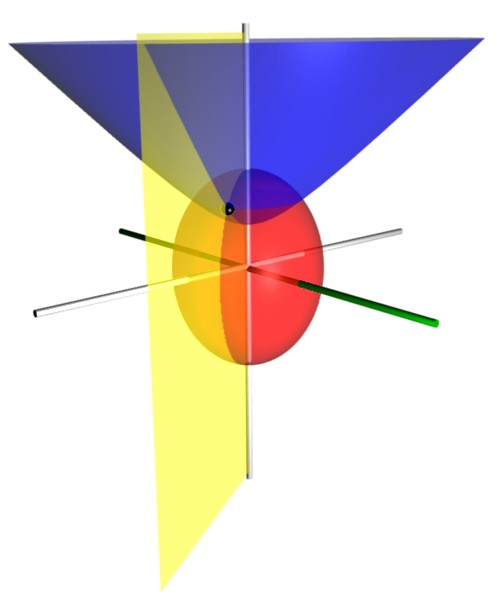
Three-dimensional coordinate system
Prolate spheroidal coordinates are a three-dimensional orthogonal coordinate system that results from rotating the two-dimensional elliptic coordinate system about the focal axis of the ellipse, i.e., the symmetry axis on which the foci are located. Rotation about the other axis produces oblate spheroidal coordinates. Prolate spheroidal coordinates can also be considered as a limiting case of ellipsoidal coordinates in which the two smallest principal axes are equal in length.
Prolate spheroidal coordinates can be used to solve various partial differential equations in which the boundary conditions match its symmetry and shape, such as solving for a field produced by two centers, which are taken as the foci on the z-axis. One example is solving for the wavefunction of an electron moving in the electromagnetic field of two positively charged nuclei, as in the hydrogen molecular ion, H2+. Another example is solving for the electric field generated by two small electrode tips. Other limiting cases include areas generated by a line segment (μ = 0) or a line with a missing segment (ν=0). The electronic structure of general diatomic molecules with many electrons can also be solved to excellent precision in the prolate spheroidal coordinate system.
Definition

The most common definition of prolate spheroidal coordinates (\mu, \nu, \varphi) is
: x = a \sinh \mu \sin \nu \cos \varphi
: y = a \sinh \mu \sin \nu \sin \varphi
: z = a \cosh \mu \cos \nu
where \mu is a nonnegative real number and \nu \in [0, \pi]. The azimuthal angle \varphi belongs to the interval [0, 2\pi].
The trigonometric identity
: \frac{z^2}{a^2 \cosh^2 \mu} + \frac{x^2 + y^2}{a^2 \sinh^2 \mu} = \cos^2 \nu + \sin^2 \nu = 1
shows that surfaces of constant \mu form prolate spheroids, since they are ellipses rotated about the axis joining their foci. Similarly, the hyperbolic trigonometric identity
: \frac{z^2}{a^2 \cos^2 \nu} - \frac{x^2 + y^2}{a^2 \sin^2 \nu} = \cosh^2 \mu - \sinh^2 \mu = 1
shows that surfaces of constant \nu form hyperboloids of revolution.
The distances from the foci located at (x, y, z) = (0, 0, \pm a) are
: r_\pm = \sqrt{x^2 + y^2 + (z \mp a)^2} = a(\cosh \mu \mp \cos \nu).
Scale factors
The scale factors for the elliptic coordinates (\mu, \nu) are equal
: h_\mu = h_\nu = a\sqrt{\sinh^2\mu + \sin^2\nu}
whereas the azimuthal scale factor is
: h_\varphi = a \sinh\mu \sin\nu,
resulting in a metric of
: \begin{align} ds^2 &= h_\mu^2 d\mu^2 + h_\nu^2 d\nu^2 + h_\varphi^2 d\varphi^2 \ &= a^2 \left[ (\sinh^2\mu + \sin^2\nu) d\mu^2 + (\sinh^2\mu + \sin^2\nu) d\nu^2 + (\sinh^2\mu \sin^2\nu) d\varphi^2 \right]. \end{align}
Consequently, an infinitesimal volume element equals
: dV = a^3 \sinh\mu \sin\nu ( \sinh^2 \mu + \sin^2 \nu) , d\mu , d\nu , d\varphi
and the Laplacian can be written
: \begin{align} \nabla^2 \Phi = {} & \frac{1}{a^2 (\sinh^2 \mu + \sin^2 \nu)} \left[ \frac{\partial^2 \Phi}{\partial \mu^2} + \frac{\partial^2 \Phi}{\partial \nu^2} + \coth \mu \frac{\partial \Phi}{\partial \mu} + \cot \nu \frac{\partial \Phi}{\partial \nu} \right] \[6pt] & {} + \frac{1}{a^2 \sinh^2 \mu \sin^2\nu} \frac{\partial^2 \Phi}{\partial \varphi^2} \end{align}
Other differential operators such as \nabla \cdot \mathbf{F} and \nabla \times \mathbf{F} can be expressed in the coordinates (\mu, \nu, \varphi) by substituting the scale factors into the general formulae found in orthogonal coordinates.
Alternative definition(1)
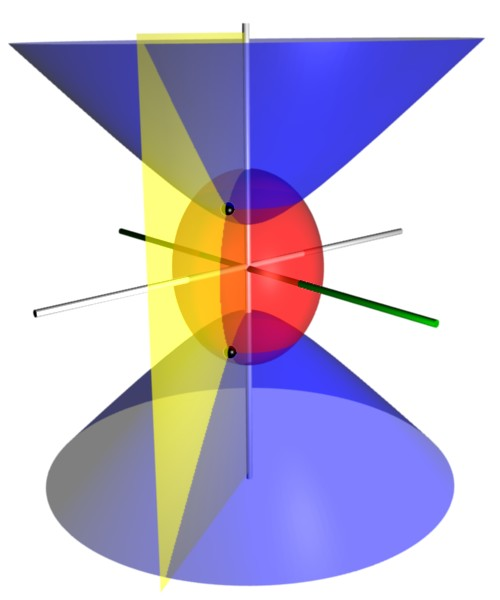
An alternative and geometrically intuitive set of prolate spheroidal coordinates (\sigma, \tau, \phi) are sometimes used, where \sigma = \cosh \mu and \tau = \cos \nu. Hence, the curves of constant \sigma are prolate spheroids, whereas the curves of constant \tau are hyperboloids of revolution. The coordinate \tau belongs to the interval [−1, 1], whereas the \sigma coordinate must be greater than or equal to one.
The coordinates \sigma and \tau have a simple relation to the distances to the foci F_{1} and F_{2}. For any point in the plane, the sum d_{1}+d_{2} of its distances to the foci equals 2a\sigma, whereas their difference d_{1}-d_{2} equals 2a\tau. Thus, the distance to F_{1} is a(\sigma+\tau), whereas the distance to F_{2} is a(\sigma-\tau). (Recall that F_{1} and F_{2} are located at z=-a and z=+a, respectively.) This gives the following expressions for \sigma, \tau, and \varphi:
: \sigma = \frac 1 {2a} \left(\sqrt{x^2+y^2+(z+a)^2}+\sqrt{x^2+y^2+(z-a)^2}\right)
: \tau = \frac 1 {2a} \left(\sqrt{x^2+y^2+(z+a)^2}-\sqrt{x^2+y^2+(z-a)^2}\right)
: \varphi = \arctan\left(\frac y x \right)
Unlike the analogous oblate spheroidal coordinates, the prolate spheroid coordinates (σ, τ, φ) are not degenerate; in other words, there is a unique, reversible correspondence between them and the Cartesian coordinates
: x = a \sqrt{(\sigma^2 - 1) (1 - \tau^2)} \cos \varphi
: y = a \sqrt{(\sigma^2 - 1) (1 - \tau^2)} \sin \varphi
: z = a\ \sigma\ \tau
Alternative scale factors
The scale factors for the alternative elliptic coordinates (\sigma, \tau, \varphi) are
: h_{\sigma} = a\sqrt{\frac{\sigma^{2} - \tau^{2}}{\sigma^{2} - 1}}
: h_{\tau} = a\sqrt{\frac{\sigma^{2} - \tau^{2}}{1 - \tau^{2}}}
while the azimuthal scale factor is now
: h_\varphi = a \sqrt{\left( \sigma^{2} - 1 \right) \left( 1 - \tau^{2} \right)}
Hence, the infinitesimal volume element becomes
: dV = a^3 (\sigma^2 - \tau^2) , d\sigma , d\tau , d\varphi
and the Laplacian equals
: \begin{align} \nabla^2 \Phi = {} & \frac{1}{a^2 (\sigma^2 - \tau^2)} \left{ \frac{\partial}{\partial \sigma} \left[ \left( \sigma^2 - 1 \right) \frac{\partial \Phi}{\partial \sigma} \right] + \frac{\partial}{\partial \tau} \left[ (1 - \tau^2) \frac{\partial \Phi}{\partial \tau} \right] \right} \ & {} + \frac{1}{a^2 (\sigma^2 - 1) (1 - \tau^2)} \frac{\partial^2 \Phi}{\partial \varphi^2} \end{align}
Other differential operators such as \nabla \cdot \mathbf{F} and \nabla \times \mathbf{F} can be expressed in the coordinates (\sigma, \tau) by substituting the scale factors into the general formulae found in orthogonal coordinates.
As is the case with spherical coordinates, Laplace's equation may be solved by the method of separation of variables to yield solutions in the form of prolate spheroidal harmonics, which are convenient to use when boundary conditions are defined on a surface with a constant prolate spheroidal coordinate (See Smythe, 1968).
Alternative definition(2)
Prolate spheroidal coordinates (η, θ, ϕ; d){{cite journal | url-access=subscription
\begin{aligned} x &= \sqrt{\eta^2 - d^2},\sin\theta\cos\phi,\ y &= \sqrt{\eta^2 - d^2},\sin\theta\sin\phi,\ z &= \eta,\cos\theta, \end{aligned}
where
0\le\theta\le\pi,\quad 0\le\phi
and 𝑑0 denotes the focal distance (half the separation between the foci of a cross-sectional ellipse). Note that if d=0, the cross-section is a circle, and coordinates become those for a sphere. The normal to the surface at each point is η, which has its length equal to the semi-major axis of a cross-sectional ellipse.
References
Bibliography
No angles convention
- Uses ξ1 = a cosh μ, ξ2 = sin ν, and ξ3 = cos φ.
- Same as Morse & Feshbach (1953), substituting u**k for ξ**k.
- Uses coordinates ξ = cosh μ, η = sin ν, and φ.
Angle convention
- Korn and Korn use the (μ, ν, φ) coordinates, but also introduce the degenerate (σ, τ, φ) coordinates.
- Similar to Korn and Korn (1961), but uses colatitude θ = 90° - ν instead of latitude ν.
- Moon and Spencer use the colatitude convention θ = 90° − ν, and rename φ as ψ.
Unusual convention
- Treats the prolate spheroidal coordinates as a limiting case of the general ellipsoidal coordinates. Uses (ξ, η, ζ) coordinates that have the units of distance squared.
References
- (21 May 2019). "A review on non-relativistic, fully numerical electronic structure calculations on atoms and diatomic molecules". Int. J. Quantum Chem..
This article was imported from Wikipedia and is available under the Creative Commons Attribution-ShareAlike 4.0 License. Content has been adapted to SurfDoc format. Original contributors can be found on the article history page.
Ask Mako anything about Prolate spheroidal coordinates — get instant answers, deeper analysis, and related topics.
Research with MakoFree with your Surf account
Create a free account to save articles, ask Mako questions, and organize your research.
Sign up freeThis content may have been generated or modified by AI. CloudSurf Software LLC is not responsible for the accuracy, completeness, or reliability of AI-generated content. Always verify important information from primary sources.
Report