From Surf Wiki (app.surf) — the open knowledge base
Projectile
Object propelled through the air
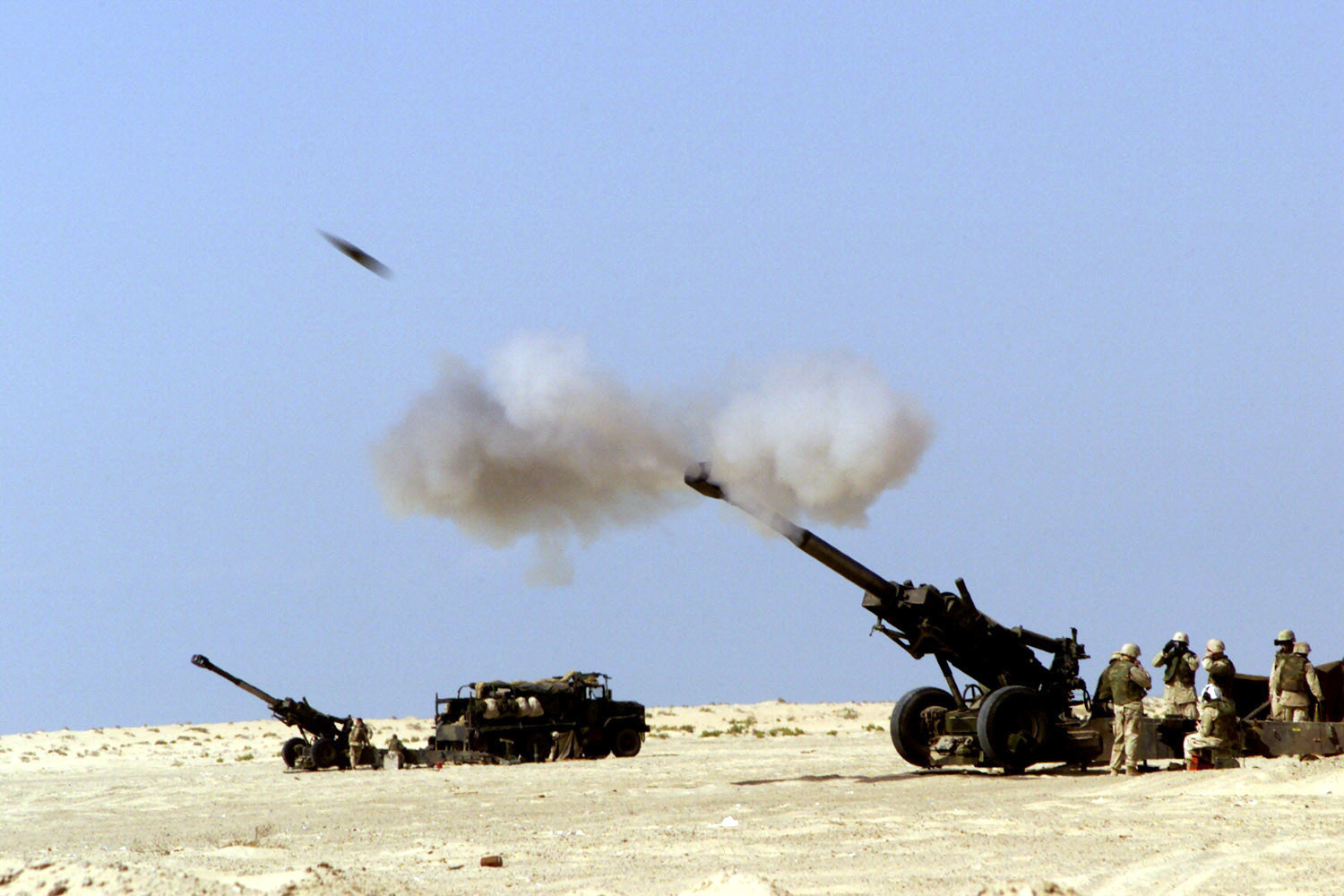
Object propelled through the air
A projectile is an object that is propelled by the application of an external force and then moves freely under the influence of gravity and air resistance. Although any objects in motion through space are projectiles, they are commonly found in warfare and sports (for example, a thrown baseball, kicked football, fired bullet, shot arrow, a ball from a cannon, stone released from catapult).
In ballistics, mathematical equations of motion are used to analyze projectile trajectories through launch, flight, and impact.
Motive force

Blowguns and pneumatic rifles use compressed gases, while most other guns and cannons utilize expanding gases liberated by sudden chemical reactions by propellants like smokeless powder. Light-gas guns use a combination of these mechanisms.
Railguns utilize electromagnetic fields to provide acceleration along the entire length of the device, greatly increasing the muzzle velocity.
Some projectiles provide propulsion during flight by means of a rocket engine or jet engine. In military terminology, a rocket is unguided, while a missile is guided. Note the two meanings of "rocket" (weapon and engine): an ICBM is a guided missile with a rocket engine.
An explosion, whether or not by a weapon, causes the debris to act as multiple high velocity projectiles. An explosive weapon or device may also be designed to produce many high velocity projectiles by the break-up of its casing; these are correctly termed fragments.
In sports {{anchor|Sport projectiles}}

]] In projectile motion the most important force applied to the projectile mass is the propelling force. In many sports, the propelling forces are provided by muscles that accelerate the projectile (ball, disc, javelin, hammer, dart), and the stronger the propelling force, the faster and farther the projectile will travel. See pitching, bowling.
As a weapon
Delivery projectiles
Many projectiles, e.g. shells, may carry an explosive charge or another chemical or biological substance. Aside from explosive payload, a projectile can be designed to cause special damage, e.g. fire (see also early thermal weapons), or poisoning (see also arrow poison).
Kinetic projectiles
Wired projectiles
Some projectiles stay connected by a cable to the launch equipment after launching it:
- for guidance: wire-guided missile (range up to 4000 m)
- to administer an electric shock, as in the case of a Taser (range up to 10.6 m); two projectiles are shot simultaneously, each with a cable.
- to make a connection with the target, either to tow it towards the launcher, as with a whaling harpoon, or to draw the launcher to the target, as a grappling hook does.
Equations of motion
Main article: Projectile motion
An object projected at an angle to the horizontal has both the vertical and horizontal components of velocity. The vertical component of the velocity on the y-axis is given as V_y=U\sin\theta while the horizontal component of the velocity is V_x=U\cos\theta. There are various calculations for projectiles at a specific angle \theta:
-
Time to reach maximum height. It is symbolized as (t), which is the time taken for the projectile to reach the maximum height from the plane of projection. Mathematically, it is given as t=U \sin\theta/g where g = acceleration due to gravity (app 9.81 m/s²), U = initial velocity (m/s) and \theta = angle made by the projectile with the horizontal axis.
-
Time of flight (T): this is the total time taken for the projectile to fall back to the same plane from which it was projected. Mathematically it is given as T=2U\sin\theta/g.
-
Maximum Height (H): this is the maximum height attained by the projectile OR the maximum displacement on the vertical axis (y-axis) covered by the projectile. It is given as H = U^2 \sin^2\theta/2g.
-
Range (R): The Range of a projectile is the horizontal distance covered (on the x-axis) by the projectile. Mathematically, R = U^2 \sin 2\theta/g. The Range is maximum when angle \theta = 45°, i.e. \sin 2\theta=1.
Notes
References
References
- (2001). "Senior Secondary School Physics". Macmillan,Lagos, Nigeria.
- "projectile".
- "projectile".
- "projectile".
- Pepin, Matt. (2010-08-26). "Aroldis Chapman hits 105 mph". [[Boston.com]].
- "Projectile motion in sports {{!}} Sports Biomechanics Class Notes".
This article was imported from Wikipedia and is available under the Creative Commons Attribution-ShareAlike 4.0 License. Content has been adapted to SurfDoc format. Original contributors can be found on the article history page.
Ask Mako anything about Projectile — get instant answers, deeper analysis, and related topics.
Research with MakoFree with your Surf account
Create a free account to save articles, ask Mako questions, and organize your research.
Sign up freeThis content may have been generated or modified by AI. CloudSurf Software LLC is not responsible for the accuracy, completeness, or reliability of AI-generated content. Always verify important information from primary sources.
Report