From Surf Wiki (app.surf) — the open knowledge base
Priority encoder
Digital electronic circuit
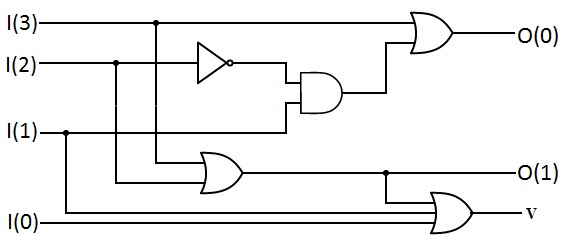
Digital electronic circuit
A priority encoder is a circuit or algorithm that compresses multiple binary inputs into a smaller number of outputs, similar to a simple encoder. The output of a priority encoder is the binary representation of the index of the most significant activated line. In contrast to the simple encoder, if two or more inputs to the priority encoder are active at the same time, the input having the highest priority will take precedence. It is an improvement on a simple encoder because it can handle all possible input combinations, but at the cost of extra logic.
Applications of priority encoders include their use in interrupt controllers (to allow some interrupt requests to have higher priority than others), decimal or binary encoding, and analog-to-digital / digital to-analog conversion.
Implementation
A truth table of a single bit 4-to-2 priority encoder is shown, where the inputs are shown in decreasing order of priority left-to-right, and "x" indicates a don't care term - i.e. any input value there yields the same output since it is superseded by a higher-priority input. The (usually-included) "v" output indicates if the input is valid.
| x}} | 1 |
|---|
Priority encoders can be easily connected in arrays to make larger encoders, such as one 16-to-4 encoder made from six 4-to-2 priority encoders – four 4-to-2 encoders having the signal source connected to their inputs, and the two remaining encoders take the output of the first four as input.
Recursive construction of priority encoders
Sources:
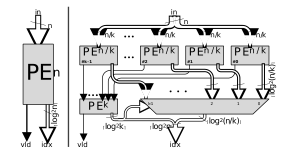
A priority-encoder, also called leading zero detector (LZD) or leading zero counter (LZC), receives an n-bit input vector and detects the index of the first binary ‘1’ in the input vector. A valid signal indicates if any binary ‘1’ was detected in the input vector, hence the index is valid.
Priority-encoders can be efficiently constructed by recursion. The input vector is split into k equal fragments with n/k bits. A priority encoder \textrm{PE}{n/k} with a narrower width of 𝑛/𝑘 is applied for each fragment. The valid bit of each of the k \textrm{PE}{n/k}‘s goes to a k bit \textrm{PE}_{n/k} to detect the first valid fragment. The location of this fragment is the higher part of the overall index, and steers the exact location within the fragment itself to produce the lower part of the overall index.
The depth of the proposed structure is \lceil\log_kn\rceil, while the hardware area complexity is \mathcal{O}(n). If Altera's Stratix V or equivalent device is used, k=4 is recommended to achieve higher performance and area compression, since the mux can be implemented using 6-LUT, hence an entire ALM.
An open-source Verilog generator for the recursive priority-encoder is available online.
A behavioral description of priority encoder in Verilog is as follows. In this case, the LSB has the highest priority. // behavioural description of priority enconder; // https://github.com/AmeerAbdelhadi/Indirectly-Indexed-2D-Binary-Content-Addressable-Memory-BCAM
module pe_bhv
- ( parameter OHW = 512 ) // encoder one-hot input width
( input clk , // clock for pipelined priority encoder
input rst , // registers reset for pipelined priority encoder
input [ OHW -1:0] oht , // one-hot input / [ OHW -1:0]
output reg [
log2(OHW)-1:0] bin , // first '1' index/ [log2(OHW)-1:0] output reg vld ); // binary is valid if one was found
// use while loop for non fixed loop length // synthesizable well with Intel's QuartusII always @(*) begin bin = {`log2(OHW){1'b0}}; vld = oht[bin] ; while ((!vld) && (bin!=(OHW-1))) begin bin = bin + 1 ; vld = oht[bin]; end end
endmodule
Simple encoder

Main article: Encoder (digital)
A simple encoder circuit is a one-hot to binary converter. That is, if there are 2n input lines, and at most only one of them will ever be high, the binary code of this 'hot' line is produced on the n-bit output lines.
Notes
References
References
- (2007). "Digital Design". Pearson Prentice Hall.
- (August 1973). "The TTL Applications Handbook". Fairchild Semiconductor.
- Abdelhadi, Ameer M. S.. (2016). "Architecture of block-RAM-based massively parallel memory structures : multi-ported memories and content-addressable memories". University of British Columbia.
- (May 2015). "2015 IEEE 23rd Annual International Symposium on Field-Programmable Custom Computing Machines".
- (December 2014). "2014 International Conference on Field-Programmable Technology (FPT)".
This article was imported from Wikipedia and is available under the Creative Commons Attribution-ShareAlike 4.0 License. Content has been adapted to SurfDoc format. Original contributors can be found on the article history page.
Ask Mako anything about Priority encoder — get instant answers, deeper analysis, and related topics.
Research with MakoFree with your Surf account
Create a free account to save articles, ask Mako questions, and organize your research.
Sign up freeThis content may have been generated or modified by AI. CloudSurf Software LLC is not responsible for the accuracy, completeness, or reliability of AI-generated content. Always verify important information from primary sources.
Report