From Surf Wiki (app.surf) — the open knowledge base
Prince Philip, Duke of Edinburgh
Consort of Elizabeth II from 1952 to 2021

Consort of Elizabeth II from 1952 to 2021
| Field | Value | |
|---|---|---|
| consort | yes | |
| name | Prince Philip | |
| title | Duke of Edinburgh | |
| image | Duke of Edinburgh 33 Allan Warren.jpg | |
| alt | refer to caption | |
| caption | Formal portrait, 1992 | |
| succession | Consort of the British monarch | |
| reign | 6 February 1952 | |
| spouse | ||
| issue-link | #Issue | |
| issue | {{plainlist | |
| house | {{plainlist | |
| father | Prince Andrew of Greece and Denmark | |
| mother | Princess Alice of Battenberg | |
| birth_name | Prince Philip of Greece and Denmark | |
| birth_date | ||
| birth_place | Mon Repos, Corfu, Greece | |
| death_date | ||
| death_place | Windsor Castle, Windsor, England | |
| burial_date | 17 April 2021 | |
| burial_place | ||
| signature | PrincePhilipSignature.svg | |
| module | {{Infobox person | |
| embed | yes | |
| education | {{plainlist | |
| embed | yes | |
| allegiance | United Kingdom | |
| branch | {{plainlist | |
| serviceyears | 1939–1952 | |
| serviceyears_label | Years of active service | |
| rank | Full list | |
| commands | ||
| battles | ||
| awards | {{plainlist |
| issue-link = #Issue
- Charles III
- Anne, Princess Royal
- Andrew Mountbatten-Windsor
- Prince Edward, Duke of Edinburgh
- Glücksburg (until 1947)
- Mountbatten (from 1947)
- Gordonstoun
- Royal Naval College, Dartmouth
- Royal Navy
- British Army
- Royal Air Force
- Second World War
- Battle of Crete
- Battle of Cape Matapan
- Allied invasion of Sicily
- Operation Dragoon
- Operation Robson
- Operation Lentil
- Battle of Okinawa
- Mentioned in dispatches
- Croix de Guerre with Palm
- War Cross}}}}
Prince Philip, Duke of Edinburgh (born Prince Philip of Greece and Denmark,{{multiref | | | | |}} later Philip Mountbatten; 10 June 19219 April 2021) was the husband of Queen Elizabeth II and served as consort of the British monarch from her accession on 6 February 1952 until his death in 2021, making him the longest-serving royal consort in British history.
Philip was born in Greece into the Greek and Danish royal families. His family was exiled from the country when he was eighteen months old. Educated in France, Germany, and the United Kingdom, he joined the Royal Navy in 1939 at the age of 18. In July 1939, he began corresponding with Princess Elizabeth, then aged 13, the elder daughter and heir presumptive of King George VI. During the Second World War, Philip served with distinction in the Mediterranean and Pacific fleets of the Royal Navy.
In the summer of 1946, King George VI granted Philip permission to marry Elizabeth, who was then 20. Prior to the official announcement of their engagement in July 1947, Philip renounced his Greek and Danish royal titles and styles, became a naturalised British subject, and adopted the surname Mountbatten from his maternal grandparents. In November 1947, he married Elizabeth, was granted the style His Royal Highness, and was created Duke of Edinburgh, Earl of Merioneth, and Baron Greenwich. Following Elizabeth’s accession to the throne in 1952, Philip left active naval service, having attained the rank of commander. In 1957, he was formally created a British prince.
Philip and Elizabeth had four children: Charles, Anne, Andrew, and Edward.
A keen sportsman, Philip played a significant role in the development of the equestrian discipline of carriage driving. He served as patron, president, or member of more than 780 organisations, including the World Wide Fund for Nature, and was chairman of The Duke of Edinburgh's Award, an international youth awards programme for people aged 14 to 24. Philip is the longest-lived male member of the British royal family. He retired from public duties in 2017 at the age of 96, having completed 22,219 solo engagements and delivered 5,493 speeches since 1952. He died at Windsor Castle two months before his 100th birthday.
Early life and education
Family, infancy and exile from Greece
Philip () was born on 10 June 1921 on the dining room table at Mon Repos, a villa on the Greek island of Corfu. He was the only son and fifth and final child of Prince Andrew of Greece and Denmark and his wife, Princess Alice of Battenberg. Philip's father was the fourth son of King George I and Queen Olga of Greece, and his mother was the eldest child of Louis Mountbatten, 1st Marquess of Milford Haven, and Victoria Mountbatten, Marchioness of Milford Haven (formerly Prince Louis of Battenberg and Princess Victoria of Hesse and by Rhine). A member of the House of Glücksburg, Philip was a prince of both Greece and Denmark by virtue of his patrilineal descent from George I of Greece and George's father, Christian IX of Denmark; he was from birth in the line of succession to both thrones. Philip's four elder sisters were Margarita, Theodora, Cecilie, and Sophie. He was baptised in the Greek Orthodox rite at St. George's Church in the Old Fortress in Corfu. His godparents were his paternal grandmother, Queen Olga of Greece; his cousin George, Crown Prince of Greece; his uncle Lord Louis Mountbatten; and the municipality of Corfu, represented by its mayor, Alexandros Kokotos, and by the president of the council, Stylianos Maniarizis.
Shortly after Philip's birth, his maternal grandfather died in London. The Marquess of Milford Haven was a naturalised British subject who, after a career in the Royal Navy, had renounced his German titles and adopted the surname Mountbatten—an Anglicised version of Battenberg—during the First World War, owing to anti-German sentiment in the United Kingdom. After visiting London for his grandfather's memorial service, Philip and his mother returned to Greece, where Prince Andrew had remained to command a Greek Army division embroiled in the Greco-Turkish War.
Greece suffered significant losses in the war, while the Turks made substantial gains. Philip's uncle and high commander of the Greek expeditionary force, King Constantine I, was blamed for the defeat and was forced to abdicate in September 1922. The new military government arrested Andrew, along with others. General Georgios Hatzianestis, who was commanding officer of the army, and five senior politicians were arrested, tried, and executed in the Trial of the Six. Andrew's life was also believed to be in danger and Alice was under surveillance. Finally, in December, a revolutionary court banished Andrew from Greece for life. The British naval vessel evacuated Andrew's family, with Philip carried to safety in a fruit box.
Upbringing in France, Britain and Germany
Philip's family settled in a house in the Paris suburb of Saint-Cloud lent to them by his wealthy aunt Princess George of Greece and Denmark. During his time there, Philip was first educated at The Elms, an American school in Paris run by Donald MacJannet, who described Philip as a "know it all smarty person, but always remarkably polite". In 1930 Philip was sent to Britain to live with his maternal grandmother at Kensington Palace and his uncle George Mountbatten, 2nd Marquess of Milford Haven, at Lynden Manor in Bray, Berkshire. He was then enrolled at Cheam School. Over the next three years, his four sisters married German princes and moved to Germany, his mother was diagnosed with schizophrenia and placed in an asylum, and his father took up residence in Monte Carlo. Philip had little contact with his mother for the remainder of his childhood.
In 1933 Philip was sent to Schule Schloss Salem in Germany, which had the "advantage of saving school fees", because it was owned by the family of his brother-in-law Berthold, Margrave of Baden. With the rise of Nazism in Germany, Salem's Jewish founder, Kurt Hahn, fled persecution and founded Gordonstoun School in Scotland, to which Philip moved after two terms at Salem. In 1937, his sister Cecilie; her husband, Georg Donatus, Hereditary Grand Duke of Hesse; their two sons; and Georg Donatus's mother were killed in an air crash at Ostend; Philip, then 16 years old, attended the funeral in Darmstadt. Cecilie and Georg Donatus were members of the Nazi Party. The following year, Philip's uncle and guardian Lord Milford Haven died of bone marrow cancer. Milford Haven's younger brother Lord Louis took parental responsibility for Philip for the remainder of his youth.
Philip did not speak Greek because he had left Greece as an infant. In 1992 he said that he "could understand a certain amount". He stated that he thought of himself as Danish and spoke mostly English, while his family was multilingual. Known for his charm in his youth, Philip was linked to several women, including Osla Benning.
Naval and wartime service
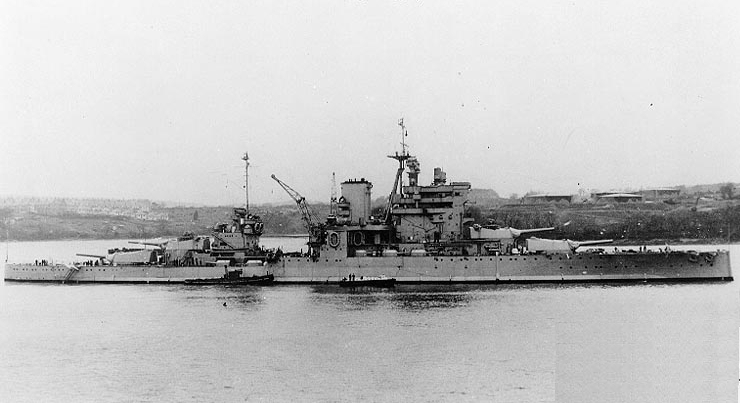
After leaving Gordonstoun in early 1939, Philip completed a term as a cadet at the Royal Naval College, Dartmouth, then repatriated to Greece, living with his mother in Athens for a month in mid-1939. At the behest of King George II of Greece, his first cousin, he returned to Britain in September to resume training for the Royal Navy. He graduated from Dartmouth the next year as the best cadet in his course. During the Second World War, he continued to serve in the British forces, while two of his brothers-in-law, Prince Christoph of Hesse and Berthold, Margrave of Baden, fought on the opposing German side. Philip was appointed as a midshipman in January 1940. He spent four months on the battleship , protecting convoys of the Australian Expeditionary Force in the Indian Ocean, followed by shorter postings on , on , and in British Ceylon. After the invasion of Greece by Italy in October 1940, he was transferred from the Indian Ocean to the battleship in the Mediterranean Fleet.
Philip was commissioned as a sub-lieutenant on 1 February 1941 after a series of courses at Portsmouth, in which he gained the top grade in four out of five sections of the qualifying examination. Among other engagements, he was involved in the Battle of Crete and was mentioned in dispatches for his service during the Battle of Cape Matapan, in which he controlled the battleship's searchlights. He was also awarded the Greek War Cross. In June 1942, he was appointed to the destroyer , which was involved in convoy escort tasks on the east coast of Britain, as well as the Allied invasion of Sicily.

Promotion to lieutenant followed on 16 July 1942. That October Philip, aged 21, became first lieutenant of HMS Wallace, one of the youngest first lieutenants in the Royal Navy. During the invasion of Sicily, in July 1943, he was second-in-command of Wallace. The ship was attacked at night by German aircraft, which would return to finish off the damaged ship; it was saved by Philip's devising a plan to launch a raft with smoke floats that successfully decoyed the bombers, allowing the ship to slip away unnoticed. In 1944, he moved on to the new destroyer, , where he saw service with the British Pacific Fleet in the 27th Destroyer Flotilla. He was present in Tokyo Bay when the Japanese Instrument of Surrender was signed. Philip returned to the United Kingdom on the Whelp in January 1946 and was posted as an instructor at , the Petty Officers' School in Corsham, Wiltshire.
Marriage
In 1939, the British King George VI and Queen Elizabeth toured the Royal Naval College, Dartmouth. During the visit, the Queen and Lord Louis Mountbatten asked his nephew Philip to escort the royal couple's daughters, 13-year-old Elizabeth and 9-year-old Margaret, who were Philip's third cousins through Queen Victoria of the United Kingdom and second cousins once removed through King Christian IX of Denmark. Philip and Elizabeth had first met as children in 1934 at the wedding of Elizabeth's uncle Prince George, Duke of Kent, to Philip's first cousin, Princess Marina of Greece and Denmark. After their 1939 meeting, Elizabeth fell in love with Philip, and they began to exchange letters.
Eventually, in the summer of 1946, Philip asked George VI for his daughter's hand in marriage. The King granted his request, provided that any formal engagement be delayed until Elizabeth's 21st birthday the following April. By March 1947, Philip had adopted the surname Mountbatten from his mother's family and had stopped using his Greek and Danish royal titles upon becoming a naturalised British subject. The engagement was announced to the public on 9 July 1947.
The engagement attracted some controversy; Philip had no financial standing, was foreign-born, and had sisters who had married German noblemen with Nazi links. Marion Crawford wrote: "Some of the King's advisors did not think him good enough for her. He was a prince without a home or kingdom. Some of the papers played long and loud tunes on the string of Philip's foreign origin." Later biographies reported that Elizabeth's mother had reservations about the union initially and teased Philip as "the Hun". In later life, however, she told the biographer Tim Heald that Philip was "an English gentleman".

Though Philip appeared "always to have regarded himself as an Anglican", and he had attended Anglican services with his classmates and relations in England and throughout his Royal Navy days, he was baptised in the Greek Orthodox Church. The archbishop of Canterbury, Geoffrey Fisher, wanted to "regularise" Philip's position by officially receiving him into the Church of England, which he did in October 1947. The day before the wedding, the King bestowed the style of Royal Highness on Philip, and, on the morning of the wedding, 20 November 1947, he was made the Duke of Edinburgh, Earl of Merioneth, and Baron Greenwich of Greenwich in the County of London. Consequently, being already a Knight of the Garter, between 19 and 20 November 1947, he bore the unusual style Lieutenant His Royal Highness Sir Philip Mountbatten and is so described in the letters patent of 20 November 1947.
Philip and Elizabeth were married in a ceremony at Westminster Abbey, recorded and broadcast by BBC radio to 200 million people around the world. In post-war Britain, it was unacceptable for any of Philip's German relations, including his three surviving sisters, to be invited to the wedding. After their marriage, Philip and Elizabeth took residence at Clarence House. Their first two children were born before Elizabeth's accession in 1952: Prince Charles in November 1948 and Princess Anne in August 1950. The couple's marriage was the longest of any British monarch, lasting over 73 years until Philip died in 2021. Concerned by her father's poor health, Elizabeth insisted that Philip give up smoking, which he did on their wedding day.
Philip was introduced to the House of Lords on 21 July 1948, immediately before his uncle Louis Mountbatten, who had been made Earl Mountbatten of Burma. Philip ostensibly never spoke in the House of Lords. He, his sons and other royals ceased to be members of the House of Lords following the House of Lords Act 1999, although Philip's former brother-in-law, Lord Snowdon, remained in the House.
Early duties
.jpg)
After his honeymoon at the Mountbatten family home, Broadlands, Philip returned to the navy, at first in a desk job at the Admiralty and later on a staff course at the Naval Staff College, Greenwich. From 1949 he was stationed in Malta (residing at Villa Guardamangia) after being posted as the first lieutenant of the destroyer , the lead ship of the 1st Destroyer Flotilla in the Mediterranean Fleet. He was promoted to lieutenant commander on 16 July 1950 and given command of the frigate . Philip was promoted to commander on 30 June 1952, though his active naval career had ended in July 1951.
With the King in ill health, Elizabeth and Philip were both appointed to the Privy Council on 4 November 1951, after a coast-to-coast tour of Canada. At the end of January 1952, the couple set out on a tour of the Commonwealth. They were in Kenya when Elizabeth's father died on 6 February 1952, and she became queen. Philip broke the news to Elizabeth at Sagana Lodge, and the royal party immediately returned to the United Kingdom.
In December 1952, Philip was initiated into Freemasonry by the Worshipful Master of Navy Lodge No 2612, honouring a commitment he had made to George VI, who had made it clear that he expected Philip to maintain the tradition of royal patronage of Freemasonry. However, according to one journalist writing in 1983, Philip's mother-in-law and his uncle Lord Mountbatten had unfavourable views of Freemasonry; after his initiation, Philip took no further part in the organisation. Although as the consort of the Queen, he might in time have been made Grand Master of British Freemasonry, Elizabeth's cousin Prince Edward, Duke of Kent, assumed that role in 1967. Philip's son Charles apparently never joined Freemasonry.
Consort of the Queen
Royal house

Elizabeth's accession to the throne brought up the question of the name of the royal house, as Elizabeth would typically have taken Philip's last name upon marriage. Lord Mountbatten advocated the name House of Mountbatten. Philip suggested House of Edinburgh after his ducal title. When Elizabeth's grandmother Queen Mary heard of this, she informed Winston Churchill, who later advised Elizabeth to issue a royal proclamation declaring that the royal house was to remain known as the House of Windsor. Philip privately complained, "I am nothing but a bloody amoeba. I am the only man in the country not allowed to give his name to his own children."
In February 1960, the Queen issued an Order in Council declaring that Mountbatten-Windsor would be the surname of the couple's male-line descendants who are not styled as Royal Highness or titled as prince or princess. While it seems Elizabeth had "absolutely set her heart" on such a change and had it in mind for some time, it occurred only 11 days before the birth of their third child, Prince Andrew, and only after three months of protracted correspondence between English constitutional expert Edward Iwi (who averred that, without such a change, the royal child would be born with "the Badge of Bastardy") and Harold Macmillan, who had attempted to refute Iwi's arguments. Elizabeth and Philip's fourth child, Prince Edward, was born in March 1964.
Six months after she acceded to the throne, Elizabeth announced that Philip was to have "place, pre-eminence and precedence" next to her "on all occasions and in all meetings, except where otherwise provided by Act of Parliament". She also intervened to ensure that Philip would serve as regent for their son Charles in the event of her unexpected death. Parliament passed a bill to that effect in 1953. Contrary to rumours over the years, Elizabeth and Philip were said by insiders to have had a strong relationship throughout their marriage, despite the challenges of Elizabeth's reign. Elizabeth referred to Philip in a speech on the occasion of her Diamond Jubilee in 2012 as her "constant strength and guide".
Philip received a Parliamentary annuity (of £359,000 since 1990) to meet official expenses in carrying out public duties. The annuity was unaffected by the reform of royal finances under the Sovereign Grant Act 2011. Any part of the allowance that was not used to meet official expenditure was liable for tax. In practice, the entire allowance was used to fund his official duties.
Supporting the Queen
_(17843185594).jpg)
As consort, Philip supported his wife in her duties as sovereign, accompanying her to ceremonies such as the State Opening of Parliament in various countries, state dinners, and tours abroad. As chairman of the Coronation Commission, he was the first member of the royal family to fly in a helicopter, visiting the troops that were to take part in the ceremony. Philip was not himself crowned in the coronation service, but knelt before Elizabeth, with her hands enclosing his, and swore to be her "liege man of life and limb". For six months, spanning 1953 and 1954, they toured the Commonwealth; as was customary during previous tours, the children remained in Britain.
In the early 1950s, Philip's sister-in-law, Princess Margaret, considered marrying a divorced older man, Peter Townsend. The press accused Philip of being hostile to the match, to which he replied: "I haven't done anything." Eventually, Margaret and Townsend parted. In 1960 Margaret married Antony Armstrong-Jones, who was created Earl of Snowdon the following year. They divorced in 1978; Margaret did not remarry.
In 1956 Philip and Kurt Hahn founded The Duke of Edinburgh's Award to give young people "a sense of responsibility to themselves and their communities". In the same year, he also established the Commonwealth Study Conferences. From 1956 to 1957, he travelled around the world aboard the newly commissioned , during which he opened the 1956 Summer Olympics in Melbourne and visited the Antarctic, becoming the first royal to cross the Antarctic Circle. Elizabeth and the children remained in Britain. On the return leg of the journey, Philip's private secretary, Mike Parker, was sued for divorce by his wife. As with Townsend, the press still portrayed divorce as a scandal, and eventually, Parker resigned. He later said that Philip was very supportive and "the Queen was wonderful throughout. She regarded divorce as a sadness, not a hanging offence." In a public show of support, Elizabeth created Parker a Commander of the Royal Victorian Order.

Further press reports claimed that the royal couple were drifting apart, which enraged Philip and dismayed Elizabeth, who issued a strongly worded denial. She granted him the style and title of a Prince of the United Kingdom by Letters Patent on 22 February 1957; it was gazetted that Philip was to be known as "His Royal Highness The Prince Philip, Duke of Edinburgh". Philip was appointed to the Queen's Privy Council for Canada on 14 October 1957, taking his Oath of Allegiance before the Queen in person at her Canadian residence, Rideau Hall. Remarks he made two years later to the Canadian Medical Association on the subject of youth and sport were taken as a suggestion that Canadian children were out of shape. This was at first considered "tactless", but Philip was later admired for his encouragement of physical fitness. While in Canada in 1969, he spoke about his views on republicanism:
In 1960 Philip attended the National Eisteddfod of Wales wearing a long green robe, where he was initiated as an Honorary Ovate by the Archdruid of Wales Edgar Phillips through his bardic name Philip Meirionnydd, to reflect his title of Earl of Merioneth. In 1961 he became the first member of the royal family to be interviewed on television, after he appeared on Panorama to answer questions by Richard Dimbleby about the Commonwealth Technical Training Week, an initiative of which he was patron. In 1969 he made a similar appearance on Meet the Press during a tour of North America.
Charities and patronages

Philip was patron of some 800 organisations, particularly focused on the environment, industry, sport, and education. His first solo engagement as Duke of Edinburgh was in March 1948, presenting prizes at the boxing finals of the London Federation of Boys' Clubs at the Royal Albert Hall. He was president of the National Playing Fields Association (now known as Fields in Trust) for 64 years, from 1947 until his grandson Prince William took over the role in 2013. He was appointed a fellow of the Royal Society in 1951. In 1952, he became patron of The Industrial Society (since renamed The Work Foundation). In the same year, and after his father-in-law's death, he took over the role of the Ranger of Windsor Great Park, overseeing its protection and maintenance. From 1955 to 1957, Philip was president of The Football Association and also served two terms as president of the Marylebone Cricket Club, with his tenures starting in 1949 and 1974, respectively. In the same decade, he became the first patron of Lord's Taverners, a youth cricket and disability sports charity, for which he organised fundraising events.
Between 1959 and 1965 Philip was the president of BAFTA. He helped found the Australian Conservation Foundation in 1963 and the World Wildlife Fund in 1961 and served as the latter's UK president from 1961 to 1982, international president from 1981, and president emeritus from 1996. He was also president of the Zoological Society of London for two decades and was appointed an honorary fellow in 1977. Despite his involvement in initiatives for conserving nature, he was also criticised for practices such as fox hunting, shooting of game birds and the killing of a tiger in India in 1961. He was president of the International Equestrian Federation from 1964 to 1986. In 1980 he became world champion in four-in-hand driving with the British national team. He served as chancellor of the universities of Cambridge, Edinburgh, Salford, and Wales. In 1965, at the suggestion of Harold Wilson, Philip became chair to a scheme set up for awarding industrial innovations, which later became known as The Queen's Awards for Enterprise. In the same year, Philip became president of the Council of Engineering Institutions and in that capacity he assisted with the inception of the Fellowship of Engineering (later the Royal Academy of Engineering), of which he later became the senior fellow. He also commissioned the Prince Philip Designers Prize and the Prince Philip Medal to recognise designers and engineers with exceptional contributions. In 1970 he was involved with the founding of The Maritime Trust for restoring and preserving historic British ships. In 2017 the British Heart Foundation thanked Philip for being its patron for 55 years, during which time, in addition to organising fundraisers, he "supported the creation of nine BHF-funded centres of excellence". He was an honorary fellow of St Edmund's College, Cambridge.
Charles and Diana
At the beginning of 1981 Philip wrote to his son Charles counselling him to make up his mind to either propose to Lady Diana Spencer or break off their courtship. Charles felt pressured by his father to make a decision and did so, proposing to Diana in February. They married five months later. By 1992 the marriage had broken down. Elizabeth and Philip hosted a meeting between Charles and Diana, trying to effect a reconciliation, but without success. Philip wrote to Diana, expressing his disappointment at Charles's and her extra-marital affairs and asking her to examine both his and her behaviour from the other's point of view. She found the letters hard to take but appreciated that he acted with good intent. Charles and Diana separated in 1992 and divorced in 1996.
A year after the divorce, Diana was killed in a car crash in Paris on 31 August 1997. At the time, Philip was on holiday at Balmoral with the extended royal family. In their grief, Diana's sons, Princes William and Harry, wanted to attend church, so Elizabeth and Philip took them that morning. For five days, the royal couple shielded their grandsons from the ensuing press interest by keeping them at Balmoral, where they could grieve in private. The royal family's seclusion caused public dismay, but the public mood changed after a live broadcast made by Elizabeth on 5 September. Uncertain as to whether they should walk behind their mother's coffin during the funeral procession, William and Harry hesitated. Philip told William: "If you don't walk, I think you'll regret it later. If I walk, will you walk with me?" On the day of the funeral, Philip, William, Harry, Charles, and Diana's brother, Earl Spencer, walked through London behind her gun carriage. Over the next few years, Mohamed Al-Fayed, whose son Dodi Fayed was also killed in the crash, claimed that Philip had ordered the death of Diana and that the accident was staged. The inquest into Diana's death concluded in 2008 that there was no evidence of a conspiracy.
In October 1994, Prince Philip became the first member of the British royal family to visit Israel. He travelled to Jerusalem to attend a ceremony at Yad Vashem honouring his mother, Princess Alice of Battenberg, who had been recognised as one of the Righteous Among the Nations for sheltering members of a Jewish family during the Nazi occupation of Greece.
Longevity
.jpg)
In April 2009, Philip became the longest-serving British royal consort, surpassing Queen Charlotte. He became the oldest-ever male British royal in February 2013 and the third-longest-lived member of the British royal family (following Princess Alice, Duchess of Gloucester, and Queen Elizabeth the Queen Mother) in April 2019. Personally, he was not enthused about living an extremely long life, remarking in a 2000 interview (when he was 79) that he could not "imagine anything worse" and had "no desire whatsoever" to become a centenarian, saying "bits of me are falling off already".
_(cropped).jpg)
In 2008 Philip was admitted to King Edward VII's Hospital, London, for a chest infection; he walked into the hospital unaided, recovered quickly, and was discharged three days later. After the Evening Standard reported that Philip had prostate cancer, Buckingham Palace—which usually refuses to comment on health rumours—denied the story and the paper retracted it.
In June 2011, in an interview marking his 90th birthday, Philip said that he would now slow down and reduce his duties, stating that he had "done [his] bit". The Queen gave him the title Lord High Admiral for his 90th birthday. While staying at Sandringham House in December 2011, Philip suffered chest pains and was taken to the cardio-thoracic unit at Papworth Hospital, Cambridgeshire, where he underwent successful coronary angioplasty and stenting. He was discharged a few days later.
In June 2012, during the celebrations in honour of his wife's diamond jubilee, Philip was taken from Windsor Castle to King Edward VII's Hospital suffering from a bladder infection. He was subsequently discharged. After a recurrence of infection in August 2012, while staying at Balmoral Castle, he was admitted to Aberdeen Royal Infirmary for five nights as a precautionary measure. In June 2013, Philip was admitted to the London Clinic for an exploratory operation on his abdomen, spending 11 days in hospital. In May 2014, he appeared in public with a bandage on his right hand after a "minor procedure" was performed in Buckingham Palace the preceding day. In June 2017, Philip was taken from Windsor to London and admitted to King Edward VII's Hospital after being diagnosed with an infection. He spent two nights in the hospital and was unable to attend the State Opening of Parliament and Royal Ascot.
Final years and retirement

Philip retired from royal duties on 2 August 2017, meeting Royal Marines in his final solo public engagement, aged 96. Since 1952, he had completed 22,219 solo engagements. British prime minister Theresa May thanked him for "a remarkable lifetime of service". On 20 November 2017, he celebrated his 70th wedding anniversary with Elizabeth, which made her the first British monarch to celebrate a platinum wedding anniversary.
In April 2018, Philip was admitted to King Edward VII's Hospital for a planned hip replacement. This came after the Duke missed the annual Maundy and Easter Sunday services. Princess Anne spent about 50 minutes in the hospital and afterwards said her father was "on good form". He was discharged the next day. In May that year, he attended the wedding of Prince Harry and Meghan Markle and was able to walk with Elizabeth unaided. That October, he also accompanied Elizabeth to the wedding of their granddaughter Princess Eugenie of York with Jack Brooksbank, with The Telegraph reporting that Philip works on a "wake up and see how I feel" basis when deciding whether to attend an event or not.
In January 2019, Philip was involved in a car collision as he drove out onto a main road near the Sandringham Estate. An official statement said he was uninjured. An eyewitness who helped him out of his car said there was "a little bit of blood". The driver and a passenger of the other car were injured and taken to hospital. Philip attended hospital the next morning as a precaution. He apologised, and three weeks later voluntarily surrendered his driving licence. In February, the Crown Prosecution Service announced that prosecuting Philip would not be in the public interest. Philip was still allowed to drive around private estates, and was seen behind the wheel in the grounds of Windsor Castle in April 2019.
In December 2019, Philip stayed at King Edward VII's Hospital and received treatment for a "pre-existing condition" in a visit described by Buckingham Palace as a "precautionary measure". He had not been seen in public since attending Lady Gabriella Windsor's wedding in May 2019. A photo of the royal couple as they isolated at Windsor Castle during the COVID-19 pandemic was released ahead of his 99th birthday in June 2020. In July 2020, he stepped down as Colonel-in-Chief of The Rifles, a position he had held since 2007. He was succeeded by his daughter-in-law Camilla, Duchess of Cornwall.
In January 2021, Philip and Elizabeth were vaccinated against COVID-19 by a household doctor at Windsor Castle. In February 2021, Philip was admitted to King Edward VII's Hospital as a "precautionary measure" after feeling unwell; he was visited by Prince Charles. Buckingham Palace confirmed that Philip was "responding to treatment" for an infection. In March, Philip was transferred by ambulance to St Bartholomew's Hospital to continue treatment for an infection, and to undergo "testing and observation" relating to a pre-existing heart condition. He underwent a successful procedure for his heart condition and was transferred back to King Edward VII's Hospital. He was discharged a week later and returned to Windsor Castle.
Death

Philip died of "old age" on the morning of 9 April 2021 at Windsor Castle, at the age of 99. He was the longest-serving royal consort in world history. Elizabeth described his death as "having left a huge void in her life".
The palace said Philip died peacefully, which was confirmed by his daughter-in-law Sophie, Countess of Wessex, who told the press it was "so gentle. It was just like somebody took him by the hand and off he went." His death led to the commencement of Operation Forth Bridge, the plan for publicly announcing his death and organising his funeral. The usual public ceremonial could not take place because of the regulations for the COVID-19 pandemic which restricted the number of mourners to thirty; it was later reported in the press that Elizabeth had rejected a government offer to relax the rules. The funeral took place on 17 April 2021 at St George's Chapel, Windsor Castle, and Philip was temporarily interred alongside 25 other coffins, including that of George III, in the Royal Vault inside St George's. Representatives of countries around the world sent condolences to the royal family upon his death.
As with other senior members of the royal family, Philip's last will and testament will be sealed for at least 90 years, according to a High Court ruling, which deemed it necessary to protect the Sovereign's "dignity and standing". This led to speculation that the will might contain material harmful to the reputation of the royal family. The order was made by the President of the Family Division after a private hearing in July 2021, who said that he had neither seen the will nor been informed of any of its contents. In January 2022, The Guardian challenged the judge's decision to exclude the press from that hearing, arguing that the judge had "erred by failing to consider any lesser interference with open justice than a private hearing", and the newspaper was granted leave to appeal. In July 2022, the Court of Appeal dismissed the newspaper's arguments, stating that the press could not have been informed of the hearing "without risking the media storm that was feared". The court added that "a perceived lack of transparency might be a matter of legitimate public debate, but the (Non-Contentious Probate Rules) allow wills and their values to be concealed from the public gaze in some cases".
A service of thanksgiving for Philip's life took place at Westminster Abbey on 29 March 2022, with Elizabeth, foreign royalty and politicians in attendance. Elizabeth died on 8 September 2022 and the royal couple's bodies were interred in the King George VI Memorial Chapel at St George's on the evening of 19 September after her state funeral.
Legacy
Interests
.jpg)
Philip played polo until 1971 when he started to compete in carriage driving, a sport which he helped to expand; the sport's early rule book was drafted under his supervision. He was also a keen yachtsman and struck up a friendship in 1949 with boat designer and sailing enthusiast Uffa Fox in Cowes.
Philip's first airborne flying lesson took place in 1952, and by his 70th birthday, he had accrued 5,150 pilot hours. He was presented with Royal Air Force wings in 1953, helicopter wings with the Royal Navy in 1956, and his private pilot's licence in 1959. After 44 years as a pilot, he retired in August 1997 with 5,986 hours spent in 59 different aircraft. In April 2014, it was reported that an old British Pathé newsreel film had been discovered of Philip's 1962 two-month flying tour of South America. Filmed sitting alongside him at the aircraft's controls was his co-pilot Captain Peter Middleton, the grandfather of Philip's granddaughter-in-law Catherine. In 1959, Philip flew solo in a Druine Turbulent, becoming the first and, the only member of the royal family to have flown a single-seat aircraft.

Philip painted with oils and collected artworks, including contemporary cartoons, which hang at Buckingham Palace, Windsor Castle, Sandringham House, and Balmoral Castle. Hugh Casson described Philip's own artwork as "exactly what you'd expect ... totally direct, no hanging about. Strong colours, vigorous brushstrokes." He was patron of the Royal Society of Arts from 1952 until 2011. He was "fascinated" by cartoons about the monarchy and the royal family and was a patron of The Cartoon Museum.
Personality and image

Philip's down-to-earth manner was attested to by a White House butler, who recalled that, on a visit in 1976, Philip engaged him and a fellow butler in a conversation and poured them drinks. As well as having a reputation for bluntness and plain speaking, Philip was noted for occasionally making observations and jokes that were construed as funny or typical for someone of his age and background by some, but as gaffes, awkward, politically incorrect, or even offensive by others. In an address to the General Dental Council in 1960, he jokingly coined a new word for his blunders: "Dontopedalogy is the science of opening your mouth and putting your foot in it, a science which I have practised for a good many years." Later in life, he suggested his comments may have contributed to the perception that he was "a cantankerous old sod".
In a private conversation with British students from Xi'an's Northwest University during a state visit to China in 1986, Philip joked: "If you stay here much longer, you'll go slit-eyed." The British press reported on the remark as indicative of racial intolerance, but the Chinese authorities were reportedly unconcerned. Chinese students studying in the UK, an official explained, were often told in jest not to stay away too long, lest they go "round-eyed". His comment did not affect Sino-British relations, but it shaped his reputation. Philip also made comments on the eating habits of Cantonese people, stating: "If it has four legs and is not a chair, has wings and is not an airplane, or swims and is not a submarine, the Cantonese will eat it." In Australia he asked an Indigenous Australian entrepreneur: "Do you still throw spears at each other?"
In 2011 historian David Starkey described Philip as a kind of "HRH Victor Meldrew". For example, in May 1999, British newspapers accused Philip of insulting deaf children at a pop concert in Wales by saying: "No wonder you are deaf listening to this row." Later, Philip wrote: "The story is largely invention. It so happens that my mother was quite seriously deaf and I have been Patron of the Royal National Institute for the Deaf for ages, so it's hardly likely that I would do any such thing." When he and Elizabeth met Stephen Menary, an army cadet blinded by a Real IRA bomb, and Elizabeth enquired how much sight he retained, Philip quipped: "Not a lot, judging by the tie he's wearing." Menary later said: "I think he just tries to put people at ease by trying to make a joke. I certainly didn't take any offence." Philip's comparison of prostitutes and wives was also perceived as offensive after he reportedly stated: "I don't think a prostitute is more moral than a wife, but they are doing the same thing."
Centenary
To mark the centenary of Philip's birth in June 2021, the Royal Collection Trust held an exhibition at Windsor Castle and the Palace of Holyroodhouse. Titled Prince Philip: A Celebration, it showcased around 150 personal items related to him, including his wedding card, wedding menu, midshipman's logbook from 1940 to 1941, Chair of Estate, and the coronation robes and coronet that he wore for his wife's coronation in 1953. George Alexis Weymouth's portrait of Philip in the ruins of Windsor Castle after the fire of 1992 formed part of a focus on Philip's involvement with the subsequent restoration.
The Royal Horticultural Society also marked Philip's centenary by breeding a new rose in his honour, christened "The Duke of Edinburgh Rose", created by British rose breeder Harkness Roses. Elizabeth, as patron of the society, was given the deep pink commemorative rose in honour of her husband, and she remarked that "It looks lovely". A Duke of Edinburgh Rose has since been planted in the mixed rose border of Windsor Castle's East Terrace Garden. Philip played a major role in the garden's design.
In September 2021, the Royal National Lifeboat Institution honoured Philip by naming their new state-of-the-art lifeboat Duke of Edinburgh. The tribute was initially planned to mark his 100th birthday. In the same month, a documentary initially planned for his centenary was broadcast on BBC One under the title Prince Philip: The Royal Family Remembers, with contributions from his children, their spouses, and seven of his grandchildren.
Portrayals
Philip has been portrayed by several actors, including Stewart Granger (The Royal Romance of Charles and Diana, 1982), Christopher Lee (Charles & Diana: A Royal Love Story, 1982), David Threlfall (The Queen's Sister, 2005), James Cromwell (The Queen, 2006), and Finn Elliot, Matt Smith, Tobias Menzies, and Jonathan Pryce (The Crown, 2016 onwards). He also appears as a fictional character in Nevil Shute's novel In the Wet (1952), Paul Gallico's novel Mrs. 'Arris Goes to Moscow (1974), Tom Clancy's novel Patriot Games (1987), and Sue Townsend's novel The Queen and I (1992).
Books
Philip authored:
- Selected Speeches – 1948–55 (1957; revised paperback edition published by Nabu Press, 2011),
- Selected Speeches – 1956–59 (1960)
- Birds from Britannia (1962; published in the United States as Seabirds from Southern Waters),
- Wildlife Crisis with James Fisher (1970),
- The Environmental Revolution: Speeches on Conservation, 1962–1977 (1978),
- Competition Carriage Driving (1982; published in France, 1984; second edition, 1984; revised edition, 1994),
- A Question of Balance (1982),
- Men, Machines and Sacred Cows (1984),
- A Windsor Correspondence with Michael Mann (1984),
- Down to Earth: Collected Writings and Speeches on Man and the Natural World 1961–87 (1988; paperback edition, 1989; Japanese edition, 1992),
- Survival or Extinction: A Christian Attitude to the Environment with Michael Mann (1989),
- Driving and Judging Dressage (1996),
- 30 Years On, and Off, the Box Seat (2004),
Forewords to:
- Royal Australian Navy 1911–1961 Jubilee Souvenir issued by authority of the Department of the Navy, Canberra (1961)
- The Concise British Flora in Colour by William Keble Martin, Ebury Press / Michael Joseph (1965)
- Birds of Town and Village by William Donald Campbell and Basil Ede (1965)
- Kurt Hahn by Hermann Röhrs and Hilary Tunstall-Behrens (1970)
- The Doomsday Book of Animals by David Day (1981)
- Saving the Animals: The World Wildlife Fund Book of Conservation by Bernard Stonehouse (1981)
- The Art of Driving by Max Pape (1982),
- Yachting and the Royal Prince Alfred Yacht Club by Graeme Norman (1988),
- National Maritime Museum Guide to Maritime Britain by Keith Wheatley (2000)
- The Royal Yacht Britannia: The Official History by Richard Johnstone-Bryden, Conway Maritime Press (2003),
- 1953: The Crowning Year of Sport by Jonathan Rice (2003)
- British Flags and Emblems by Graham Bartram, Tuckwell Press (2004),
- Chariots of War by Robert Hobson, Ulric Publication (2004),
- RMS Queen Mary 2 Manual: An Insight into the Design, Construction and Operation of the World's Largest Ocean Liner by Stephen Payne, Haynes Publishing (2014)
- The Triumph of a Great Tradition: The Story of Cunard's 175 Years by Eric Flounders and Michael Gallagher, Lily Publications (2014),
Titles, styles, honours, and arms

Philip held many titles throughout his life. Originally holding the title and style of a prince of Greece and Denmark, Philip abandoned these royal titles before he married and was thereafter created a British duke, among other noble titles. Elizabeth formally issued letters patent in 1957 making him a British prince.
Honours and honorary military appointments
Philip was awarded medals from Britain, France, and Greece for his service during the Second World War, as well as ones commemorating the coronations of George VI and Elizabeth II and the silver, gold and diamond jubilees of Elizabeth. George VI appointed him to the Order of the Garter on the eve of his wedding on 19 November 1947. Since then, Philip received 17 appointments and decorations in the Commonwealth and 48 from foreign states. The inhabitants of some villages on the island of Tanna, Vanuatu, worship Philip as a god-like spiritual figure; the islanders possess portraits of him and hold feasts on his birthday.
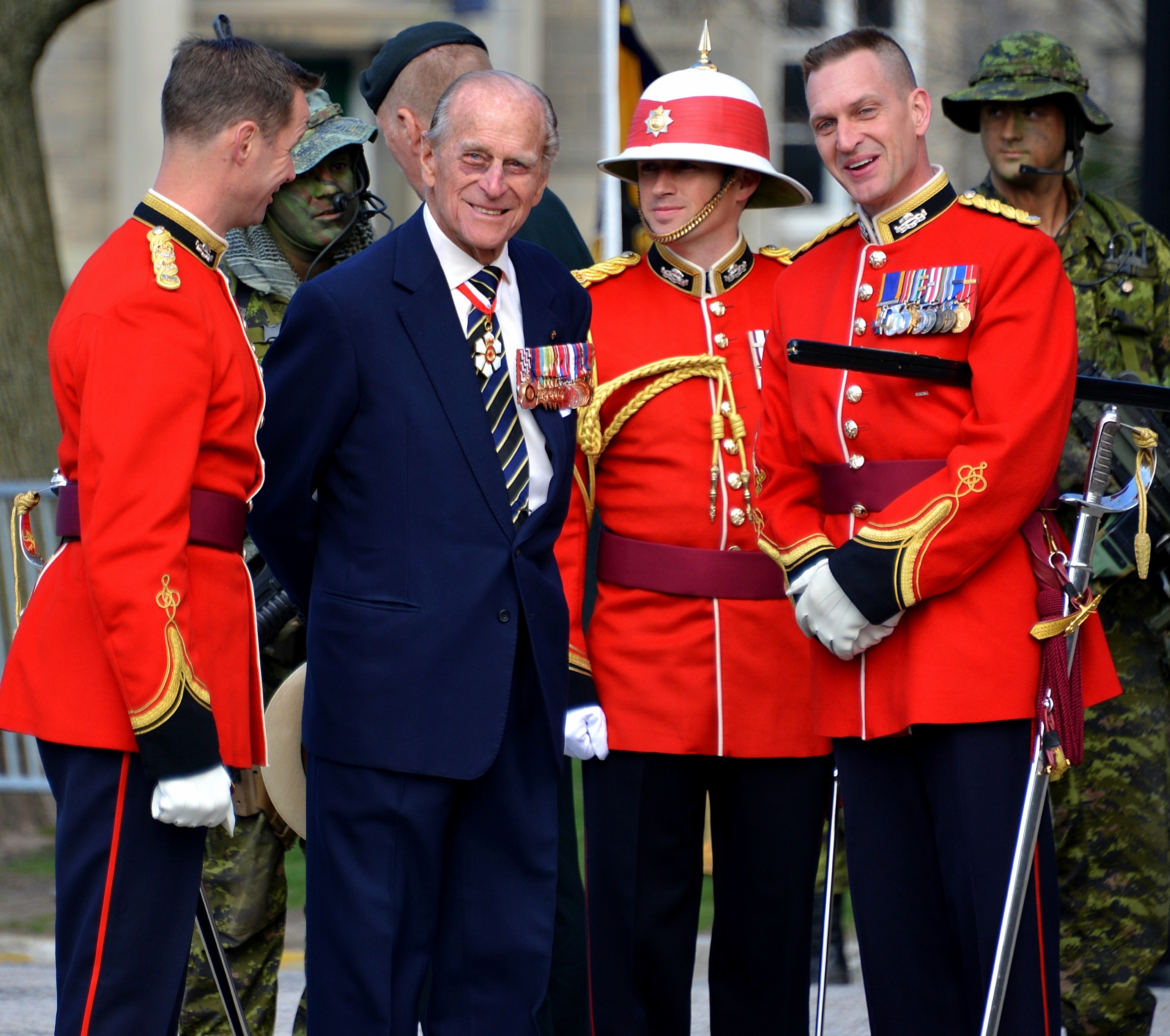
Upon his wife's accession to the throne in 1952, Philip was appointed Admiral of the Sea Cadet Corps, Colonel-in-Chief of the British Army Cadet Force, and Air Commodore-in-Chief of the Air Training Corps. The following year, he was appointed to the equivalent positions in Canada and made Admiral of the Fleet, Captain General Royal Marines, Field Marshal, and Marshal of the Royal Air Force in the United Kingdom. Subsequent military appointments were made in New Zealand and Australia. In 1975 he was appointed colonel of the Grenadier Guards, a position he handed over to his son Andrew in 2017. On 16 December 2015, he relinquished his role as Honorary Air Commodore-in-Chief and was succeeded by his granddaughter-in-law Catherine, then Duchess of Cambridge, as Honorary Air Commandant.
To celebrate Philip's 90th birthday, Elizabeth appointed him Lord High Admiral, as well as to the highest ranks available in all three branches of the Canadian Armed Forces. On their 70th wedding anniversary, 20 November 2017, she appointed him Knight Grand Cross of the Royal Victorian Order, making him the first British national since his uncle Lord Mountbatten of Burma to be entitled to wear the breast stars of four orders of chivalry in the United Kingdom.
Arms
:Before 1947: "Coat of arms as a Greek & Danish Prince; Arms of Greece surmounted by an inescutcheon of the lesser arms of Denmark; the shield ensigned with a princely coronet of crosses pattée and fleurs-de-lis."
.svg)
:During 1947: "Arms of Greece surmounted by an inescutcheon of the arms of Denmark; and over all in the first quarter the arms of Princess Alice, daughter of Queen Victoria, viz, the Royal Arms differenced with a label of three points argent, the middle point charged with a rose gules and each of the others with an ermine spot."
.svg)
:From 1947 to 1949: "Arms of Greece surmounted by an inescutcheon of the arms of Denmark; and over all in the first quarter the arms of Princess Alice, daughter of Queen Victoria, viz, the Royal Arms differenced with a label of three points argent, the middle point charged with a rose gules and each of the others with an ermine spot. The shield is encircled by the Garter and ensigned with a princely coronet of crosses pattée and fleurs-de-lis, above which is placed a barred helm affronte, and thereon the crest; out of a ducal coronet or, a plume of five ostrich feathers alternately sable and argent. The supporters are, dexter, the figure of Hercules proper, and sinister, a lion queue fourché ducally crowned or, gorged with a naval coronet azure."
Genealogy
Both Philip and Elizabeth were great-great-grandchildren of Queen Victoria, Elizabeth by descent from Victoria's eldest son, King Edward VII, and Philip by descent from Victoria's second daughter, Princess Alice. Both were also descended from King Christian IX of Denmark. Philip was also related to the House of Romanov through all four of his grandparents. His maternal grandmother, Princess Victoria of Hesse and by Rhine, was a sister of Empress Alexandra of Russia. In 1993 scientists were able to confirm the identity of the remains of several members of the Romanov family, more than seventy years after their murder in 1918, by comparing their mitochondrial DNA to living matrilineal relatives, including Philip. Philip, Alexandra, and her children were all descended from Princess Alice through a purely female line.
Notes
References
Citations
Bibliography
References
- Bates, Stephen. (20 February 2008). "How German is Prince Philip". The Guardian.
- Sakalis, Alex. (17 April 2021). "Prince Philip's secret return visit to the island of his birth". The Independent.
- Lloyd, Howard. (11 April 2021). "Prince Philip's real name as birth certificate discovered on Greek island". Plymouth Live.
- (5 December 1922). "News in Brief: Prince Andrew's departure". [[The Times]].
- Philip quoted in {{harvnb. Brandreth. 2004
- Brooks-Pollock, Tom. (20 July 2015). "Queen Nazi salute film: Documentary will show Prince Philip's sister calling Hitler 'charming and modest'". The Independent.
- (10 April 2021). "Prince Philip: A turbulent childhood stalked by exile, mental illness and death". BBC News.
- Rocco, Fiammetta. (13 December 1992). "A strange life: Profile of Prince Philip". The Independent.
- Eade, Philip. (5 May 2017). "The romances of young Prince Philip". The Telegraph.
- "Naval career".
- {{London Gazette. (13 February 1942)
- Smith, David. (28 December 2003). "Prince Philip's war heroics come to light after 60 years". The Guardian.
- {{London Gazette. (11 August 1942)
- "HMS Whelp, destroyer".
- [[Alexandra of Yugoslavia]] quoted in {{harvnb. Heald. 1991
- Edwards, Phil. (31 October 2000). "The Real Prince Philip". Channel 4.
- Davies, Caroline. (20 April 2006). "Philip, the one constant through her life". The Telegraph.
- (10 July 1947). "The Times".
- (4 October 1947). "Elizabeth's fiance now an Anglican". The New York Times.
- {{London Gazette. (21 November 1947)
- (19 November 2007). "Queen celebrates diamond wedding". BBC News.
- Rayner, Gordon. (19 November 2012). "Queen and Duke of Edinburgh celebrate 65th wedding anniversary". The Telegraph.
- Roberts, Kayleigh. (17 October 2020). "Queen Elizabeth insisted that Prince Philip give up smoking when they got married".
- "HRH The Duke of Edinburgh (Lords Sitting of 21 July 1948)". UK Parliament.
- "Earl Mountbatten of Burma (Lords Sitting of 21 July 1948)". UK Parliament.
- Torrance, David. (12 April 2021). "Prince Philip: Parliament to pay tribute". [[House of Commons Library]].
- Watt, Nicholas. (3 November 1999). "Dismay as Snowdon stays in Lords". The Guardian.
- {{London Gazette. (15 August 1950)
- {{London Gazette. (15 July 1952)
- "The Duke of Edinburgh > Military involvement".
- Soames, Emma. (1 June 2012). "Emma Soames: As Churchills we're proud to do our duty". The Telegraph.
- {{London Gazette. (8 February 1960)
- Travis, Alan. (18 February 1999). "Queen feared 'slur' on family". The Guardian.
- {{London Gazette. (11 March 1964)
- {{London Gazette. (30 September 1952)
- Furness, Hannah. (30 November 2014). "Queen intervened to make Prince Philip regent over her sister Princess Margaret, documents show". The Telegraph.
- (19 November 1953). "Regency Act 1953".
- Smith, Sally Bedell. (January 2012). "Love and Majesty".
- (5 June 2012). "Prince Philip: The man at the Queen's side". ITV News.
- "Royal Public Finances".
- (2013). "Memorandum of Understanding on Royal Taxation". HM Government.
- "Sovereign grant Act 2011: Tax". gov.uk.
- "Princess Margaret: Marriage and family". Royal Household.
- Dixon, Hayley. (9 April 2021). "Duke of Edinburgh's Award: How headteacher inspired Prince Philip's greatest legacy". The Telegraph.
- "What We Do".
- Nikkhah, Roya. (25 January 2011). "Prince Philip: The Duke you don't know". The Telegraph.
- Quoted in {{harvnb. Brandreth. 2004
- {{London Gazette. (22 February 1957)
- "Prince Philip (HRH The Duke of Edinburgh)". Historica Canada.
- (9 April 2021). "Prince Philip: The Duke of Edinburgh and Wales in light and dark times". BBC News.
- (29 May 1961). "First TV interview by a member of the Royal Family". History of the BBC.
- "Full episode: Prince Philip talks about the Queen, the Beatles and his view of reporters". NBC.
- (2 August 2017). "Royal Albert Hall hosted Duke's first solo engagement". ITV News London.
- (24 November 2020). "The history of Fields in Trust". ArcGIS.
- "His Royal Highness Prince Philip, Duke of Edinburgh KG Kt OM GBE FRS Statute 12". Royal Society.
- Longair, Malcolm. (2021). "His Royal Highness Prince Philip, the Duke of Edinburgh. 10 June 1921 – 9 April 2021". Biographical Memoirs of Fellows of the Royal Society.
- "A History of the Commonwealth Study Conferences by Ian Anderson and Joel Ruimy".
- "The Queen's Castle". Canadian Broadcasting Corporation.
- Harris, Rob. (9 April 2021). "2-minute silence across sports to mark Prince Philip's death". Associated Press News.
- (9 April 2021). "Marylebone Cricket Club is greatly saddened by the death of HRH Prince Philip, The Duke of Edinburgh". Lord's.
- "Lord's Taverners – Governance". Lord's Taverners.
- (30 April 2013). "President and Vice Presidents".
- Sommerlad, Joe. (9 April 2021). "How Prince Philip tackled conservation and climate change". The Independent.
- (13 April 2021). "Old footage reveals Prince Philip's lifelong support of London Zoo". ITV News.
- "The Zoological Society of London Honorary Fellows". Zoological Society of London.
- Roux, Erene. (10 April 2021). "Tiger hunt controversy: Prince Philip, a hunter and conservationist [photos]". The South African.
- "Philip, Duke of Edinburgh, talks love of and involvement in combined driving". US Equestrian Communications Department.
- (9 April 2021). "Remembering Prince Philip, an equestrian pioneer".
- "The Duke of Edinburgh: Activities and interests".
- "The Queen's Award to Industry (The Queen's Awards for Enterprise)".
- (9 April 2021). "Academy pays tribute to its Senior Fellow, HRH The Prince Philip, Duke of Edinburgh". Royal Academy of Engineering.
- (29 August 2014). "The Prince Philip Designers Prize". Design Council.
- "Our Chief Executive thanks Prince Philip for his commitment as Patron". British Heart Foundation.
- "St Edmund's College". University of Cambridge.
- (9 December 1992). "Prince and Princess of Wales".
- (28 August 1996). "Text of Charles and Diana's divorce decree". CNN.
- (31 March 2008). "Duke 'did not order Diana death'". BBC News.
- "The Ceremony at Yad Vashem in Honor of Princess Alice, 30 October 1994".
- Adamson, Daniel. (2 June 2021). "A Righteous Princess". [[Holocaust Centre North]].
- (30 October 1994). "Israel: Prince {{sic". Associated Press.
- (18 April 2009). "Prince Philip reaches milestone". BBC News.
- (19 April 2019). "Prince Philip, 97, becomes third oldest royal (and oldest ever male) in British history – but who is number one?". ITV News.
- Ward, Victoria. (27 December 2020). "Duke of Edinburgh proves reluctant celebrant ahead of his 100th birthday". The Telegraph.
- (4 April 2008). "Duke of Edinburgh is in hospital". BBC News.
- (6 April 2008). "Prince discharged from hospital". BBC News.
- (6 August 2008). "Statement from Buckingham Palace Following the ''Evening Standard''{{'s}} story entitled 'Prince Philip Defies Cancer Scare'". The Royal Family.
- (8 August 2008). "British paper retracts story claiming Prince Philip has prostate cancer". Fox News.
- (8 August 2008). "Paper apologises for Prince Philip story". The Sydney Morning Herald.
- (10 June 2011). "Prince Philip turns 90 and vows to 'slow down'". BBC News.
- (10 June 2011). "New title for Duke of Edinburgh as he turns 90". BBC News.
- (24 December 2011). "Prince Philip has heart procedure at Papworth Hospital". BBC News.
- (27 December 2011). "Duke of Edinburgh leaves hospital". BBC News.
- (4 June 2012). "Prince Philip in hospital and to miss Diamond Jubilee concert". BBC News.
- (9 June 2012). "Britain's Prince Philip released from hospital in time for his birthday". CNN.
- (20 August 2012). "Prince Philip leaves Aberdeen hospital after five nights". BBC News.
- Greene, Richard Allen. (17 June 2013). "Prince Philip leaves hospital, will recuperate at Windsor Castle". CNN.
- (21 May 2014). "Duke of Edinburgh has 'minor procedure' on hand". BBC News.
- Furness, Hannah. (21 June 2017). "Prince Philip admitted to hospital with infection and misses State Opening of Parliament". The Telegraph.
- Davies, Caroline. (21 June 2017). "Prince Philip to spend second night in hospital". The Guardian.
- Mackintosh, Eliza. (22 June 2017). "UK's Prince Philip discharged from hospital after treatment for infection". CNN.
- Mills, Rhiannon. (2 August 2017). "Prince Philip carries out final royal engagement before retirement". Sky News.
- (2 August 2017). "Prince Philip carries out final official engagement". BBC News.
- (20 November 2017). "Queen and Prince Philip portraits released to mark 70th anniversary". The Guardian.
- (13 April 2018). "Duke of Edinburgh leaves hospital". BBC News.
- "Royal Wedding 2018". BBC News.
- (12 October 2018). "Princess Eugenie wedding in pictures: Splendid hats and gusts of wind". BBC News.
- Tominey, Camilla. (9 October 2018). "Duke of Edinburgh 'will decide at last moment' whether he attends royal wedding of Princess Eugenie". The Telegraph.
- Furness, Hannah. (18 January 2019). "Prince Philip crash: Duke 'asked if everyone else was alright' after car 'tumbled' across road leaving him bleeding". The Telegraph.
- Siddique, Haroon. (20 January 2019). "Prince Philip has not said sorry for car crash, injured woman claims". The Guardian.
- Davies, Caroline. (18 January 2019). "Prince Philip undergoes hospital checks after car crash". The Guardian.
- Ward, Victoria. (27 January 2019). "Prince Philip sends personal apology to victims of Sandringham car crash". The Telegraph.
- Jenkins, Lin. (9 February 2019). "Prince Philip gives up driving licence three weeks after car crash". The Guardian.
- (9 February 2019). "Prince Philip, 97, gives up driving licence". BBC News.
- Bowcott, Owen. (14 February 2019). "Prince Philip will not be prosecuted over car crash, says CPS". The Guardian.
- (18 April 2019). "Prince Philip 'spotted behind wheel for first time since giving up licence'". Irish Examiner.
- (24 December 2019). "Prince Philip leaves hospital to spend Christmas with the Queen". The Independent.
- (20 December 2019). "Prince Philip taken to hospital as a 'precautionary measure'". BBC News.
- (9 June 2020). "Prince Philip: Photo with Queen to mark Duke of Edinburgh's 99th birthday". BBC News.
- (22 July 2020). "Prince Philip hands over military role to Camilla". BBC News.
- (9 January 2021). "Covid-19: Queen and Prince Philip receive vaccinations". BBC News.
- (17 February 2021). "Prince Philip admitted to hospital as precautionary measure". The Guardian.
- (20 February 2021). "Duke of Edinburgh: Prince Charles visits his father in hospital". BBC News.
- (23 February 2021). "Prince Philip has infection and is set to stay in hospital for 'several days'". BBC News.
- (17 February 2021). "Prince Philip, 99, in hospital 'as a precaution'". BBC News.
- Davies, Caroline. (1 March 2021). "Prince Philip moves hospital two weeks after admission". The Guardian.
- (4 March 2021). "Prince Philip, Duke of Edinburgh, has had 'successful procedure' for pre-existing heart condition, palace says". Sky News.
- (5 March 2021). "Prince Philip transfers back to King Edward VII's Hospital". BBC News.
- (16 March 2021). "Prince Philip: Duke of Edinburgh leaves hospital after a month". BBC News.
- Ward, Victoria. (4 May 2021). "Exclusive: Duke of Edinburgh's official cause of death recorded as 'old age'". The Telegraph.
- "Guidance for doctors completing Medical Certificates of Cause of Death in England and Wales". [[Office for National Statistics]].
- (8 September 2021). "Royal Family to pay tribute to His Royal Highness Prince Philip Duke of Edinburgh in new BBC One film". BBC Media Centre.
- . (11 April 2021). ["Prince Philip: The Queen says his death has 'left a huge void' – Duke of York"](https://www.bbc.com/news/uk-56710086). *BBC News*.
- Shields, Bevan. (9 April 2021). "Prince Philip dies in Windsor Castle aged 99". The Sydney Morning Herald.
- Davies, Caroline. (11 April 2021). "Queen says Prince Philip's death has left 'a huge void'". The Guardian.
- (9 April 2021). "Prince Philip: tributes paid to Duke of Edinburgh after death aged 99 – latest updates". The Guardian.
- Burford, Rachael. (20 January 2022). "No10 'offered to ease Covid rules for Prince Philip's funeral but Queen declined because it wouldn't be fair'". Evening Standard.
- (17 April 2021). "Prince Philip funeral: Pictures as Queen and nation bid farewell to the duke". BBC News.
- Hopper, Tristin. (14 September 2022). "Prince Philip's coffin has been in temporary storage awaiting the Queen's death". National Post.
- (11 April 2021). "Prince Philip: World leaders and royals send heartfelt sympathy". BBC News.
- Lee, Joseph. (16 September 2021). "Prince Philip's will to be secret for 90 years". BBC News.
- Bennett, Catherine. (20 November 2021). "What fresh hell must Philip's will contain to make the royal family look any worse?". The Guardian.
- Harrison, Sian. (24 January 2022). "Guardian challenges exclusion of media from Duke of Edinburgh's will hearing". The Independent.
- (27 January 2022). "Court agrees to hear Guardian's challenge in case of Prince Philip's will". InPublishing.
- Furness, Hannah. (29 July 2022). "Guardian loses appeal against ban on media at Prince Philip's will hearing". The Telegraph.
- Robinson, Matthew. (29 March 2022). "Prince Philip memorial guest list: Prince Andrew attends first public engagement in months". The Telegraph.
- (19 September 2022). "Your complete guide to the Queen's funeral". BBC News.
- (27 October 1972). "Uffa Fox is dead; yacht designer". The New York Times.
- (9 June 2011). "Twenty things you didn't know about Philip". Sky News.
- Sparkes, Matthew. (22 April 2014). "Royal couples' grandparents' jet-age meeting". The Telegraph.
- (14 April 2021). "Prince Philip: Derby plane flown by duke to be restored". BBC News.
- "Royal Society of Arts". [[AIM25]].
- (14 April 2021). "Royals 'natural targets' for cartoons, but Philip 'saw humour'". ITV News.
- Goodwin, Christopher. (18 January 2009). "I'm tickled to death. I never thought I'd see such a thing". The Guardian.
- "The White House and Queen Elizabeth II". [[White House Historical Association]].
- (9 June 2011). "Prince Philip at 90 on a lifetime of speaking his mind". BBC News.
- (19 September 2006). "Caught on tape: Infamous gaffes". BBC News.
- Blair, Tim. (23 May 2008). "Prince Philip right to have a dig at Durie". news.com.au.
- Kennedy, Stephanie. (10 June 2006). "AM – Prince Philip reminded of blunders on his 85th birthday". Australian Broadcasting Corporation.
- Naysmith, Stephen. (23 April 2000). "The secret life of Prince Philip". Sunday Herald.
- Duggan, Paul. (5 May 2007). "Prince Philip has a mouthful of a title. And, often, his foot". The Washington Post.
- Philip quoted in {{harvnb. Brandreth. 2004
- (31 May 2021). "King's College staff outraged over photo of 'racist' Prince Philip". The Independent.
- (11 April 2021). "The chequered legacy of Prince Philip's notorious 'gaffes'". The Guardian.
- Starkey, speaking on BBC News Radio Four, 10 June 2011
- Letter of 4 June 1999 quoted in {{harvnb. Brandreth. 2004
- Leach, Ben. (14 December 2009). "Duke of Edinburgh gaffes by mocking blind boy". The Telegraph.
- Malvern, Jack. (8 June 2021). "Palace exhibitions to celebrate Prince Philip's life". [[The Times]].
- Cope, Rebecca. (8 June 2021). "Prince Philip's life to be celebrated in new exhibitions at Windsor Castle and Holyroodhouse".
- Goldsmith, Annie. (9 June 2021). "Queen Elizabeth is given a new rose named in honor of Prince Philip".
- Coke, Hope. (10 June 2021). "The Queen presented with newly bred rose in touching tribute to Prince Philip".
- Petit, Stephanie. (2 September 2021). "Prince Philip is honored with a Duke of Edinburgh lifeboat on a meaningful anniversary".
- Singh, Anita. (22 September 2021). "Prince Philip: The Royal Family Remembers, review: this tribute was lovingly unfussy – just like him". The Telegraph.
- (29 March 2018). "The Crown: Tobias Menzies cast as new Prince Philip". BBC News.
- (13 August 2020). "Jonathan Pryce: Netflix's The Crown casts its final Prince Philip". BBC News.
- Cassidy, Suzanne. (25 December 1993). "The British novelist who turned a class system upside down". The New York Times.
- Corbishley, Sam. (17 April 2021). "Full list of Prince Philip's military medals and what they were awarded for". Metro.
- Squires, Nick. (10 June 2007). "Is Prince Philip an island god?". BBC News.
- Dunn, Charlotte. (1 December 2017). "The Duke of York is appointed Colonel of the Grenadier Guards". Royal Household.
- "The Duke of Edinburgh hands Air Cadet patronage to The Duchess of Cambridge, 16 December 2015". Royal Air Force.
- (10 June 2011). "The Duke of Edinburgh appointed Lord High Admiral".
- [[Office of the Prime Minister (Canada). (10 June 2011). "PM announces the appointment of His Royal Highness the Duke of Edinburgh to the highest ranks of the Canadian Armed Forces". Queen's Printer for Canada.
- Furness, Hannah. (20 November 2017). "Queen grants new honour to Prince Philip for 70th wedding anniversary". The Telegraph.
- (9 April 2021). "HRH The Duke of Edinburgh". [[College of Arms]].
- (13 January 2009). "Duke of Edinburgh".
- (February 1994). "Identification of the remains of the Romanov family by DNA analysis". Nature Genetics.
This article was imported from Wikipedia and is available under the Creative Commons Attribution-ShareAlike 4.0 License. Content has been adapted to SurfDoc format. Original contributors can be found on the article history page.
Ask Mako anything about Prince Philip, Duke of Edinburgh — get instant answers, deeper analysis, and related topics.
Research with MakoFree with your Surf account
Create a free account to save articles, ask Mako questions, and organize your research.
Sign up freeThis content may have been generated or modified by AI. CloudSurf Software LLC is not responsible for the accuracy, completeness, or reliability of AI-generated content. Always verify important information from primary sources.
Report