From Surf Wiki (app.surf) — the open knowledge base
Prince Frederick, Duke of York and Albany
British prince (1763–1827)

British prince (1763–1827)
| Field | Value | ||
|---|---|---|---|
| name | Prince Frederick | ||
| title | Duke of York and Albany | ||
| image | Portrait of Frederick, Duke of York - Lawrence 1816.jpg | ||
| caption | Portrait of the Duke of York by Thomas Lawrence, 1816 | ||
| alt | Frederick in military uniform | ||
| succession | Prince-Bishop of Osnabrück | ||
| reign | 27 February 1764 – | ||
| full name | Frederick Augustus | ||
| spouse | |||
| house | Hanover | ||
| father | George III | ||
| mother | Charlotte of Mecklenburg-Strelitz | ||
| birth_date | |||
| birth_place | St. James's Palace, London, England | ||
| death_date | |||
| death_place | Rutland House, London, England | ||
| burial_date | 20 January 1827 | ||
| burial_place | Royal Vault, St George's Chapel, Windsor Castle | ||
| signature | Signature of Prince Frederick, Duke of York.svg | ||
| module | {{Infobox military person | embed=yes | |
| allegiance | {{plainlist | ||
| branch | |||
| serviceyears | {{plainlist | ||
| serviceyears_label | Years of active service | ||
| rank | Field marshal | ||
| unit | Life Guards | ||
| commands | Commander-in-Chief of the Forces | ||
| battles | {{show | ||
| relations | }} |
- Kingdom of Great Britain
- United Kingdom}}
- 1780–1809
- 1811–1827}}
- French Revolutionary Wars
- War of the First Coalition
- Flanders Campaign
- Battle of Raismes
- Battle of Famars
- Siege of Valenciennes
- Battle of Caesar's Camp
- Battle of Lincelles
- Siege of Dunkirk
- Battle of Hondschoote
- Battle of Beaumont
- Battle of Willems
- Battle of Courtrai
- Battle of Tourcoing
- Battle of Tournay
- Battle of Boxtel
- Battle of Puiflijk
- Siege of Nijmegen
- Flanders Campaign
- War of the Second Coalition
- Anglo-Russian invasion of Holland
- Battle of Bergen
- Battle of Alkmaar
- Battle of Castricum
- Anglo-Russian invasion of Holland
- War of the First Coalition
- Napoleonic Wars
Prince Frederick, Duke of York and Albany (Frederick Augustus; 16 August 1763 – 5 January 1827), was the second son of George III, King of the United Kingdom and Hanover, and his consort Charlotte of Mecklenburg-Strelitz. A soldier by profession, from 1764 to 1803 he was Prince-Bishop of Osnabrück in the Holy Roman Empire. From the death of his father in 1820 until his own death in 1827, he was the heir presumptive to his elder brother, George IV, in both the United Kingdom of Great Britain and Ireland and the Kingdom of Hanover.
Frederick was thrust into the British Army at a very early age and was appointed to high command at the age of thirty, when he was given command of a notoriously ineffectual campaign during the War of the First Coalition, a continental war following the French Revolution. Later, as Commander-in-Chief during the Napoleonic Wars, he oversaw the reorganisation of the British Army, establishing vital structural, administrative and recruiting reforms for which he is credited with having done "more for the army than any one man has done for it in the whole of its history".
Early life
Frederick belonged to the House of Hanover. He was born on 16 August 1763, at St. James's Palace, London.
On 27 February 1764, when Frederick was six months old, he became Prince-Bishop of Osnabrück upon the death of Clemens August of Bavaria. The bishopric of Osnabrück came with a substantial income, which he retained until the city was incorporated into Hanover in 1803 during the German mediatisation. He was invested as Knight of the Most Honourable Order of the Bath on 30 December 1767 and as a Knight of the Order of the Garter on 19 June 1771.
Military career
George III decided that his second son would pursue an army career and had him gazetted colonel on 4 November 1780. From 1781 to 1787, Prince Frederick lived in Hanover, where he studied (along with his younger brothers, Prince Edward, Prince Ernest, Prince Augustus and Prince Adolphus) at the University of Göttingen. He was appointed colonel of the 2nd Horse Grenadier Guards (now 2nd Life Guards) on 26 March 1782 before being promoted to major-general on 20 November 1782.
He was created Duke of York and Albany and Earl of Ulster on 27 November 1784 and became a member of the Privy Council.
Flanders
Main article: Low Countries theatre of the War of the First Coalition{{!}}Flanders campaign

On 12 April 1793, Frederick was promoted to full general. That year, he was sent to Flanders in command of the British contingent of Coburg's army destined for the invasion of France. but was defeated at the Battle of Hondschoote in September 1793. In the 1794 campaign he gained a notable success at the Battle of Beaumont in April and another at the Battle of Willems in May but was defeated at the Battle of Tourcoing later that month. The British army was evacuated through Bremen in April 1795.
Commander-in-Chief
After his return to Britain, his father George III promoted him to the rank of field marshal on 18 February 1795. although the title was not confirmed until three years later. He was also colonel of the 60th Regiment of Foot from 19 August 1797.
On appointment as Commander-in-Chief he immediately declared, reflecting on the Flanders Campaign of 1793–94, "that no officer should ever be subject to the same disadvantages under which he had laboured".
His second field command was with the army sent for the Anglo-Russian invasion of Holland in August 1799. On 7 September 1799, he was given the honorary title of Captain-General. Sir Ralph Abercromby and Admiral Sir Charles Mitchell, in charge of the vanguard, had succeeded in capturing some Dutch warships in Den Helder. However, following the Duke's arrival with the main body of the army, a number of disasters befell the allied forces, including shortage of supplies. On 17 October 1799, the Duke signed the Convention of Alkmaar, by which the allied expedition withdrew after giving up its prisoners.
Frederick's military setbacks of 1799 were inevitable given his lack of experience as a field commander, the poor state of the British army at the time, and the conflicting military objectives of the protagonists. After this ineffectual campaign, Frederick was mocked, perhaps unfairly, in the rhyme "The Grand Old Duke of York":
He had ten thousand men. He marched them up to the top of the hill And he marched them down again. And when they were up, they were up. And when they were down, they were down. And when they were only halfway up, They were neither up nor down.}}

Frederick's experience in the Dutch campaign made a strong impression on him. That campaign, and the Flanders campaign, had demonstrated the numerous weaknesses of the British army after years of neglect. Frederick as Commander-in-Chief of the British army carried through a massive programme of reform. He was the person most responsible for the reforms that created the force which served in the Peninsular War. He was also in charge of the preparations against Napoleon's planned invasion of the United Kingdom in 1803. In the opinion of Sir John Fortescue, Frederick did "more for the army than any one man has done for it in the whole of its history".
In 1801 Frederick actively supported the foundation of the Royal Military College, Sandhurst, which promoted the professional, merit-based training of future commissioned officers.
In 1801 touched by the plight of children orphaned as a result of the Napoleonic wars, Frederick issued a Royal Warrant and laid the foundation stone in Chelsea to build the Royal Military Asylum (now known as the Duke of York's Headquarters) for orphaned children. In 1892 the Royal Military Asylum was renamed the Duke of York's Royal Military School. The school relocated to Dover, Kent in 1909.
On 14 September 1805 he was given the honorary title of Warden of Windsor Forest.
Frederick resigned as Commander-in-Chief on 25 March 1809, as the result of a scandal caused by the activities of his latest mistress, Mary Anne Clarke. and the Prince Regent reappointed the exonerated Frederick as Commander-in-Chief on 29 May 1811. The Duke's relationship with Mary Anne Clarke is used by Mary Anne's descendant, Daphne du Maurier, in her historical novel Mary Anne.
Residences
Frederick maintained a country residence at Oatlands near Weybridge, Surrey but he was seldom there, preferring to immerse himself in his administrative work at Horse Guards (the British army's headquarters) and, after hours, in London's high life, with its gaming tables: Frederick was perpetually in debt because of his excessive gambling on cards and racehorses.
Construction of a palatial London residence for Frederick, York House (later Lancaster House) commenced in 1825. Sir Robert Smirke was originally hired to design the house, until under the influence of the Duke's mistress the Duchess of Rutland, he was replaced by Benjamin Dean Wyatt who mainly designed the exterior. The house was only a shell when Frederick died in 1827. It is constructed from Bath stone, in a neo-classical style. The lease of the house was purchased from Frederick's executors by the 2nd Marquess of Stafford (later 1st Duke of Sutherland) and was under his direction that it was completed in 1838.
Heir presumptive
Following the unexpected death of his niece, Princess Charlotte of Wales, in 1817, Frederick became second in line to the throne, with a serious chance of inheriting it. In 1820, he became heir presumptive with the death of his father, George III.
Death
Frederick died of dropsy and apparent cardiovascular disease at the home of the Duke of Rutland in Arlington Street, London, in 1827. Frederick's remains were interred in St George's Chapel, Windsor Castle, following his funeral there. Canning died on 8 August the same year.
Family

Frederick married his third cousin Princess Frederica Charlotte of Prussia, the daughter of King Frederick William II of Prussia and Elisabeth Christine of Brunswick-Lüneburg, at Charlottenburg, Berlin, on 29 September 1791 and again on 23 November 1791 at Buckingham Palace. The marriage was not a happy one and the couple soon separated. Frederica retired to Oatlands Palace, in Surrey, where she lived until her death in 1820.
Honours and arms

_RMG_RP-32-25-6.jpg)
Honours
His honours were as follows:
- Royal Knight of the Order of the Garter, 19 June 1771
- Knight Grand Cross (military) of the Order of the Bath, 2 January 1815
- Knight Grand Cross of the Royal Guelphic Order, 12 August 1815
- Knight of the Order of the Black Eagle of Prussia, 11 April 1814
- Knight of the Order of the St-Esprit of France, 21 April 1814
- Knight of the Order of St. Andrew of Russia, 9 June 1814
- Knight of the Order of St. Alexander Nevsky of Russia, 9 June 1814
- Knight Grand Cross of the Order of Charles III of Spain, 21 August 1814
- Knight Grand Cross of the Order of Maria Theresa of Austria, 1814
Legacy

Fredericton, the capital of the Canadian province of New Brunswick, was named after Prince Frederick. The city was originally named "Frederick's Town".
Also in Canada, Duke of York Bay, Nunavut was named in his honour, since it was discovered on his birthday, 16 August.
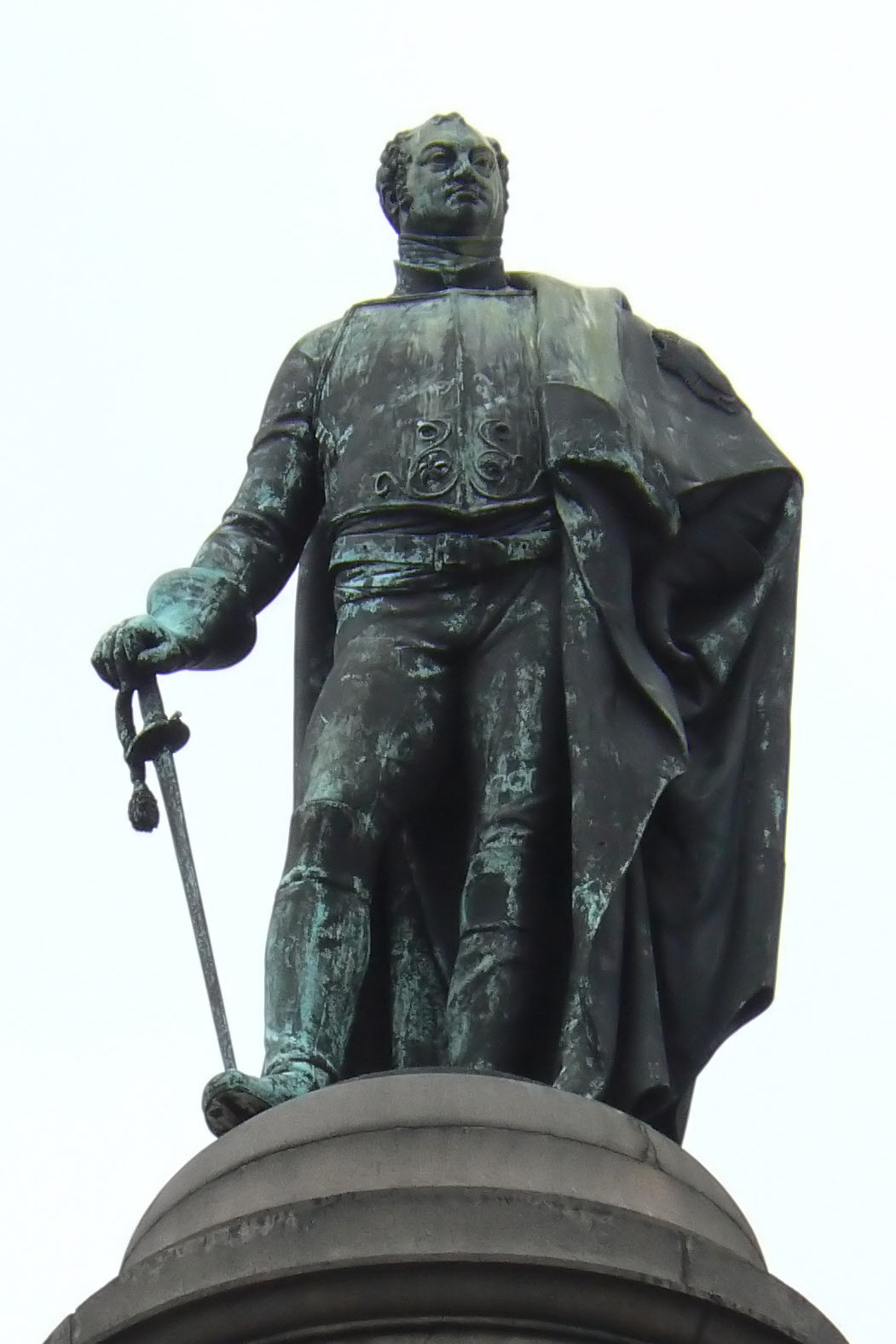
A statue of Prince Frederick, stands on the grounds of Edinburgh Castle, Scotland and was unveiled in 1836. The inscription reads: "Field Marshall His Royal Highness Frederick Duke of York and Albany K.G. Commander and Chief of the British Army MDCCCXXVII."
In Western Australia, York County and the towns of York and Albany were named after Prince Frederick. Albany was originally named "Frederick Town".
The towering Duke of York Column on Waterloo Place, just off The Mall, London was completed in 1834 as a memorial to Prince Frederick.
The 72nd Regiment of Foot was given the title Duke of Albany's Own Highlanders in 1823 and, in 1881, became 1st Battalion Seaforth Highlanders (Ross-shire Buffs, The Duke of Albany's).
The first British fortification in southern Africa, Fort Frederick, Port Elizabeth, a city in the Eastern Cape province of South Africa, was built in 1799 to prevent French assistance for rebellious Boers in the short-lived republic of Graaff-Reinet.
The Duke of York's Royal Military School is named in the duke's honour as he was largely responsible for the founding of the school by Royal Warrant in 1801 (it was originally called the Royal Military Asylum for the Children of Soldiers of the Regular Army). The school was moved to its current site near Dover in 1909. The original building still stands in Chelsea, London.
Ancestors
References and notes
Sources
- {{cite book|url=https://archive.org/details/namesandtheirhi01taylgoog
References
- Glover, (1963), p.12
- ''The Oxford Illustrated History of the British Army'' (1994) p. 145
- Heathcote, p. 127.
- Kiste, John Van der. (2004). "George III's Children". The History Press.
- (2013). "Beau Brummell: The Ultimate Man of Style". Simon and Schuster.
- Cokayne, p.921
- Weir, p. 286.
- {{London Gazette. (31 October 1780)
- "Prince Frederick, Duke of York and Albany". Regency History.
- {{London Gazette. (23 March 1782)
- "Lennox, Charles, 4th Duke of Richmond and Lennox". Dictionary of Canadian Biography.
- Heathcote, p.128
- Frederick and his command fought in the [[Low Countries theatre of the War of the First Coalition. Flanders campaign]] under extremely trying conditions. He won several notable engagements, such as the [[Siege of Valenciennes (1793). Siege of Valenciennes]] in July 1793,{{London Gazette. (1 August 1793)
- {{London Gazette. (3 April 1798)
- {{London Gazette. (19 August 1797)
- {{London Gazette. (3 September 1799)
- Heathcote, p. 129
- "Fort Frederick". Artifacts.
- Opie, pp. 442–443
- {{NHLE
- "Military Heritage". Duke of York's Royal Military School.
- {{London Gazette. (10 September 1805)
- {{London Gazette. (21 May 1811)
- Auerbach, Nina. (2002). "Daphne Du Maurier, Haunted Heiress". Personal Takes.
- Kinloch Cooke, Clement. (1900). "A Memoir of Princess Mary Adelaide, Duchess of Teck: Based on Her Private Diaries and Letters". John Murray.
- Mitton, G. E.. (1903). "Mayfair, Belgravia and Bayswater". A. & C. Black.
- Stourton, James. (16 October 2012). "Great Houses of London". Francis Lincoln.
- "St James's Palace Pages 100-122 Old and New London: Volume 4. Originally published by Cassell, Petter & Galpin, London, 1878.".
- Heathcote, p. 130
- (17 March 2017). "'London Bridge is down': the secret plan for the days after the Queen's death". The Guardian.
- [[Arthur Penrhyn Stanley. Stanley, A. P.]], ''Historical Memorials of Westminster Abbey'' (London; John Murray; 1882), p. 247.
- Fox-Davies, p.498
- {{London Gazette. (24 January 1827)
- Shaw, Wm. A. (1906) ''The Knights of England'', '''I''', London, [https://archive.org/stream/cu31924092537418#page/n135/mode/2up p. 47]
- Shaw, [https://archive.org/stream/cu31924092537418#page/n271/mode/2up p. 180]
- Shaw, [https://archive.org/stream/cu31924092537418#page/n537/mode/2up p. 447]
- ''Liste der Ritter des Königlich Preußischen Hohen Ordens vom Schwarzen Adler'' (1851), "Von Seiner Majestät dem Könige Friedrich Wilhelm III. ernannte Ritter" [https://www.digitale-sammlungen.de/de/view/bsb10362193?page=27 p. 17]
- ''The Complete Peerage, Volume XII, Part II'' (1959), page 923, St Catherine's Press (London), editors Godfrey H. White and R.S. Lea.
- (1817). "Almanach de la cour: pour l'année ... 1817". l'Académie Imp. des Sciences.
- (1817). "Almanach de la cour: pour l'année ... 1817". l'Académie Imp. des Sciences.
- (1826). "Caballeros Grandes-cruces existentes en la Real y distinguida Orden Espanola de Carlos Tercero". Calendario manual y guía de forasteros en Madrid.
- "Fredericton – Capital City".
- Taylor, p.300
- [https://canmore.org.uk/site/236871/edinburgh-castle-esplanade-duke-of-york-statue Edinburgh Castle Esplanade, Duke Of York Statue]
- (1860). "Western Australia; its history, progress, position, & prospects, Volume 13". G. Street.
- West, D.A.P., ''The Settlement on the Sound – Discovery and settlement of the Albany Region 1791–1831'', Western Australian Museum, Perth, 1976, reprinted 2004. pp. 55–115.
- Nind, Isaac Scott. (7 February 1828). "View of Frederick Town, King Georges Sound, at the expiration of the first year of its settlement". [[State Library of New South Wales]].
- "Victorian London – Buildings, Monuments and Museums – Duke of York's column". Victorian London.
- "Old Scots Regiments".
- "Fort Frederick". Nelson Mandela Bay.
- "Royal Military Asylum, Kings Road, Chelsea, London {{!}} Educational Images {{!}} Historic England".
- (1768). "Genealogie ascendante jusqu'au quatrieme degre inclusivement de tous les Rois et Princes de maisons souveraines de l'Europe actuellement vivans". Frederic Guillaume Birnstiel.
- McNaughton, vol. 1, p. 413.
- Louda & MacLagan
This article was imported from Wikipedia and is available under the Creative Commons Attribution-ShareAlike 4.0 License. Content has been adapted to SurfDoc format. Original contributors can be found on the article history page.
Ask Mako anything about Prince Frederick, Duke of York and Albany — get instant answers, deeper analysis, and related topics.
Research with MakoFree with your Surf account
Create a free account to save articles, ask Mako questions, and organize your research.
Sign up freeThis content may have been generated or modified by AI. CloudSurf Software LLC is not responsible for the accuracy, completeness, or reliability of AI-generated content. Always verify important information from primary sources.
Report