From Surf Wiki (app.surf) — the open knowledge base
Primitive communism
Mode of production

Mode of production
Primitive communism is a way of describing the gift economies of hunter-gatherers throughout history, where resources and property hunted or gathered are shared with all members of a group in accordance with individual needs. In political sociology and anthropology, it is also a concept (often credited to Karl Marx and Friedrich Engels), that describes hunter-gatherer societies as traditionally being based on egalitarian social relations and common ownership. A primary inspiration for both Marx and Engels were Lewis H. Morgan's descriptions of "communism in living" as practised by the Haudenosaunee of North America. In Marx's model of socioeconomic structures, societies with primitive communism had no hierarchical social class structures or capital accumulation.
The idea has been criticised by anthropologists as too ethnocentrically European a model to be applied to other societies, whilst also romanticising non-European societies. Anthropologists such as Margaret Mead argue that private property exists in hunter-gatherer and other "primitive societies" and provide examples that Marx and subsequent theorists label as personal property, not private property.
Development of the idea
The original idea of primitive communism is rooted in the idea of the noble savage present in the works of Jean-Jacques Rousseau and the early anthropological work of Morgan and Ely S. Parker. Engels was the first to write about primitive communism in detail, with the 1884 publication of The Origin of the Family, Private Property and the State. Engels categorised primitive communist societies into two phases: the "wild" (hunter-gatherer) phase that lacked permanent superstructure and had close relationships with the natural world, and the "barbarian" phase which held a superstructure like that of the ancient Germanic populations beyond the borders of the Roman Empire and the Indigenous peoples of North America before colonisation by Europeans, being intra-communally egalitarian and matrilineal within the community.
Marx and Engels used the term more broadly than Marxists did later, and applied it not only to hunter-gatherers but also to some communities that engaged in subsistence agriculture. There is also no agreement among later scholars, including Marxists, on the historical extent, or longevity, of primitive communism. Marx and Engels also noted how capitalist accumulation latched itself onto social organizations of primitive communism. For instance, in private correspondence the same year that The Origin of the Family was published, Engels attacked European colonialism, describing the Dutch regime in Java directly organizing agricultural production and profiting from it, "on the basis of the old communistic village communities". He added that cases like the Dutch East Indies, British India and the Russian Empire showed "how today primitive communism furnishes ... the finest and broadest basis of exploitation".
Anarchists, including Peter Kropotkin and Élisée Reclus, believed that societies that exemplified primitive communism were also examples of anarchist society before industrialisation. An example of this is Kropotkin's anthropological work on anarchism and gift economies, Mutual Aid: A Factor of Evolution, which uses a study of the San people of southern Africa for its thesis.
There was little development in the research of "primitive communism" among Marxist scholars beyond Engels' study until the 20th and 21st centuries when Ernest Mandel, Rosa Luxemburg, Ian Hodder, Marija Gimbutas and others took up and developed upon the original theses. Some non-Marxist scholars of prehistory and early history did not take the term seriously, although it was occasionally engaged with and often dismissed. The term primitive communism first appeared in Russian scholarship in the late 19th century, with references to primitive communism existing in ancient Crete. However, it was not researched in any depth until the 20th century, with work such as that of the ethnographer Dmitry Konstantinovich Zelenin, who looked at non-hunter-gatherer societies within the Soviet Union to identify remnants of primitive communism within their societies.
The belief of primitive communism as based on Morgan's work is inaccurate due to Morgan's misunderstandings of Haudenosaunee society and his since-disproven theory of social evolution. Subsequent and more accurate research has focused on hunter-gatherer societies and aspects of such societies in relation to land ownership, communal ownership, and criminality and justice. A newer definition of primitive communism could be summarized as societies that practice economic cooperation among the members of their community, where almost every member of a community has their own contribution to society and land and natural resources are often shared peacefully among the community.
From the 20th century onward, sociologists and archaeologists have looked at the application of the term of primitive communism to hunter-gatherer societies of the Paleolithic through to horticultural societies of the Chalcolithic, including Paleo-American societies from the lithic stage through the archaic period. Soviet archaeologists, influenced by Morgan's and Engels' works, interpreted the various Paleolithic cultures that created Venus figures, many of which were found in the Soviet Union in the 1920s and 1930s, as evidence of the societies being primitive communist and matriarchal in nature. The psychoanalyst Wilhelm Reich concluded in 1931 the existence of an early communism from the information in Bronisław Malinowski's work. However, Malinowski and the philosopher Erich Fromm did not consider this conclusion to be compelling. Ernest Borneman supported Reich's ideas in his 1975 work Das Patriarchat.
Primitive communist societies
Characteristics
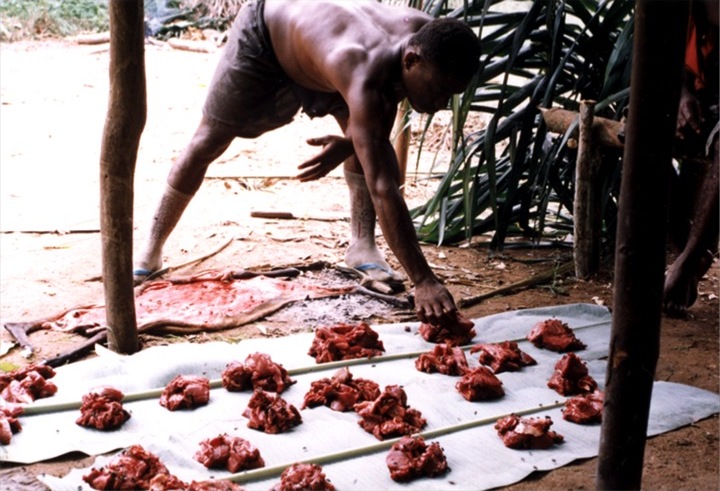
In a primitive communist society, the productive forces would have consisted of all able-bodied persons engaged in obtaining food and resources from the land, and everyone would share in what was produced by hunting and gathering. There would be no private property, which is distinguished from personal property such as articles of clothing and similar personal items, because primitive society produced no surplus; what was produced was quickly consumed and this was because there existed no division of labour, hence people were forced to work together. The few things that existed for any length of time - the means of production (tools and land), housing - were held communally. In Engels' view, in association with matrilocal residence and matrilineal descent, reproductive labour was shared. There would have also been a lack of state.
The Origin of the Family]]'', 1884), and referring to the collective right to basic resources, egalitarianism in social relationships, and absence of authoritarian rule and hierarchy that is supposed to have preceded stratification and exploitation in human history. Both Marx and Engels were heavily influenced by Lewis Henry Morgan's speculative evolutionary history, which described the "liberty, equality and fraternity of the ancient gentes", and the "communism in living" said to be evident in the village architecture of [Indigenous peoples of the Americas
native Americans]].
Domestication of animals and plants following the [Neolithic Revolution through herding and agriculture, and the subsequent urban revolution, were seen as the turning point from primitive communism to class society, as this transition was followed by the appearance of private ownership and slavery, with the inequality that those entail. In addition, parts of the population began to specialize in different activities, such as manufacturing, culture, philosophy, and science which lead in part to social stratification and the development of social classes.
Egalitarian and communist-like hunter-gatherer societies have been studied and described by many well-known social anthropologists including James Woodburn, Richard Borshay Lee, Alan Barnard and Jerome Lewis. Anthropologists such as Christopher Boehm, Chris Knight and Lewis offer theoretical accounts to explain how communistic, assertively egalitarian social arrangements might have emerged in the prehistoric past. Despite differences in emphasis, these and other anthropologists follow Engels in arguing that evolutionary change—resistance to primate-style sexual and political dominance—culminated eventually in a revolutionary transition. Lee criticizes the mainstream and dominant culture's long-time bias against the idea of primitive communism, deriding "Bourgeois ideology [that] would have us believe that primitive communism doesn't exist. In popular consciousness it is lumped with romanticism, exoticism: the noble savage."
Papers have argued that the depiction of hunter-gatherers as egalitarian is misleading. According to one paper published in Current Anthropology, while levels of inequality were low, they were still present, with the average hunter-gatherer group having a Gini coefficient of 0.25 (for comparison, this was attained by the nation of Denmark in 2007). This argument is in part supported by Alain Testart and others, who have said that a society without property is not free from problems of exploitation, domination or wars. Marx and Engels, however, did not argue that communism brought about equality, as according to them equality was a concept without connection in physical reality. Testart does support Engels' observations that societies without surplus are economically egalitarian and conversely that societies with surplus are unequal.
Arnold Petersen has used the existence of primitive communism to argue against the idea that communism goes against human nature. Hikmet Kıvılcımlı in his The Thesis of History argued that in pre-capitalist societies, the main dynamic of historical change "was not class struggle within society but rather the strong collective action" of egalitarian and collectivist values of "primitive socialist society".
Example societies

Due to the strong evidence of an egalitarian society, lack of hierarchy, and lack of economic inequality, historian Murray Bookchin has argued that Çatalhöyük was an early example of anarcho-communism, and so an example of primitive communism in a proto-city. However, still others use Çatalhöyük as an example that refutes the concept of primitive communism. Similarly, it has been argued that the Indus Valley Civilisation is an example of a primitive communist society due to its perceived lack of conflict and social hierarchies. Daniel Miller and others argue that such an assessment of the Indus Valley Civilisation is not correct.
The Marxist archaeologist V. Gordon Childe carried out excavations in Scotland from the 1920s and concluded that there was a Neolithic classless society that reached as far as the Orkney Islands. This has been supported by Perry Anderson, who has argued that primitive communism was prevalent in pre-Roman western Europe. Descriptions of such societies are also present in the works of classical authors.
Biblical scholars have also argued that the mode of production seen in early Hebrew society was a communitarian domestic one that was akin to primitive communism. Claude Meillassoux has commented on how the mode of production seen in many primitive societies is a communistic domestic one.
The Indian communist politician Shripad Amrit Dange considered ancient Indian society to be of a primitive communist nature. Other communists within India have also labelled the societies of current indigenous groups, such as the Adivasi, as examples of primitive communism. In Alfred Radcliffe-Brown's study of the Andamanese at the beginning of the 20th century he comments that they have "customs which result in an approach to communism" and "their domestic policy may be described as a communism".

, in his 1960 work on the development of religious cult communities from tribal communities in the Balkans, spoke of the primitive communism of the "archaic form of the tribal system".
Rolf Jensen in the 1980s conducted a historical study of Wolof society in west Africa looking at the development of class antagonisms from a primitive communist society. Also in the 1980s, Bourgeault looked at the forceful transition of indigenous societies in Canada from their traditional structures, which were anarchist and communistic in nature, into capitalist exploitation due to encroaching imperialism and colonialism. Such an area of interest has been a common topic of research for many fields beyond just Marxist scholars. Some anthropologists, such as John H. Moore, have continued to argue that societies such as those of Native Americans constitute primitive communist societies, whilst acknowledging and incorporating the research showing the complexity and diversity in native American societies.
James Connolly believed that "Gaelic primitive communism" existed in remnants in Irish society after it "had almost entirely disappeared" from much of western Europe. The agrarian communes of the rundale system in Ireland have subsequently been assessed using a framework of primitive communism, where the system fits Marx and Engels' definition.
Soviet theorists and anthropologists, such as Lev Sternberg, considered some of the indigenous groups of Siberia and the Russian far east (such as the Nivkh) to be primitive communist in nature.
Criticism

Criticism of the idea of primitive communism relates to definitions of property, where anthropologists such as Margaret Mead argue that private property exists in hunter-gatherer and other "primitive societies" but provide examples that Marx and subsequent theorists label as personal property, not private property. Similar arguments have been made by other academics, such as the economist Richard Pipes. The idea has also been critiqued by other anthropologists for being based on Morgan's evolutionary model of society and for romanticising non‐Western societies.
Western and non-Western scholars have criticised applying models that are too ethnocentrically European to non-European societies. Western scholars, including Eleanor Leacock, have also criticised the ethnocentric point of view and biases in previous ethnographic research into hunter-gatherer societies. This is similar to criticism of adhering to stadialism in analysing cultures. Feminist scholars have criticised the idea of the lack of subjugation of women as suggested from the works of Engels, while Marxist feminists have been critical of and have reassessed Engels' ideas in The Origin of the Family related to the development of women's subjugation in the transition from primitive communism to class society.
The Marxian economist Ernest Mandel criticised the research of Soviet scholars on primitive communism due to the influence of "Soviet-Marxist ideology" in their social sciences work.
David Graeber and David Wengrow's The Dawn of Everything challenges the notion that humans ever lived in precarious, small-scale societies with little surplus. While they provide examples of sharing egalitarian societies in pre-history, they claim that a huge variety of complex societies (some with large cities) existed long before the supposed agricultural and then urban revolutions proposed by V. Gordon Childe. Graeber and Wengrow's understanding of hunter-gatherer societies has, however, been questioned by other anthropologists.
Anthropologist Manvir Singh argued that while some indigenous groups, such as the Aché of Paraguay, exemplified primitive communism, this did not apply to all indigenous groups, such as the Hiwi, using the example of the unequal distribution of meat from hunting. Singh asserts that many hunter gatherers, including the Andaman Islanders and Northern Paiute, recognized private ownership over land and trees, and claims that all hunter gatherers had private property, but provides examples that Marx and subsequent theorists label as personal property, not private property, such as personal "bows, arrows, axes and cooking implements".
The use of the term "communism" to describe these societies has been questioned when put in comparison with a future post-industrial communism, particularly in relation to the difference in scale from small communal groups to the size of modern nation-states.
Use of the term "primitive"
The term "primitive" in recent anthropological and social studies has begun to fall out of use due to racial stereotypes surrounding the ideas of what is primitive. Such a move has been supported by indigenous peoples who have faced racial stereotyping and violence due to being viewed as "primitive". Due to this, the term "primitive communism" may be replaced by terms such as Pre-Marxist communism.
Alain Testart and others have said that anthropologists should be careful when using research on current hunter-gatherer societies to determine the structure of societies in the paleolithic, where viewing current hunter-gatherer communities as "the most ancient of so-called primitive societies" is likely due to appearances and perceptions and does not reflect the progress and development that such societies have undergone in the past 10,000 years.
There have been Marxist historians criticised for their comments on the "primitivism" and "barbarism" of societies prior to their contact with European empires, such as the comments of Endre Sík. Such views on "primitivism" and "barbarism" are also prevalent in the works of their non-Marxist contemporaries. Marxist anthropologists have criticised and denounced Soviet anthropologists and historians for declaring indigenous communities they were studying for primitive communism as "degenerate".
References
Bibliography
References
- {{harvp. Scott. Marshall. 2007; {{harvp. Felluga. 2011; {{harvp. Bealey. 1999; {{harvp. Rozental. Judin. 1955
- (1881). "Houses and House-Life of the American Aborigines". [[University of Chicago Press]].
- (1969). "[[Man the Hunter]]". Aldine Transaction.
- Woodcock, George. (1983). "The Anarchist Reader". Fontana Paperbacks.
- Engels, Friedrich. (1972). "The Origin of the Family, Private Property, and the State, in the Light of the Researches of Lewis H. Morgan". International Publishers.
- Darmangeat, Christophe. (2009). "Le Communisme primitif n'est plus ce qu'il était". Collectif d'édition Smolny.
- (2018). "A Concise Oxford Dictionary of Politics and International Relations". [[Oxford University Press]].
- Wilson, James. (2000). "The Earth Shall Weep: A history of native America". Grove Press.
- Gatto Trocchi, Cecilia. "Storia Dell'Antropologia Culturale".
- Patterson, Thomas C.. (2021). "Reexamining Engels's Legacy in the 21st Century". [[Palgrave Macmillan]].
- {{harvp. Casal. 2020; {{harvp. Knight. June 2021; {{harvp. Seagle. 1937; {{harvp. Kostick. 2021
- Pal Singh, Nikhil. (September 2016). "On Race, Violence, and So-Called Primitive Accumulation". [[Social Text]].
- Bottomore, T. B.. (1991). "A Dictionary of Marxist Thought". [[Wiley-Blackwell]].
- (2005). "Anarchism: A documentary history of libertarian ideas". [[Black Rose Books]].
- Barnard, Alan. (17 December 1992). "Socialism: Ideals, Ideologies, and Local Practice". [[Routledge]].
- Löwy, Michael. (1 January 2012). "Zachodni imperializm przeciwko pierwotnemu komunizmowi – nowe odczytanie pism ekonomicznych Róży Luksemburg". Dziedzictwo Róży Luksemburg.
- (2012). "Der Urkommunismus. Auf den Spuren der egalitären Gesellschaft". Promedia.
- Parreira Álvares, Lucas. (2017). "Comunismo Primitivo e transição capitalista no pensamento de Rosa Luxemburgo". Revista Direito e Práxis.
- Morton, Stephen. (2018). "Capital Accumulation and Debt Colonialism after Rosa Luxemburg.". Lawrence & Wishart Ltd..
- Harman, Chris. (1994). "Engels and the Origins of Human Society". [[International Socialism (magazine).
- Vodovozov, Vasily Vasilievich. (1890–1907). "Entsiklopedicheskiy slovar' Brokgauza i Yefrona: v 86 t. (82 t. i 4 dop.)".
- Zelenin, Dmitry Konstantinovich. (1934). "Imushchestvennyye zaprety kak perezhitki pervobytnogo kommunizma". Transactions of the Institute of Anthropology and Ethnography.
- {{harvp. Morgan. 1964; {{harvp. Service. Barnard. Bodemann. Fleuret. Fried. Harding. Köcke. Krader. Kuper. Legros. Makarius. Moore. Pilling. Skalník. Strathern. Tooker. Whitecotton. 1981; {{harvp. Hersey. 1993; {{harvp. Smith. 2009; {{harvp. Haller. 1971; {{harvp. Hume. 2011; {{harvp. Yang. 2012
- Ratner, Carl. (2012). "Cooperation, Community, and Co-Ops in a Global Era". [[Springer Science+Business Media]].
- Saitta, Dean J.. (1988). "Marxism, Prehistory, and Primitive Communism". [[Rethinking Marxism.
- (28 May 2013). "Primitive communism: life before class and oppression". [[Socialist Worker]].
- (1996). "The Cambridge history of the Native Peoples of the Americas". [[Cambridge University Press]].
- Reshetov, A. M.. (1972). "Okhotniki, sobirateli, rybolovy. Problemy sotsial'no-ekonomicheskikh otnosheniy v dozemledel'cheskom obshchestve".
- (2020). ""Pervobytno-kommunisticheskoye obshchestvo i yego raspad": doistoricheskoye proshloye territorii Belarusi soglasno kontseptsii V. K. Shcherbakova". Journal of the Belarusian State University. History.
- Fehlmann, Meret. (2011). "Die Rede vom Matriarchat: Zur Gebrauchsgeschichte eines Arguments". Chronos.
- Reich, Wilhelm. (1936). "Der Einbruch der Sexualmoral. Zur Geschichte der sexuellen Ökonomie". [[International Psychoanalytic University]].
- Reich, Wilhelm. (1972). "SEX-POL: Essays 1929-1934". Vintage Books New York.
- Malinowski, Bronisław. (1929). "Życie seksualne dzikich w północno-zachodniej Melanezji".
- Fromm, Erich. (1999). "Erich Fromm: Gesamtausgabe in zwölf Bänden".
- Borneman, Ernest. (1975). "Das Patriarchat".
- Fluehr-Lobban, Carolyn. (1979). "Marxist Reappraisal of the Matriarchate". [[Current Anthropology]].
- Matveevich, Rumyantsev Alexey. (1987). "Pervobytnyy sposob proizvodstva: Politiko-ekonomicheskiye ocherki".
- (1975). "Diccionario de Economía Política". Akal.
- Miropolsky, Dmitry Yurievich. (2012). "Философия экономических Ценностей". Проблемы современной экономики.
- "Eight myths about socialism—and their answers". [[Party for Socialism and Liberation]].
- {{harvp. Ward Gailey. 2016; {{harvp. Stearns. Adas. Schwartz. Gilbert. 2004; {{harvp. Svizzero. Tisdell. 2016; {{harvp. Tomba. 2012; {{harvp. Semenov. 1989
- Knight, Chris. (2008). "Early Human Kinship". [[Blackwell Publishing.
- (2021). "The Digital Economy of the Sourdough: Housewifisation in the Time of COVID-19". tripleC.
- Sims, Lionel. (9 February 2012). "Primitive communism, barbarism and the origins of class society".
- (2020). "Revolution: Theorists, Theories & Practice". [[University of Colorado, Boulder]].
- Ember, Carol R.. (1 June 2020). "Hunter-Gatherers (Foragers)".
- (September 1982). "Egalitarian Societies". [[Journal of the Royal Anthropological Institute.
- Barnard, Alan. (2008). "The Cradle of Language (Studies in the Evolution of Language 12)". [[Oxford University Press]].
- Lewis, Jerome. (2008). "Ekila: "Blood, Bodies and Egalitarian Societies"". [[Journal of the Royal Anthropological Institute]].
- Lewis, Jerome. (2002). "Forest Hunter-Gatherers and Their World: A Study of Mbendjele Yaka Pygmies of Congo-Brazzaville and Their Secular and Religious Activities and Representations". [[London School of Economics and Political Science]].
- Boehm, Christopher. (2001). "Hierarchy in the Forest. The evolution of egalitarian behavior". [[Harvard University Press]].
- Knight, Chris. (2002). "The Transition to Language". [[Oxford University Press]].
- (2014). "The Social Origins of Language". [[Oxford University Press]].
- {{harvp. Lee. 1992. Bloodworth. 2018; {{harvp. Gowdy. 1998; {{harvp. Power. 2018a
- (2010). "Wealth transmission and inequality among hunter-gatherers". [[Current Anthropology]].
- Darmangeat, Christophe. (2015). "Were Some more Equal than Others? II- Forms of Exploitation under Primitive Communism". [[Actuel Marx]].
- Testart, Alain. (2007). "Critique du don: Etudes sur la circulation non marchande". Syllepse.
- Keeley, Lawrence H.. (1996). "[[War Before Civilization]]: the Myth of the Peaceful Savage". [[Oxford University Press]].
- "Letters: Marx-Engels Correspondence 1875".
- Testart, Alain. (2012). "Avant l'histoire: l'évolution des sociétés, de Lascaux à Carnac". Gallimard.
- Testart, Alain. (1995). "Le communisme primitif: Tome I, Économie et Idéologie". Maison des Sciences de l'Homme.
- Petersen, Arnold. (November 2004). "Socialism and Human Nature". [[Socialist Labor Party of America]].
- (31 May 2021). "Beyond Nationalism and the Nation-State: Radical Approaches to Nation". [[Routledge]].
- Bookchin, Murray. (1987). "The Rise of Urbanisation and Decline of Citizenship".
- Khan, Lal. (18 February 2014). "The Essence of the Legacy of Mohenjo-daro". [[International Marxist Tendency]].
- Miller, Daniel. (1985). "Ideology and the Harappan Civilization". [[Journal of Anthropological Archaeology]].
- Cork, Edward. (2005). "Peaceful Harappans? Reviewing the evidence for the absence of warfare in the Indus Civilisation of north-west India and Pakistan (c. 2500-1900 BC)". [[Antiquity (journal).
- Gordon Childe, Vere. (1940). "Prehistoric Communities of the British Isles". W. and R. Chambers.
- Gordon Childe, Vere. (1935). "The Prehistory of Scotland". Kegan Paul, Trench, Trubner & Co., Ltd.
- Anderson, Perry. (1996). "Passages from Antiquity to Feudalism". [[Verso Books]].
- Vencl, Slavomil. (1988). "The problem of disappearance of hunter-gatherer societies in prehistory. Archaeological evidence and testimonies of classical authors". Centre for Classical Studies at the Institute of Philosophy of the [[Czech Academy of Sciences]].
- Boer, Roland. (2005). "Women First? On the Legacy of 'Primitive Communism'". [[Journal for the Study of the Old Testament]].
- Boer, Roland. (2009). "Political Myth: On the Use and Abuse of Biblical Themes". [[Duke University Press]].
- (12 March 2015). "Marxism and Feminism". [[Bloomsbury Publishing]].
- Dange, Shripad Amrit. (1949). "India from Primitive Communism to Slavery: A Marxist Study of Ancient History in Outline".
- Shah, Alpa. (February 2021). "For an anthropological theory of praxis: dystopic utopia in Indian Maoism and the rise of the Hindu Right". [[Wiley-Blackwell.
- Radcliffe-Brown, Alfred. (1922). "The Andaman Islanders: a study in social anthropology". [[Cambridge University Press]].
- Shephard, Henry M.. (2020). "On some geographical distribution of the Old Indo-European layer derivative roots". On Some Geographical Distribution of the Derivatives Roots of Old Indo-European Layer.
- Jensen, Rolf. (March 1982). "The Transition from Primitive Communism: The Wolof Social Formation of West Africa". [[Cambridge University Press]].
- Bourgeault, Ron G.. (1983). "The Indian, the Métis and the Fur Trade Class, Sexism and Racism in the Transition from "Communism" to Capitalism". Studies in Political Economy: A Socialist Review.
- Anthony, Thalia. (23 March 2021). "Leading Works in Law and Social Justice". [[Routledge]].
- (2021). "Beyond Capitalism and Neoliberalism". Institute for Political Studies, Belgrade.
- Moore, John H.. (2007). "Free Goods and Primitive Communism: An Anthropological Perspective". [[Nature, Society, and Thought]].
- Dobbins, Gregory. (2008). "Connolly, the archive, and method". Interventions: International Journal of Postcolonial Studies.
- (2009). "Marx on Primitive Communism: The Irish Rundale Agrarian Commune, its internal Dynamics and the Metabolic Rift". [[Irish Journal of Anthropology]].
- Slezkine, Yuri. (30 April 1997). "Socialist Realism without Shores". [[Duke University Press]].
- (8 February 2018). "The burdens of primitive communism". Anuário Antropológico.
- Fryd, Vivien Green. (1995). "Rereading the Indian in Benjamin West's "Death of General Wolfe"". American Art.
- Mead, Margaret. (1 January 1961). "Some Anthropological Considerations Concerning Natural Law". Natural Law Forum.
- Lowie, Robert H.. (March 1928). "Incorporeal Property in Primitive Society". [[Yale Law Journal]].
- Martin, Keir. (5 September 2018). "The International Encyclopedia of Anthropology". [[Wiley (publisher).
- Kaviraj, Sudipta. (2005). "An Outline of a Revisionist Theory of Modernity". [[Cambridge University Press]].
- (2021). "Materialism and Politics". [[ICI Berlin Press]].
- {{harvp. Vogel. 2014; {{harvp. Dunayevskaya. 1982; {{harvp. Dunayevskaya. 2018; {{harvp. McGregor. 2021
- Mandel, Ernest. (October 1969). "The Marxist Theory of the State". [[Pathfinder tendency.
- (December 2021). "Wrong About (Almost) Everything". Focaal.
- (August 2018). "Gender egalitarianism made us human: patriarchy was too little, too late". [[Open Democracy]].
- (November 2021). "On the Origin of Our Species". [[Literary Review]].
- Singh, Manvir. (19 April 2022). "The idea of primitive communism is as seductive as it is wrong".
- (6 July 2009). "Primitive communism versus integral communism - Antagonism".
- {{harvp. Lee. 1990; {{harvp. Corry. 2009; {{harvp. Croom. 2015; {{harvp. Ward Gailey. 2016; {{harvp. Diamond. 1979; {{harvp. Brown. 2009
- Yunkaporta, Tyson. (2020). "[[Sand Talk]]: How Indigenous Thinking Can Save the World". Text Publishing.
- Dozier, Edward P.. (1955). "The Concepts of "Primitive" and "Native" in Anthropology". The [[University of Chicago Press]] on behalf of Wenner-Gren Foundation for Anthropological Research.
- Hodges, Donald C.. (1992). "Sandino's Communism: Spiritual Politics for the Twenty-First Century". [[University of Texas Press]].
- (February 1988). "Some Major Problems in the Social Anthropology of Hunter-Gatherers [and Comments and Reply]". The [[University of Chicago Press]].
- Wesseling, Henk. (2011). "A Cape of Asia: Essays on European History". [[Leiden University Press]].
- Rouse, Carolyn M.. (September 2019). "[[Claude Lévi-Strauss]]'s Contribution to the Race Question: Race and History". [[American Anthropologist]].
This article was imported from Wikipedia and is available under the Creative Commons Attribution-ShareAlike 4.0 License. Content has been adapted to SurfDoc format. Original contributors can be found on the article history page.
Ask Mako anything about Primitive communism — get instant answers, deeper analysis, and related topics.
Research with MakoFree with your Surf account
Create a free account to save articles, ask Mako questions, and organize your research.
Sign up freeThis content may have been generated or modified by AI. CloudSurf Software LLC is not responsible for the accuracy, completeness, or reliability of AI-generated content. Always verify important information from primary sources.
Report