From Surf Wiki (app.surf) — the open knowledge base
Pranāma
Indian gesture of respect
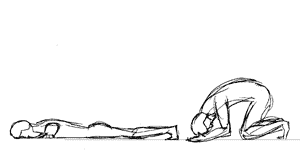
Indian gesture of respect
Pranāma (Sanskrit: प्रणाम; IAST: praṇāma; meaning: "obeisance, prostration or bowing forward") is a form of respectful or reverential salutation (or reverential bowing) before something or another person – usually one's elders, spouse or teachers – as well as anyone deeply respected such as a deity, found in Indian culture and Hindu, Buddhist, Jain and Sikh traditions.
The gesture, also known as the apology hand gesture, is also used as an apology in certain situations.
Etymology
Pranama is derived from pra (Sanskrit: प्र) and ānama (Sanskrit: आनम); pra as prefix means "forward, in front, before, very, or very much", while ānama means "bending or stretching". Combined pranama means "bending, bowing in front" or "bending much" or "prostration". In cultural terms, it means "respectful salutation" or "reverential bowing" before another, usually elders or teachers or someone deeply respected such as a deity.
Types
Customs
It is found in Indian culture and Hindu traditions. There are following six types of Pranama:
-
Ashtanga (Sanskrit: अष्टाङ्ग, lit. eight parts), also called "Ashtanga Dandavat": following eight parts of body touching the ground simultaneously, Uras (Chest), Shiras (Head), Drishti (Eyes), Manas (Attention), Vachana (Speech), Pada (Feet), Kara (Hand), Jahnu (Knee).
-
Shashthanga (Sanskrit: षष्ठाङ्ग, lit. six parts), also called "Shashthanga Dandavat": following six parts of body touching the ground simultaneously, toes, knees, hands, chin, nose and temple.
-
Panchanga (Sanskrit: पञ्चाङ्ग, lit. five parts), also called "Panchanga Dandavat": following five parts of body touching the ground simultaneously, knees, chest, chin, temple and forehead.
-
Dandavat (Sanskrit: दण्डवत्, lit. stick): following four parts of body touching the ground simultaneously, bowing forehead down to ground while being on knees with knees, feet, forehead & hands touching the ground.
-
Namaskara (Sanskrit: नमस्कार, lit. adoration) folded hands touching the forehead while standing or sitting. This is a more common form of salutation and greeting expressed between people. Also see Balinese Hinduism' sembah and Thai greeting based on the Indian Namaskara.
-
Abhinandana (Sanskrit: अभिनन्दन, lit. congratulations) – bending forward with folded hands touching the chest.
As an apology
It is a Hindu custom to apologize in the form of a hand gesture with the right hand when a person's foot accidentally touches a book or any written material (which are considered as a manifestation of the goddess of knowledge Saraswati), money (which is considered as a manifestation of the goddess of wealth Lakshmi) or another person's leg. The offending person first touches the object with the fingertips and then the forehead and/or chest.
Notes
References
- Apte Dictionary, [http://www.aa.tufs.ac.jp/~tjun/sktdic/cgi-bin/dic-srch.cgi See:] pra, aanama
- "Word Meaning - (praNAma)". Sanskrit.Today.
- Sivaya Subramuniyaswami. "Loving Ganesha". Himalayan Academy Publications.
- Chatterjee, Gautam. (2001). "Sacred Hindu Symbols". Google books.
- Bhatia, S., & Ram, A. (2009). Theorizing identity in transnational and diaspora cultures: A critical approach to acculturation. International Journal of Intercultural Relations, 33(2), pp 140–149
- (2010). "Frommer's India". John Wiley & Sons.
- [https://theculturetrip.com/asia/india/articles/why-do-indians-touch-the-feet-of-their-elders Why Do Indians Touch the Feet of Their Elders?], theculturetrip, 21 dec 2022.
This article was imported from Wikipedia and is available under the Creative Commons Attribution-ShareAlike 4.0 License. Content has been adapted to SurfDoc format. Original contributors can be found on the article history page.
Ask Mako anything about Pranāma — get instant answers, deeper analysis, and related topics.
Research with MakoFree with your Surf account
Create a free account to save articles, ask Mako questions, and organize your research.
Sign up freeThis content may have been generated or modified by AI. CloudSurf Software LLC is not responsible for the accuracy, completeness, or reliability of AI-generated content. Always verify important information from primary sources.
Report