From Surf Wiki (app.surf) — the open knowledge base
Prairie dress
Skirt with one or more deep flounces, loosely inspired by 1830s styles
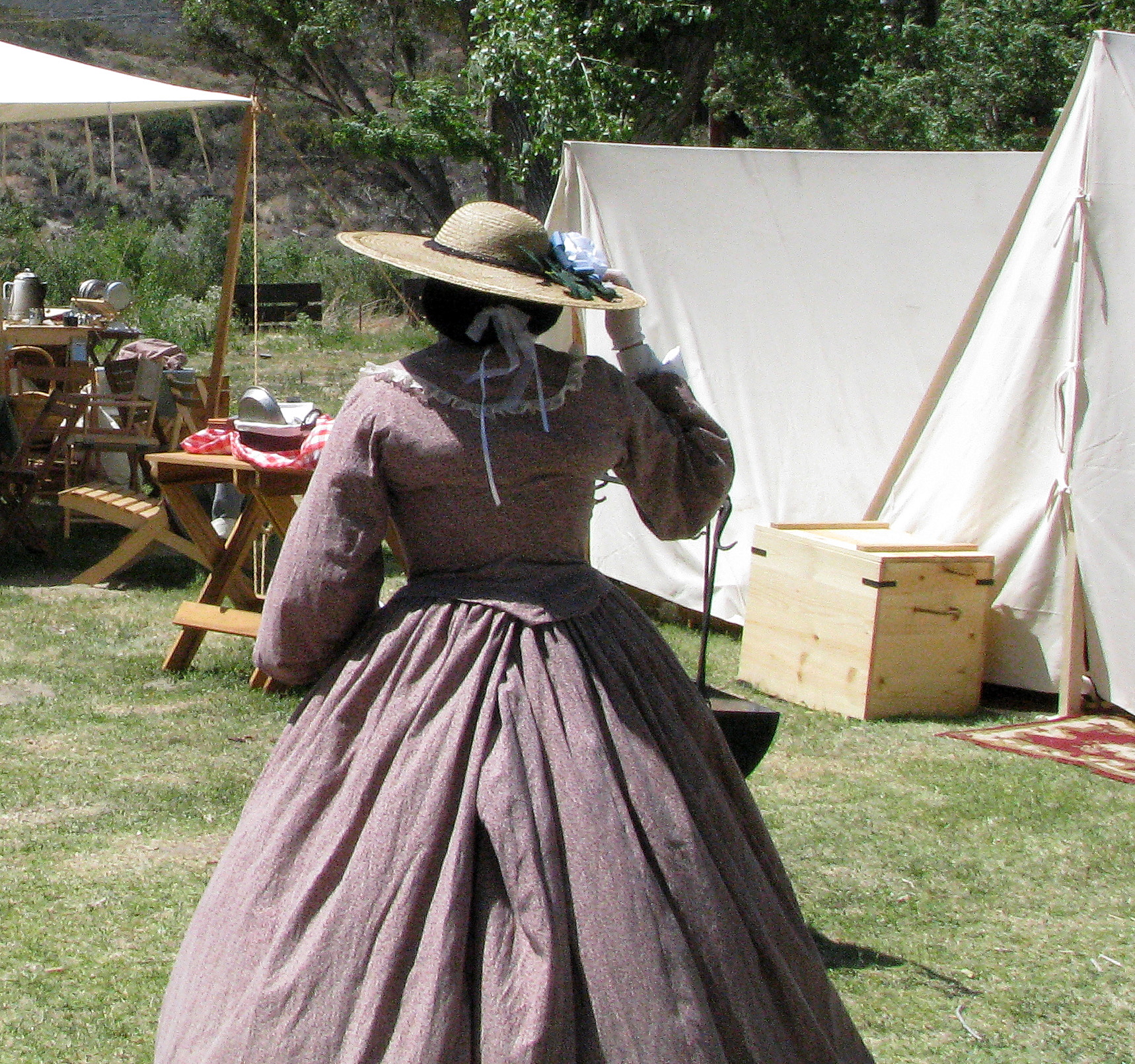
Skirt with one or more deep flounces, loosely inspired by 1830s styles
A prairie dress or prairie skirt is a modest American style of skirt, an article of women's and girls' clothing.
Prairie dresses may be straight to slightly flared to very full, and may have one or more flounces (deep ruffles) or tiers; prairie dresses may be worn over a ruffled eyelet or lace-trimmed petticoat. Traditionally, prairie dresses have long sleeves. In keeping with their design inspiration, traditional prairie skirts are usually made of "country" fabrics such as denim and flowered calico, though they can be of a solid colour too. Prairie skirts are a staple of women's western wear, and very full prairie skirts are worn for square dancing. Prairie dresses are often worn by women who attend Christian churches that emphasize the practice of plain dress (as with the Bruderhof Communities) or the doctrine of outward holiness (as with the Allegheny Wesleyan Methodist Connection). They are seen as fashionable, especially in cold weather.
Prairie dresses earned their name for people travelling to the Western parts of the United States, though they were once "worn by women of all classes all over the country."
Origins in the 19th century
Prairie skirts are so-called after their resemblance to the home-sewn skirts worn by pioneer women in the mid-19th century, which in turn are a simplified version of the flared, ruffled skirts characteristic of high-fashion dresses of the 1820s. The style originated as an adaptation of high fashion to the practicalities of rural life in the Western United States. Deep colors and prints were used as they did not show dirt, while decorations were used to update clothing to changing fashions.
Revival in the 1960s and 1970s
Counterculture Hippies rejecting mainstream fashion looking instead to historical and non-Western styles. While 19th century prairie clothing was usually homemade, new companies such as Gunne Sax in San Francisco began manufacturing ready to wear prairie clothing. The style grew in popularity in the 1970s with the approach of the United States Bicentennial and was introduced to high fashion by Ralph Lauren in his fall 1978 Western-themed collection.
Mid-calf length, button-front denim prairie skirts with a single flounce, worn with a 1950s-style petticoat that was slightly longer than the skirt, became a mainstream fashion in the 1970s and early 1980s following Lauren's introduction.
Blue-prairie-dress.jpg|Late 1970s prairie dress Blue-prairie-dress-closeup.jpg|Collar of a 1970s prairie dress, showing common parts of the style such as lace, buttons, floral fabric, and ruffles. Brown-and-pink-prairie-dresses.jpg|1970s prairie dresses
21st century
Prairie dresses were a fashion trend in the late 2010s, and were part of the cottagecore trend in 2020.
Prairie dresses are often worn by women who attend Christian churches that emphasize the practice of plain dress (as with the Bruderhof Communities, an Anabaptist denomination) or the doctrine of outward holiness (as with the Evangelical Wesleyan Church, a Methodist connexion in the holiness movement).
Notes
References
- George-Warren, Holly, and Michelle Freedman: How the West Was Worn, Harry N. Abrams (2001), .
References
- (30 October 2014). "Ethnic Dress in the United States: A Cultural Encyclopedia". Rowman & Littlefield.
- (May 2015). "The Secrets of Tree Taylor". [[Random House]].
- (10 October 2019). "Women in Fundamentalism: Modesty, Marriage, and Motherhood". Rowman & Littlefield.
- (11 June 2018). "Seventh-Day Adventists, Ellen G. White, and Salvation". Christian Faith Publishing.
- (23 November 2015). "Clothing and Fashion: American Fashion from Head to Toe [4 volumes]: American Fashion from Head to Toe". ABC-CLIO.
- (2013). "The Fairchild Books dictionary of fashion".
- "Sutter's Fort Clothing - 1840s". California State Parks.
- (2001). "How the West Was Worn". Harry N. Abrams, Inc..
- (8 May 2020). "Why Cottagecore and Prairie Dressing Are Fashion's Biggest Trends in 2020". Teen Vogue.
This article was imported from Wikipedia and is available under the Creative Commons Attribution-ShareAlike 4.0 License. Content has been adapted to SurfDoc format. Original contributors can be found on the article history page.
Ask Mako anything about Prairie dress — get instant answers, deeper analysis, and related topics.
Research with MakoFree with your Surf account
Create a free account to save articles, ask Mako questions, and organize your research.
Sign up freeThis content may have been generated or modified by AI. CloudSurf Software LLC is not responsible for the accuracy, completeness, or reliability of AI-generated content. Always verify important information from primary sources.
Report