From Surf Wiki (app.surf) — the open knowledge base
Praia
Capital of Cape Verde
.jpg)
Capital of Cape Verde
| Field | Value |
|---|---|
| name | Praia |
| settlement_type | Capital city |
| official_name | |
| native_name | |
| image_skyline | {{multiple image |
| border | infobox |
| total_width | 270 |
| perrow | 1/2/2/1 |
| image1 | Praia Ribeira de Palmarejo (cropped).jpg |
| caption1 | View of Monte Vermelho |
| image2 | Palácio da Cultura, Praia, Cape Verde.jpg |
| caption2 | Palácio da Cultura Ildo Lobo |
| image3 | Praia-Hôtel de ville (2).jpg |
| caption3 | Praia City Hall |
| image4 | Praia-Fundação Amílcar Cabral (1).jpg |
| caption4 | Fundação Amílcar Cabral |
| image5 | Praia-Monument to Diogo Gomes (3) (cropped).jpg |
| caption5 | Monumento de Diogo Gomes |
| image6 | Praia aerial (cropped).jpg |
| caption6 | Aerial view of Praia |
| image_flag | Flag_of_Praia.svg |
| image_shield | Coat of Arms of Praia.png |
| pushpin_map | Cape Verde#Africa |
| pushpin_relief | 1 |
| pushpin_mapsize | 250 |
| pushpin_map_caption | Location of Praia in Cape Verde |
| subdivision_type | Island |
| subdivision_name | Santiago |
| subdivision_type1 | Municipality |
| subdivision_name1 | Praia |
| subdivision_type2 | Civil Parish |
| subdivision_name2 | Nossa Senhora da Graça |
| coordinates | |
| area_total_km2 | 102.6 |
| established_title | Founded |
| established_date | 16th century |
| established_title1 | City |
| established_date1 | 1858 |
| population_total | 159050 |
| population_as_of | 2017 estimate |
| population_density_km2 | auto |
| timezone | CVT |
| utc_offset | -01:00 |
Praia (, Portuguese for "beach") is the capital and largest city of Cape Verde. Located on the southern coast of Santiago island within the Sotavento Islands group, the city is the seat of the Praia Municipality. Praia is the political, economic and cultural center of Cape Verde.
History
_p098_PORTO_PRAYA,_ISLAND_OF_ST.JAGO_(cropped).jpg)
The island of Santiago was discovered by António da Noli in 1460. The first settlement on the island was Ribeira Grande (Cidade Velha). The village Praia de Santa Maria was first mentioned around 1615 and grew near the natural harbour. The ports of Santiago were important ports of call for ships sailing between Portugal and the Portuguese colonies in Africa and South America. Between the end of the 16th century and the end of the 18th century, both Ribeira Grande and Praia suffered many pirate attacks, including those by Francis Drake (1585) and Jacques Cassard (1712).
Due to its strategic position on a plateau it had better protection against pirate attacks, which gave it a large advantage over the older city of Ribeira Grande (Cidade Velha). It gradually superseded Cidade Velha to become the most important settlement of Cape Verde, and became the capital of Cape Verde in 1770. The naval battle of Porto Praya took place at Praia Harbour on 16 April 1781, as Portugal was neutral, it involved Great Britain and France and ended in a tactical draw and French strategic victory. Praia was the first stop of Charles Darwin's voyage with in 1832. Journal of researches into the natural history and geology of the countries visited during the voyage of H.M.S. Beagle round the world – Chapter 1 at Wikisource, top part
In the course of the 19th century, the Plateau was completely redeveloped with streets according to a grid plan, lined with grand colonial buildings and mansions. Praia officially became a city (cidade) in 1858, which secured its status as the capital of Cape Verde, concentrating political, religious and economic roles.
As in other parts of the archipelago, resistance against Portuguese rule rose in the 1950s. There was no open independence war like in Guinea-Bissau; after the 1974 Carnation Revolution in Portugal and the resulting end of the Portuguese Colonial War, Cape Verde declared independence in July 1975. After independence, Praia underwent a demographic boom, receiving migrating movements from all the islands. As a result, 56% of the entire population of Cape Verde resides in Santiago; and 29% in the Municipality of Praia alone. Its estimated population has reached 151,436 (2015).
Geography

Geographically, Praia may be described as a set of plateaus and their surrounding valleys. These plateaus generally have the name achada (Achada de Santo António, Achada de São Filipe, Achada Eugénio Lima, Achada Grande, Achadinha, etc. — achada being a Portuguese word to designate a volcanic plateau), but the central one is called Plateau. The urban settlement is made mostly on top of these plateaus and along the valleys. The islet of Santa Maria is in front of the beach bearing the same name.
For a long time, only the Plateau was considered to be the city, the other neighbourhoods being relegated to the condition of peripheral suburbs, in spite of always having a close relationship with the Plateau (people movements, goods and services exchanges, etc.). This is why only the Plateau previously had relatively well-developed urbanization with its own infra-structures. The remaining neighbourhoods developed in a more organic, chaotic way.
Only after independence did the Plateau merge with the other neighbourhoods to constitute what is now considered the City of Praia. The whole city was, at the time, equipped with adequate infrastructure. Urbanization begun immediately after independence and sought to expand north.
Climate
Praia has a desert climate (Köppen: BWh) with a short wet season and a lengthy, very pronounced dry season. In fact, outside of the months of August, September and October, little precipitation falls on Praia. The city on average sees about 210 mm of rain per year. Since the coldest month is far above 18 C its temperature patterns resembles a tropical climate, but lacks enough precipitation to be classified as such. Despite the fact that it has an arid climate, Praia seldom gets very hot or very cold, due to its oceanside location on Santiago Island. Temperatures are warm and constant with an average high temperature of 27 C and an average low temperature of 22 C.
|Jan record high C = 31.9 |Feb record high C = 33.1 |Mar record high C = 34.2 |Apr record high C = 33.4 |May record high C = 33.3 |Jun record high C = 34.1 |Jul record high C = 32.5 |Aug record high C = 33.1 |Sep record high C = 36.2 |Oct record high C = 34.8 |Nov record high C = 33.0 |Dec record high C = 31.0 |year record high C = 36.2 |Jan record low C = 16.9 |Feb record low C = 16.2 |Mar record low C = 16.5 |Apr record low C = 17.0 |May record low C = 18.8 |Jun record low C = 19.2 |Jul record low C = 20.3 |Aug record low C = 20.6 |Sep record low C = 19.6 |Oct record low C = 19.6 |Nov record low C = 19.5 |Dec record low C = 17.3 |year record low C = 16.2 |access-date = January 4, 2024}} Instituto Nacional de Meteorologia e Geofísica (humidity 1981-2010) | archive-url = https://web.archive.org/web/20201229191802/https://www.inmg.gov.cv/index.php/servicos/servicos-climaticos | archive-date = 29 December 2020 | access-date = 28 December 2020}} | access-date = 6 November 2018}}
Demographics

According to the national statistics office, the city's population was estimated 159,050 as of July 2017. As of the mid-19th century, the population was estimated at 1,500 to 2,000.
When Edmund Roberts visited in 1832, he noted a population of black people in Praia totaling about "nineteen twentieths" of the population. | 1990 |61644 | 2000 |94161 | 2010 |130271 | 2017 |159050 | graph-pos=bottom | graph-width = 250
Education

.JPG)
The city of Praia is home to the first primary school in the archipelago, originally known as the Escola Central (today known as the Escola Grande). For much time it was the only primary school in Praia. At the beginning of the 1960s, other primary schools began to be built in neighbourhoods around the Plateau and in other localities on the island.
Praia was also the first site in Cape Verde with a secondary education institution with the creation of the Liceu Nacional in 1861. However, the Portuguese authorities were not interested in implementing secondary education in Cape Verde and the school failed as a result; secondary education became, afterwards, the role of the Seminário de Ribeira Brava on the island of São Nicolau, and later of the lyceum in Mindelo.
In 1960, Praia again had secondary education, first with a facility on 12 September Plaza and later in its own building. With the expansion of education in Cape Verde in the 1990s, buildings dedicated to education were constructed in Cape Verde, and Praia in 2016 had 12 secondary education schools.
International schools:
- École Internationale Les Alizés (French school)
- Colégio Internacional – Cabo Verde (Portuguese school)
For higher education, there are the Universidade de Santiago, Instituto Superior de Ciencias Juridícas e Sociais, Instituto Superior de Ciencias Económicas e Empresariais, Jean Piaget University of Cape Verde, and University of Cape Verde.
Praia is also home to the National Library and the National Archives Building or the ANCV.
Economy
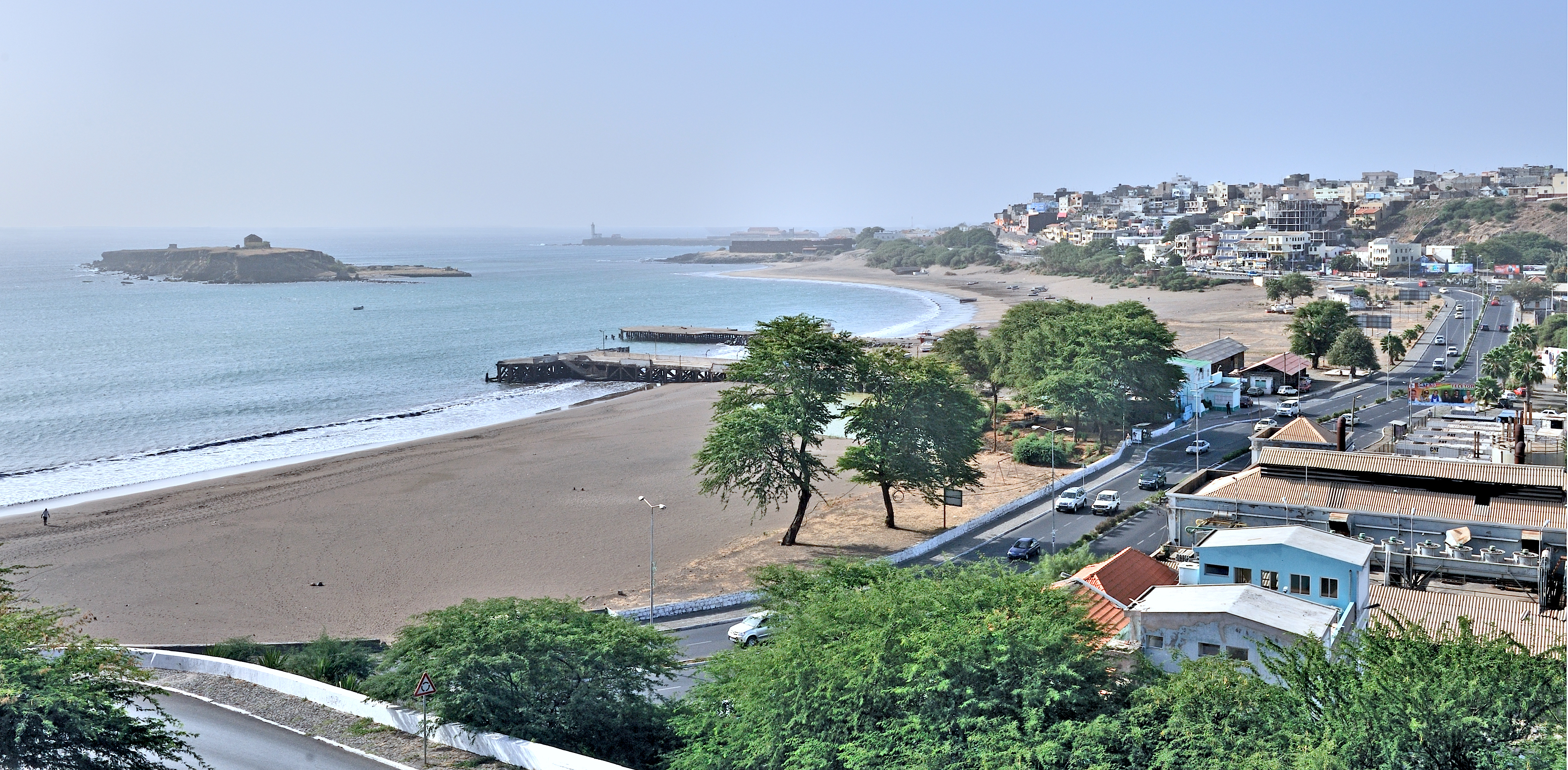
The principal economic activities of Praia belong to the tertiary sector. Beyond activities related to administration and governance (local and national), there are extensive commerce, services (health care, education, tourism, restaurants and hotels, public functions, etc.), and other activities of a liberal character.{{Cite encyclopedia
Being the nation's capital as well as the economic hub, Praia is one of the most economically viable cities in the Cape Verde archipelago. About one third (1/3) of the city's population lives below the poverty line today (2014). The gross metropolitan product for the city is about 39% of the country's GDP, translating into US$4764 income per capita.
Transport

The city is served by Nelson Mandela International Airport and Cabo Verde Airlines, both having headquarters in Praia. It has the nation's second most used port, Praia Harbor, with a ferry terminal linking to other islands, direct ferry routes are Maio, Fogo and São Vicente. The port is managed by the national port authority ENAPOR. The port was reconstructed and expanded in 2014.
Praia has a dual carriageway ring road, the Circular da Praia (EN1-ST06), which is connected with the main national roads to the north (EN1-ST01) and the west (EN1-ST05) of the island. The main roads inside the city are Avenida Grão Ducado de Luxemburgo (from the centre to the west), Avenida Amílcar Cabral (in Plateau) and Avenida Cidade de Lisboa.
Public transport
Public transport within the city of Praia is provided by the company SolAtlântico. There are 12 city bus lines. Intercity share taxis for other cities on the island of Santiago depart from the Sucupira terminal in the city centre, which was opened in May 2018. In 2015 a project called EcobusCV started running a fleet of dual fuel waste vegetable oil / diesel minibuses between Praia and Assomada. However, services were suspended in November 2016.
Culture
_(cropped).jpg)

There is the Museu Etnográfico (Ethnographic Museum), which was founded in 1997. Some of the oldest buildings in Praia are Jaime Mota Barracks (Quartel Jaime Mota) dating from 1826. Since 2016, the historic centre of Praia is on the tentative list of World Heritage Sites.
Landmarks in the colonial city center include Albuquerque Square (named after the colonial governor of the mid 19th century, Caetano Alexandre de Almeida e Albuquerque), the old city hall built in the 1920s, the Presidential Palace, which was constructed in the end of the 19th century to house the Portuguese governor and the Monumento de Diogo Gomes, named after the Portuguese navigator who discovered the island of Santiago in 1460.
Places of worship
Among the places of worship, they are predominantly Christian churches and temples: Roman Catholic Diocese of Santiago de Cabo Verde (Catholic Church), Church of Jesus Christ of Latter-day Saints, Church of the Nazarene, Universal Church of the Kingdom of God, Assemblies of God.
Sports
Praia is home to several sports teams with the most popular football (soccer) clubs include Sporting, Boavista, Travadores, Académica, Vitória and Desportivo; others include ADESBA, based in Craveiro Lopes; Celtic, based in Achadinha de Baixo; Tchadense, based out of Achada Santo Antônio; Delta, and Eugênio Lima, based in that neighbourhood. Basketball clubs include ABC Praia, Bairro and Travadores. Volleyball clubs include Desportivo da Praia. All are part of the Santiago League South Zone. Many clubs play at Estádio da Várzea.
Notable people
- Caló, footballer
- Arménio Vieira, writer
- Dário Furtado, footballer
- Gardénia Benrós, singer
- Gelson Fernandes, footballer
- Ivan Almeida, basketball player
- Mito Elias, artist
- Nando Maria Neves, footballer
- Ronny Souto, footballer
- Tania Fernandes Anderson, Cape Verdean-born American politician and member of the Boston City Council
- Vadú, singer
- Yara dos Santos, writer
- Roberto Lopes, footballer
International relations
Praia is twinned with:
- USA Boston, United States
- POR Faro, Portugal
- POR Figueira da Foz, Portugal
- POR Funchal, Portugal
- POR Gondomar, Portugal
- CHN Jinan, China
- POR Lisbon, Portugal
- MAC Macau, China
- POR Ponta Delgada, Portugal
- USA Providence, United States
References
References
- [http://ine.cv/wp-content/uploads/2017/02/statistical-yearbook-cv-2015_en.pdf Cape Verde, Statistical Yearbook 2015], [[Instituto Nacional de Estatística (Cape Verde). Instituto Nacional de Estatística]]
- [http://hdl.handle.net/11328/594 Valor simbólico do centro histórico da Praia], Lourenço Conceição Gomes, Universidade Portucalense, 2008
- Roman Adrian Cybriwsky, ''Capital Cities around the World: An Encyclopedia of Geography, History, and Culture'', ABC-CLIO, USA, 2013, p. 244
- (2016). "Centre historique de Praia".
- [http://www.portaldoconhecimento.gov.cv/bitstream/10961/2407/1/monografia%20Domigas%20de%20Pina.pdf Antigas residências senhoriais do Centro Histórico da Praia], Domingas Andrade Silva Barbosa de Pina, [[University of Cape Verde. Universidade de Cabo Verde]], 2009
- Habbel, Josef. (1925). "Habbels Konversationslexikon".
- "Site of the City of Lisbon: UCCLA". City of Lisbon.
- Roberts, Edmund. (1837). "Embassy to the Eastern Courts of Cochin-China, Siam, and Muscat". Harper & Brothers.
- "[http://www.dgae.mec.pt/web/14650/cabo-verde ESCOLAS COM CURRÍCULO PORTUGUÊS EM CABO VERDE]" ([https://web.archive.org/web/20160304111526/http://www.dgae.mec.pt/web/14650/cabo-verde Archive]). Direção de Serviços de Ensino e Escolas Portuguesas no Estrangeiro (DSEEPE) of the [[Ministry of Education (Portugal). Portuguese Education Ministry]]. Retrieved on 27 October 2015.
- "TACV Cabo Verde Airlines".
- "Information about the port". [[ENAPOR]].
- (3 July 2018). "Santiago: Condutores de hiace satisfeitos com o terminal da Praia". SAPO Notícias.
- (7 November 2016). "Ecobus suspende rota Praia/Assomada/Praia". [[Expresso das Ilhas]].
- J. Gordon Melton, Martin Baumann, ‘‘Religions of the World: A Comprehensive Encyclopedia of Beliefs and Practices’’, ABC-CLIO, USA, 2010, p. 505
- (3 August 2016). "Sister cities". City of Boston.
- "Geminações". Faro.
- "Geminações de Cidades e Vilas: Figueira da Foz". Associação Nacional de Municípios Portugueses.
- "Acordos de Geminação". Funchal.
- "Geminações". Gondomar.
- "Sister Cities". Jinan.
- "Acordos de geminação". Lisboa.
- (2019). "Exchange between IACM and other cities". Governo da Região Administrativa Special de Macau.
- "Geminações de Cidades e Vilas: Ponta Delgada". Associação Nacional de Municípios Portugueses.
- (13 October 2016). "Providence Gets Its Fifth Sister City, But No One Knows for Sure". GoLocalProv News.
This article was imported from Wikipedia and is available under the Creative Commons Attribution-ShareAlike 4.0 License. Content has been adapted to SurfDoc format. Original contributors can be found on the article history page.
Ask Mako anything about Praia — get instant answers, deeper analysis, and related topics.
Research with MakoFree with your Surf account
Create a free account to save articles, ask Mako questions, and organize your research.
Sign up freeThis content may have been generated or modified by AI. CloudSurf Software LLC is not responsible for the accuracy, completeness, or reliability of AI-generated content. Always verify important information from primary sources.
Report