From Surf Wiki (app.surf) — the open knowledge base
PowerBook Duo
Line of subnotebooks manufactured and sold by Apple Computer
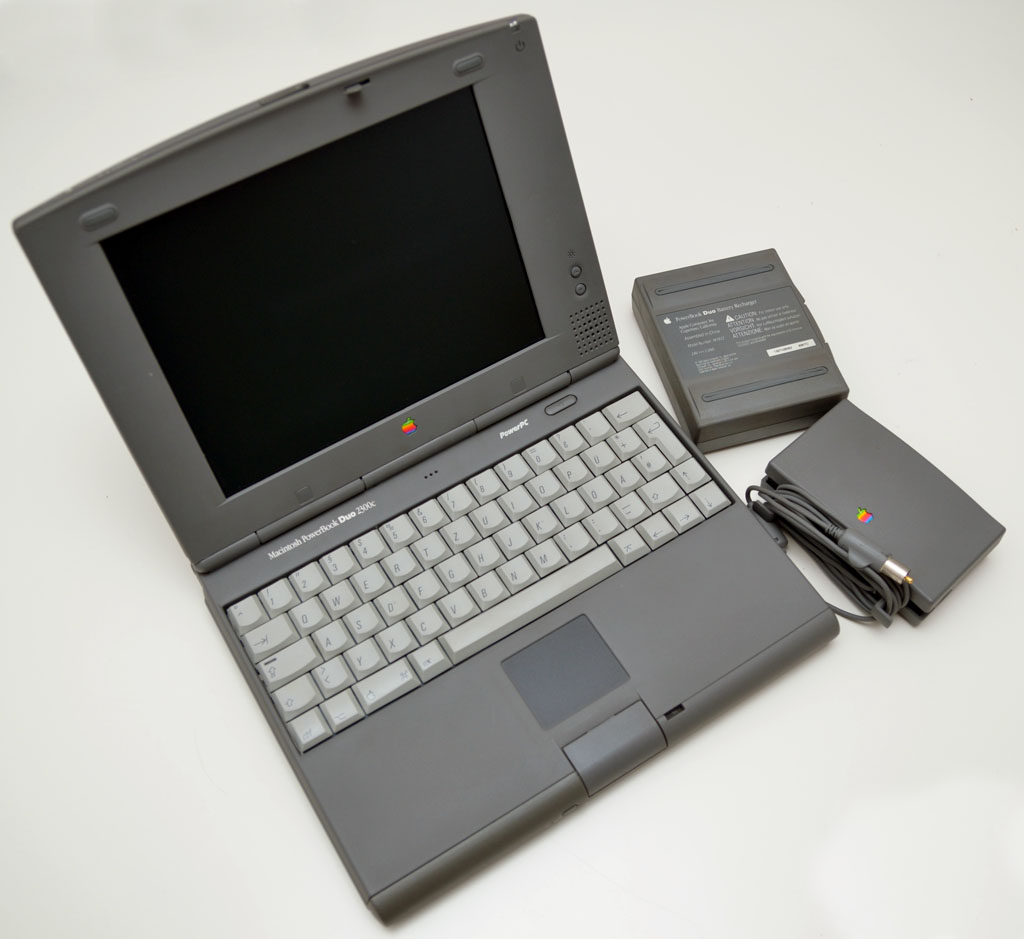
Line of subnotebooks manufactured and sold by Apple Computer
| Field | Value |
|---|---|
| name | PowerBook Duo |
| image | Powerbook duo 2300c.jpg |
| caption | Apple PowerBook Duo 2300c with standard CD jewel case, for size comparison |
| manufacturer | Apple Computer |
| family | PowerBook |
| type | Subnotebook |
| release_date | |
| discontinued | |
| dimensions | 10.9 xx |
| weight | 4.1 lb |
| predecessor | PowerBook 100 |
| successor | PowerBook 2400 |
The PowerBook Duo is a line of subnotebooks manufactured and sold by Apple Computer from 1992 until 1997 as a more compact companion to the PowerBook line. Improving upon the PowerBook 100's portability (its immediate predecessor and Apple's third-smallest laptop), the Duo came in seven different models. They were the Duo 210, 230, 250, 270c, 280, 280c, and 2300c, with the 210 and 230 being the earliest, and the 2300c being the final version before the entire line was dropped in early 1997.
Weighing 4.1 lb and slightly smaller than a sheet of paper at 10.9 x, and only 1.4 in thick, it was the lightest and smallest of all of Apple's PowerBooks at the time, and remains one of Apple's smallest notebooks ever produced. The Duo had the most in common with the original MacBook Air which only included one USB 2.0 port, one video port (requiring an adapter) and one speaker port, but no ability for expansion.
The PowerBook Duo line was replaced by the PowerBook 2400, which was slightly larger in size than the Duos, but still only the fifth-smallest behind the 12-inch PowerBook G4 which succeeded it as fourth-smallest. Although both featured much more onboard functionality, they lacked docking ability.
Features
The Duo line offered an ultraportable design that was light and functional for travel and expandable via its unique docking connector. However certain compromises were made to achieve this level of portability. The Duo series used an 88% of standard desktop-sized keyboard which was criticized for being difficult to type on. Likewise, the trackball was reduced in size from even that used on the PowerBook 100. The only usable port which came standard on the Duo was a dual printer/modem EIA-422 serial port.
There was a slot for an expensive, optional, internal 14.4 Express Modem and no provision for built-in Ethernet. This somewhat limited configuration meant the only way to move data in or out of the laptop in a stock configuration, without purchasing additional accessories, was via a relatively slow AppleTalk connection, which was not practical in the event of hard drive problems. Compensating for these limitations, the initial Duo offering provided for a considerably higher RAM limit of 24 MB (as compared to the 100 series' 14 MB), and a standard 80 MB hard drive (versus the 100's 40 MB drive). The debut year for the Duo only offered a passive matrix display on both the mid-level and high-end models, in contrast to the high-end of the PowerBook 100 series—the PowerBook 170 and 180 (in which the Duos shared the same processors). With their crisp active matrix displays, both were already in great demand over the lower-powered models with passive matrix displays. The following year, Apple replaced the Duo models with both an active matrix display and a color active matrix display, the latter becoming the de facto standard of the PowerBook line. The respective Duo models are easily differentiated by their display method and processor. All other features are identical.
Duo 210 and Duo 230
The initial launch of the PowerBook Duo occurred in October of 1992 with the Duo 210 and the Duo 230. The two machines were almost identical, with both having a 9.1" 4-bit grayscale passive matrix LCD and a Motorola 68030 (the Duo 210 at 25 MHz and the Duo 230 at 33MHz). The Duo 210 came with an 80 MB hard drive, while the 230 had options for either 80 MB or 120 MB. Both came with 4 MB of RAM, upgradable to 24 MB via a DRAM card. The Duo 210 retailed for $2249, while the slightly faster 230 was $2609.
Duo 250 and Duo 270c
In October of 1993, Apple released the Duo 250 and the 270c. The Duo 250 was essentially a 230 with a much improved active-matrix display and a 200 MB hard drive. The Duo 270c had a color active matrix display, but in addition to displaying 256 colors at 640x480, it could display 16-bit color (32,768 colors) at 640x400 - the first for any notebook computer. A redesigned motherboard included a Motorola 68882 math coprocessor and could accept up to 32 MB of RAM. Both the Duo 250 and 270c shipped with a new high capacity Type II nickel-metal-hydride battery, which promised 25% more capacity.
Duo 280 and Duo 280c
Released in May of 1994, the Duo 280 and 280c were the Motorola 68LC040 replacements to the 250 and 270c. Both have the same displays as their 68030 counterparts, but the 33 MHz 68LC040 was substantially faster, and can support up to 40 MB of RAM. The 280c also shipped with a new Type III battery, which had 15% more capacity over the prior Type II.
Duo 2300c
In August of 1995, Apple released the PowerPC based Duo 2300c. Based on a 100 MHz PowerPC 603e, the 2300 had a larger 9.5" 16-bit active matrix display, a trackpad, and support for up to 64 MB of RAM. The 2300c retailed for $3,700 for an 8MB/750MB configuration, or $4,700 for 20MB/1.1GB.
Specifications
The 200–series Duos were powered by either Motorola 68030 or 68LC040 processors, ranging from 25–33 MHz. When Apple debuted its next-generation PowerPC processors in 1994, it took over a year for the first PowerPC Duo (the 2300c) to debut. The original PowerPC 601, like the original 68040 before it, produced too much heat and consumed too much power for Apple to use in any laptop but, by the end of 1995, the more efficient PowerPC 603e had been developed, which was featured in the Duo 2300c and its full-size companion, the PowerBook 5300 series. The PowerPC 603e was designed for a 64-bit bus, but was engineered by Apple to run on an older 32-bit bus to maintain compatibility with the Duo Docks. This led to poor system and video performance.
| Models | PowerBook Duo 210 | PowerBook Duo 230 | PowerBook Duo 250 | PowerBook Duo 270c | PowerBook Duo 280 | PowerBook Duo 280c | PowerBook Duo 2300c | Timetable | Introduced | Discontinued | Ordering info. | Model | Gestalt ID | Order number | Display | Size | Colors | Method | Performance | Processor | Motorola 68030 | Motorola 68030 with Motorola 68882 FPU | Motorola 68LC040 | PowerPC 603e | Processor speed | RAM | |||||
|---|---|---|---|---|---|---|---|---|---|---|---|---|---|---|---|---|---|---|---|---|---|---|---|---|---|---|---|---|---|---|---|
| (min.–max.) | Storage | Operating systems | Original | Maximum | Docking Stations | ||||||||||||||||||||||||||
| October 19, 1992 | October 21, 1993 | May 16, 1994 | August 28, 1995 | ||||||||||||||||||||||||||||
| October 21, 1993 | July 27, 1994 | May 16, 1994 | November 14, 1994 | January 27, 1996 | February 1, 1997 | ||||||||||||||||||||||||||
| M7777 | |||||||||||||||||||||||||||||||
| 29 | 32 | 38 | 77 | 102 | 103 | 118 | |||||||||||||||||||||||||
| M4161 | M4195 | M1933 | M1752 | M2797 | M2329 | M4220 | |||||||||||||||||||||||||
| 9.1" | 8.4" | 9.1" | 8.4" | 9.5" | |||||||||||||||||||||||||||
| Grayscale 4-bit | Color 16-bit | Grayscale 4-bit | Color 16-bit | Color 16-bit | |||||||||||||||||||||||||||
| Passive matrix | Active matrix | ||||||||||||||||||||||||||||||
| 25 MHz | 33 MHz | 100 MHz | |||||||||||||||||||||||||||||
| 4–24 MB | 4–32 MB | 4–40 MB | 8–56 MB | ||||||||||||||||||||||||||||
| 80 MB | 80, 120 MB | 200 MB | 240 MB | 320 MB | 750 MB, 1.1 GB | ||||||||||||||||||||||||||
| System 7.1 | System 7.1.1 | System 7.5.2 | |||||||||||||||||||||||||||||
| Mac OS 7.6.1 | Mac OS 8.1 | Mac OS 9.1 | |||||||||||||||||||||||||||||
| Duo Dock | |||||||||||||||||||||||||||||||
| Duo Dock II | |||||||||||||||||||||||||||||||
| Duo Dock Plus (has no FPU) | Duo Dock (with top cover replacement) | ||||||||||||||||||||||||||||||
| Duo Dock II | |||||||||||||||||||||||||||||||
| Duo Dock Plus | Duo Dock | ||||||||||||||||||||||||||||||
| Duo Dock II | |||||||||||||||||||||||||||||||
| Duo Dock Plus | Duo Dock (with top cover replacement) | ||||||||||||||||||||||||||||||
| Duo Dock II | |||||||||||||||||||||||||||||||
| Duo Dock Plus |
Docking stations
PowerBook Duos lacked most common ports (featuring only one internal printer/modem serial port and an optional fax/modem card port). In their place was docking ability, accomplished via a unique 156-pin Processor Direct Slot (PDS) giving the docks full access to the Duo's central processing unit (CPU) and data buses. Several dock options were offered by Apple and third parties.
{{anchor|Duo Dock}}Duo Dock (M7779) (1992), Duo Dock II (1994), Duo Dock Plus (1995)

This was the largest and most expensive dock for the PowerBook Duo, in a form factor common for that period: the Duo Dock (M7779) was first offered by Apple on October 19, 1992, and the similar docks presented by Compaq (as the LTE Lite Desktop Expansion Base) and IBM (as the 3550 Expansion Unit) were introduced in the same year. Unlike the smaller docks, or "port replicators" that plugged into the back of laptops, the listed docks pulled the laptop inside the dock's metal and plastic case via an internal sliding mechanism (similar to that of a VHS recorder). The Duo Dock turned the PowerBook Duo into a full-size, AC-powered, fully functional desktop computer with all the standard ports. Like a desktop computer, the dock could physically support a heavy, high-resolution CRT display on top. The Duo Dock included a floppy drive on the side, two NuBus expansion slots, an optional floating-point unit (FPU), level 2 cache, a slot for more VRAM to enable more colors at higher resolutions, and space for a second hard drive.
The original Duo Dock was replaced by the Duo Dock II on May 16, 1994, which added AAUI networking and compatibility with the newer color-screen PowerBook Duos. A replacement lid was offered to allow use of the thicker color Duos with the original Duo Dock.
The Dock II was followed by the Duo Dock Plus on May 15, 1995, which was identical to the Duo Dock II, but lacked the FPU and level 2 cache—which were not compatible with the 68LC040-processor Duo 280 and PowerPC-processor Duo 2300c. While the laptop's LCD display obviously could not be opened when inside the dock, additional NuBus video cards could be installed to drive up to three monitors.
Aging Duo Docks are known to have problems with the failing of the capacitors which drive the docking mechanism. This is colloquially known as 'The Duo Dock Tick of Death'.
MiniDock (M7780) (1992)
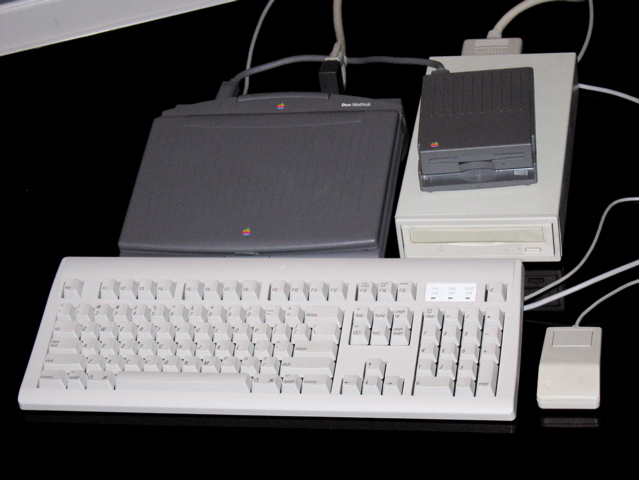
The Mini Dock was a port expander for the PowerBook Duo and was popularly offered by many third-party manufacturers and Apple. When attached, the PowerBook Duo could be plugged into various standard desktop devices including SCSI, Apple Desktop Bus (ADB), serial, floppy disk, external speakers, and an external display. This type of dock also allowed the Duo's internal LCD and battery to be used. Third-party contributions to the Mini Dock added a variety of specialized custom options including Ethernet connectivity, NTSC and PAL video ports. The only significant difference between these docks and a full desktop configuration was the lack of custom PDS or NuBus expansion slots, which were included on all standard desktop Macs, a shortfall made up in task-specific third-party dock offerings.
MicroDock

This type of dock was manufactured by both Apple and many third parties, and gave the PowerBook Duo up to three extra ports in a minimal configuration. Examples include floppy, SCSI, video and Ethernet docks, each typically included one ADB port as well. This was the least expensive, and most basic of the docks. This type of dock allowed the Duo's internal LCD to be used as well, and could run on the Duo's internal battery for a reduced amount of time. Popular due to the minimal impact in accessories that must be carried with the Duo, they offered a practical alternative to emergency hard disk and software situations and task-specific needs.
Design
The 2300 was the last Apple product to carry any vestige of the Snow White design language, which Apple had been phasing out since 1990. Drawing heavily upon improvements made to the original PowerBook 140 design, the Duo series continues many of the styling traits of the PowerBook 100, which is approximately equivalent in size and weight. In addition to the Snow White features, the Duo takes the 100's radius curves a step further along the display top, front, and sides, and which is also heavily mirrored in the various docks.
PenLite

The PenLite was an early tablet computer prototyped by Apple Computer in 1993 around the same time as the Apple Newton. It was not a PDA but rather a complete computer. The project was canceled in 1994 due to its similarity to the Newton.
The PenLite was based on the PowerBook Duo and was meant to be a tablet-style addition, with a stylus as the input device. It was designed to be compatible with PowerBook Duo docks and accessories and ran the standard classic Mac OS.
In popular culture

One of the most stylish and iconic of the laptops available at the time, the Duo was widely used in advertising, film and television.
- Sandra Bullock, starring as systems analyst Angela Bennett, prominently uses a PowerBook Duo 280c (and also a PowerBook 540c) in the movie The Net (1995)
- In the TV sitcom Home Improvement, a Powerbook Duo was used in the fifth episode of season 6 (Episode #131: Al's Video - Original air date: October 15, 1996) as Jill's new computer. Just as she gets some work done on it, Tim comes along and destroys it by playing a game.
- Anne Heche, playing Amy Barnes, a geologist and seismologist, uses a PowerBook Duo 280c in the movie Volcano (1997) to calculate the speed of lava flowing beneath the city streets.
- In the film Wag The Dog (1997), the President's team members, including Anne Heche and Dustin Hoffman among others, use several PowerBook Duo 280c.
- In the critically acclaimed TV sitcom NewsRadio (1994-1999), Dave Nelson used a PowerBook Duo almost exclusively for the first four seasons, the only exceptions being the first few episodes in which he used a PowerBook 100 series. In the fourth season (beginning in 1997), PowerBook Duos were also used prominently by Lisa Miller and occasionally by other characters. In the fifth season (beginning in 1998), all computers on the show were replaced with PowerBook G3s and a first-generation iMac.
- A complete PowerBook Duo system, including Dock, is featured prominently throughout seasons five through seven of Seinfeld.
- In the movie Hackers (1995), Kate Libby owns a PowerBook Duo 280c (with a 2300c logic board infamously remarked to have a "28.8 bps modem" The 28.8 for the 2300 was never produced and remained a prototype only). She claims it has a "P6 chip". While people believed she was referring to the Intel Pentium Pro, it was actually a PowerPC 603e in the 2300 motherboard (which was referred to by Apple as the "P6" chip for marketing purposes.) Dade Murphy is sent a clear-cased prototype 280c[1] by Eugene "The Plague" Belford.
- Denzel Washington, playing Lieutenant Colonel Nathaniel Serling in Courage Under Fire (1996), drafts a letter using a Powerbook Duo 250.
Timeline
Notes
References
References
- (December 1992). "MacWorld December 1992".
- (December 1993). "MacWorld December 1993".
- (July 1994). "MacWorld July 1994".
- (November 1995). "MacWorld November 1995".
- "Apple Macintosh PowerBook Duo Specs (Mac PowerBook Duo Specs): EveryMac.com".
- "Macintosh PowerBook Duo 210: Technical Specifications". [[Apple Inc.]].
- "Macintosh PowerBook Duo 230: Technical Specifications". [[Apple Inc.]].
- "Macintosh PowerBook Duo 250: Technical Specifications". [[Apple Inc.]].
- "Macintosh PowerBook Duo 270c: Technical Specifications". [[Apple Inc.]].
- "Macintosh PowerBook Duo 280: Technical Specifications". [[Apple Inc.]].
- "Macintosh PowerBook Duo 280c: Technical Specifications". [[Apple Inc.]].
- "Macintosh PowerBook Duo 2300c: Technical Specifications". [[Apple Inc.]].
- "PowerBook Duo Dock Specs: EveryMac.com".
- [http://www.1000bit.it/ad/bro/compaq/Compaq-LTE-Family.pdf Compaq LTE Family of personal computers] ''1000bit.it''
- "Service Manual - IBM Expansion Unit (3550) - Notebook".
- Lundin, Leigh. (October 9, 2011). "An Apple Today". SleuthSayers.org.
- (September 3, 2016). "The Duo Dock Tick of Death: lowendmac.com".
- Michael. (November 27, 2006). "Apple Prototypes: 5 Products We Never Saw". Splashpress Media.
- Embler, Gary. (October 14, 2002). "Macintosh PowerBook Duo Tablet Computer (code named "PenLite")". Inspirics.
- Warren, Christina. (2015-06-23). "Hulu's 'Seinfeld' apartment is now perfect".
- Omura, Kevin. "Macintosh PowerBook Duo".
This article was imported from Wikipedia and is available under the Creative Commons Attribution-ShareAlike 4.0 License. Content has been adapted to SurfDoc format. Original contributors can be found on the article history page.
Ask Mako anything about PowerBook Duo — get instant answers, deeper analysis, and related topics.
Research with MakoFree with your Surf account
Create a free account to save articles, ask Mako questions, and organize your research.
Sign up freeThis content may have been generated or modified by AI. CloudSurf Software LLC is not responsible for the accuracy, completeness, or reliability of AI-generated content. Always verify important information from primary sources.
Report