From Surf Wiki (app.surf) — the open knowledge base
Povarov reaction
Chemical reaction
Chemical reaction
The Povarov reaction is an organic reaction described as a formal cycloaddition between an aromatic imine and an alkene. The imine in this organic reaction is a condensation reaction product from an aniline type compound and a benzaldehyde type compound. The alkene must be electron rich which means that functional groups attached to the alkene must be able to donate electrons. Such alkenes are enol ethers and enamines. The reaction product in the original Povarov reaction is a quinoline. Because the reactions can be carried out with the three components premixed in one reactor it is an example of a multi-component reaction. :[[Image:Povarov reaction general.svg|Povarov reaction]]
Reaction mechanism
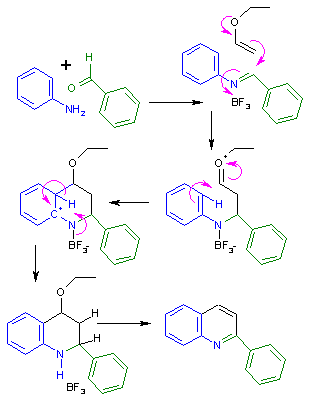
The reaction mechanism for the Povarov reaction to the quinoline is outlined in Scheme 1. In step one aniline and benzaldehyde react to the Schiff base in a condensation reaction. The Povarov reaction requires a Lewis acid such as boron trifluoride to activate the imine for an electrophilic addition of the activated alkene. This reaction step forms an oxonium ion which then reacts with the aromatic ring in a classical electrophilic aromatic substitution. Two additional elimination reactions create the quinoline ring structure.
The reaction is also classified as a subset of aza Diels-Alder reactions; however, it occurs by a step-wise rather than concerted mechanism.
Examples
The reaction depicted in Scheme 2 illustrates the Povarov reaction with an imine and an enamine in the presence of yttrium triflate as the Lewis acid. This reaction is regioselective because the iminium ion preferentially attacks the nitro ortho position and not the para position. The nitro group is a meta directing substituent but since this position is blocked, the most electron rich ring position is now ortho and not para. The reaction is also stereoselective because the enamine addition occurs with a diastereomeric preference for trans addition without formation of the cis isomer. This is in contrast to traditional Diels–Alder reactions, which are stereospecific based on the alkene geometry.


Variations
One variation of the Povarov reaction is a four component reaction. Whereas in the traditional Povarov reaction the intermediate carbocation gives an intramolecular reaction with the aryl group, this intermediate can also be terminated by an additional nucleophile such as an alcohol. Scheme 4 depicts this 4 component reaction with the ethyl ester of glyoxylic acid, 3,4-dihydro-2H-pyran, aniline and ethanol with lewis acid scandium(III) triflate and molecular sieves.

References
References
- Povarov, L. S.; Mikhailov, B. M. Izv. Akad. Nauk SSR, Ser. Khim. '''1963''', 953–956.
- Povarov, L. S.; Grigos, V. I.; Mikhailov, B. M. Izv. Akad. Nauk SSR, Ser. Khim. '''1963''', 2039–2041.
- (1967). "αβ-UNSATURATED ETHERS AND THEIR ANALOGUES IN REACTIONS OF DIENE SYNTHESIS". [[Russian Chemical Reviews]].
- ''Recent synthetic developments in a powerful imino Diels–Alder reaction (Povarov reaction): application to the synthesis of ''N''-polyheterocycles and related alkaloids'' Vladimir V. Kouznetsov [[Tetrahedron (journal). Tetrahedron]] 65 ('''2009''') 2721–2750 {{doi. 10.1016/j.tet.2008.12.059
- ''Unprecedented regio and stereocontrol in Povarov reaction of benzylidene-(3-nitrophenyl)amine'' Paul J. Stevenson and Isla Graham [[Arkivoc]] AM-717D '''2003'''. ([http://www.arkat-usa.org/ark/journal/2003/I07_McKervey/AM-717D/717D.asp Article])
- (2013-07-05). "Tetrahydroquinolines and Benzazepines through Catalytic Diastereoselective Formal [4 + 2]-Cycloaddition Reactions between Donor–Acceptor Cyclopropenes and Imines". Organic Letters.
- ''Straightforward Access to a Structurally Diverse Set of Oxacyclic Scaffolds through a Four-Component Reaction '' Oscar Jiménez, Guillermo de la Rosa, Rodolfo Lavilla [[Angewandte Chemie International Edition]] Volume 44, Issue 40 , Pages 6521 - 6525 '''2005''' [https://archive.today/20110812233512/http://www3.interscience.wiley.com/cgi-bin/abstract/112092897/ABSTRACT Abstract]
This article was imported from Wikipedia and is available under the Creative Commons Attribution-ShareAlike 4.0 License. Content has been adapted to SurfDoc format. Original contributors can be found on the article history page.
Ask Mako anything about Povarov reaction — get instant answers, deeper analysis, and related topics.
Research with MakoFree with your Surf account
Create a free account to save articles, ask Mako questions, and organize your research.
Sign up freeThis content may have been generated or modified by AI. CloudSurf Software LLC is not responsible for the accuracy, completeness, or reliability of AI-generated content. Always verify important information from primary sources.
Report