From Surf Wiki (app.surf) — the open knowledge base
Post-grunge
Music genre

Music genre
| Field | Value |
|---|---|
| name | Post-grunge |
| stylistic_origins | |
| cultural_origins | Early to mid-1990s, United States |
| other_topics |
Post-grunge is an offshoot of grunge that has a less abrasive or intense tone than traditional grunge. Originally, the term was used derisively and indicated mid-1990s alternative rock bands such as Bush, Candlebox, Collective Soul, Live, Foo Fighters, and Silverchair, that emulated the original sound of grunge.
In the late 1990s, post-grunge became a more clearly defined style that combined the sound and aesthetic of grunge with more commercially accessible songwriting, rising to prominence that lasted into the 2000s. Bands such as Foo Fighters, Creed, Matchbox Twenty, 3 Doors Down, Puddle of Mudd, Nickelback, Seether, and Staind achieved mainstream success in this second wave. Some bands in this wave also had crossover with the alternative metal and nu metal genres.
Characteristics
During the 1990s, a post-grunge sound emerged that emulated the attitudes and music of grunge, particularly its thick, distorted guitars, but with a less intense and less abrasive tone. and incorporated influences from other genres such as classic rock, alternative metal, On some occasions, post-grunge music features both an electric guitar and an acoustic guitar playing simultaneously. Post-grunge tends to have production quality that is more polished than grunge. Hence, Graham Hartmann of Metal Injection noted that the genre's second wave "had a vice grip on rock radio from the mid-to-late 2000s—arguably the last time a wave of rock experienced mainstream popularity."
A "major rift" between grunge and post-grunge is in the lyrical substance of the music; grunge often expressed emotion through loose metaphors or third-person narratives, while post-grunge was known for being direct and blunt. While describing lyrics that are common in post-grunge, Sasha Geffen of Consequence of Sound wrote that post-grunge "plunged directly into the 'I.'" Geffen also wrote that most post-grunge songs that achieved mainstream success "call after a prospective or past companion in the first person". Post-grunge lyrics also tend to be about topics such as relationships, romance and drug addiction. According to Geffen, "grunge's frontmen posed with their addictions; post-grunge's songwriters sought redemption for them". Geffen then states that post-grunge songs "fit the mold of songs made for... teenage boys and girls" who were "longing for a distant someone".
Etymology

Originally, post-grunge was a label that was meant to be almost pejorative, suggesting that mid-1990s bands labelled as post-grunge were simply musically derivative, or a cynical response to the "authentic" rock movement of grunge. When grunge became a mainstream genre through bands such as Nirvana and Pearl Jam, record labels started signing bands with similar sonic identities, such as Bush, Candlebox and Collective Soul. In the late 1990s and early 2000s, post-grunge morphed via newer bands like Creed and Nickelback, becoming a more well-defined style that combined characteristics of grunge with a more commercially accessible sound. Grierson wrote that "bands like Nirvana and Pearl Jam were beloved partly because of their perceived integrity in avoiding the mainstream," whereas "Post-grunge, by comparison, seemed to exist in order to court that very audience."
"Butt rock"
In the 2010s, the derogatory term "butt rock", which was previously used to refer to 1980s glam metal and hard rock such as Mötley Crüe, Def Leppard, and Poison, gained traction when applied to many second-wave post-grunge artists. Notably, the term would be used to refer to the likes of Nickelback, Creed, Puddle of Mudd, Shinedown, Flyleaf and Hinder. Graham Hartmann of Metal Injection stated that the term "usually refers to the second wave of post-grunge music, where bands like Bush and Candlebox ultimately turned into Nickelback and Seether." Angelica Leicht of Houston Press said: "Butt-rock is that musical stank on your shoe that you can’t get off. It’s one part aggro noise, one part self-indulgent and whiny singer, and somehow a whole lot of douche."
The origins of the term are debated, with some attributing it to the alleged radio slogan "Nothing but rock". The term "butt rock" is usually used by individuals critical of what they perceive to be derivative musicianship, overly clichéd or angsty lyrics, and over-reliance on raspy vocals (often described as imitations of Pearl Jam's Eddie Vedder). Eva Zhu of CBC said butt rock is "a style of music that manages to be as popular as it is hated." According to Erica Banas of WMMR, some consider butt rock to be rock music that is "watered down both musically and lyrically" in order to maximize radio airplay and mainstream success. She added: "Perhaps, Butt Rock is truly in the ear of the beholder. It might just be a derogatory term rock fans use on bands they don't like." Butt rock has also been referred to as a subgenre in itself, or a microgenre. A related term for second-wave post-grunge is "divorced dad rock".
History
1993–1997: First wave and rise in popularity
Even at the height of their popularity, after the release of Nevermind (1991) brought grunge to international attention, Nirvana experienced increasing problems, partly caused by Kurt Cobain's drug addiction and growing dissatisfaction with commercial success. In late 1992, Cobain was photographed in a T-shirt with 'Grunge is Dead' printed on its front at which point the genre's decline started to be widely discussed. Cobain's suicide in 1994, as well as Pearl Jam's touring problems, marked a decline for grunge that year. Addiction and legal problems for Scott Weiland of Stone Temple Pilots led to the band having touring problems, causing the band to tour their album Purple for only four months, and their follow up album Tiny Music... Songs from the Vatican Gift Shop for only 6 weeks.
.jpg)
As the original grunge movement began to fade, major record labels began signing and promoting bands emulating the genre in a more mainstream style, dubbed by some writers as "post-grunge". Though bands such as Bush and Candlebox have been categorized as grunge, both bands have also been categorized as post-grunge. Collective Soul and Live are two other bands categorized as post-grunge that emerged along with Bush and Candlebox. Bush, Candlebox, Collective Soul and Live all achieved mainstream success; Candlebox's self-titled album (1993) was certified 4× platinum by the Recording Industry Association of America (RIAA) and, according to Nielsen SoundScan, sold at least 4,000,000 copies. Its song "Far Behind" peaked at number 18 on the Billboard Hot 100. Collective Soul's song "Shine" peaked at number 11 on the same chart and was certified gold by the RIAA in September 1994. The band's album Hints Allegations and Things Left Unsaid (1993) was certified 2× platinum by the RIAA, and their self-titled 1995 album was certified 3× platinum by the RIAA.
Bush's debut studio album Sixteen Stone (1994) was certified 6× platinum by the RIAA and the band's second studio album Razorblade Suitcase (1996), which peaked at number 1 on the Billboard 200, was certified 3× platinum by the RIAA. Carl Williott of Stereogum called Bush's album Sixteen Stone "a harbinger of post-grunge's pop dominance". Live's album Throwing Copper (1994) was certified 8× platinum by the RIAA, and the band's album Secret Samadhi (1997) was certified 2× platinum by the RIAA. Both Throwing Copper and Secret Samadhi peaked at number 1 on the Billboard 200. Consequence of Sounds Paolo Ragusa credits Throwing Copper with starting post-grunge and shifting rock music to a new direction after the death of Kurt Cobain by combining some harder rock influences with clearer vocals, softer guitar melodies, and the production of Jerry Harrison to make a distinct sound.
In 1995, former Nirvana drummer Dave Grohl's newer band Foo Fighters released their self-titled debut album, becoming one of the most commercially successful rock bands in the United States, aided by considerable airplay on MTV. Like grunge bands such as Nirvana, Pearl Jam, Soundgarden, and Alice in Chains, the post-grunge band Candlebox was from Seattle, but post-grunge was marked by a broadening of its geographical base, with bands such as York, Pennsylvania's Live, Atlanta, Georgia's Collective Soul, Australia's Silverchair, and England's Bush.
1997–2010: Second wave and peak popularity
.jpg)
The 1997 breakup of Soundgarden was seen by some as the end of the original grunge movement. Post-grunge then morphed in the late 1990s and 2000s, gaining further popularity with newer acts such as Creed, Matchbox Twenty, Fuel, Oleander, Godsmack, 3 Doors Down, Puddle of Mudd, Staind, Nickelback, Seether, 12 Stones, Breaking Benjamin, Shinedown, Stone Sour, Hinder, Daughtry, and Skillet. This wave retained some of the angst and anger of the earlier artists but also had more conventional anthems, narratives, and romantic songs. Creed's albums My Own Prison (1997) and Weathered (2001) were both certified 6× platinum by the RIAA. Weathered sold at least 6,400,000 copies in the United States. Creed's album Human Clay, released in 1999, was certified diamond by the RIAA and sold at least 11,690,000 copies in the United States. Human Clay song "With Arms Wide Open" peaked at number 1 on the Billboard Hot 100. Matchbox Twenty's 1996 debut album, Yourself or Someone Like You, was a success in 1997 and 1998 on the strength of radio singles "Push" and "3AM"; it was certified 12× platinum by the RIAA. The Foo Fighters' second album The Colour and the Shape, which is considered a post-grunge album, became a hit and was certified Platinum by the RIAA having sold at least two million copies in the United States.
Nickelback broke into the mainstream in the early 2000s; their song "How You Remind Me" peaked at number 1 on the Billboard Hot 100. The Nickelback album that featured the song, Silver Side Up, was certified 6× platinum by the RIAA and sold at least 5,528,000 copies in the United States. Nickelback's next album, The Long Road, was certified 3× platinum by the RIAA and sold at least 3,591,000 copies in the United States. and sold at least 716,000 copies in its release week, and, according to Nielsen SoundScan, sold at least 4,240,000 copies in 2001. Break the Cycle song "It's Been Awhile" peaked at number 5 on the Billboard Hot 100.
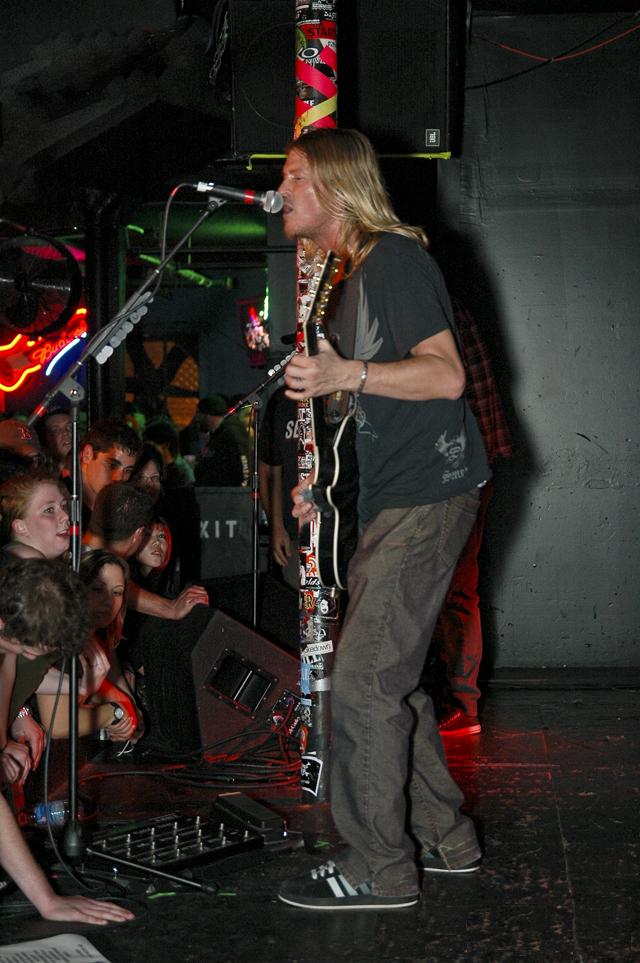
3 Doors Down's debut studio album The Better Life (2000) was certified 6× platinum by the RIAA and sold at least 5,653,000 copies in the United States. The Better Life song "Kryptonite" peaked at number 3 on the Billboard Hot 100 and number 1 on the Mainstream Top 40 chart. 3 Doors Down's second studio album Away from the Sun was certified 4× platinum by the RIAA and sold at least 3,863,000 copies in the United States. Lifehouse achieved mainstream success in the early 2000s; their song "Hanging by a Moment", which peaked at number 2 on the Billboard Hot 100, was the most played song on the radio in 2001. Puddle of Mudd broke into the mainstream in the early 2000s; their album Come Clean was certified 3× platinum by the RIAA and the album's songs "Blurry" and "She Hates Me" both reached very high positions on the Billboard Hot 100. "Blurry" peaked at number 5 on the Billboard Hot 100 and "She Hates Me" peaked at number 13 on the Billboard Hot 100. "She Hates Me" also peaked at number 7 on the Top 40 Mainstream chart.
The post-grunge band Cold's song "Stupid Girl" peaked at number 87 on the Billboard Hot 100. Post-grunge band Crossfade's song "Cold" peaked at number 81 on the Billboard Hot 100, number 23 on the Top 40 Mainstream chart, number 39 on the Pop 100 chart, number 28 on the Pop 100 Airplay chart, and number 57 on the Hot Digital Songs chart. It was certified gold by the RIAA in December 2006. Crossfade's self-titled album was certified platinum by the RIAA in August 2005. Three Days Grace broke into the mainstream with their 2003 self-titled album; their song "I Hate Everything About You" peaked at number 55 on the Billboard Hot 100 and number 28 on the Pop Songs chart.
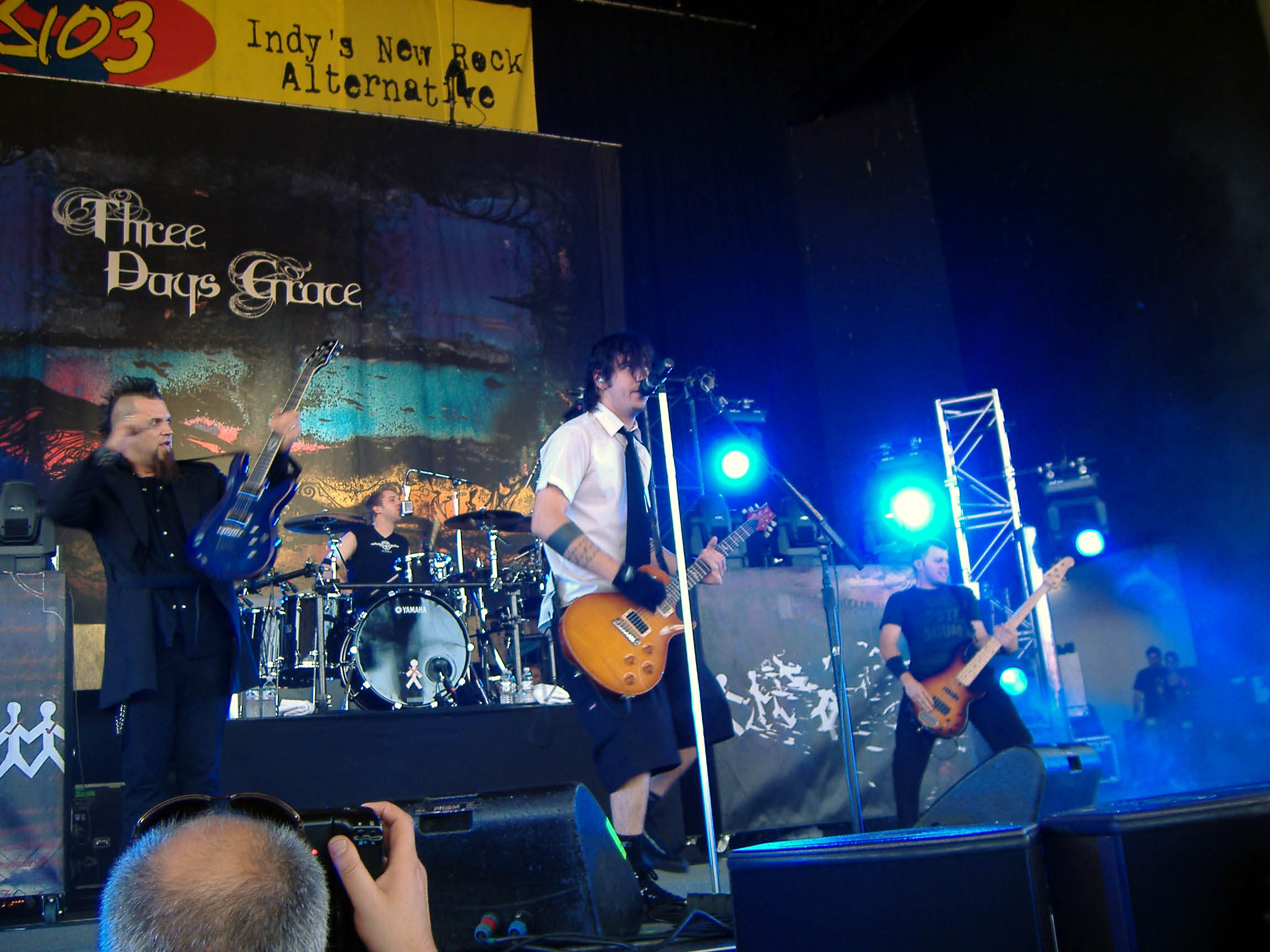
In 2006, Three Days Grace released their album One-X, which was certified 3× platinum by the RIAA. The album's song "Pain" peaked at number 44 on the Billboard Hot 100, number 47 on the Pop 100 chart and number 35 on the Hot Digital Songs chart. It sold at least 5,040,000 copies in the United States. The band Flyleaf's song "All Around Me" peaked at: number 40 on the Billboard Hot 100, number 12 on the Top 40 Mainstream, number 17 on the Pop 100, number 15 on the Pop 100 Airplay, number 38 on the Hot Digital Songs and number 23 on the Adult Top 40. Flyleaf's self-titled album was certified platinum by the RIAA.
References
References
- "Post-Grunge". AllMusic.
- Blackie, Andrew. (September 23, 2008). "Nu-Metal's Not Dead!".
- Geffen, Sasha. (7 October 2013). "In Defense of Post-Grunge Music".
- Thomas, Jeremy. (15 November 2014). "The 8 Ball: Top 8 Post-Grunge Bands". 411MANIA.
- (July 18, 2018). "Foo Fighters are Classic Rock Now".
- Marko, Aaron J.. (20 March 2014). "10 Laughable Post-Grunge Bands You Won't Believe Are Still Going (Puddle of Mudd)". WhatCulture.
- Hartmann, Graham. (2025-04-29). "10 Butt Rock Anthems That Actually Kinda Rule".
- Diehl, Matt. (13 November 1996). "Review: ''Bush – Razorblade Suitcase''".
- Grierson, Tim. "Post-Grunge. A History of Post-Grunge Rock".
- Corpos, Mike. (September 23, 2002). "MTV needs butt rock, not Kid Rock".
- Jordan, Isamu. (April 1, 2005). "‘80s band stages flashy comeback".
- Hansen Orf, Chris. (September 17, 2009). "Please Don't Call Chickenfoot a "Supergroup"".
- Koester, Megan. (December 24, 2013). "You Can Eat Brunch in Black Flag's Old Practice Space (If You’re Terrible)".
- "Welcome to Buttland".
- Leicht, Angelica. (2014-04-17). "Top 10 Butt-Rock Bands of All Time".
- Leicht, Angelica. (2024-11-20). "Top 10 Butt-Rock Bands of All Time". Houston Press.
- Klee, Miles. (21 October 2019). "What Was Butt Rock?". Mel.
- "Behold the butt-rock renaissance: celebrate the genre's return in 5 songs {{!}} CBC Music".
- Banas, Erica. (2024-11-20). "11 Butt Rock Songs that Actually Rule". 93.3 WMMR.
- (2025-06-18). "10 Greatest Divorced Dad Rock Songs of All Time".
- Prato, Greg. (2009). "Grunge Is Dead. The Oral Herstory of Seattle Rock Music". [[ECW Press]].
- Sweet, Stephen. (1992). "Live Nirvana Photo Archive". [[Melody Maker]].
- Strong, Catherine. (2011). "Grunge: Music and Memory". [[Ashgate Publishing.
- (29 April 2009). "'Grunge Is Dead' – An Interview with Greg Prato". [[UGO Networks.
- (3 November 2017). "Backspin: Stone Temple Pilots talk 'No. 4'".
- Azerrad, Michael. (2012). "Our band could be your life. Scenes from the American indie underground 1981–1991". [[Little, Brown and Company.
- Condran, Ed. (26 February 2015). "Gavin Rossdale brings '90s grunge band Bush to Raleigh". [[The News & Observer]].
- Kaufman, Gil. (2 June 1999). "Bush To Play U.S. Club Gigs". MTV.
- Graff, Gary. (1996). "MusicHound Rock: The Essential Album Guide". [[Visible Ink Press]].
- "Candlebox – Biography & Herstory". AllMusic.
- Steininger, Adam. (23 August 2013). "The 10 Worst Post-Grunge Bands". [[LA Weekly]].
- Vrabel, Jeff. (5 May 2008). "Candlebox To Release First Album in 10 Years".
- "Candlebox – Candlebox – Awards". AllMusic.
- "Collective Soul – Awards". AllMusic.
- "Bush – Chart herstory".
- Williott, Carl. (5 December 2014). "''Sixteen Stone'' Turns 20".
- "Live – Awards". AllMusic.
- Ragusa, Paolo. (2024-05-22). "Following Kurt Cobain's Death, Live's Throwing Copper Birthed the Post-Grunge Movement".
- (2002). "All Music Guide to Rock. The Definitive Guide to Rock, Pop, and Soul". [[Hal Leonard Corporation.
- Ankeny, Jason. "Live {{!}} Music Biography, Credits and Discography". AllMusic.
- Strong, Catherine. ''Grunge: Music and Memory''. Routledge, 2016. p.55
- [https://loudwire.com/90s-post-grunge-bands-should-have-been-bigger/ 10 '90s Post-Grunge Bands That Should Have Been Bigger], ''Loudwire''
- Bulmer, Jeff. (September 18, 2014). "Godsmack Goes Back in Time with 1000hp". The Phoenix News.
- True, Chris. "Staind {{!}} Music Biography, Credits and Discography". AllMusic.
- Graves, Wren. (May 20, 2024). "50 Best Post-Grunge Songs".
- Sharpe-Young, Garry. "12 Stones".
- Climek, Joseph. "Worth the Drive: Henry Rollins, Janeane Garofalo, Diana Ross, Meat Loaf and more".
- (16 November 2008). "Nickleback and David Cook releases mark the death of grunge". [[Daily News (New York).
- Christopher Monger, James. "Skillet - Rise". [[AllMusic]].
- Grein, Paul. (16 May 2012). "Chart Watch Extra: Following Up A Monster". [[Yahoo Music]].
- Caulfield, Keith. (10 October 2014). "Adele's '21' Surpasses 11 Million in U.S. Sales".
- "Creed – Chart history".
- [https://www.riaa.com/gold-platinum/?tab_active=default-award&ar=Matchbox+Twenty&ti=Push&format=Single&type=#search_section American single certifications – Matchbox Twenty – Push]
- [https://www.riaa.com/gold-platinum/?tab_active=default-award&ar=Matchbox+Twenty&ti=3AM&format=Single&type=#search_section American single certifications – Matchbox Twenty – 3AM]
- Erlewine, Stephen Thomas. "The Colour and the Shape – Foo Fighters".
- Hughes, Kim (November 3, 2011). "Foo Fighters surpass 10 million sales mark (so yeah, they're loaded)".
- "Nickelback | Awards". AllMusic.
- Grein, Paul. (13 April 2011). "Week Ending April 10, 2011. Albums: Adele Is Everywhere". [[Yahoo Music]].
- "All the Right Reasons". AllMusic.
- Dansby, Andrew. (30 May 2001). "Staind Break in at No. One".
- Basham, David. (4 January 2002). "Got Charts? Linkin Park, Shaggy, 'NSYNC Are 2001's Top-Sellers". MTV.
- Cohen, Stephen J.. (23 June 2014). "Top New Acts Since 2000". [[Yahoo Music]].
- "3 Doors Down – Chart history (The Hot 100)".
- "3 Doors Down – Chart history (Pop Songs)".
- Trust, Gary. (6 November 2009). "Ask Billboard: Swift's Latest 'Fearless' Feat".
- "Lifehouse – Chart history".
- Lamb, Bill. "Top 10 Pop Songs Summer 2001".
- "Puddle of Mudd {{!}} Awards". AllMusic.
- "Default – Chart history".
- "Cold {{!}} Awards". AllMusic.
- "Crossfade {{!}} Awards". AllMusic.
- "Three Days Grace {{!}} Awards". AllMusic.
- Caulfield, Keith. (10 December 2015). "Adele's '25' Hits 5 Million Sold in U.S.".
- "Flyleaf {{!}} Awards". AllMusic.
This article was imported from Wikipedia and is available under the Creative Commons Attribution-ShareAlike 4.0 License. Content has been adapted to SurfDoc format. Original contributors can be found on the article history page.
Ask Mako anything about Post-grunge — get instant answers, deeper analysis, and related topics.
Research with MakoFree with your Surf account
Create a free account to save articles, ask Mako questions, and organize your research.
Sign up freeThis content may have been generated or modified by AI. CloudSurf Software LLC is not responsible for the accuracy, completeness, or reliability of AI-generated content. Always verify important information from primary sources.
Report